
BuddhistCatholicContemplativeEvangelicalGeneral ChristianHinduJewishLatter-day SaintMuslimNew VisionsProgressive Christian
Beliefs
- Buddhist
- Catholic
- Contemplative
- Evangelical
- General Christian
- Hindu
- Jewish
- Latter-day Saint
- More Voices
- Muslim
- New Visions
- Pagan
- Progressive Christian
Topics
- Religion News
- Food and Religion
- Sports and Religion
- Religious Art
- Religious Music and Entertainment
- Religious Events
- History and Religion
- Style and Religion
- Politics and Religion
- Women in Religion
- Recreation Outdoors and Religion
- Business Finance and Religion
- Careers Workplace and Religion
- Education and Religion
- Family Parenting and Religion
- Health Fitness and Religion
- Home and Religion
- Relationships and Religion
- Technology and Religion
- Travel and Religion
Columnists
- Buddhist Columnists
- Business Finance and Religion Columnists
- Careers Workplace and Religion Columnists
- Catholic Columnists
- Contemplative Columnists
- Education and Religion Columnists
- Evangelists Columnists
- Family Parenting and Religion Columnists
- General Christian Columnists
- Health Fitness and Religion Columnists
- Hindu Columnists
- History and Religion Columnists
- Home and Religion Columnists
- Jewish Columnists
- More Voices Columnists
- Latter Day Columnists
- Muslim Columnists
- New Visions Columnists
- Nonreligious Columnists
- Pagan Columnists
- Politics and Religion Columnists
- Progressive Columnists
- Recreation Outdoors and Religion Columnists
- Relationships and Religion Columnists
- Religion News Columnists
- Religious Art Columnists
- Religious Events Columnists
- Religious Music and Entertainment Columnists
- Sports and Religion Columnists
- Style and Religion Columnists
- Technology and Religion Columnists
- Travel and Religion Columnists
- Women in Religion Columnists
Resource Library
- 2026 Calendar
- Library of World Religions
- The 100 Most Holy Places on Earth
- Patheos Answers
- Podcasts
- Videos
- Faith Leaders Database
- Anglican Episcopalian
- Bahai
- Baptist
- Buddhism
- Christianity
- Confucianism
- Eastern Orthodoxy
- Hinduism
- Holiness and Pentecostal
- ISKCON
- Islam
- Judaism
- Lutheran
- Methodist
- The Church of Jesus Christ of Latter-day Saints
- New Age
- Paganism
- Presbytarian and Reformed
- Protestantism
- Religion Behind the Scenes
- Roman Catholic
- Scientology
- Shia Islam
- Sikhism
- Sufism
- Sunni Islam
- Taoism
- Zen
- See all religions
Research Tools
 Ad-Free & Subscriber Log-In Subscription Support
Ad-Free & Subscriber Log-In Subscription Support
Follow Patheos 

- Trending:
- Forgiveness
- |
- Marriage
- |
- Consciousness
- |
- Death Penalty
- |
- Election
- |
- Halloween

- Home
- Latter-day Saint
- “Lord, it is good for us to be here”
“Lord, it is good for us to be here”
Last updated on: September 5, 2018 at 9:52 am by Dan Peterson
“Lord, it is good for us to be here” 2018-09-05T09:52:50-06:00 Dan Peterson
Patheos Explore the world's faith through different perspectives on religion and spirituality! Patheos has the views of the prevalent religions and spiritualities of the world.
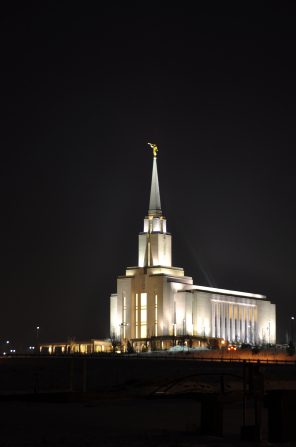
The Oquirrh Mountain Utah Temple (LDS.org)
From time to time, when I worship with my home congregation or, as tonight, visit with good friends (some of whom will shortly be leaving to serve others overseas for a couple of years) and share, among other things, “talk of poems and prayers and promises and things that we believe in,” it suddenly hits me how good it is — and how blessed I am — to be part of such a community.
This is especially apparent to me at times of great loss and sorrow, such as my wife and I and many other have experienced. But it’s very clear at other times, too. As I listen to the testimonies borne by members of the ward — including some whom I know quite well — I thought of the history, the sorrows and the fun times, the jokes and the expressions of deep commitment that we’ve shared over the years.
To live in a caring community that is both very local and intimate and that, at the same time, is replicated and represented around the world, is a deeply good thing.
Consider, for example, those times of loss. We see the goodness of belonging to the Church when bishops take time from their personal duties and interests — we have a lay clergy, and this is what bishops continually do — during a weekday to preside over and conduct the memorial services for a departed member of the congregation. We see it in the kindness of the Relief Society sisters of the ward, who provide excellent food for the grieving extended family at the post-funeral luncheon, and who stay after the family leaves to do the clean-up. Ward choristers and ward organists throughout the Church also commonly take time out of their private lives to help. A small example: As we exited the building to go home after my mother-in-law’s funeral, I saw the first counselor in her bishopric, who had been sitting with the bishop on the stand during the service, now changed into everyday clothes and pushing a broom to clean up the cultural hall where the luncheon had been held.
Such things are so common — many active Latter-day Saints, if not the overwhelming majority, will have provided similar service in such cases, and probably many times — that we tend to take them for granted. But we shouldn’t. They’re a wonderful thing.
I find myself thinking of what Alma the Elder said to those who had followed him in fleeing out the land of Nephi, as those words are recorded in Mosiah 18:8-10:
“Behold, here are the waters of Mormon (for thus were they called) and now, as ye are desirous to come into the fold of God, and to be called his people, and are willing to bear one another’s burdens, that they may be light;
“Yea, and are willing to mourn with those that mourn; yea, and comfort those that stand in need of comfort, and to stand as witnesses of God at all times and in all things, and in all places that ye may be in, even until death, that ye may be redeemed of God, and be numbered with those of the first resurrection, that ye may have eternal life—
“Now I say unto you, if this be the desire of your hearts, what have you against being baptized in the name of the Lord, as a witness before him that ye have entered into a covenant with him, that ye will serve him and keep his commandments, that he may pour out his Spirit more abundantly upon you?”
I revert to the passing of my wife’s mother, now more than five years ago: Neighbors and friends supplied food and caring words to us and to the other members of her family. We were moved to see so many from our own home ward among the substantial attendance at the funeral service, a solid hour’s drive to the north from where we live.
On the night that my mother-in-law died, a good friend, a member of the Mormon Tabernacle Choir, felt prompted to drive up with her daughter in order to visit my wife at the hospital where she was keeping vigil at her mother’s bedside. At my wife’s request, they sang a duet in the hospital room, of “Where Can I Turn for Peace?” by Emma Lou Thayne and Joleen Meredith:
Where can I turn for peace?
Where is my solace when other sources cease to make me whole?
When with a wounded heart, anger, or malice,
I draw myself apart, searching my soul?
Where, when my aching grows?
Where when I languish?
Where, in my need to know, where can I run?
Where is the quiet hand to calm my anguish?
Who, who can understand?
He, only One.
He answers privately,
Reaches my reaching,
In my Gethsemane,
Savior and Friend.
Gentle the peace he finds
for my beseeching.
Constant he is and kind,
Love without end.
(Our friend actually appears in this video of the Tabernacle Choir performing the hymn. She’s the one wearing the reddish dress.)
It was a very sacred experience for my wife, and, at her request, I pass over the details.
“Thou shalt live together in love,” said the Lord to Joseph Smith in a February 1831 revelation given at Kirtland, Ohio, “insomuch that thou shalt weep for the loss of them that die, and more especially for those that have not hope of a glorious resurrection. And it shall come to pass that those that die in me shall not taste of death, for it shall be sweet unto them.” (Doctrine and Covenants 42:45-46)
And, indeed, the members of this community do “live together in love.” It’s not without tensions and frictions, and I’m sure that there are others out there who are blessed to live in loving communities of faith and hope, but it’s remarkable nonetheless. When I was a student living in Egypt many years ago, the director of the Fulbright-supported program in which I was studying confided to me that, if he had to make a choice between a non-Mormon, on the one hand, and, on the other, a Mormon who had scored a slightly lower score on the qualifying exam for the program, he would take the Mormon. Why? Because — he said — non-Mormons tended to arrive in the vast, disorienting, very foreign city of Cairo and, in too many cases, implode from culture shock. Whereas, he said, you Mormons have an instant and supportive community from the very moment you land. Which was and remains absolutely true, in Cairo and elsewhere.
Some disaffected members of the Church claim to have found it oppressive, to have been injured by it. I don’t doubt that bad things happen. We are, after all, a community composed of fallible and imperfect humans. I don’t discount their stories — though, sometimes, I also marvel at how utterly foreign to my experience in the Church and with the Saints the narratives a few of them tell are. I mourn for them. I would like to help them, if I could. I wish them well. I wish they would return.
Overwhelmingly, though, I consider it one of the greatest blessings of my life to be a part of the community of the Latter-day Saints.
I definitely don’t understand the hostile secular critics who want to detach believers from their faith, and, if possible, to pull the Church from its foundations. I think, in this context, of the words of the high priest Giddonah to the anti-Christ Korihor in Alma 30:22. Giddonah seeks to know why Korihor wants to destroy the faith of the ancient Nephite saints, and “to interrupt their rejoicings.”
I’m curious about the same question. Do the secularists have anything better to offer?
I think not.
I’m a believer. I’m convinced that the claims of the Church of Jesus Christ of Latter-day Saints, incredible as they certainly seem to many, are actually true. But even if they turned out to be false, even if our lives were merely a flickering candle surrounded by an eternity of pointless darkness and soon to be extinguished by it, the Mormon way of life, in the company of the Saints, is a very good place to be.
Church of Jesus Christ of Latter-day Saints
Previous Post

August 15, 2018
A Modern Apostle
Next Post
August 15, 2018 Unforeseen Complexities in Darwin's Tree of Life
Browse Our Archives
Select a Category Uncategorized
Select a Month October 2026 September 2026 August 2026 July 2026 June 2026 May 2026 April 2026 March 2026 February 2026 January 2026 December 2025 November 2025 October 2025 September 2025 August 2025 July 2025 June 2025 May 2025 April 2025 March 2025 February 2025 January 2025 December 2024 November 2024 October 2024 September 2024 August 2024 July 2024 June 2024 May 2024 April 2024 March 2024 February 2024 January 2024 December 2023 November 2023 October 2023 September 2023 August 2023 July 2023 June 2023 May 2023 April 2023 March 2023 February 2023 January 2023 December 2022 November 2022 October 2022 September 2022 August 2022 July 2022 June 2022 May 2022 April 2022 March 2022 February 2022 January 2022 December 2021 November 2021 October 2021 September 2021 August 2021 July 2021 June 2021 May 2021 April 2021 March 2021 February 2021 January 2021 December 2020 November 2020 October 2020 September 2020 August 2020 July 2020 June 2020 May 2020 April 2020 March 2020 February 2020 January 2020 December 2019 November 2019 October 2019 September 2019 August 2019 July 2019 June 2019 May 2019 April 2019 March 2019 February 2019 January 2019 December 2018 November 2018 October 2018 September 2018 August 2018 July 2018 June 2018 May 2018 April 2018 March 2018 February 2018 January 2018 December 2017 November 2017 October 2017 September 2017 August 2017 July 2017 June 2017 May 2017 April 2017 March 2017 February 2017 January 2017 December 2016 November 2016 October 2016 September 2016 August 2016 July 2016 June 2016 May 2016 April 2016 March 2016 February 2016 January 2016 December 2015 November 2015 October 2015 September 2015 August 2015 July 2015 June 2015 May 2015 April 2015 March 2015 February 2015 January 2015 December 2014 November 2014 March 2014 August 2013 February 2012
Follow Us!
TAKE THE
Religious Wisdom Quiz
Which book is written almost completely as poetry?
Select your answer to see how you score.
Ezra Isaiah Jeremiah Lamentations
Related posts from Sic et Non


Notes on Women, Priesthood, and General Conference

"The Book of Moses as a Temple Text"

TRENDING AT PATHEOS Latter-day Saint

When Halloween Unmasks Married Hearts
Written by Dr. David K. Ewen from Eternal Truth Bible College Behind...

Aristotle. He’s been called the father of logic, the father of the...

Methodist Central Hall and Westminster Abbey
Situated on the same square is Methodist Central Hall and Westminster Abbey. ...

57th Dove Awards Honor Dolly Parton, Crown New...
On gospel music’s biggest night, the 57th annual GMA Dove Awards honored...

The First Eucharistic Controversy: Christ’s Real Presence
For Catholics, the Eucharist is the source and summit of the Christian...

What a Stop Sign Can Teach Us About...
How to Make a Decision When You Can't Hear God Main point:...
view all Latter-day Saint blogs
Ad-Free & Subscriber Log-In Subscription Support
- About Us
- 2026 Calendar
- Videos
- Podcasts
- Library of World Religions
- Faith In Media Tracker
- Advertise With Us
- Write for Us
- Privacy Policy
- Terms of Service
- Do Not Sell My Data
- Contact Us
- Radiant Digital
- Manage Newsletter Subscriptions
- Unsubscribe From Notifications
- Sitemap
Copyright 2008-2026, Patheos. All rights reserved.
Subscription Support Ad-Free & Subscriber Log-In
Follow Patheos