
BuddhistCatholicContemplativeEvangelicalGeneral ChristianHinduJewishLatter-day SaintMuslimNew VisionsProgressive Christian
Beliefs
- Buddhist
- Catholic
- Contemplative
- Evangelical
- General Christian
- Hindu
- Jewish
- Latter-day Saint
- More Voices
- Muslim
- New Visions
- Pagan
- Progressive Christian
Topics
- Religion News
- Food and Religion
- Sports and Religion
- Religious Art
- Religious Music and Entertainment
- Religious Events
- History and Religion
- Style and Religion
- Politics and Religion
- Women in Religion
- Recreation Outdoors and Religion
- Business Finance and Religion
- Careers Workplace and Religion
- Education and Religion
- Family Parenting and Religion
- Health Fitness and Religion
- Home and Religion
- Relationships and Religion
- Technology and Religion
- Travel and Religion
Columnists
- Buddhist Columnists
- Business Finance and Religion Columnists
- Careers Workplace and Religion Columnists
- Catholic Columnists
- Contemplative Columnists
- Education and Religion Columnists
- Evangelists Columnists
- Family Parenting and Religion Columnists
- General Christian Columnists
- Health Fitness and Religion Columnists
- Hindu Columnists
- History and Religion Columnists
- Home and Religion Columnists
- Jewish Columnists
- More Voices Columnists
- Latter Day Columnists
- Muslim Columnists
- New Visions Columnists
- Nonreligious Columnists
- Pagan Columnists
- Politics and Religion Columnists
- Progressive Columnists
- Recreation Outdoors and Religion Columnists
- Relationships and Religion Columnists
- Religion News Columnists
- Religious Art Columnists
- Religious Events Columnists
- Religious Music and Entertainment Columnists
- Sports and Religion Columnists
- Style and Religion Columnists
- Technology and Religion Columnists
- Travel and Religion Columnists
- Women in Religion Columnists
Resource Library
- 2026 Calendar
- Library of World Religions
- The 100 Most Holy Places on Earth
- Patheos Answers
- Podcasts
- Videos
- Faith Leaders Database
- Anglican Episcopalian
- Bahai
- Baptist
- Buddhism
- Christianity
- Confucianism
- Eastern Orthodoxy
- Hinduism
- Holiness and Pentecostal
- ISKCON
- Islam
- Judaism
- Lutheran
- Methodist
- The Church of Jesus Christ of Latter-day Saints
- New Age
- Paganism
- Presbytarian and Reformed
- Protestantism
- Religion Behind the Scenes
- Roman Catholic
- Scientology
- Shia Islam
- Sikhism
- Sufism
- Sunni Islam
- Taoism
- Zen
- See all religions
Research Tools
 Ad-Free & Subscriber Log-In Subscription Support
Ad-Free & Subscriber Log-In Subscription Support
Follow Patheos 

- Trending:
- Forgiveness
- |
- Marriage
- |
- Consciousness
- |
- Death Penalty
- |
- Election
- |
- Halloween

- Home
- Latter-day Saint
- A Note on Theology, Galileo, and Change in Science
A Note on Theology, Galileo, and Change in Science
Last updated on: September 5, 2018 at 9:52 am by Dan Peterson
A Note on Theology, Galileo, and Change in Science 2018-09-05T09:52:48-06:00 Dan Peterson
Patheos Explore the world's faith through different perspectives on religion and spirituality! Patheos has the views of the prevalent religions and spiritualities of the world.
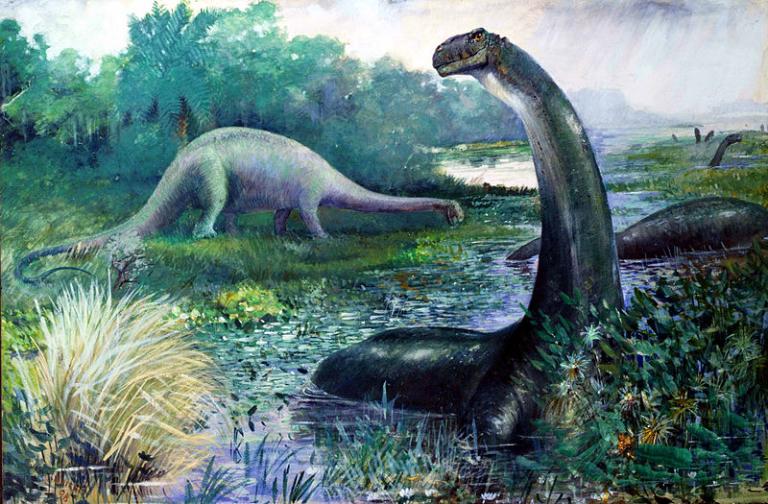
This 1897 image shows a diplodocus on land and a brontosaurus in the water, and is not very different from the images with which I grew up. Today, although Brontosauruses were a staple of my childhood toys and even supplied “Bronto Burgers” to the Flintstones and the Rubbles, Brontosauruses and their classification are rather controversial. (Wikimedia Commons public domain)
Dr. Melik: This morning for breakfast he requested something called “wheat germ, organic honey and tiger’s milk.”
Dr. Aragon: [chuckling] Oh, yes. Those are the charmed substances that some years ago were thought to contain life-preserving properties.
Dr. Melik: You mean there was no deep fat? No steak or cream pies or . . . hot fudge?
Dr. Aragon: Those were thought to be unhealthy . . . precisely the opposite of what we now know to be true.
Dr. Melik: Incredible.
From Woody Allen, Sleeper (1973)
On Saturday, in the context of a discussion about cosmic “worm holes,” I cautioned that “we should . . . be very careful about wedding theology or doctrine too closely to the changeable findings of whatever contemporary science has to say. (Surely that’s one of the lessons to be learned from the story of Galileo and the Aristotelians.)”
I think that I’ll expand upon that caution just a bit.
Science changes. In a very important sense, that’s not a weakness. On the contrary, it’s one of the great things about science. In fits and starts, at least, if not always quite smoothly, the scientific consensus adjusts itself to new findings and newly discovered facts. I like to think of science (to use a metaphor from analytic geometry) as asymptotic, as perhaps never altogether reaching the complete truth about physical reality but, over time — we hope! — drawing nearer and nearer to it.
We know now, for instance — or, anyhow, are pretty confident that we do — that there are no artificial canals on Mars, that four-humors medical theory is not true, that the steady-state theory of the universe is false, that continents drift, that ulcers are caused by the H. pylori bacterium rather than by stress, that leeching isn’t an effective treatment for disease, and that, contrary to M. Lamarck, parents don’t biologically pass acquired characteristics on to their offspring.
When I was younger, eggs were considered rather bad for your health, and egg consumption was a pretty good path to a heart attack. Since then, though — and without my really noticing it as it happened — eggs have made a comeback. Some argue that certain nutrients contained in eggs may actually help to lower the risk for heart disease.
The Ptolemaic model of the solar system was a vast improvement over what had gone before. Various refinements were made to it over the centuries, up to and including Tycho Brahe’s in the sixteenth century. In the end, though, the Copernican model replaced it. But that model wasn’t entirely satisfactory, either. Not until Kepler came along. However, there’s still plenty to be learned about our solar system — what should we make of Pluto, for example? and does the hypothetical Planet 9 really exist? — to say nothing of the inconceivably vast universe beyond.
In the case of Galileo (1564-1642), the prominent historian of science and Galileo expert Stillman Drake (1910-1993) demonstrated, via many works, that the simplistic science-versus-religion morality play with which I grew up is historically untenable. There were many factors in Galileo’s trial and condemnation, but one of them was a conflict between Galileo and the powerfully entrenched Aristotelian philosophers who spoke for the scientific consensus of his era. In other words, it was really a battle between new science and old science, not between Christianity and science as such.
A substantial contributor to the dispute was the fact that the heliocentric system proposed by Nicolaus Copernicus (1473-1543), whom we now justly venerate as the founder of the “Copernican Revolution,” didn’t really account with entire accuracy for the long-observed motions of the planets. In the contemporary language of the debate, it did not “save the appearances” noted by astronomers. For example, Tycho Brahe (1546-1601), the greatest observational astronomer of his day, could never bring himself to fully endorse or accept the Copernican model. Moreover, the laws of planetary motion proposed by Johannes Kepler (1571-1630), which, with their elliptical orbits, would eventually reconcile heliocentrism with observational astronomy, weren’t immediately accepted. Even Galileo ignored Kepler’s work.
This — coupled with the fact that many astronomers, by this point, thought that they were simply constructing models that would fit the data, rather than discerning actual astronomical reality (which, they suspected, was beyond human capacity) — helps to make sense of the reaction of St. Robert Cardinal Bellarmine (1542-1641) to Galileo’s passionate advocacy of Copernicanism:
I say that if there were a true demonstration that the sun is at the center of the world and the earth in the third heaven, and that the sun does not circle the earth but the earth circles the sun, then one would have to proceed with great care in explaining the Scriptures that appear contrary, and say rather that we do not understand them, than that what is demonstrated is false. But I will not believe that there is such a demonstration, until it is shown me. Nor is it the same to demonstrate that by supposing the sun to be at the center and the earth in heaven one can save the appearances, and to demonstrate that in truth the sun is at the center and the earth in heaven; for I believe the first demonstration may be available, but I have very great doubts about the second, and in case of doubt one must not abandon the Holy Scripture as interpreted by the Holy Fathers.
Unfortunately, many Catholic theologians had adopted Aristotelian science, which had been venerated by both pagans and Christians for many centuries, as essentially a part of their fundamental doctrine, which we now plainly see it was not. Thus, what should simply have been a debate between traditional science and the new science became, to the considerable harm of both science and religion, the concern of theologians and ecclesiastical leaders .
There is always a risk, even today, of illegitimately identifying a current and possibly transient scientific consensus (or political ideology, or other fashion) with the core doctrines of Christianity or the Restoration, such that those doctrines are vulnerable to the next scientific theory. Orson Pratt and some other Latter-day Saint writers of earlier generations, for example, seem to have toyed with the idea of a connection between the Holy Spirit and the universal “luminiferous ether” presupposed by many scientists. But the famous 1887 Michelson-Morley experiment rendered belief in the universal luminiferous ether untenable. Fortunately, Elder Pratt (who died in 1881) was aware that he was speculating and did not insist that his speculations be taken as official, binding doctrine.
That’s why I say that “we should . . . be very careful about wedding theology or doctrine too closely to the changeable findings of whatever contemporary science has to say.”
Previous Post

August 18, 2018
A Significant Event in Late September
Next Post
August 19, 2018 Two Christian Arabic Books
Browse Our Archives
Select a Category Uncategorized
Select a Month October 2026 September 2026 August 2026 July 2026 June 2026 May 2026 April 2026 March 2026 February 2026 January 2026 December 2025 November 2025 October 2025 September 2025 August 2025 July 2025 June 2025 May 2025 April 2025 March 2025 February 2025 January 2025 December 2024 November 2024 October 2024 September 2024 August 2024 July 2024 June 2024 May 2024 April 2024 March 2024 February 2024 January 2024 December 2023 November 2023 October 2023 September 2023 August 2023 July 2023 June 2023 May 2023 April 2023 March 2023 February 2023 January 2023 December 2022 November 2022 October 2022 September 2022 August 2022 July 2022 June 2022 May 2022 April 2022 March 2022 February 2022 January 2022 December 2021 November 2021 October 2021 September 2021 August 2021 July 2021 June 2021 May 2021 April 2021 March 2021 February 2021 January 2021 December 2020 November 2020 October 2020 September 2020 August 2020 July 2020 June 2020 May 2020 April 2020 March 2020 February 2020 January 2020 December 2019 November 2019 October 2019 September 2019 August 2019 July 2019 June 2019 May 2019 April 2019 March 2019 February 2019 January 2019 December 2018 November 2018 October 2018 September 2018 August 2018 July 2018 June 2018 May 2018 April 2018 March 2018 February 2018 January 2018 December 2017 November 2017 October 2017 September 2017 August 2017 July 2017 June 2017 May 2017 April 2017 March 2017 February 2017 January 2017 December 2016 November 2016 October 2016 September 2016 August 2016 July 2016 June 2016 May 2016 April 2016 March 2016 February 2016 January 2016 December 2015 November 2015 October 2015 September 2015 August 2015 July 2015 June 2015 May 2015 April 2015 March 2015 February 2015 January 2015 December 2014 November 2014 March 2014 August 2013 February 2012
Follow Us!
TAKE THE
Religious Wisdom Quiz
Which sea did Moses cross in the Exodus story?
Select your answer to see how you score.
Sea of Galilee Dead Sea Red Sea Caspian Sea
Related posts from Sic et Non

Cosmology and Cosmic Design, Again
Science and Religion: A Great Scottish Example


Slandering the Lord's anointed
TRENDING AT PATHEOS Latter-day Saint

57th Dove Awards Honor Dolly Parton, Crown New...
On gospel music’s biggest night, the 57th annual GMA Dove Awards honored...

The First Eucharistic Controversy: Christ’s Real Presence
For Catholics, the Eucharist is the source and summit of the Christian...

What a Stop Sign Can Teach Us About...
How to Make a Decision When You Can't Hear God Main point:...

Archdiocese Hosts Military Marriage Retreat in Germany
RASTATT, Germany — The transient military lifestyle, with its frequent deployments and...

Nearly every morning, I make the drive to Detroit with my high-school-age...

The Real AI Story Is Adoption Without Trust
Artificial intelligence has crossed a political threshold. It is no longer a...
view all Latter-day Saint blogs
Ad-Free & Subscriber Log-In Subscription Support
- About Us
- 2026 Calendar
- Videos
- Podcasts
- Library of World Religions
- Faith In Media Tracker
- Advertise With Us
- Write for Us
- Privacy Policy
- Terms of Service
- Do Not Sell My Data
- Contact Us
- Radiant Digital
- Manage Newsletter Subscriptions
- Unsubscribe From Notifications
- Sitemap
Copyright 2008-2026, Patheos. All rights reserved.
Subscription Support Ad-Free & Subscriber Log-In
Follow Patheos