
BuddhistCatholicContemplativeEvangelicalGeneral ChristianHinduJewishLatter-day SaintMuslimNew VisionsProgressive Christian
Beliefs
- Buddhist
- Catholic
- Contemplative
- Evangelical
- General Christian
- Hindu
- Jewish
- Latter-day Saint
- More Voices
- Muslim
- New Visions
- Pagan
- Progressive Christian
Topics
- Religion News
- Food and Religion
- Sports and Religion
- Religious Art
- Religious Music and Entertainment
- Religious Events
- History and Religion
- Style and Religion
- Politics and Religion
- Women in Religion
- Recreation Outdoors and Religion
- Business Finance and Religion
- Careers Workplace and Religion
- Education and Religion
- Family Parenting and Religion
- Health Fitness and Religion
- Home and Religion
- Relationships and Religion
- Technology and Religion
- Travel and Religion
Columnists
- Buddhist Columnists
- Business Finance and Religion Columnists
- Careers Workplace and Religion Columnists
- Catholic Columnists
- Contemplative Columnists
- Education and Religion Columnists
- Evangelists Columnists
- Family Parenting and Religion Columnists
- General Christian Columnists
- Health Fitness and Religion Columnists
- Hindu Columnists
- History and Religion Columnists
- Home and Religion Columnists
- Jewish Columnists
- More Voices Columnists
- Latter Day Columnists
- Muslim Columnists
- New Visions Columnists
- Nonreligious Columnists
- Pagan Columnists
- Politics and Religion Columnists
- Progressive Columnists
- Recreation Outdoors and Religion Columnists
- Relationships and Religion Columnists
- Religion News Columnists
- Religious Art Columnists
- Religious Events Columnists
- Religious Music and Entertainment Columnists
- Sports and Religion Columnists
- Style and Religion Columnists
- Technology and Religion Columnists
- Travel and Religion Columnists
- Women in Religion Columnists
Resource Library
- 2026 Calendar
- Library of World Religions
- The 100 Most Holy Places on Earth
- Patheos Answers
- Podcasts
- Videos
- Faith Leaders Database
- Anglican Episcopalian
- Bahai
- Baptist
- Buddhism
- Christianity
- Confucianism
- Eastern Orthodoxy
- Hinduism
- Holiness and Pentecostal
- ISKCON
- Islam
- Judaism
- Lutheran
- Methodist
- The Church of Jesus Christ of Latter-day Saints
- New Age
- Paganism
- Presbytarian and Reformed
- Protestantism
- Religion Behind the Scenes
- Roman Catholic
- Scientology
- Shia Islam
- Sikhism
- Sufism
- Sunni Islam
- Taoism
- Zen
- See all religions
Research Tools
 Ad-Free & Subscriber Log-In Subscription Support
Ad-Free & Subscriber Log-In Subscription Support
Follow Patheos 

- Trending:
- Forgiveness
- |
- Marriage
- |
- Consciousness
- |
- Death Penalty
- |
- Election
- |
- Halloween

- Home
- Latter-day Saint
- “Muslim Identity” (Part 1)
“Muslim Identity” (Part 1)
Last updated on: September 5, 2018 at 9:52 am by Dan Peterson
“Muslim Identity” (Part 1) 2018-09-05T09:52:58-06:00 Dan Peterson
Patheos Explore the world's faith through different perspectives on religion and spirituality! Patheos has the views of the prevalent religions and spiritualities of the world.
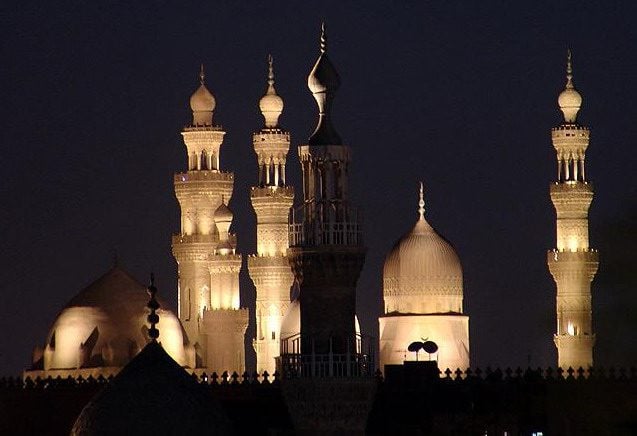
A montage of some mosques in Cairo (Wikimedia Commons)
Here’s the first part of an article that I wrote for Richard C. Martin, et al., eds. Encyclopedia of Islam and the Muslim World, 2 vols. (New York: Macmillan Reference USA, 2004), on the subject of “Muslim Identity”:
In Islamic societies, religion, rather than language and ethnicity, has typically defined political, social, and personal identity. Obviously, Muslims have always been aware of linguistic, ethnic, and territorial divisions, but, through much of Islamic history, these have seemed relatively unimportant to them. Their formative past and spiritual ancestry were to be found in the line of prophets and believers chronicled in the Qur’an, prominently including the Prophet Muhammad and his companions, rather than, depending upon where they lived, among the related by spiritually foreign peoples of, say, pharaonic Egypt, or polytheistic Babylonia.
Although the situation has become more complex during the past two centuries, Muslims have traditionally been integrated by their common identity as followers of Muhammad and the Qur’an, and, secondarily, by their allegiance to dynastic rulers (e.g., caliphs and sultans). At least in theory (but very often in fact), Muslims of entirely distinct tongues and genealogies have recognized each other as brothers while rejecting as aliens compatriots who, while sharing both dialect and ancestry, differ in religious affiliation. (In recent years, certain unfortunate consequences of these attitudes—generally reciprocated with at least equal fervor by the non-Muslims involved—have been strikingly illustrated in the Balkans and elsewhere.) Before residents of the region adopted such nineteenth and early-twentieth-century terms as Middle East and Near East, no equivalent vocabulary, and, hence, no such unifying concept of shared geographical identity, seems really to have existed in the area. Until modern times, Turkish had no word for Turkey; the word used today originated in Europe. Arabic still lacks a word for Arabia. On the other hand, such distinctions as that between the dar al-islam (the “abode of Islam” or “of submission [to God]”) and the counterpoised dar al-harb (“the abode of strife” or “of war”) were readily available and far more salient.
It must be understood, of course, that religion in the areas dominated by Islam has commonly included rather more than a mere system of belief and worship, distinct from and possibly subordinated to national and political allegiances. Those of Muslim background often retain a shared communal identity even in instances where Islamic faith and practice have been abandoned.
Initially, of course, the fact that the Qur’an had been revealed in Arabic, while obviously useful to its first hearers, could not forge a unique identity. All of its original audience, after all, both believers and unbelievers, were Arabic-speakers. With the spread of Islam westward to Iberia and eastward to India, however, the Qur’an’s Arabic character (emphasized in the book itself at 12:2; 13:37; 16:103; 20:113; 26:195; 39:28; 41:3; 42:7; 43:3; 46:12) marked the Arabs off as a favored nation whose ethnic identity was intimately connected with the identity most of them shared as Muslims. Arabic came to be the principal language of a vast civilization that, although it included considerable numbers of non-Muslims who enjoyed the status of protected dhimmis, had been formed and shaped by Arabo-Islamic sensibilities. In this were sown the seeds of later Arabic nationalism.
Posted from Victoria, British Columbia
Previous Post

July 23, 2018
Hell on Earth, and Its Aftermath
Next Post
July 24, 2018 Joseph Smith's sense of humor?
Browse Our Archives
Select a Category Uncategorized
Select a Month October 2026 September 2026 August 2026 July 2026 June 2026 May 2026 April 2026 March 2026 February 2026 January 2026 December 2025 November 2025 October 2025 September 2025 August 2025 July 2025 June 2025 May 2025 April 2025 March 2025 February 2025 January 2025 December 2024 November 2024 October 2024 September 2024 August 2024 July 2024 June 2024 May 2024 April 2024 March 2024 February 2024 January 2024 December 2023 November 2023 October 2023 September 2023 August 2023 July 2023 June 2023 May 2023 April 2023 March 2023 February 2023 January 2023 December 2022 November 2022 October 2022 September 2022 August 2022 July 2022 June 2022 May 2022 April 2022 March 2022 February 2022 January 2022 December 2021 November 2021 October 2021 September 2021 August 2021 July 2021 June 2021 May 2021 April 2021 March 2021 February 2021 January 2021 December 2020 November 2020 October 2020 September 2020 August 2020 July 2020 June 2020 May 2020 April 2020 March 2020 February 2020 January 2020 December 2019 November 2019 October 2019 September 2019 August 2019 July 2019 June 2019 May 2019 April 2019 March 2019 February 2019 January 2019 December 2018 November 2018 October 2018 September 2018 August 2018 July 2018 June 2018 May 2018 April 2018 March 2018 February 2018 January 2018 December 2017 November 2017 October 2017 September 2017 August 2017 July 2017 June 2017 May 2017 April 2017 March 2017 February 2017 January 2017 December 2016 November 2016 October 2016 September 2016 August 2016 July 2016 June 2016 May 2016 April 2016 March 2016 February 2016 January 2016 December 2015 November 2015 October 2015 September 2015 August 2015 July 2015 June 2015 May 2015 April 2015 March 2015 February 2015 January 2015 December 2014 November 2014 March 2014 August 2013 February 2012
Follow Us!
TAKE THE
Religious Wisdom Quiz
Who declared, "Choose for yourselves this day whom you will serve"?
Select your answer to see how you score.
Joshua Gideon Moses Aaron
Related posts from Sic et Non

Learning more about a region of which I've...

From Serbia's "White City," Belgrade


TRENDING AT PATHEOS Latter-day Saint

The Sermon on the Mount, Part I: Matthew...
The Sermon on the Mount, Part I (Matthew 4:12-5:12) St. Matthew moves...

What's up from Crossway: Reviewing some of their latest A few weeks...

Janie Learns the Way of the Cross: A...
Teaching children about Jesus' Passion can be challenging. Many parents and educators...

Looking For Good Catholic Writing - October 2026
He alone extends the heavens, and he walks upon the waves of...

In "Irreplaceable," our book on vocation and technology, Trevor Sutton and I...

I was strolling through the top floor of the brand new Parthenon...
view all Latter-day Saint blogs
Ad-Free & Subscriber Log-In Subscription Support
- About Us
- 2026 Calendar
- Videos
- Podcasts
- Library of World Religions
- Faith In Media Tracker
- Advertise With Us
- Write for Us
- Privacy Policy
- Terms of Service
- Do Not Sell My Data
- Contact Us
- Radiant Digital
- Manage Newsletter Subscriptions
- Unsubscribe From Notifications
- Sitemap
Copyright 2008-2026, Patheos. All rights reserved.
Subscription Support Ad-Free & Subscriber Log-In
Follow Patheos