
BuddhistCatholicContemplativeEvangelicalGeneral ChristianHinduJewishLatter-day SaintMuslimNew VisionsProgressive Christian
Beliefs
- Buddhist
- Catholic
- Contemplative
- Evangelical
- General Christian
- Hindu
- Jewish
- Latter-day Saint
- More Voices
- Muslim
- New Visions
- Pagan
- Progressive Christian
Topics
- Religion News
- Food and Religion
- Sports and Religion
- Religious Art
- Religious Music and Entertainment
- Religious Events
- History and Religion
- Style and Religion
- Politics and Religion
- Women in Religion
- Recreation Outdoors and Religion
- Business Finance and Religion
- Careers Workplace and Religion
- Education and Religion
- Family Parenting and Religion
- Health Fitness and Religion
- Home and Religion
- Relationships and Religion
- Technology and Religion
- Travel and Religion
Columnists
- Buddhist Columnists
- Business Finance and Religion Columnists
- Careers Workplace and Religion Columnists
- Catholic Columnists
- Contemplative Columnists
- Education and Religion Columnists
- Evangelists Columnists
- Family Parenting and Religion Columnists
- General Christian Columnists
- Health Fitness and Religion Columnists
- Hindu Columnists
- History and Religion Columnists
- Home and Religion Columnists
- Jewish Columnists
- More Voices Columnists
- Latter Day Columnists
- Muslim Columnists
- New Visions Columnists
- Nonreligious Columnists
- Pagan Columnists
- Politics and Religion Columnists
- Progressive Columnists
- Recreation Outdoors and Religion Columnists
- Relationships and Religion Columnists
- Religion News Columnists
- Religious Art Columnists
- Religious Events Columnists
- Religious Music and Entertainment Columnists
- Sports and Religion Columnists
- Style and Religion Columnists
- Technology and Religion Columnists
- Travel and Religion Columnists
- Women in Religion Columnists
Resource Library
- 2026 Calendar
- Library of World Religions
- The 100 Most Holy Places on Earth
- Patheos Answers
- Podcasts
- Videos
- Faith Leaders Database
- Anglican Episcopalian
- Bahai
- Baptist
- Buddhism
- Christianity
- Confucianism
- Eastern Orthodoxy
- Hinduism
- Holiness and Pentecostal
- ISKCON
- Islam
- Judaism
- Lutheran
- Methodist
- The Church of Jesus Christ of Latter-day Saints
- New Age
- Paganism
- Presbytarian and Reformed
- Protestantism
- Religion Behind the Scenes
- Roman Catholic
- Scientology
- Shia Islam
- Sikhism
- Sufism
- Sunni Islam
- Taoism
- Zen
- See all religions
Research Tools
 Ad-Free & Subscriber Log-In Subscription Support
Follow Patheos 

- Trending:
- Advent
- |
- Forgiveness
- |
- Thanksgiving
- |
- Election
- |
- Seasonal Holidays
- |
- Marriage

- Home
- Latter-day Saint
- An apology for the pre-1978 priesthood ban?
An apology for the pre-1978 priesthood ban?
Last updated on: September 5, 2018 at 9:53 am by Dan Peterson
An apology for the pre-1978 priesthood ban? 2018-09-05T09:53:35-06:00 Dan Peterson
Patheos Explore the world's faith through different perspectives on religion and spirituality! Patheos has the views of the prevalent religions and spiritualities of the world.
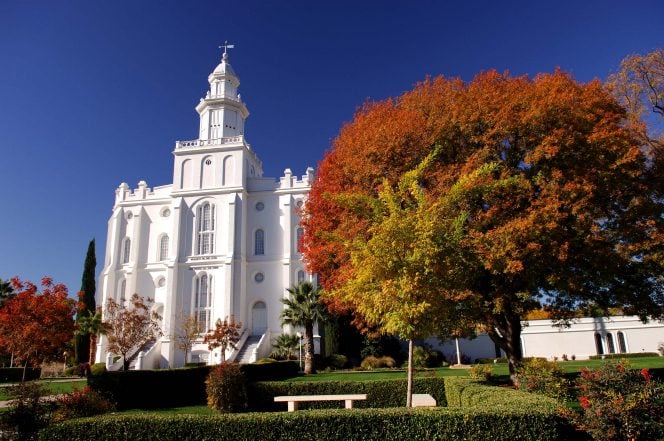
The St. George Utah Temple is the oldest temple still in use by the Church of Jesus Christ of Latter-day Saints, and the first built by the Saints in Utah after their exodus from the United States.(LDS.org)
There has been a lot of talk over the past two or three weeks about a hypothetical apology from the Church for its policy, until June 1978, against priesthood ordination for men of African descent. Back in March 2012, I posted the following item on exactly the same topic. Reading through it, I don’t see much (if anything) that I would change today:
Should the Church of Jesus Christ of Latter-day Saints apologize for its pre-1978 ban on ordaining blacks to the priesthood?
Many critics are demanding it, and some believing members of the Church are publicly asking for it, as well.
I’m not joining them. Though, if the Church ever issues such a statement, I’ll be fine with it.
Do I regret the pain and sorrow that the ban and its side effects caused to good and worthy people who could not, during their lives, enjoy the blessings of the priesthood and the temple?
Yes. Very much.
The stories of faithful Saints like Jane Manning James and Elijah Abel are deeply inspiring to me, but, at the same time, deeply painful.
Do I regret the damage that the ban did, and continues to do, to the reputation of the Church?
More than I can say.
Was I delighted to see it come to an end?
I was ecstatic.
As a genuine geezer who grew up in “the mission field” (California, in my case), I was very much alive and aware during the late 1960s, when the priesthood ban became a matter of public controversy. My neighborhood and high school had very, very few blacks — it wasn’t purely WASP, either; there were many Hispanics at my school and quite a few Asian-Americans — but there was one black teacher. I never had him for a class. Still, I knew him somewhat, and I can remember how I felt when he asked me where I was going to college and I told him “Brigham Young University.” He congratulated me, and said it was a fine school, but the Stanford/BYU and Wyoming/BYU, and similar controversies (provoked by the Church’s exclusion of black men from its priesthood) had been all over the news, and I felt as if I had just kicked him in the teeth.
The ban on ordaining worthy black men to the priesthood was in significant tension with my basic worldview, theological and otherwise, and I was delighted to see it go.
That said, however, I don’t know where it came from. Others confidently declare that it was an error, even an evil, rooted in racism. And perhaps it was. (Hugh Nibley speculated that the Lord was waiting for the Church’s white membership to overcome its own racism; the fault, in his view, lay not with blacks and not even with the leaders of the Church, but with the Saints as a whole.) But, while they may know that, I don’t.
Yes, Brigham Young (and others whom I revere as prophets and apostles) made comments that, certainly by today’s standards, were egregiously racist. I don’t attempt to defend those statements; the men who made them were, in that respect, very much of their time, region, socio-economic status, and educational level. They should, I believe, not be judged by the relatively-recently-attained high standards of contemporary American racial sensitivity.
Nor should Abraham Lincoln, the Great Emancipator, who was surely a very noble and great man and quite arguably America’s greatest president.
“I will say then,” Lincoln declared in his fourth debate with Senator Stephen A. Douglas (Charleston, Illinois; 18 September 1858), “that I am not, nor ever have been in favor of bringing about in any way the social and political equality of the white and black races — that I am not nor ever have been in favor of making voters or jurors of negroes, nor of qualifying them to hold office, nor to intermarry with white people; and I will say in addition to this that there is a physical difference between the white and black races which I believe will forever forbid the two races living together on terms of social and political equality. And inasmuch as they cannot so live, while they do remain together there must be the position of superior and inferior, and I as much as any other man am in favor of having the superior position assigned to the white race. I say upon this occasion I do not perceive that because the white man is to have the superior position the negro should be denied everything.” (Roy P. Basler, The Collected Works of Abraham Lincoln, 3:145-146)
It would be a crime against accurate historical understanding and against Abraham Lincoln to condemn him altogether for his racial attitudes. They scarcely sum the man up. And they weren’t unusual at the time.
Likewise, abhorrent as I find some of the things that Brigham Young said about blacks, they’re relatively insignificant against the background of everything else he did and said, and they don’t deserve the last word about his character. Not even close. I’m not convinced that Brigham and other past Church leaders were worse on racial matters than their contemporaries. Should they have been better? It would have been very nice. And perhaps, in practice, they actually were, to at least some extent. But God has never been able to work through perfect people. They’re unavailable. And it’s not about us, anyway.
“For what we preach,” said the Apostle Paul, “is not ourselves, but Jesus Christ as Lord, and ourselves as your servants for Jesus’ sake. For God, who said, ‘Let light shine out of darkness,’ made his light shine in our hearts to give us the light of the knowledge of God’s glory displayed in the face of Christ. But we have this treasure in jars of clay to show that this all-surpassing power is from God and not from us.” (Corinthians 4:5-7, NIV).
All of us, leaders and members of the Church alike, are “jars of clay” or, as the King James Version puts it, “earthen vessels.” We’re unworthy of the message of the Gospel. But God is gracious to us.
As the priesthood ban became an issue in the late 1960s, I heard all sorts of differing and sometimes contradictory explanations for it — though I don’t believe that I’ve ever before heard precisely the explanation offered up by a BYU professor of religion to the Washington Post last week. Accordingly, I concluded that we just didn’t know the actual reason for it, and that remains my view to this day.
I’m struck, though, by the fact that — and, so that all will understand, I need to confess right now that I’m a believer who accepts the leadership of the Church of Jesus Christ of Latter-day Saints as genuine prophets and apostles — the Lord plainly seems to have permitted the ban on ordaining blacks to the priesthood to continue until June 1978. However it originated, that seems to me significant. And, while I’m not clear on how the prohibition began, I’m absolutely clear on how it ended: with a breathtaking revelation to the then-leaders of the Church.
Should the Church apologize for the ban? Its leaders will do what they believe is wise, under the inspiration (as I believe) of heaven. From my vantage point, though, right now, I don’t see precisely how they can. I, at least, don’t know that the ban wasn’t the Lord’s will. Maybe it wasn’t. Maybe, though, it was. He seems to work through lineages in a way that seems quite foreign to me — but then, if God always did things the way I think they ought to be done, he would appear to be entirely redundant, and maybe, in fact, only a projection of Me. Which would be, to put it mildly, disappointing.
From among all the nations, he chose Israel. From among Israel, he chose the descendents of Levi to bear the priesthood. He assigned very different blessings to the various tribes of the Hebrews, and he doesn’t seem to have been overly fond of the Canaanites. During his earthly ministry, Jesus largely restricted his teaching to fellow Jews.
Those believers who denounce the pre-1978 priesthood restriction as racist simpliciter and who seek an apology from the Church contend, with considerable plausibility and persuasive force, that the ban was inconsistent with the fundamental values of Mormonism itself, and commonly cite these marvelous words from 2 Nephi 26:33 in support of their position:
“He inviteth them all to come unto him and partake of his goodness; and he denieth none that come unto him, black and white, bond and free, male and female; and he remembereth the heathen; and all are alike unto God, both Jew and Gentile.”
But the very book from which that verse is cited is replete with time tables, prophecies, commandments, and narratives that distinguish Gentiles and Jews, Nephites and Lamanites, and that plainly discriminate between the House of Israel and, pending their possible adoption into it, those outside. Heathens and Hebrews aren’t, simply and in every way, “alike unto God.” In this respect, it’s entirely congruent with the Bible, which surely distinguishes between men and women.
I have no doubt whatever that, ultimately and fundamentally, “all are alike unto God.” In the meantime, though, that seems rarely to have been the case, historically speaking. Perhaps because of the imperfections of the human instruments, his prophets and his people, through whom he’s had to work. Perhaps, though, because that’s the way he intended things to work.
But, in that case, Why?
I honestly have no idea.
As the Narnia books repeatedly point out, “He’s not a tame lion.” “‘For my thoughts are not your thoughts, neither are your ways my ways,’ declares the LORD.” (Isaiah 55:8, NIV)
Just some hasty and rather late-night relections on a difficult issue. I thank God with all my heart that, in 2012, the policy of denying priesthood ordination to blacks, that difference, is no more.
Re-posted from Richmond, Virginia
Previous Post

June 8, 2018
The Palestine-Syrian Mission
Next Post
June 8, 2018 Remembering Stephen Webb (1961-2016)
Browse Our Archives
Select a Category Uncategorized
Select a Month November 2026 October 2026 September 2026 August 2026 July 2026 June 2026 May 2026 April 2026 March 2026 February 2026 January 2026 December 2025 November 2025 October 2025 September 2025 August 2025 July 2025 June 2025 May 2025 April 2025 March 2025 February 2025 January 2025 December 2024 November 2024 October 2024 September 2024 August 2024 July 2024 June 2024 May 2024 April 2024 March 2024 February 2024 January 2024 December 2023 November 2023 October 2023 September 2023 August 2023 July 2023 June 2023 May 2023 April 2023 March 2023 February 2023 January 2023 December 2022 November 2022 October 2022 September 2022 August 2022 July 2022 June 2022 May 2022 April 2022 March 2022 February 2022 January 2022 December 2021 November 2021 October 2021 September 2021 August 2021 July 2021 June 2021 May 2021 April 2021 March 2021 February 2021 January 2021 December 2020 November 2020 October 2020 September 2020 August 2020 July 2020 June 2020 May 2020 April 2020 March 2020 February 2020 January 2020 December 2019 November 2019 October 2019 September 2019 August 2019 July 2019 June 2019 May 2019 April 2019 March 2019 February 2019 January 2019 December 2018 November 2018 October 2018 September 2018 August 2018 July 2018 June 2018 May 2018 April 2018 March 2018 February 2018 January 2018 December 2017 November 2017 October 2017 September 2017 August 2017 July 2017 June 2017 May 2017 April 2017 March 2017 February 2017 January 2017 December 2016 November 2016 October 2016 September 2016 August 2016 July 2016 June 2016 May 2016 April 2016 March 2016 February 2016 January 2016 December 2015 November 2015 October 2015 September 2015 August 2015 July 2015 June 2015 May 2015 April 2015 March 2015 February 2015 January 2015 December 2014 November 2014 March 2014 August 2013 February 2012
Follow Us!
TAKE THE
Religious Wisdom Quiz
Which book prophesies the destruction of Nineveh?
Select your answer to see how you score.
Obadiah Nahum Zephaniah Jonah
Related posts from Sic et Non



Demmed if it do and demmed if it...

TRENDING AT PATHEOS Latter-day Saint

"Three B's" of My Apologetics Ministry (+ VIDEO)
In early December 2026 (less than a week from the time...

James Ishmael Ford's books on Zen
James Ishmael Ford's Official Website provides the most complete annotated list of...

The Trouble with Taking Chesterton Literally
Guest writer: Pilgrim. On paradox, human nature and the art of seeing...

Somewhere right now, someone is sitting in a parked car with a...

Just as the emergence of leaves on the fig tree signals the...
Belief and Disbelief in Christ's Presence in Holy...
A study found that only 29% of Catholics believe that the bread...
view all Latter-day Saint blogs
Ad-Free & Subscriber Log-In Subscription Support
- About Us
- 2026 Calendar
- Videos
- Podcasts
- Library of World Religions
- Faith In Media Tracker
- Advertise With Us
- Write for Us
- Privacy Policy
- Terms of Service
- Do Not Sell My Data
- Contact Us
- Radiant Digital
- Manage Newsletter Subscriptions
- Unsubscribe From Notifications
- Sitemap
Copyright 2008-2026, Patheos, part of the Radiant Digital network of media brands. All rights reserved.
Subscription Support Ad-Free & Subscriber Log-In
Follow Patheos