
BuddhistCatholicContemplativeEvangelicalGeneral ChristianHinduJewishLatter-day SaintMuslimNew VisionsProgressive Christian
Beliefs
- Buddhist
- Catholic
- Contemplative
- Evangelical
- General Christian
- Hindu
- Jewish
- Latter-day Saint
- More Voices
- Muslim
- New Visions
- Pagan
- Progressive Christian
Topics
- Religion News
- Food and Religion
- Sports and Religion
- Religious Art
- Religious Music and Entertainment
- Religious Events
- History and Religion
- Style and Religion
- Politics and Religion
- Women in Religion
- Recreation Outdoors and Religion
- Business Finance and Religion
- Careers Workplace and Religion
- Education and Religion
- Family Parenting and Religion
- Health Fitness and Religion
- Home and Religion
- Relationships and Religion
- Technology and Religion
- Travel and Religion
Columnists
- Buddhist Columnists
- Business Finance and Religion Columnists
- Careers Workplace and Religion Columnists
- Catholic Columnists
- Contemplative Columnists
- Education and Religion Columnists
- Evangelists Columnists
- Family Parenting and Religion Columnists
- General Christian Columnists
- Health Fitness and Religion Columnists
- Hindu Columnists
- History and Religion Columnists
- Home and Religion Columnists
- Jewish Columnists
- More Voices Columnists
- Latter Day Columnists
- Muslim Columnists
- New Visions Columnists
- Nonreligious Columnists
- Pagan Columnists
- Politics and Religion Columnists
- Progressive Columnists
- Recreation Outdoors and Religion Columnists
- Relationships and Religion Columnists
- Religion News Columnists
- Religious Art Columnists
- Religious Events Columnists
- Religious Music and Entertainment Columnists
- Sports and Religion Columnists
- Style and Religion Columnists
- Technology and Religion Columnists
- Travel and Religion Columnists
- Women in Religion Columnists
Resource Library
- 2026 Calendar
- Library of World Religions
- The 100 Most Holy Places on Earth
- Patheos Answers
- Podcasts
- Videos
- Faith Leaders Database
- Anglican Episcopalian
- Bahai
- Baptist
- Buddhism
- Christianity
- Confucianism
- Eastern Orthodoxy
- Hinduism
- Holiness and Pentecostal
- ISKCON
- Islam
- Judaism
- Lutheran
- Methodist
- The Church of Jesus Christ of Latter-day Saints
- New Age
- Paganism
- Presbytarian and Reformed
- Protestantism
- Religion Behind the Scenes
- Roman Catholic
- Scientology
- Shia Islam
- Sikhism
- Sufism
- Sunni Islam
- Taoism
- Zen
- See all religions
Research Tools
 Ad-Free & Subscriber Log-In Subscription Support
Ad-Free & Subscriber Log-In Subscription Support
Follow Patheos 

- Trending:
- Forgiveness
- |
- Marriage
- |
- Consciousness
- |
- Death Penalty
- |
- Election
- |
- Halloween

- Home
- Latter-day Saint
- A battlefield report from Paris, “third-world hellhole”
A battlefield report from Paris, “third-world hellhole”
Last updated on: September 5, 2018 at 9:53 am by Dan Peterson
A battlefield report from Paris, “third-world hellhole” 2018-09-05T09:53:40-06:00 Dan Peterson
Patheos Explore the world's faith through different perspectives on religion and spirituality! Patheos has the views of the prevalent religions and spiritualities of the world.
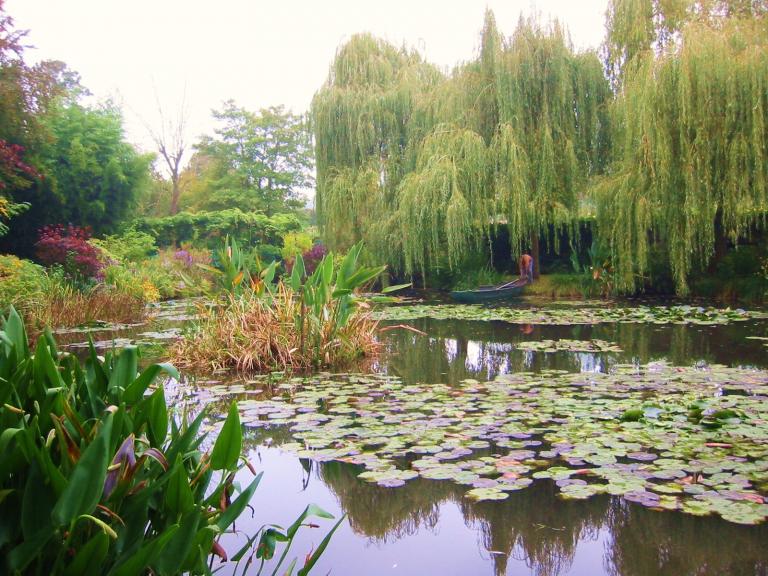
A view of Monet’s garden at Giverny, by Art Anderson (Wikimedia Commons public domain)
I’ve been informed by several people that, in the words of one of them, Paris has now become “a third-world hellhole.” Why? Because of Islam. Because a number of Muslims have moved here.
I’ve been in and out of Paris now for many more decades than I would like to admit, and have been here at least every other year for quite a while now. (This is my second stay in the city over the past twelve or thirteen months.) I’ve tried really, really hard to discern the evidence that Paris has turned into Fallujah or Kabul but, thus far, I’ve been unable to see it. Perhaps I lack the necessary eye of faith.
In the meantime, though, there’s this wonderful story:
“‘Spiderman’ granted French citizenship after rescuing child from Paris balcony”
It’s not too difficult, I think, to see that the name Mamoudou — affixed to an immigrant from Mali, a country that is 90% Muslim — is a form of the Arabic name Muhammad.
Oh, the blight of Muslim immigration!
Anyway, back to the “third-world hellhole” that is today’s Paris:
Our room is small, but it has a magnificent view. Our balcony overlooks the Jardin des Tuileries, across which we can see the Musée d’Orsay and, beyond, both the golden dome of Les Invalides and the Montparnasse Tower. To the right, we see the gold tipped obelisk that stands in the Place de la Concorde — ironically named, since, during the French Revolution, it was the location for the decapitation by guillotine (often applauded lustily by loud and bloodthirsty crowds) of such figures as King Louis XVI, Queen Marie Antoinette, Charlotte Corday, Georges Danton, the great chemist Antoine Lavoisier, Maximilien Robespierre, and Louis de Saint-Just — and the Grand Palais and, further off but still looming quite large, a very clear view of the Eiffel Tower. To the left, we have an unobstructed view of the grand Musée du Louvre and, in the distance beyond it, of the twin towers of the Cathedral of Notre-Dame de Paris and of the great white or gray dome of the Panthéon.
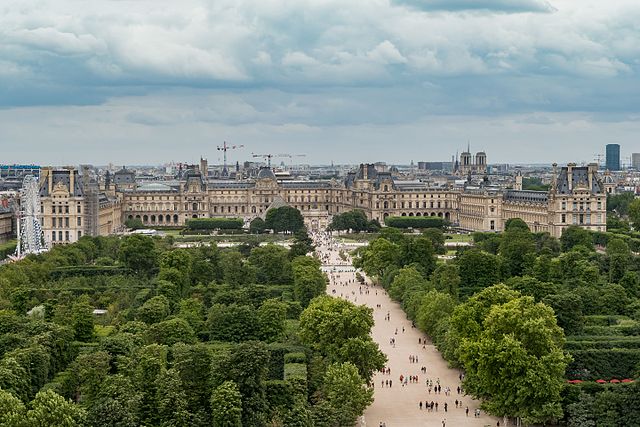
The Louvre Museum, with the Tuileries in the foreground and, in the distance beyond, the two towers of Notre-Dame (Wikimedia Commons public domain)
All of these things appear to be intact. None of them seems to have been destroyed by hordes of invading Muslims.
In fact, I’m inclined to think that the Place de la Concorde is a much more pleasant place today than it was in, say, 1793, during the heyday of the Revolution. And Notre-Dame hasn’t yet been turned into a mosque. It’s still a Catholic cathedral, in fact, still the seat of the Archbishop of Paris. (Back in the murderous days of the Revolution, it was, for some time, the official seat of the state-sponsored atheistic religion called the “Cult of Reason” or Culte de la Raison.)
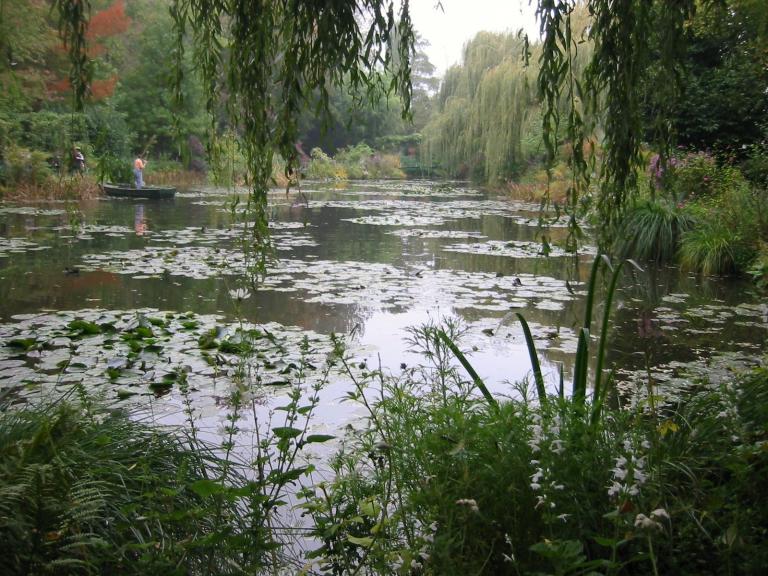
Water lilies and willows at Giverny (Art Anderson, Wikimedia CC)
We’ve been fairly relaxed here, after five intense weeks in the Middle East. I’ve read a couple of mystery novels. We’ve strolled in the Tuileries. We’ve eaten some excellent crêpes, both savory and sweet, and enjoyed some delectable croissants — which is rather remarkable if this is now a Muslim-dominated third-world city, given the culinary legend associated with the origin of croissants. We spent much of today sampling, yet again, the magnificent collections of the Louvre. Earlier, we went out to Giverny, to visit the home and gardens of the great impressionist painter Claude Monet (1840-1926).
I looked to see whether any of the statues or paintings at the Louvre had been retrofitted with hijabs or burkas, but I was unable to find any that had. (I saw an ad today for the Lido de Paris nightclub, and I can promise you that none of the dancers there were wearing burkas.) The call to prayer doesn’t appear to be sounding from atop the tour Eiffel.
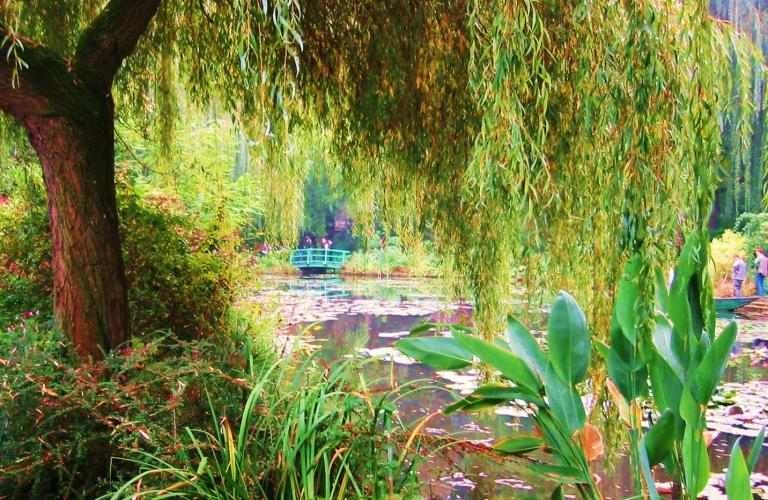
Another view of Monet’s garden at Giverny, by Art Anderson (Wikimedia CC)
But back, for a moment, to Monet’s Giverny:
A couple of months ago, I made a repeat pilgrimage to Frank Lloyd Wright’s Taliessin West, near Phoenix. And now I’ve finally made my pilgrimage to Giverny. (My wife has visited Monet’s house and garden at least twice before.) So I can report what I want, in case anybody out there is thinking of a gift for me: I want a house done in the style of Frank Lloyd Wright — something like Fallingwater would do nicely — surrounded by gardens in the style of Monet’s Giverny. Okay?
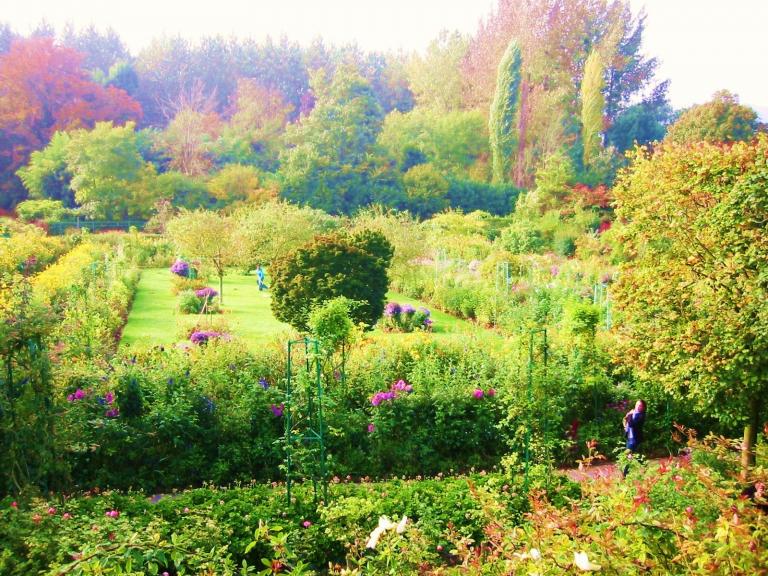
Another view of Monet’s garden by Art Anderson (Wikimedia Commons image)
On a (somewhat) more serious note: Claude Monet loved light and gardens. In his last years, though — ironically, and rather sadly reminiscent of Beethoven’s deafness — he suffered from cataracts and declining vision. Many who have returned from near-death experiences have reported supremely acute and clear vision as well as richly warm light, and have told of seeing indescribably beautiful gardens in the spiritual world, featuring colors unlike any in this world and varieties of plants that they could not identify. I like to imagine Monet — of all people — opening his newly enhanced eyes upon such scenes.
Posted from Paris, France (aka “Islamabad-on-the-Seine”)
Previous Post

May 27, 2018
Two poems at the Garden Tomb
Next Post
May 28, 2018 The Beginning of the End
Browse Our Archives
Select a Category Uncategorized
Select a Month October 2026 September 2026 August 2026 July 2026 June 2026 May 2026 April 2026 March 2026 February 2026 January 2026 December 2025 November 2025 October 2025 September 2025 August 2025 July 2025 June 2025 May 2025 April 2025 March 2025 February 2025 January 2025 December 2024 November 2024 October 2024 September 2024 August 2024 July 2024 June 2024 May 2024 April 2024 March 2024 February 2024 January 2024 December 2023 November 2023 October 2023 September 2023 August 2023 July 2023 June 2023 May 2023 April 2023 March 2023 February 2023 January 2023 December 2022 November 2022 October 2022 September 2022 August 2022 July 2022 June 2022 May 2022 April 2022 March 2022 February 2022 January 2022 December 2021 November 2021 October 2021 September 2021 August 2021 July 2021 June 2021 May 2021 April 2021 March 2021 February 2021 January 2021 December 2020 November 2020 October 2020 September 2020 August 2020 July 2020 June 2020 May 2020 April 2020 March 2020 February 2020 January 2020 December 2019 November 2019 October 2019 September 2019 August 2019 July 2019 June 2019 May 2019 April 2019 March 2019 February 2019 January 2019 December 2018 November 2018 October 2018 September 2018 August 2018 July 2018 June 2018 May 2018 April 2018 March 2018 February 2018 January 2018 December 2017 November 2017 October 2017 September 2017 August 2017 July 2017 June 2017 May 2017 April 2017 March 2017 February 2017 January 2017 December 2016 November 2016 October 2016 September 2016 August 2016 July 2016 June 2016 May 2016 April 2016 March 2016 February 2016 January 2016 December 2015 November 2015 October 2015 September 2015 August 2015 July 2015 June 2015 May 2015 April 2015 March 2015 February 2015 January 2015 December 2014 November 2014 March 2014 August 2013 February 2012
Follow Us!
TAKE THE
Religious Wisdom Quiz
What king of Judah found the Book of the Law during Temple repairs?
Select your answer to see how you score.
Manasseh Hezekiah Jehoshaphat Josiah
Related posts from Sic et Non

The Iron Gates and the Lion of the...


Learning more about a region of which I've...

From Serbia's "White City," Belgrade
TRENDING AT PATHEOS Latter-day Saint

The Dangers of Gradual Accommodation (Winking at Sin)
Recently, the “law of gradualness” resurfaced during the opening of a weeklong,...

The Iron Gates and the Lion of the...
Yesterday, I didn't finish my report about, well, yesterday. So I'll...

Dolly Parton’s Last Song Wins Dove Award with...
Bluegrass band The Grascals, speaking on the red carpet at the 57th...

The Image: On the Horror of Capitalism and...
The Image Then went the Pharisees, and took counsel how they might...

We are approaching the date of our new American national holiday: October...

Letters on Living the Faith by C.S. Lewis
Most of us met C.S. Lewis as a public intellectual. Mere Christianity....
view all Latter-day Saint blogs
Ad-Free & Subscriber Log-In Subscription Support
- About Us
- 2026 Calendar
- Videos
- Podcasts
- Library of World Religions
- Faith In Media Tracker
- Advertise With Us
- Write for Us
- Privacy Policy
- Terms of Service
- Do Not Sell My Data
- Contact Us
- Radiant Digital
- Manage Newsletter Subscriptions
- Unsubscribe From Notifications
- Sitemap
Copyright 2008-2026, Patheos. All rights reserved.
Subscription Support Ad-Free & Subscriber Log-In
Follow Patheos