
BuddhistCatholicContemplativeEvangelicalGeneral ChristianHinduJewishLatter-day SaintMuslimNew VisionsProgressive Christian
Beliefs
- Buddhist
- Catholic
- Contemplative
- Evangelical
- General Christian
- Hindu
- Jewish
- Latter-day Saint
- More Voices
- Muslim
- New Visions
- Pagan
- Progressive Christian
Topics
- Religion News
- Food and Religion
- Sports and Religion
- Religious Art
- Religious Music and Entertainment
- Religious Events
- History and Religion
- Style and Religion
- Politics and Religion
- Women in Religion
- Recreation Outdoors and Religion
- Business Finance and Religion
- Careers Workplace and Religion
- Education and Religion
- Family Parenting and Religion
- Health Fitness and Religion
- Home and Religion
- Relationships and Religion
- Technology and Religion
- Travel and Religion
Columnists
- Buddhist Columnists
- Business Finance and Religion Columnists
- Careers Workplace and Religion Columnists
- Catholic Columnists
- Contemplative Columnists
- Education and Religion Columnists
- Evangelists Columnists
- Family Parenting and Religion Columnists
- General Christian Columnists
- Health Fitness and Religion Columnists
- Hindu Columnists
- History and Religion Columnists
- Home and Religion Columnists
- Jewish Columnists
- More Voices Columnists
- Latter Day Columnists
- Muslim Columnists
- New Visions Columnists
- Nonreligious Columnists
- Pagan Columnists
- Politics and Religion Columnists
- Progressive Columnists
- Recreation Outdoors and Religion Columnists
- Relationships and Religion Columnists
- Religion News Columnists
- Religious Art Columnists
- Religious Events Columnists
- Religious Music and Entertainment Columnists
- Sports and Religion Columnists
- Style and Religion Columnists
- Technology and Religion Columnists
- Travel and Religion Columnists
- Women in Religion Columnists
Resource Library
- 2026 Calendar
- Library of World Religions
- The 100 Most Holy Places on Earth
- Patheos Answers
- Podcasts
- Videos
- Faith Leaders Database
- Anglican Episcopalian
- Bahai
- Baptist
- Buddhism
- Christianity
- Confucianism
- Eastern Orthodoxy
- Hinduism
- Holiness and Pentecostal
- ISKCON
- Islam
- Judaism
- Lutheran
- Methodist
- The Church of Jesus Christ of Latter-day Saints
- New Age
- Paganism
- Presbytarian and Reformed
- Protestantism
- Religion Behind the Scenes
- Roman Catholic
- Scientology
- Shia Islam
- Sikhism
- Sufism
- Sunni Islam
- Taoism
- Zen
- See all religions
Research Tools
 Ad-Free & Subscriber Log-In Subscription Support
Ad-Free & Subscriber Log-In Subscription Support
Follow Patheos 

- Trending:
- Forgiveness
- |
- Marriage
- |
- Consciousness
- |
- Death Penalty
- |
- Election
- |
- Halloween

- Home
- Latter-day Saint
- “Still music, but no more sorrow or partings”
“Still music, but no more sorrow or partings”
Last updated on: April 10, 2018 at 11:55 am by Dan Peterson
“Still music, but no more sorrow or partings” 2018-04-10T11:55:31-06:00 Dan Peterson
Patheos Explore the world's faith through different perspectives on religion and spirituality! Patheos has the views of the prevalent religions and spiritualities of the world.
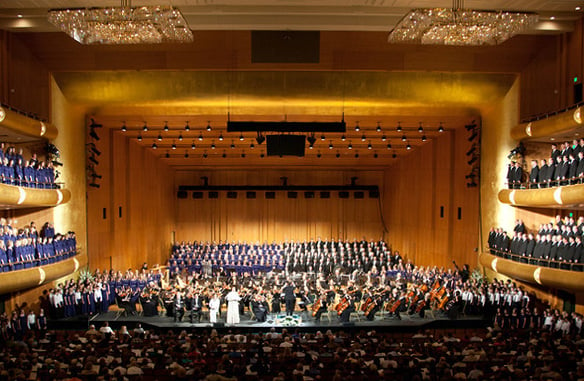
In Abravanel Hall, to the southwest of Temple Square (Wikimedia Commons)
Two or three weeks ago, having just dropped my wife off at the airport, I drove home listening to a special program on KBYU-FM devoted to pieces by Felix Mendelssohn (1809-1847), a contemporary of Joseph Smith whose music I love. I found myself reflecting on the injustice, and the loss to the world, represented by his death at the horribly early age (again, like Joseph Smith) of 38. (To make matters worse, he had been in ill health for several years by the time he died.)
In his short life, Mendelssohn gave us such wonderful music — his catalogue lists about 200 works — as the so-called “Scottish Symphony” (the Symphony No.3 in A minor), the “Overture” and “Incidental Music” to A Midsummer Night’s Dream (including the famous “Wedding March”), the Hebrides Overture, the St. Paul and Elijah oratorios, and the music to “Hark! The Herald Angels Sing.” He was also a pivotal figure in reviving interest in the music of J. S. Bach, who had been virtually forgotten at that time.
From Elijah, here’s the Mormon Tabernacle Choir singing “He, Watching Over Israel, Slumbers Not Nor Sleeps”:
I was saddened by the thought of how much more Mendelssohn could have given us, had he been granted a healthy lifespan of even seventy years.
My wife and I have just (Friday night) returned from a concert by the Utah Symphony at Abravanel Hall. The guest conductor this evening was Karina Canellakis, who was very energetic and remarkably entertaining to watch.
The concert opened with Le Chasseur maudit (“The Accursed Huntsman”), by César Franck (1822-1890), which I like a great deal.
It continued with Sergei Prokofiev’s Concerto No. 2 in G minor for Piano and Orchestra, Op. 16, an extraordinarily difficult piece that I don’t believe I’ve ever heard before. The guest pianist was Conrad Tao, who was nothing short of spectacular. And, fortunately, my wife and I were well positioned to watch his hands flying across the keyboard. Tao received a prolonged standing ovation from the audience — so long, in fact, that, when he came out the third time, he performed a mid-concert encore of a solo piece by Domenico Scarlatti (1685-1757), who — like Prokofiev himself — has long been a favorite composer of mine. (I’ve always been partial to the Baroque — Bach, Buxtehude, Handel, Vivaldi, Scarlatti, and etc.)
The last piece was Pyotr Ilyich Tchaikovsky’s Symphony No. 2 in C minor, Op. 17 “Little Russian.” Not my favorite Tchaikovsky, I’ll admit, but very pleasant and sometimes stirring.
The concert program got me to thinking again about mortality and loss. César Franck lived to a reasonably good age, but both Prokofiev (1891-1953) and Tchaikovsky (1840-1993) died relatively young — at respectively, not quite 62 and just barely 53. Tchaikovsky died suddenly, but Prokofiev had been ill for eight years by the time of his passing.
Tchaikovsky gave us The Nutcracker, the Capriccio Italien, the 1812 Overture, Swan Lake, Sleeping Beauty, and many other masterpieces. But what more could he have done had he been able to compose for another two decades or so?
From Prokofiev, we have The Love for Three Oranges, Romeo and Juliet, Alexander Nevsky, the Lieutenant Kijé Suite, and Peter and the Wolf. But he could have done, and we could have had, so much more.
I’ve reflected on such things before — in my 2012 Deseret News column “Beethoven is a study in hope, healing,” for example (I had no say in the titles back then). I simply can’t see how some people can regard atheism and its attendant belief in the final oblivion of death as “good news.”
***
Friday, 6 April, was the 188th anniversary of the founding of the Church of Jesus Christ of Latter-day Saints, and the fifth anniversary of the death of my mother in law, Ruth M. Stephens. Although, under the circumstances, her death came as a mercy, we miss her deeply. I thought of both of those anniversaries throughout the day on Friday, and reflected on how the Resurrection and the Restoration give us hope. I’m aware of others at this very time who are coping with loss. I pray that they will be comforted.
In a letter, Mendelssohn once described death as a place “where it is to be hoped there is still music, but no more sorrow or partings.”
Amen.
Previous Post

April 6, 2018
"Do You Look Like Christ?"
Browse Our Archives
Select a Category Uncategorized
Select a Month October 2026 September 2026 August 2026 July 2026 June 2026 May 2026 April 2026 March 2026 February 2026 January 2026 December 2025 November 2025 October 2025 September 2025 August 2025 July 2025 June 2025 May 2025 April 2025 March 2025 February 2025 January 2025 December 2024 November 2024 October 2024 September 2024 August 2024 July 2024 June 2024 May 2024 April 2024 March 2024 February 2024 January 2024 December 2023 November 2023 October 2023 September 2023 August 2023 July 2023 June 2023 May 2023 April 2023 March 2023 February 2023 January 2023 December 2022 November 2022 October 2022 September 2022 August 2022 July 2022 June 2022 May 2022 April 2022 March 2022 February 2022 January 2022 December 2021 November 2021 October 2021 September 2021 August 2021 July 2021 June 2021 May 2021 April 2021 March 2021 February 2021 January 2021 December 2020 November 2020 October 2020 September 2020 August 2020 July 2020 June 2020 May 2020 April 2020 March 2020 February 2020 January 2020 December 2019 November 2019 October 2019 September 2019 August 2019 July 2019 June 2019 May 2019 April 2019 March 2019 February 2019 January 2019 December 2018 November 2018 October 2018 September 2018 August 2018 July 2018 June 2018 May 2018 April 2018 March 2018 February 2018 January 2018 December 2017 November 2017 October 2017 September 2017 August 2017 July 2017 June 2017 May 2017 April 2017 March 2017 February 2017 January 2017 December 2016 November 2016 October 2016 September 2016 August 2016 July 2016 June 2016 May 2016 April 2016 March 2016 February 2016 January 2016 December 2015 November 2015 October 2015 September 2015 August 2015 July 2015 June 2015 May 2015 April 2015 March 2015 February 2015 January 2015 December 2014 November 2014 March 2014 August 2013 February 2012
Follow Us!
TAKE THE
Religious Wisdom Quiz
True or False: Deborah was a prophetess and judge who led Israel to victory over the Canaanites.
Select your answer to see how you score.
TRUE FALSE
Related posts from Sic et Non



TRENDING AT PATHEOS Latter-day Saint

A new article, written by Jeff Lindsay and Gale L. Pooley,...

Swimfan: Forgotten Aughts Pleasures
This is a recovery effort. In 2002, My Big Fat Greek Wedding...

Top Three Anti-Catholic Lies About Catholicism
This is my initial transcript for the video, "THE 3 WORST...

Pope Leo Celebrates Mass for Nurses & Docs...
I don't have any idea how he did it, but Pope Leo...

The Sermon on the Mount, Part I: Matthew...
The Sermon on the Mount, Part I (Matthew 4:12-5:12) St. Matthew moves...

What's up from Crossway: Reviewing some of their latest A few weeks...
view all Latter-day Saint blogs
Ad-Free & Subscriber Log-In Subscription Support
- About Us
- 2026 Calendar
- Videos
- Podcasts
- Library of World Religions
- Faith In Media Tracker
- Advertise With Us
- Write for Us
- Privacy Policy
- Terms of Service
- Do Not Sell My Data
- Contact Us
- Radiant Digital
- Manage Newsletter Subscriptions
- Unsubscribe From Notifications
- Sitemap
Copyright 2008-2026, Patheos. All rights reserved.
Subscription Support Ad-Free & Subscriber Log-In
Follow Patheos