
BuddhistCatholicContemplativeEvangelicalGeneral ChristianHinduJewishLatter-day SaintMuslimNew VisionsProgressive Christian
Beliefs
- Buddhist
- Catholic
- Contemplative
- Evangelical
- General Christian
- Hindu
- Jewish
- Latter-day Saint
- More Voices
- Muslim
- New Visions
- Pagan
- Progressive Christian
Topics
- Religion News
- Food and Religion
- Sports and Religion
- Religious Art
- Religious Music and Entertainment
- Religious Events
- History and Religion
- Style and Religion
- Politics and Religion
- Women in Religion
- Recreation Outdoors and Religion
- Business Finance and Religion
- Careers Workplace and Religion
- Education and Religion
- Family Parenting and Religion
- Health Fitness and Religion
- Home and Religion
- Relationships and Religion
- Technology and Religion
- Travel and Religion
Columnists
- Buddhist Columnists
- Business Finance and Religion Columnists
- Careers Workplace and Religion Columnists
- Catholic Columnists
- Contemplative Columnists
- Education and Religion Columnists
- Evangelists Columnists
- Family Parenting and Religion Columnists
- General Christian Columnists
- Health Fitness and Religion Columnists
- Hindu Columnists
- History and Religion Columnists
- Home and Religion Columnists
- Jewish Columnists
- More Voices Columnists
- Latter Day Columnists
- Muslim Columnists
- New Visions Columnists
- Nonreligious Columnists
- Pagan Columnists
- Politics and Religion Columnists
- Progressive Columnists
- Recreation Outdoors and Religion Columnists
- Relationships and Religion Columnists
- Religion News Columnists
- Religious Art Columnists
- Religious Events Columnists
- Religious Music and Entertainment Columnists
- Sports and Religion Columnists
- Style and Religion Columnists
- Technology and Religion Columnists
- Travel and Religion Columnists
- Women in Religion Columnists
Resource Library
- 2026 Calendar
- Library of World Religions
- The 100 Most Holy Places on Earth
- Patheos Answers
- Podcasts
- Videos
- Faith Leaders Database
- Anglican Episcopalian
- Bahai
- Baptist
- Buddhism
- Christianity
- Confucianism
- Eastern Orthodoxy
- Hinduism
- Holiness and Pentecostal
- ISKCON
- Islam
- Judaism
- Lutheran
- Methodist
- The Church of Jesus Christ of Latter-day Saints
- New Age
- Paganism
- Presbytarian and Reformed
- Protestantism
- Religion Behind the Scenes
- Roman Catholic
- Scientology
- Shia Islam
- Sikhism
- Sufism
- Sunni Islam
- Taoism
- Zen
- See all religions
Research Tools
 Ad-Free & Subscriber Log-In Subscription Support
Ad-Free & Subscriber Log-In Subscription Support
Follow Patheos 

- Trending:
- Forgiveness
- |
- Marriage
- |
- Consciousness
- |
- Death Penalty
- |
- Election
- |
- Halloween

- Home
- Latter-day Saint
- Some Notes on English Translations of the Qur’an (Part 3)
Some Notes on English Translations of the Qur’an (Part 3)
Last updated on: April 10, 2018 at 12:00 pm by Dan Peterson
Some Notes on English Translations of the Qur’an (Part 3) 2018-04-10T12:00:15-06:00 Dan Peterson
Patheos Explore the world's faith through different perspectives on religion and spirituality! Patheos has the views of the prevalent religions and spiritualities of the world.
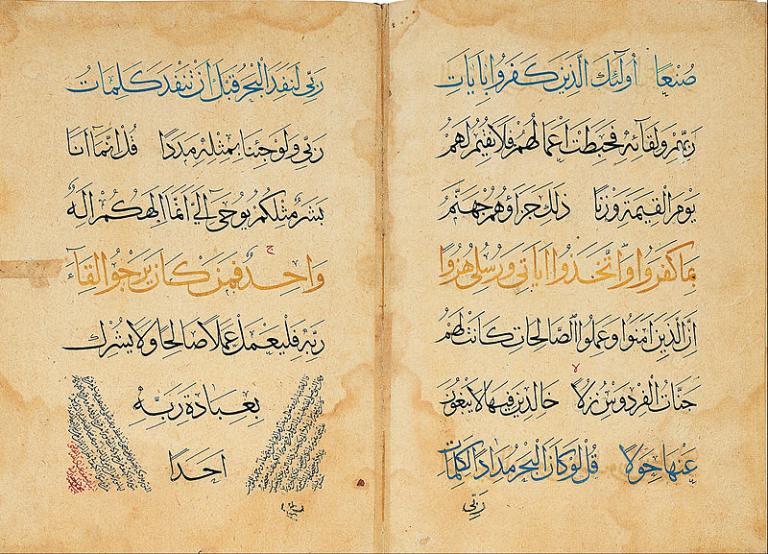
From a late-16th-century manuscript of the Qur’an’s Surat al-Kahf (“Sura of the Cave”)
Wikimedia Commons
Building upon two previous entries, here and here, I offer a bit more from the notes that I wrote up, at the request of a committee in Salt Lake City, back in January 2017:
Some Early Translations
English translation of the Qur’an seems to have begun with Christian missionary motivations—all of the earliest translations were done by Christians—and the first efforts often had a polemical edge. Many translation errors were made, and there was frequently an explicit effort to make Islam and the Qur’an look bad.
In 1649, Alexander Ross, chaplain to the King Charles I of England, produced the first translation of the Qur’an into English. But he did it from a French translation. He knew no Arabic. (His French was apparently a bit weak, as well.) And his title well illustrates his intent:
The Alcoran, Translated out of Arabic into French. By the Sieur du Ryer, Lord of Malezair, and Resident for the French King, at ALEXANDRIA. And Newly Englished, for the satisfaction of all that desire to look into the Turkish Vanities.[1]
Ross had done his translation, he said, “that so viewing thine enemies in their full body, thou must the better prepare to encounter . . . his Alcoran.”
Two appendices are attached to Ross’s translation: “A Needful Caveat or Admonition, for them who desire to know what use may be made of or if there be danger in reading the Alcoran” and “The Life and Death of Mahomet: the Prophet of the Turks and author of the Alcoran.”[2]
By the eighteenth and especially the nineteenth century, European colonialism was on the rise, and the Islamic world was on the defensive.
In 1734, the lawyer George Sale produced the first English translation of the Qur’an taken directly from the Arabic. But European knowledge of Arabic was shaky in his time, and he still relied heavily upon a 1698 Latin translation:
Koran, commonly called the Alcoran of Mohammed, tr. into English immediately from the original Arabic; with explanatory notes, taken from the most approved commentators. To which is prefixed a preliminary discourse.
Until recent times, Sale’s translation was far and away the most popular English version and, in fact, it is still in print, with a new edition published as recently as 2009. It has been criticized for omissions, distortions, and hostile interpolations, and its “Preliminary Discourse” sets out principles for converting “Mohammedans” to Christianity.
J. M. Rodwell, an Anglican cleric, published The Koran in London in 1861. The preface to his translation is extremely critical of Muhammad, and his notes are still offensive to Muslim readers.
In the twentieth century, armed with the English that they had learned from their colonial overlords, Muslims—very commonly from the Indian subcontinent—began to produce their own translations, often with the express goal of refuting or at least countering what they saw as offensive European versions.
Thus, Mohammad Abdul Hakim Khan published The Holy Qur’an in 1905, “with short notes based on the Holy Qur’an or the authentic traditions of the Prophet. . . . All fictitious romance, questionable history and disputed theories have been carefully avoided.”
In 1912, Hairat Dehlawi—his last name indicates his connection with Dehli (aka Delhi), in India—and a group under his leadership published The Koran Prepared, which was intended as “a complete and exhaustive reply to the manifold criticisms of the Koran by various Christian authors such as Drs. Sale, Rodwell, Palmer and Sir W. Muir.” (The first three of those authors had produced Qur’an translations; the fourth was a pioneer English biographer of Muhammad.)
None of the early Muslim translations were by trained scholars, though, and, if they retain any importance today, it’s purely historical.
[1] The Arabic definite article is al-, prefixed to its noun. So, in Arabic, the Qur’an is al-Qur’an. (I’m omitting the diacritical marks that we Arabists prefer to use in our transliterations.) That’s where Alcoran comes from. But to speak of the Alcoran is, really, to say the The Qur’an.
[2] The claim that Muhammad was the author of the Qur’an rather than its recipient through divine revelation is deeply offensive to Muslims, much in the same way that orthodox Latter-day Saints are displeased by assertions that Joseph Smith created the Book of Mormon.
***
I’ll be spending the latter part of this month and all of May in the Middle East — in Jordan, Israel, and Egypt. Some of you might be interested, though, in a tour to Egypt that I’ll be involved with at the end of the year:
It’s a great time to go to Egypt — principally because the weather won’t be hot.
Previous Post

April 9, 2018
"They looked so exceedingly white and strange"
Next Post
April 10, 2018 "Anything But Pedestrian"
Browse Our Archives
Select a Category Uncategorized
Select a Month October 2026 September 2026 August 2026 July 2026 June 2026 May 2026 April 2026 March 2026 February 2026 January 2026 December 2025 November 2025 October 2025 September 2025 August 2025 July 2025 June 2025 May 2025 April 2025 March 2025 February 2025 January 2025 December 2024 November 2024 October 2024 September 2024 August 2024 July 2024 June 2024 May 2024 April 2024 March 2024 February 2024 January 2024 December 2023 November 2023 October 2023 September 2023 August 2023 July 2023 June 2023 May 2023 April 2023 March 2023 February 2023 January 2023 December 2022 November 2022 October 2022 September 2022 August 2022 July 2022 June 2022 May 2022 April 2022 March 2022 February 2022 January 2022 December 2021 November 2021 October 2021 September 2021 August 2021 July 2021 June 2021 May 2021 April 2021 March 2021 February 2021 January 2021 December 2020 November 2020 October 2020 September 2020 August 2020 July 2020 June 2020 May 2020 April 2020 March 2020 February 2020 January 2020 December 2019 November 2019 October 2019 September 2019 August 2019 July 2019 June 2019 May 2019 April 2019 March 2019 February 2019 January 2019 December 2018 November 2018 October 2018 September 2018 August 2018 July 2018 June 2018 May 2018 April 2018 March 2018 February 2018 January 2018 December 2017 November 2017 October 2017 September 2017 August 2017 July 2017 June 2017 May 2017 April 2017 March 2017 February 2017 January 2017 December 2016 November 2016 October 2016 September 2016 August 2016 July 2016 June 2016 May 2016 April 2016 March 2016 February 2016 January 2016 December 2015 November 2015 October 2015 September 2015 August 2015 July 2015 June 2015 May 2015 April 2015 March 2015 February 2015 January 2015 December 2014 November 2014 March 2014 August 2013 February 2012
Follow Us!
TAKE THE
Religious Wisdom Quiz
Which major prophet book is directly after Isaiah?
Select your answer to see how you score.
Ezekiel Daniel Lamentations Jeremiah
Related posts from Sic et Non

Islam in America or Islam versus America?

A basic working chronology of Islamic-era Iran

Actual Data and Actual Crusades

TRENDING AT PATHEOS Latter-day Saint

'Super Scam Me' Exposes AI Jon Bon Jovi...
Leslie Pickett believed she was in a relationship with Jon Bon Jovi....

The Brazilian Remake of Kendricks' 'Flywheel' Opens in...
“Flywheel,” the story that launched the Kendrick Brothers’ filmmaking career is getting...

The Dangers of Gradual Accommodation (Winking at Sin)
Recently, the “law of gradualness” resurfaced during the opening of a weeklong,...

The Iron Gates and the Lion of the...
Yesterday, I didn't finish my report about, well, yesterday. So I'll...

The Image: On the Horror of Capitalism and...
The Image Then went the Pharisees, and took counsel how they might...

We are approaching the date of our new American national holiday: October...
view all Latter-day Saint blogs
Ad-Free & Subscriber Log-In Subscription Support
- About Us
- 2026 Calendar
- Videos
- Podcasts
- Library of World Religions
- Faith In Media Tracker
- Advertise With Us
- Write for Us
- Privacy Policy
- Terms of Service
- Do Not Sell My Data
- Contact Us
- Radiant Digital
- Manage Newsletter Subscriptions
- Unsubscribe From Notifications
- Sitemap
Copyright 2008-2026, Patheos. All rights reserved.
Subscription Support Ad-Free & Subscriber Log-In
Follow Patheos