
BuddhistCatholicContemplativeEvangelicalGeneral ChristianHinduJewishLatter-day SaintMuslimNew VisionsProgressive Christian
Beliefs
- Buddhist
- Catholic
- Contemplative
- Evangelical
- General Christian
- Hindu
- Jewish
- Latter-day Saint
- More Voices
- Muslim
- New Visions
- Pagan
- Progressive Christian
Topics
- Religion News
- Food and Religion
- Sports and Religion
- Religious Art
- Religious Music and Entertainment
- Religious Events
- History and Religion
- Style and Religion
- Politics and Religion
- Women in Religion
- Recreation Outdoors and Religion
- Business Finance and Religion
- Careers Workplace and Religion
- Education and Religion
- Family Parenting and Religion
- Health Fitness and Religion
- Home and Religion
- Relationships and Religion
- Technology and Religion
- Travel and Religion
Columnists
- Buddhist Columnists
- Business Finance and Religion Columnists
- Careers Workplace and Religion Columnists
- Catholic Columnists
- Contemplative Columnists
- Education and Religion Columnists
- Evangelists Columnists
- Family Parenting and Religion Columnists
- General Christian Columnists
- Health Fitness and Religion Columnists
- Hindu Columnists
- History and Religion Columnists
- Home and Religion Columnists
- Jewish Columnists
- More Voices Columnists
- Latter Day Columnists
- Muslim Columnists
- New Visions Columnists
- Nonreligious Columnists
- Pagan Columnists
- Politics and Religion Columnists
- Progressive Columnists
- Recreation Outdoors and Religion Columnists
- Relationships and Religion Columnists
- Religion News Columnists
- Religious Art Columnists
- Religious Events Columnists
- Religious Music and Entertainment Columnists
- Sports and Religion Columnists
- Style and Religion Columnists
- Technology and Religion Columnists
- Travel and Religion Columnists
- Women in Religion Columnists
Resource Library
- 2026 Calendar
- Library of World Religions
- The 100 Most Holy Places on Earth
- Patheos Answers
- Podcasts
- Videos
- Faith Leaders Database
- Anglican Episcopalian
- Bahai
- Baptist
- Buddhism
- Christianity
- Confucianism
- Eastern Orthodoxy
- Hinduism
- Holiness and Pentecostal
- ISKCON
- Islam
- Judaism
- Lutheran
- Methodist
- The Church of Jesus Christ of Latter-day Saints
- New Age
- Paganism
- Presbytarian and Reformed
- Protestantism
- Religion Behind the Scenes
- Roman Catholic
- Scientology
- Shia Islam
- Sikhism
- Sufism
- Sunni Islam
- Taoism
- Zen
- See all religions
Research Tools
 Ad-Free & Subscriber Log-In Subscription Support
Ad-Free & Subscriber Log-In Subscription Support
Follow Patheos 

- Trending:
- Forgiveness
- |
- Marriage
- |
- Consciousness
- |
- Death Penalty
- |
- Election
- |
- Halloween

- Home
- Latter-day Saint
- Some Notes on English Translations of the Qur’an (Part 1)
Some Notes on English Translations of the Qur’an (Part 1)
Last updated on: April 10, 2018 at 11:44 am by Dan Peterson
Some Notes on English Translations of the Qur’an (Part 1) 2018-04-10T11:44:16-06:00 Dan Peterson
Patheos Explore the world's faith through different perspectives on religion and spirituality! Patheos has the views of the prevalent religions and spiritualities of the world.
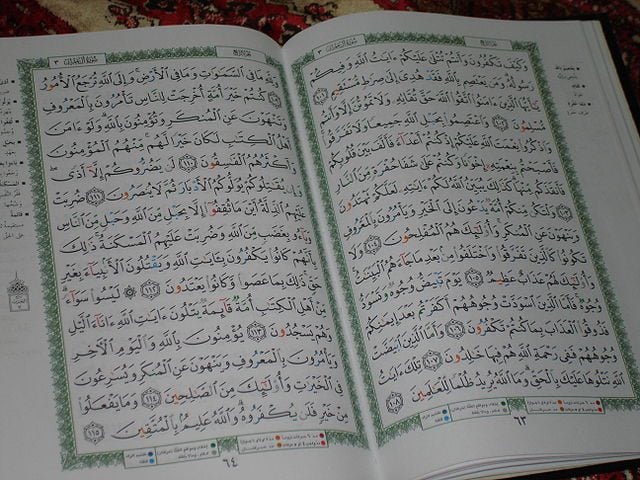
The Qur’an (Wikimedia Commons)
Some notes that I wrote up, at the request of a committee in Salt Lake City, back in January 2017:
Preliminary Remarks
Perhaps the crucial thing to keep in mind about translations of the Qur’an is that they play a sharply subordinate role in Islam, especially when compared to the importance of biblical translations in Christianity.
They are, for example, not authoritative. That is, while (especially) non-academic discussions in Christian circles (and, specifically, in LDS circles) are commonly based on translations of the Bible (and, for non-English speaking LDS, the other Standard Works), references to the Qur’an in Muslim discussions always refer to the Arabic original text, even if those engaged in the discussion aren’t really Arabic speakers and even if they then move to a translation. When the Qur’an is cited in prayer services at mosques and other Muslim gatherings, it is always cited in Arabic first—and then, if necessary, in another language. And no serious issue of doctrine or practice would ever be resolved on the basis of a translation.
Strictly speaking, in Muslim belief, the Qur’an is only really the Qur’an in its original Arabic.
It is considered to be the literal word of God, the words actually spoken by God—but, again, only in the Arabic original revealed to Muhammad.
For Muslims, translations exist as a tool for studying and understanding the original Arabic text.
(Fewer than 20% of the world’s Muslims speak Arabic, so the vast majority of those who seek to read it are reliant to a greater or lesser degree upon translations. But they recognize this as undesirable. (By contrast, presumably very few Christians regard an inability to read the New Testament in its original Greek as even remotely a serious defect.)
This analogy might help to explain the attitude: In a sense, the proper parallel to the Qur’an in Christianity isn’t the Bible but Christ himself. Just as Christ is believed by Christians to have been the “incarnation” (literally, the “enfleshment”) of God and the literal physical presence of God (the divine “Word”) in our world, the Arabic Qur’an is believed by Muslims to represent the literal physical presence of the Divine among us. (They believe Jesus to have been a prophet, but not the Son of God, not divine.) We might coin a word—“inlibration,” or, literally, “embookment”—to capture this notion of the nature of the Qur’an.
Thus, devout Muslims believe that there is spiritual value in learning to recite the Qur’an in Arabic even if they can’t read or understand Arabic. For this reason, editions of the Arabic Qur’an have sometimes been published in the Roman alphabet, so that non-Arabs can sound out the words and recite them with reasonably good pronunciation.
There’s a “sacramental” quality to this: A Muslim reciting the Arabic Qur’an is becoming one with the divine Word in somewhat the same way that Catholics believe that they are “becoming one” with deity by consuming the consecrated wafer—which Catholics believe to be, in a mysterious way, the actual flesh of Christ, not merely a memorial—at communion or mass.
Previous Post

April 8, 2018
Of "meaning" and neurons
Next Post
April 8, 2018 "A set of near optimal mechanisms"
Browse Our Archives
Select a Category Uncategorized
Select a Month October 2026 September 2026 August 2026 July 2026 June 2026 May 2026 April 2026 March 2026 February 2026 January 2026 December 2025 November 2025 October 2025 September 2025 August 2025 July 2025 June 2025 May 2025 April 2025 March 2025 February 2025 January 2025 December 2024 November 2024 October 2024 September 2024 August 2024 July 2024 June 2024 May 2024 April 2024 March 2024 February 2024 January 2024 December 2023 November 2023 October 2023 September 2023 August 2023 July 2023 June 2023 May 2023 April 2023 March 2023 February 2023 January 2023 December 2022 November 2022 October 2022 September 2022 August 2022 July 2022 June 2022 May 2022 April 2022 March 2022 February 2022 January 2022 December 2021 November 2021 October 2021 September 2021 August 2021 July 2021 June 2021 May 2021 April 2021 March 2021 February 2021 January 2021 December 2020 November 2020 October 2020 September 2020 August 2020 July 2020 June 2020 May 2020 April 2020 March 2020 February 2020 January 2020 December 2019 November 2019 October 2019 September 2019 August 2019 July 2019 June 2019 May 2019 April 2019 March 2019 February 2019 January 2019 December 2018 November 2018 October 2018 September 2018 August 2018 July 2018 June 2018 May 2018 April 2018 March 2018 February 2018 January 2018 December 2017 November 2017 October 2017 September 2017 August 2017 July 2017 June 2017 May 2017 April 2017 March 2017 February 2017 January 2017 December 2016 November 2016 October 2016 September 2016 August 2016 July 2016 June 2016 May 2016 April 2016 March 2016 February 2016 January 2016 December 2015 November 2015 October 2015 September 2015 August 2015 July 2015 June 2015 May 2015 April 2015 March 2015 February 2015 January 2015 December 2014 November 2014 March 2014 August 2013 February 2012
Follow Us!
TAKE THE
Religious Wisdom Quiz
How many animals did Moses take on the Ark?
Select your answer to see how you score.
One of each None Two of each Seven of each
Related posts from Sic et Non

Islam in America or Islam versus America?

A basic working chronology of Islamic-era Iran

Actual Data and Actual Crusades

TRENDING AT PATHEOS Latter-day Saint

Emotion in Early Christianity by Andrew Crislip
Andrew Crislip’s Emotion in Early Christianity examines an often overlooked dimension of...

16 Spiritual Touchstones for a More Grounded Life
After decades of spiritual study, here are 16 principles I try...

Catholic Evangelization: Sharing Your Faith Every Day
Welcome back to the Graceful Awakening mini-series called, “From Faith to Mission.” ...

The Pillar of the Boatmen: the Ancient Monument...
The Pillar of the Boatmen is a Romano-Gaulish sculpture that dates from...

In one sense walking into Westminster Abbey is like walking down the...

'Super Scam Me' Exposes AI Jon Bon Jovi...
Leslie Pickett believed she was in a relationship with Jon Bon Jovi....
view all Latter-day Saint blogs
Ad-Free & Subscriber Log-In Subscription Support
- About Us
- 2026 Calendar
- Videos
- Podcasts
- Library of World Religions
- Faith In Media Tracker
- Advertise With Us
- Write for Us
- Privacy Policy
- Terms of Service
- Do Not Sell My Data
- Contact Us
- Radiant Digital
- Manage Newsletter Subscriptions
- Unsubscribe From Notifications
- Sitemap
Copyright 2008-2026, Patheos. All rights reserved.
Subscription Support Ad-Free & Subscriber Log-In
Follow Patheos