
BuddhistCatholicContemplativeEvangelicalGeneral ChristianHinduJewishLatter-day SaintMuslimNew VisionsProgressive Christian
Beliefs
- Buddhist
- Catholic
- Contemplative
- Evangelical
- General Christian
- Hindu
- Jewish
- Latter-day Saint
- More Voices
- Muslim
- New Visions
- Pagan
- Progressive Christian
Topics
- Religion News
- Food and Religion
- Sports and Religion
- Religious Art
- Religious Music and Entertainment
- Religious Events
- History and Religion
- Style and Religion
- Politics and Religion
- Women in Religion
- Recreation Outdoors and Religion
- Business Finance and Religion
- Careers Workplace and Religion
- Education and Religion
- Family Parenting and Religion
- Health Fitness and Religion
- Home and Religion
- Relationships and Religion
- Technology and Religion
- Travel and Religion
Columnists
- Buddhist Columnists
- Business Finance and Religion Columnists
- Careers Workplace and Religion Columnists
- Catholic Columnists
- Contemplative Columnists
- Education and Religion Columnists
- Evangelists Columnists
- Family Parenting and Religion Columnists
- General Christian Columnists
- Health Fitness and Religion Columnists
- Hindu Columnists
- History and Religion Columnists
- Home and Religion Columnists
- Jewish Columnists
- More Voices Columnists
- Latter Day Columnists
- Muslim Columnists
- New Visions Columnists
- Nonreligious Columnists
- Pagan Columnists
- Politics and Religion Columnists
- Progressive Columnists
- Recreation Outdoors and Religion Columnists
- Relationships and Religion Columnists
- Religion News Columnists
- Religious Art Columnists
- Religious Events Columnists
- Religious Music and Entertainment Columnists
- Sports and Religion Columnists
- Style and Religion Columnists
- Technology and Religion Columnists
- Travel and Religion Columnists
- Women in Religion Columnists
Resource Library
- 2026 Calendar
- Library of World Religions
- The 100 Most Holy Places on Earth
- Patheos Answers
- Podcasts
- Videos
- Faith Leaders Database
- Anglican Episcopalian
- Bahai
- Baptist
- Buddhism
- Christianity
- Confucianism
- Eastern Orthodoxy
- Hinduism
- Holiness and Pentecostal
- ISKCON
- Islam
- Judaism
- Lutheran
- Methodist
- The Church of Jesus Christ of Latter-day Saints
- New Age
- Paganism
- Presbytarian and Reformed
- Protestantism
- Religion Behind the Scenes
- Roman Catholic
- Scientology
- Shia Islam
- Sikhism
- Sufism
- Sunni Islam
- Taoism
- Zen
- See all religions
Research Tools
 Ad-Free & Subscriber Log-In Subscription Support
Ad-Free & Subscriber Log-In Subscription Support
Follow Patheos 

- Trending:
- Forgiveness
- |
- Marriage
- |
- Consciousness
- |
- Death Penalty
- |
- Election
- |
- Halloween

- Home
- Latter-day Saint
- What the West Owes the East (Part 12)
What the West Owes the East (Part 12)
Last updated on: March 3, 2018 at 4:49 pm by Dan Peterson
What the West Owes the East (Part 12) 2018-03-03T16:49:14-07:00 Dan Peterson
Patheos Explore the world's faith through different perspectives on religion and spirituality! Patheos has the views of the prevalent religions and spiritualities of the world.
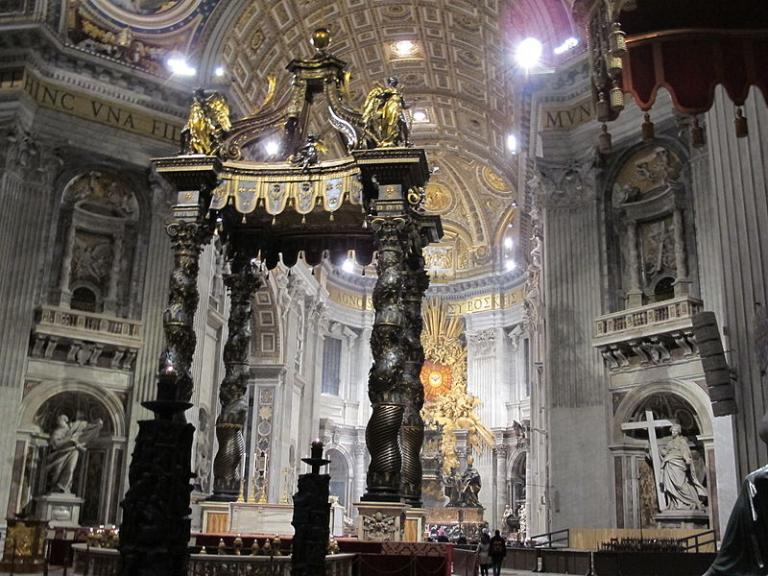
Bernini’s great Baldacchino, in St. Peter’s Basilica, Vatican City
(Wikimedia Commons public domain image by “Sailko”)
And now, my manuscript takes a brief look at Islamic influence on the Western artistic tradition:
Arabic influence is clearly visible in the arts and crafts of the West. Many materials associated with Western clothing were originally of Arab design. Thus, damask, a silk or linen with a design visible from either side, is named after the great Syrian city of Damascus. Muslin, a thin cotton cloth, comes to us from Mosul, an important town in Iraq. Sicilian silk weaving, for which that island is famous, is modelled on the Arab silk industry and in fact dates from the days when the Arabs ruled Sicily. Mohair and cotton and kaftan are all originally Arabic terms. Satin comes to us from the Arabic name for the great medieval Chinese seaport of Tzu-t’ing, where the fabric was first manufactured; it is eloquent evidence of the vast extent of Arab merchant trading. The term fustian, which today (for some odd reason) generally means “pompous language,” or “bombast,” originally identified a thick, twilled cotton cloth with a short nap that was usually dyed dark and dull. The word seems to come from Fustat, the name of the Arab military encampment founded in Egypt right after the conquest of that cotton-producing country. Another odd transformation was undergone by the word baldachin. It originally referred to a rich embroidered cloth of silk and gold, a brocade. Then it came to refer to a canopy, originally to one made of that particular cloth or brocade. Eventually, though, it seems to have come to refer to canopies in general. It is for this reason that we now have Bernini’s early seventeenth-century baldacchino, the centerpiece of the most important church in Catholic Christendom, St. Peter’s Basilica at Rome. This huge baroque canopy, standing under the main dome and covering the high altar of the Pope’s own church, was intended to mark the tomb of St. Peter. Nearly a hundred feet high, it is made not of brocade, but of bronze. But whatever transformations in meaning the word may have undergone, it is clear that it derives from Baldac, a medieval corruption of “Baghdad.”
Other Western crafts have received important contributions from the Arabs. Dutch blue china or delftware, for instance, seems to have been invented by the Arabs rather than by the Dutch, who merely borrowed the technique. And Damascus and Toledo blades, carryovers from the old weapons manufacturers of Muslim Spain, tell their own story of Arab influence, as does Moroccan leather.
But the fine arts also receive their share of Arab influence. Sometimes this is very striking, as in Fra Lippo Lippi’s Italian Renaissance painting of “The Coronation of the Virgin,” in which the angels surrounding the Madonna hold transparent ribbons inscribed with Arab words in praise of Allah. This is not so surprising because, ironically, many of the church vestments used in the Roman Catholic liturgy during the period were of Arab manufacture. This is apparent in certain paintings of Giotto and Fra Angelico.
The word arabesque tells us all we need to know about its inspiration or origin. The Italian campanile, the bell tower that is so characteristic of Italian churches, seems to have been inspired by the Islamic minaret, or prayer tower. And it is only a short jump from the marvelous campanile at the Piazza di San Marco, in Venice, to the look-alike Sather Tower on the campus of the University of California at Berkeley. And from there, it is no great distance to other bell towers on university campuses across the United States, including the carillon tower at Brigham Young University. Arab influence on certain buildings is undeniable. For example, the medallions of the Christian saints in the Norman Palatine Chapel in Palermo, Sicily, bear inscriptions in Kufic Arabic script.
Previous Post

March 2, 2018
The Secret Mental Life of Trees (Part 1)
Next Post
March 3, 2018 The Secret Mental Life of Trees (Part 2)
Browse Our Archives
Select a Category Uncategorized
Select a Month October 2026 September 2026 August 2026 July 2026 June 2026 May 2026 April 2026 March 2026 February 2026 January 2026 December 2025 November 2025 October 2025 September 2025 August 2025 July 2025 June 2025 May 2025 April 2025 March 2025 February 2025 January 2025 December 2024 November 2024 October 2024 September 2024 August 2024 July 2024 June 2024 May 2024 April 2024 March 2024 February 2024 January 2024 December 2023 November 2023 October 2023 September 2023 August 2023 July 2023 June 2023 May 2023 April 2023 March 2023 February 2023 January 2023 December 2022 November 2022 October 2022 September 2022 August 2022 July 2022 June 2022 May 2022 April 2022 March 2022 February 2022 January 2022 December 2021 November 2021 October 2021 September 2021 August 2021 July 2021 June 2021 May 2021 April 2021 March 2021 February 2021 January 2021 December 2020 November 2020 October 2020 September 2020 August 2020 July 2020 June 2020 May 2020 April 2020 March 2020 February 2020 January 2020 December 2019 November 2019 October 2019 September 2019 August 2019 July 2019 June 2019 May 2019 April 2019 March 2019 February 2019 January 2019 December 2018 November 2018 October 2018 September 2018 August 2018 July 2018 June 2018 May 2018 April 2018 March 2018 February 2018 January 2018 December 2017 November 2017 October 2017 September 2017 August 2017 July 2017 June 2017 May 2017 April 2017 March 2017 February 2017 January 2017 December 2016 November 2016 October 2016 September 2016 August 2016 July 2016 June 2016 May 2016 April 2016 March 2016 February 2016 January 2016 December 2015 November 2015 October 2015 September 2015 August 2015 July 2015 June 2015 May 2015 April 2015 March 2015 February 2015 January 2015 December 2014 November 2014 March 2014 August 2013 February 2012
Follow Us!
TAKE THE
Religious Wisdom Quiz
We made a deceptive treaty with Israel by pretending to come from a distant land with moldy bread and worn-out wineskins. Who are we?
Select your answer to see how you score.
The Amorites The Hivites The Canaanites The Gibeonites
Related posts from Sic et Non
Revision 5.17 "What the West Owes the East"...
What the West Owes the East (Part 8)


Learning more about a region of which I've...
TRENDING AT PATHEOS Latter-day Saint

Nearly every morning, I make the drive to Detroit with my high-school-age...

The Real AI Story Is Adoption Without Trust
Artificial intelligence has crossed a political threshold. It is no longer a...

A new article, written by Jeff Lindsay and Gale L. Pooley,...

Swimfan: Forgotten Aughts Pleasures
This is a recovery effort. In 2002, My Big Fat Greek Wedding...

Top Three Anti-Catholic Lies About Catholicism
This is my initial transcript for the video, "THE 3 WORST...

Pope Leo Celebrates Mass for Nurses & Docs...
I don't have any idea how he did it, but Pope Leo...
view all Latter-day Saint blogs
Ad-Free & Subscriber Log-In Subscription Support
- About Us
- 2026 Calendar
- Videos
- Podcasts
- Library of World Religions
- Faith In Media Tracker
- Advertise With Us
- Write for Us
- Privacy Policy
- Terms of Service
- Do Not Sell My Data
- Contact Us
- Radiant Digital
- Manage Newsletter Subscriptions
- Unsubscribe From Notifications
- Sitemap
Copyright 2008-2026, Patheos. All rights reserved.
Subscription Support Ad-Free & Subscriber Log-In
Follow Patheos