
BuddhistCatholicContemplativeEvangelicalGeneral ChristianHinduJewishLatter-day SaintMuslimNew VisionsProgressive Christian
Beliefs
- Buddhist
- Catholic
- Contemplative
- Evangelical
- General Christian
- Hindu
- Jewish
- Latter-day Saint
- More Voices
- Muslim
- New Visions
- Pagan
- Progressive Christian
Topics
- Religion News
- Food and Religion
- Sports and Religion
- Religious Art
- Religious Music and Entertainment
- Religious Events
- History and Religion
- Style and Religion
- Politics and Religion
- Women in Religion
- Recreation Outdoors and Religion
- Business Finance and Religion
- Careers Workplace and Religion
- Education and Religion
- Family Parenting and Religion
- Health Fitness and Religion
- Home and Religion
- Relationships and Religion
- Technology and Religion
- Travel and Religion
Columnists
- Buddhist Columnists
- Business Finance and Religion Columnists
- Careers Workplace and Religion Columnists
- Catholic Columnists
- Contemplative Columnists
- Education and Religion Columnists
- Evangelists Columnists
- Family Parenting and Religion Columnists
- General Christian Columnists
- Health Fitness and Religion Columnists
- Hindu Columnists
- History and Religion Columnists
- Home and Religion Columnists
- Jewish Columnists
- More Voices Columnists
- Latter Day Columnists
- Muslim Columnists
- New Visions Columnists
- Nonreligious Columnists
- Pagan Columnists
- Politics and Religion Columnists
- Progressive Columnists
- Recreation Outdoors and Religion Columnists
- Relationships and Religion Columnists
- Religion News Columnists
- Religious Art Columnists
- Religious Events Columnists
- Religious Music and Entertainment Columnists
- Sports and Religion Columnists
- Style and Religion Columnists
- Technology and Religion Columnists
- Travel and Religion Columnists
- Women in Religion Columnists
Resource Library
- 2026 Calendar
- Library of World Religions
- The 100 Most Holy Places on Earth
- Patheos Answers
- Podcasts
- Videos
- Faith Leaders Database
- Anglican Episcopalian
- Bahai
- Baptist
- Buddhism
- Christianity
- Confucianism
- Eastern Orthodoxy
- Hinduism
- Holiness and Pentecostal
- ISKCON
- Islam
- Judaism
- Lutheran
- Methodist
- The Church of Jesus Christ of Latter-day Saints
- New Age
- Paganism
- Presbytarian and Reformed
- Protestantism
- Religion Behind the Scenes
- Roman Catholic
- Scientology
- Shia Islam
- Sikhism
- Sufism
- Sunni Islam
- Taoism
- Zen
- See all religions
Research Tools
 Ad-Free & Subscriber Log-In Subscription Support
Ad-Free & Subscriber Log-In Subscription Support
Follow Patheos 

- Trending:
- Forgiveness
- |
- Marriage
- |
- Consciousness
- |
- Death Penalty
- |
- Election
- |
- Halloween

- Home
- Latter-day Saint
- On Science and the Church
On Science and the Church
Last updated on: March 22, 2018 at 9:00 pm by Dan Peterson
On Science and the Church 2018-03-22T21:00:36-06:00 Dan Peterson
Patheos Explore the world's faith through different perspectives on religion and spirituality! Patheos has the views of the prevalent religions and spiritualities of the world.
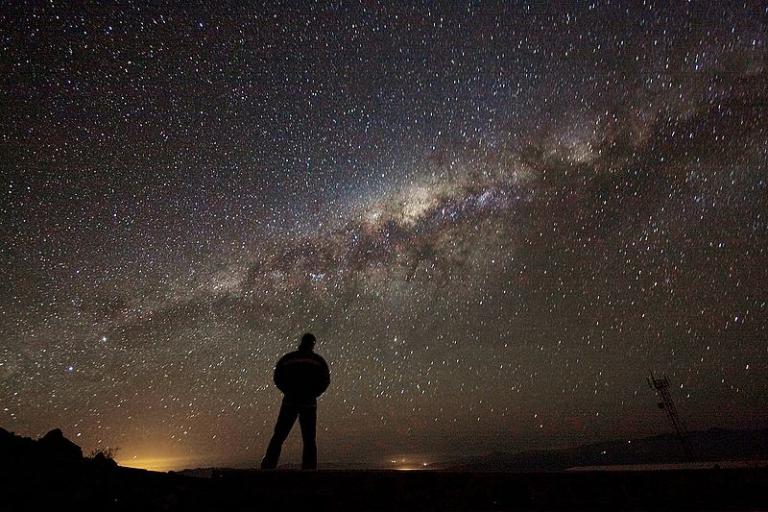
A public domain image from the European Southern Observatory
According to the conception of geologists the earth passed through ages of preparation, to us unmeasured and immeasurable, during which countless generations of plants and animals existed in great variety and profusion and gave in part the very substance of their bodies to help form certain strata which are still existent as such. . . .
Geologists say that these very simple forms of plant and animal bodies were succeeded by others more complicated; and in the indestructible record of the rocks they read the story of advancing life from the simple to the more complex, from the single-celled protozoan to the highest animals, from the marine algae to the advanced types of flowering plant — to the apple-tree, the rose, and the oak.
What a fascinating story is inscribed upon the stony pages of the earth’s crust! . . . This record of Adam and his posterity is the only scriptural account we have of the appearance of man upon this earth. But we have also a vast and ever-increasing volume of knowledge concerning man, his early habits and customs, his industries and works of art, his tools and implements, about which such scriptures as we have thus far received are entirely silent. Let us not try to wrest the scriptures in an attempt to explain away what we cannot explain.
The opening chapters of Genesis, and scriptures related thereto, were never intended as a textbook of geology, archaeology, earth-science or man-science. Holy Scripture will endure, while the conceptions of men change with new discoveries. We do not show reverence for the scriptures when we misapply them through faulty interpretation.
James E. Talmage, “The Earth and Man,” address delivered in the Salt Lake Tabernacle on 9 August 1931; published by the Church of Jesus Christ of Latter-day Saints.
A native of England, Elder Talmage was trained (through to one of the earliest Ph.D.s, if not the earliest, ever earned by a Latter-day Saint) as a geologist and served in the Quorum of the Twelve Apostles from 1911 until his passing in 1933.
The time of creation has ever been a subject of much comment and dispute. Yet I challenge anybody to produce from the Bible itself any finite limitation whatsoever of the periods of creation. By strained inferential references and interpretations men have sought to set the time in days or periods of a thousand years, but I feel sure that no justification of such limitations is warranted by the scriptures themselves. If the evolutionary hypothesis of the creation of life and matter in the universe is ultimately found to be correct, and I shall neither be disappointed nor displeased if it shall turn out so to be, in my humble opinion the Biblical account is sufficiently comprehensive to include the whole of the process.
Stephen L. Richards, “An Open Letter to College Students,” Improvement Era, vol. 36 (June 1933), pp. 451-453, 484-485.
At the time that he wrote this “Open Letter,” Elder Richards (originally an attorney, trained at the University of Chicago) was a member of the Council of the Twelve. Later, from 1951 until his death in 1959, he would serve as first counselor in the First Presidency of the Church of Jesus Christ of Latter-day Saints.
Truth is truth forever. Scientific truth cannot be theological lie. To the sane mind, theology and philosophy must harmonize. They have the common ground of truth on which to meet.
John A. Widtsoe, Joseph Smith as Scientist, originally published in 1908, Bookcraft, 1964, p. 156.
Born in Norway and educated at Harvard University and Germany’s Universität Göttingen in biochemistry, Elder Widtsoe served as president of Utah State University and then of the University of Utah prior to his calling as an apostle in 1921. He remained one of the Twelve until his death in 1952.
[T]o limit and insist upon the whole of life and death to this side of Adam’s advent to the earth, some six or eight thousand years ago, as proposed by some, is to fly in the face of the facts so indisputably brought to light by the researcher of science in modern times, and this as set forth by men of the highest type in the intellectual and moral world; not inferior men, or men of sensual and devilish temperament, but men who must be accounted as among the noblest and most self-sacrificing of the sons of men — of the type whence must come the noblest sons of God, since “the glory of God is intelligence” (D&C 93:36); and that too the glory of man. These researchers after truth are of that class. To pay attention to and give reasonable credence to their research and findings is to link the church of God with the highest increase of human thought and effort. On that side lies development, on the other lies contraction. It is on the former side that research work is going on and will continue to go on, future investigation and discoveries will continue on that side, nothing will retard them, and nothing will develop on the other side. One leads to narrow sectarianism, the other keeps the open spirit of a world movement with which our New Dispensation began. As between them which is to be our choice?
B. H. Roberts, The Truth, the Way, the Life, originally written 1931, published by Smith Research Associates, Salt Lake City, UT, 1994, p. 364.
Originally from England, B. H. Roberts, who served in the First Council of the Seventy from 1888 until his passing in 1933, is widely esteemed as one of the greatest intellectual figures in Latter-day Saint history.
These quotations come from Dr. David Bailey’s excellent website Science Meets Religion.
Previous Post

March 11, 2018
Everyone Else Makes Such Lonely Heavens
Next Post
March 11, 2018 "Party Kings" and Crusaders
Browse Our Archives
Select a Category Uncategorized
Select a Month October 2026 September 2026 August 2026 July 2026 June 2026 May 2026 April 2026 March 2026 February 2026 January 2026 December 2025 November 2025 October 2025 September 2025 August 2025 July 2025 June 2025 May 2025 April 2025 March 2025 February 2025 January 2025 December 2024 November 2024 October 2024 September 2024 August 2024 July 2024 June 2024 May 2024 April 2024 March 2024 February 2024 January 2024 December 2023 November 2023 October 2023 September 2023 August 2023 July 2023 June 2023 May 2023 April 2023 March 2023 February 2023 January 2023 December 2022 November 2022 October 2022 September 2022 August 2022 July 2022 June 2022 May 2022 April 2022 March 2022 February 2022 January 2022 December 2021 November 2021 October 2021 September 2021 August 2021 July 2021 June 2021 May 2021 April 2021 March 2021 February 2021 January 2021 December 2020 November 2020 October 2020 September 2020 August 2020 July 2020 June 2020 May 2020 April 2020 March 2020 February 2020 January 2020 December 2019 November 2019 October 2019 September 2019 August 2019 July 2019 June 2019 May 2019 April 2019 March 2019 February 2019 January 2019 December 2018 November 2018 October 2018 September 2018 August 2018 July 2018 June 2018 May 2018 April 2018 March 2018 February 2018 January 2018 December 2017 November 2017 October 2017 September 2017 August 2017 July 2017 June 2017 May 2017 April 2017 March 2017 February 2017 January 2017 December 2016 November 2016 October 2016 September 2016 August 2016 July 2016 June 2016 May 2016 April 2016 March 2016 February 2016 January 2016 December 2015 November 2015 October 2015 September 2015 August 2015 July 2015 June 2015 May 2015 April 2015 March 2015 February 2015 January 2015 December 2014 November 2014 March 2014 August 2013 February 2012
Follow Us!
TAKE THE
Religious Wisdom Quiz
Who fasted and prayed after reading the prophecy of Jeremiah's 70 years?
Select your answer to see how you score.
Joel Daniel Hosea Micah
Related posts from Sic et Non

What if Wallace had prevailed, rather than Darwin?

Studying the Pearl of Great Price, and Evolution

Evolutionary Biology and Divine Creation?
TRENDING AT PATHEOS Latter-day Saint

Pope Leo Celebrates Mass for Nurses & Docs...
I don't have any idea how he did it, but Pope Leo...

The Sermon on the Mount, Part I: Matthew...
The Sermon on the Mount, Part I (Matthew 4:12-5:12) St. Matthew moves...

What's up from Crossway: Reviewing some of their latest A few weeks...

Janie Learns the Way of the Cross: A...
Teaching children about Jesus' Passion can be challenging. Many parents and educators...

Looking For Good Catholic Writing - October 2026
He alone extends the heavens, and he walks upon the waves of...

In "Irreplaceable," our book on vocation and technology, Trevor Sutton and I...
view all Latter-day Saint blogs
Ad-Free & Subscriber Log-In Subscription Support
- About Us
- 2026 Calendar
- Videos
- Podcasts
- Library of World Religions
- Faith In Media Tracker
- Advertise With Us
- Write for Us
- Privacy Policy
- Terms of Service
- Do Not Sell My Data
- Contact Us
- Radiant Digital
- Manage Newsletter Subscriptions
- Unsubscribe From Notifications
- Sitemap
Copyright 2008-2026, Patheos. All rights reserved.
Subscription Support Ad-Free & Subscriber Log-In
Follow Patheos