
BuddhistCatholicContemplativeEvangelicalGeneral ChristianHinduJewishLatter-day SaintMuslimNew VisionsProgressive Christian
Beliefs
- Buddhist
- Catholic
- Contemplative
- Evangelical
- General Christian
- Hindu
- Jewish
- Latter-day Saint
- More Voices
- Muslim
- New Visions
- Pagan
- Progressive Christian
Topics
- Religion News
- Food and Religion
- Sports and Religion
- Religious Art
- Religious Music and Entertainment
- Religious Events
- History and Religion
- Style and Religion
- Politics and Religion
- Women in Religion
- Recreation Outdoors and Religion
- Business Finance and Religion
- Careers Workplace and Religion
- Education and Religion
- Family Parenting and Religion
- Health Fitness and Religion
- Home and Religion
- Relationships and Religion
- Technology and Religion
- Travel and Religion
Columnists
- Buddhist Columnists
- Business Finance and Religion Columnists
- Careers Workplace and Religion Columnists
- Catholic Columnists
- Contemplative Columnists
- Education and Religion Columnists
- Evangelists Columnists
- Family Parenting and Religion Columnists
- General Christian Columnists
- Health Fitness and Religion Columnists
- Hindu Columnists
- History and Religion Columnists
- Home and Religion Columnists
- Jewish Columnists
- More Voices Columnists
- Latter Day Columnists
- Muslim Columnists
- New Visions Columnists
- Nonreligious Columnists
- Pagan Columnists
- Politics and Religion Columnists
- Progressive Columnists
- Recreation Outdoors and Religion Columnists
- Relationships and Religion Columnists
- Religion News Columnists
- Religious Art Columnists
- Religious Events Columnists
- Religious Music and Entertainment Columnists
- Sports and Religion Columnists
- Style and Religion Columnists
- Technology and Religion Columnists
- Travel and Religion Columnists
- Women in Religion Columnists
Resource Library
- 2026 Calendar
- Library of World Religions
- The 100 Most Holy Places on Earth
- Patheos Answers
- Podcasts
- Videos
- Faith Leaders Database
- Anglican Episcopalian
- Bahai
- Baptist
- Buddhism
- Christianity
- Confucianism
- Eastern Orthodoxy
- Hinduism
- Holiness and Pentecostal
- ISKCON
- Islam
- Judaism
- Lutheran
- Methodist
- The Church of Jesus Christ of Latter-day Saints
- New Age
- Paganism
- Presbytarian and Reformed
- Protestantism
- Religion Behind the Scenes
- Roman Catholic
- Scientology
- Shia Islam
- Sikhism
- Sufism
- Sunni Islam
- Taoism
- Zen
- See all religions
Research Tools
 Ad-Free & Subscriber Log-In Subscription Support
Ad-Free & Subscriber Log-In Subscription Support
Follow Patheos 

- Trending:
- Forgiveness
- |
- Marriage
- |
- Consciousness
- |
- Death Penalty
- |
- Election
- |
- Halloween

- Home
- Latter-day Saint
- What the West Owes the East (Part 8)
What the West Owes the East (Part 8)
Last updated on: February 27, 2018 at 1:29 am by Dan Peterson
What the West Owes the East (Part 8) 2018-02-27T01:29:26-07:00 Dan Peterson
Patheos Explore the world's faith through different perspectives on religion and spirituality! Patheos has the views of the prevalent religions and spiritualities of the world.
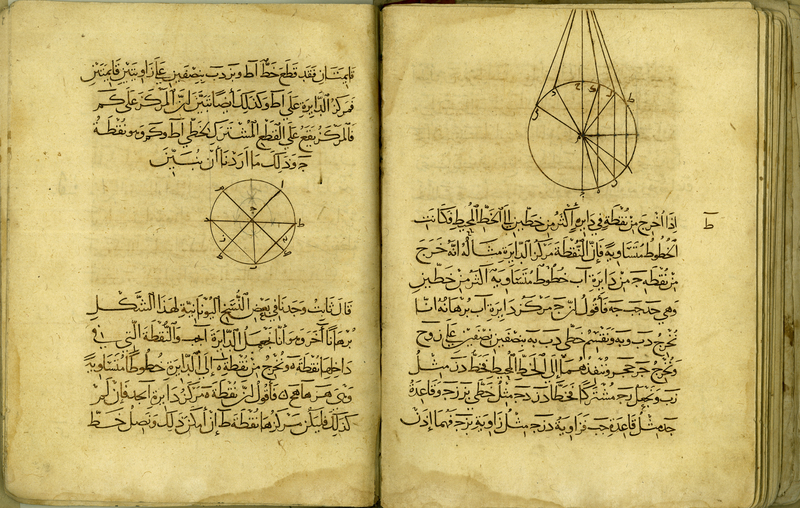
A medieval Arabic mathematical manuscript
(Wikimedia Commons)
I like etymologies, so, naturally, my manuscript contains a few of them:
Few readers are surprised, probably, to learn that the name Sahara is Arabic (it means “deserts”), but the extent of our debt to the Arabs in the field of navigation and geography is shown by such Arabic terms as nadir, zenith, and azimuth, which still form an important part of those disciplines in our own language. Even weather terms like monsoon (mawsim, “season”) and scirocco—probably more familiar as the name of an automobile than in its original meaning of “the east wind” (sharqi)—come to us from the Arabs.[1] (The same Arabic term for eastern, sharqi, is the source for the name by which the Crusaders called their Muslim opponents in the Middle Ages: Saracens.)[2]
In the physical sciences, the Arab Ibn Haytham came to an essentially modern view of the nature of human vision in the tenth century by rejecting the incorrect views of Euclid and Ptolemy. (The question of how external objects come to form images within our minds is a very difficult one. The solution is not at all obvious.) Ibn Haytham’s work on the principles of optics also led him to a theory of what makes rainbows. In the thirteenth century, a scientist by the name of Kamal al-Din concluded, correctly, that the speed of light, although great, cannot be infinite. (We know this now, but, again, it is hardly obvious.) Our term alchemy furnishes an important clue to the connection of that discipline, and of chemistry in general, with the Arabs. The term al-kimiya is the Arab word for both alchemy and chemistry. (The “al-” prefix is simply the article the. We have borrowed it in Arabic-English words like alfalfa and albatross and alcatraz.)[3] As Arabic chemical treatises began to enter Western languages, so, too, did items of Arabic chemical vocabulary such as alembic, alkali, benzene, camphor, elixir, talc, and talcum.[4] Ironically, the word alcohol also comes to us from the Arabs—most of whom, as Muslims, do not drink “alcoholic” beverages. In Arabic the word al-kohl (“the powder”) refers to a substance known in English as antimony or even, borrowing the Arabic term directly, as kohl; it is commonly used by Arab women as a cosmetic, to darken their eyelids.
[1] It has even been argued that our word “typhoon” comes from Arabic tufan (“flood,” “inundation,” “deluge”), but I think this must be rejected.
[2] I’m tempted to suggest, for the benefit of fellow fans of J. R. R. Tolkien’s trilogy The Lord of the Rings, that the undignified nickname given at the end of the story to the fallen wizard Saruman—”Sharkey”—may also be related to the Arabic sharqi, “Easterner.” After all, throughout the trilogy “the West” is good and “the East” is bad. Tolkien was a medievalist, and his good friend C. S. Lewis indisputably borrowed the Turkish word arslan, “lion,” as the name of the hero of his Chronicles of Narnia. Other commentators have claimed that Sharkey derives from the Orkish sharhu, “old man.” Both theories may be right.
[3] In terms of their origin, albatross and alcatraz are the same word. Both go back to the Arabic al-qadus, meaning “waterwheel bucket,” “scoop,” or “waterbearer.”
[4] Some have suggested an Arabic etymology for the word lava, but this appears doubtful.
Posted from Laie, Oahu, Hawai’i
Previous Post

February 26, 2018
What the West Owes the East (Part 7)
Next Post
February 27, 2018 Some reflections on probabilities (1)
Browse Our Archives
Select a Category Uncategorized
Select a Month October 2026 September 2026 August 2026 July 2026 June 2026 May 2026 April 2026 March 2026 February 2026 January 2026 December 2025 November 2025 October 2025 September 2025 August 2025 July 2025 June 2025 May 2025 April 2025 March 2025 February 2025 January 2025 December 2024 November 2024 October 2024 September 2024 August 2024 July 2024 June 2024 May 2024 April 2024 March 2024 February 2024 January 2024 December 2023 November 2023 October 2023 September 2023 August 2023 July 2023 June 2023 May 2023 April 2023 March 2023 February 2023 January 2023 December 2022 November 2022 October 2022 September 2022 August 2022 July 2022 June 2022 May 2022 April 2022 March 2022 February 2022 January 2022 December 2021 November 2021 October 2021 September 2021 August 2021 July 2021 June 2021 May 2021 April 2021 March 2021 February 2021 January 2021 December 2020 November 2020 October 2020 September 2020 August 2020 July 2020 June 2020 May 2020 April 2020 March 2020 February 2020 January 2020 December 2019 November 2019 October 2019 September 2019 August 2019 July 2019 June 2019 May 2019 April 2019 March 2019 February 2019 January 2019 December 2018 November 2018 October 2018 September 2018 August 2018 July 2018 June 2018 May 2018 April 2018 March 2018 February 2018 January 2018 December 2017 November 2017 October 2017 September 2017 August 2017 July 2017 June 2017 May 2017 April 2017 March 2017 February 2017 January 2017 December 2016 November 2016 October 2016 September 2016 August 2016 July 2016 June 2016 May 2016 April 2016 March 2016 February 2016 January 2016 December 2015 November 2015 October 2015 September 2015 August 2015 July 2015 June 2015 May 2015 April 2015 March 2015 February 2015 January 2015 December 2014 November 2014 March 2014 August 2013 February 2012
Follow Us!
TAKE THE
Religious Wisdom Quiz
Who was the first Nazarite?
Select your answer to see how you score.
Eli David Samuel Samson
Related posts from Sic et Non

Islam in America or Islam versus America?

A basic working chronology of Islamic-era Iran

Actual Data and Actual Crusades

TRENDING AT PATHEOS Latter-day Saint

Methodist Central Hall and Westminster Abbey
Situated on the same square is Methodist Central Hall and Westminster Abbey. ...

57th Dove Awards Honor Dolly Parton, Crown New...
On gospel music’s biggest night, the 57th annual GMA Dove Awards honored...

The First Eucharistic Controversy: Christ’s Real Presence
For Catholics, the Eucharist is the source and summit of the Christian...

What a Stop Sign Can Teach Us About...
How to Make a Decision When You Can't Hear God Main point:...

Archdiocese Hosts Military Marriage Retreat in Germany
RASTATT, Germany — The transient military lifestyle, with its frequent deployments and...

Nearly every morning, I make the drive to Detroit with my high-school-age...
view all Latter-day Saint blogs
Ad-Free & Subscriber Log-In Subscription Support
- About Us
- 2026 Calendar
- Videos
- Podcasts
- Library of World Religions
- Faith In Media Tracker
- Advertise With Us
- Write for Us
- Privacy Policy
- Terms of Service
- Do Not Sell My Data
- Contact Us
- Radiant Digital
- Manage Newsletter Subscriptions
- Unsubscribe From Notifications
- Sitemap
Copyright 2008-2026, Patheos. All rights reserved.
Subscription Support Ad-Free & Subscriber Log-In
Follow Patheos