
BuddhistCatholicContemplativeEvangelicalGeneral ChristianHinduJewishLatter-day SaintMuslimNew VisionsProgressive Christian
Beliefs
- Buddhist
- Catholic
- Contemplative
- Evangelical
- General Christian
- Hindu
- Jewish
- Latter-day Saint
- More Voices
- Muslim
- New Visions
- Pagan
- Progressive Christian
Topics
- Religion News
- Food and Religion
- Sports and Religion
- Religious Art
- Religious Music and Entertainment
- Religious Events
- History and Religion
- Style and Religion
- Politics and Religion
- Women in Religion
- Recreation Outdoors and Religion
- Business Finance and Religion
- Careers Workplace and Religion
- Education and Religion
- Family Parenting and Religion
- Health Fitness and Religion
- Home and Religion
- Relationships and Religion
- Technology and Religion
- Travel and Religion
Columnists
- Buddhist Columnists
- Business Finance and Religion Columnists
- Careers Workplace and Religion Columnists
- Catholic Columnists
- Contemplative Columnists
- Education and Religion Columnists
- Evangelists Columnists
- Family Parenting and Religion Columnists
- General Christian Columnists
- Health Fitness and Religion Columnists
- Hindu Columnists
- History and Religion Columnists
- Home and Religion Columnists
- Jewish Columnists
- More Voices Columnists
- Latter Day Columnists
- Muslim Columnists
- New Visions Columnists
- Nonreligious Columnists
- Pagan Columnists
- Politics and Religion Columnists
- Progressive Columnists
- Recreation Outdoors and Religion Columnists
- Relationships and Religion Columnists
- Religion News Columnists
- Religious Art Columnists
- Religious Events Columnists
- Religious Music and Entertainment Columnists
- Sports and Religion Columnists
- Style and Religion Columnists
- Technology and Religion Columnists
- Travel and Religion Columnists
- Women in Religion Columnists
Resource Library
- 2026 Calendar
- Library of World Religions
- The 100 Most Holy Places on Earth
- Patheos Answers
- Podcasts
- Videos
- Faith Leaders Database
- Anglican Episcopalian
- Bahai
- Baptist
- Buddhism
- Christianity
- Confucianism
- Eastern Orthodoxy
- Hinduism
- Holiness and Pentecostal
- ISKCON
- Islam
- Judaism
- Lutheran
- Methodist
- The Church of Jesus Christ of Latter-day Saints
- New Age
- Paganism
- Presbytarian and Reformed
- Protestantism
- Religion Behind the Scenes
- Roman Catholic
- Scientology
- Shia Islam
- Sikhism
- Sufism
- Sunni Islam
- Taoism
- Zen
- See all religions
Research Tools
 Ad-Free & Subscriber Log-In Subscription Support
Ad-Free & Subscriber Log-In Subscription Support
Follow Patheos 

- Trending:
- Forgiveness
- |
- Marriage
- |
- Consciousness
- |
- Death Penalty
- |
- Election
- |
- Halloween

- Home
- Latter-day Saint
- “Raffiniert ist der Herr Gott, aber boshaft ist er nicht”
“Raffiniert ist der Herr Gott, aber boshaft ist er nicht”
Last updated on: February 7, 2018 at 10:46 pm by Dan Peterson
“Raffiniert ist der Herr Gott, aber boshaft ist er nicht” 2018-02-07T22:46:09-07:00 Dan Peterson
Patheos Explore the world's faith through different perspectives on religion and spirituality! Patheos has the views of the prevalent religions and spiritualities of the world.
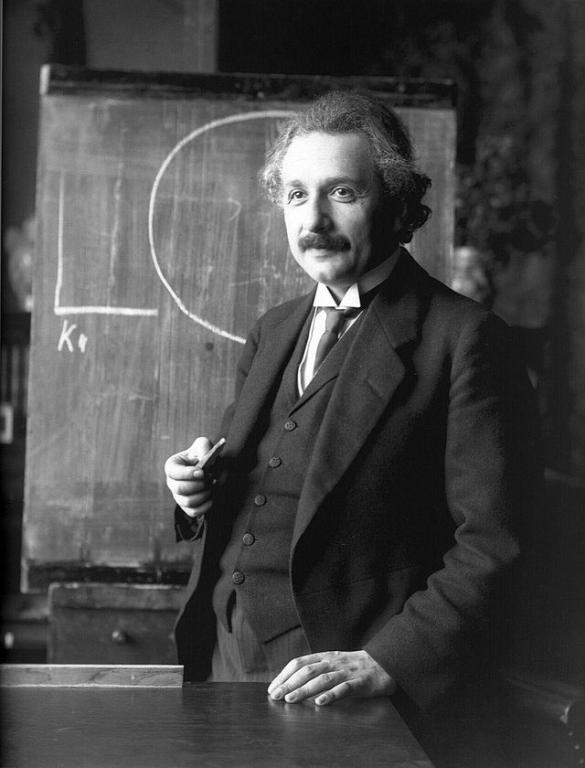
Albert Einstein lecturing in Vienna in 1921 (Wikimedia Commons)
Curiously, as someone who hates and fears science and who neither knows nor wants to know anything of the subject, I enjoy reading about it. I typically have about fifteen to twenty books going at a time — by no means all of them about science, of course — and I often fail to finish one book because it becomes buried under new books. (I’m trying to reform myself on that score.) Lately, every few days, I’ve been reading a few pages in Amir D. Aczel, God’s Equation: Einstein, Relativity, and the Expanding Universe (New York and London: Four Walls Eight Windows, 1999). Here are a couple of items from it, the first of which refers to Albert Einstein’s brief stint as a professor at the German University of Prague:
The office Einstein was assigned at the university overlooked what seemed a beautiful, manicured green park. Looking through his window, deep in thought about the problems of gravity, Einstein couldn’t fail to notice that in the morning only women walked in the park, while in the afternoon it was only men. Perplexed by this observation, Einstein asked people what was going on in the park below. He was told that this was no park — these were the grounds of a mental institution. Later he would joke with colleagues about the people in the park, saying that they were the mad people who would not occupy themselves with quantum theory. (Einstein had a life-long battle with the quantum theory. In reference to the quantum theory, with its probabilistic nature, Einstein would later make his famous statement: “I shall never believe that God plays dice with the world.” (38-39)
Another famous bon mot from Einstein is his declaration Raffiniert ist der Herr Gott, aber boshaft ist er nicht.
The saying is chiseled in stone over a fireplace in the common room of the mathematics department at Princeton University — a testimony to the enduring nature of the special theory of relativity. (25)
It’s usually translated as something along the lines of “Subtle is the Lord, but malicious He is not.” Aczel is correct in arguing (at 13, note 1) that it can also, and perhaps should, be rendered “Tricky [crafty, shrewd] is the Lord God, but malicious he is not.” Aczel thinks the difference highly important. I confess that, at least at the moment, I don’t.
***
I frequently hear that scientists — real scientists — believe only what they can demonstrate to be true, and that, accordingly, non-scientists should follow their lead. Just the facts, ma’am.
This is a bit of an oversimplification.
Take, for example, the matter of gravitational lensing, in which light from a very distant object (e.g., a star or galaxy), can be bent by gravity and even magnified as it passes by a massive object located between the more distant object and an observer — e.g., an astronomer on Earth. Einstein evidently entered this thought into a notebook that he kept during a visit to the Royal Observatory of Berlin during April 1912. However, he seems to have forgotten the idea, because he first wrote it up in a 1936 paper submitted to the journal Science — and seems to have derived it anew, all over again. In any event, it was only 1979 that gravitational lensing, predicted by Einstein, was actually observed (amid considerable excitement) by astronomers. That was forty-three years after his paper was published, and sixty-seven years after he first had the thought. (See Aczel’s discussion on pages 37-38.)
Next Post

February 7, 2018 A scientist's dissent
Browse Our Archives
Select a Category Uncategorized
Select a Month October 2026 September 2026 August 2026 July 2026 June 2026 May 2026 April 2026 March 2026 February 2026 January 2026 December 2025 November 2025 October 2025 September 2025 August 2025 July 2025 June 2025 May 2025 April 2025 March 2025 February 2025 January 2025 December 2024 November 2024 October 2024 September 2024 August 2024 July 2024 June 2024 May 2024 April 2024 March 2024 February 2024 January 2024 December 2023 November 2023 October 2023 September 2023 August 2023 July 2023 June 2023 May 2023 April 2023 March 2023 February 2023 January 2023 December 2022 November 2022 October 2022 September 2022 August 2022 July 2022 June 2022 May 2022 April 2022 March 2022 February 2022 January 2022 December 2021 November 2021 October 2021 September 2021 August 2021 July 2021 June 2021 May 2021 April 2021 March 2021 February 2021 January 2021 December 2020 November 2020 October 2020 September 2020 August 2020 July 2020 June 2020 May 2020 April 2020 March 2020 February 2020 January 2020 December 2019 November 2019 October 2019 September 2019 August 2019 July 2019 June 2019 May 2019 April 2019 March 2019 February 2019 January 2019 December 2018 November 2018 October 2018 September 2018 August 2018 July 2018 June 2018 May 2018 April 2018 March 2018 February 2018 January 2018 December 2017 November 2017 October 2017 September 2017 August 2017 July 2017 June 2017 May 2017 April 2017 March 2017 February 2017 January 2017 December 2016 November 2016 October 2016 September 2016 August 2016 July 2016 June 2016 May 2016 April 2016 March 2016 February 2016 January 2016 December 2015 November 2015 October 2015 September 2015 August 2015 July 2015 June 2015 May 2015 April 2015 March 2015 February 2015 January 2015 December 2014 November 2014 March 2014 August 2013 February 2012
Follow Us!
TAKE THE
Religious Wisdom Quiz
What does the name "Moses" mean?
Select your answer to see how you score.
Delivered Saved Drawn out (of water) Judge
Related posts from Sic et Non

A case of twin near-death experiences?

Toward a "Post-Materialist Science"?

A great American thinker on dogmatic scientific orthodoxy
Of Spheres, Spirals, Spindles, and the Divine
TRENDING AT PATHEOS Latter-day Saint

Pope Leo Celebrates Mass for Nurses & Docs...
I don't have any idea how he did it, but Pope Leo...

The Sermon on the Mount, Part I: Matthew...
The Sermon on the Mount, Part I (Matthew 4:12-5:12) St. Matthew moves...

What's up from Crossway: Reviewing some of their latest A few weeks...

Janie Learns the Way of the Cross: A...
Teaching children about Jesus' Passion can be challenging. Many parents and educators...

Looking For Good Catholic Writing - October 2026
He alone extends the heavens, and he walks upon the waves of...

In "Irreplaceable," our book on vocation and technology, Trevor Sutton and I...
view all Latter-day Saint blogs
Ad-Free & Subscriber Log-In Subscription Support
- About Us
- 2026 Calendar
- Videos
- Podcasts
- Library of World Religions
- Faith In Media Tracker
- Advertise With Us
- Write for Us
- Privacy Policy
- Terms of Service
- Do Not Sell My Data
- Contact Us
- Radiant Digital
- Manage Newsletter Subscriptions
- Unsubscribe From Notifications
- Sitemap
Copyright 2008-2026, Patheos. All rights reserved.
Subscription Support Ad-Free & Subscriber Log-In
Follow Patheos