
BuddhistCatholicContemplativeEvangelicalGeneral ChristianHinduJewishLatter-day SaintMuslimNew VisionsProgressive Christian
Beliefs
- Buddhist
- Catholic
- Contemplative
- Evangelical
- General Christian
- Hindu
- Jewish
- Latter-day Saint
- More Voices
- Muslim
- New Visions
- Pagan
- Progressive Christian
Topics
- Religion News
- Food and Religion
- Sports and Religion
- Religious Art
- Religious Music and Entertainment
- Religious Events
- History and Religion
- Style and Religion
- Politics and Religion
- Women in Religion
- Recreation Outdoors and Religion
- Business Finance and Religion
- Careers Workplace and Religion
- Education and Religion
- Family Parenting and Religion
- Health Fitness and Religion
- Home and Religion
- Relationships and Religion
- Technology and Religion
- Travel and Religion
Columnists
- Buddhist Columnists
- Business Finance and Religion Columnists
- Careers Workplace and Religion Columnists
- Catholic Columnists
- Contemplative Columnists
- Education and Religion Columnists
- Evangelists Columnists
- Family Parenting and Religion Columnists
- General Christian Columnists
- Health Fitness and Religion Columnists
- Hindu Columnists
- History and Religion Columnists
- Home and Religion Columnists
- Jewish Columnists
- More Voices Columnists
- Latter Day Columnists
- Muslim Columnists
- New Visions Columnists
- Nonreligious Columnists
- Pagan Columnists
- Politics and Religion Columnists
- Progressive Columnists
- Recreation Outdoors and Religion Columnists
- Relationships and Religion Columnists
- Religion News Columnists
- Religious Art Columnists
- Religious Events Columnists
- Religious Music and Entertainment Columnists
- Sports and Religion Columnists
- Style and Religion Columnists
- Technology and Religion Columnists
- Travel and Religion Columnists
- Women in Religion Columnists
Resource Library
- 2026 Calendar
- Library of World Religions
- The 100 Most Holy Places on Earth
- Patheos Answers
- Podcasts
- Videos
- Faith Leaders Database
- Anglican Episcopalian
- Bahai
- Baptist
- Buddhism
- Christianity
- Confucianism
- Eastern Orthodoxy
- Hinduism
- Holiness and Pentecostal
- ISKCON
- Islam
- Judaism
- Lutheran
- Methodist
- The Church of Jesus Christ of Latter-day Saints
- New Age
- Paganism
- Presbytarian and Reformed
- Protestantism
- Religion Behind the Scenes
- Roman Catholic
- Scientology
- Shia Islam
- Sikhism
- Sufism
- Sunni Islam
- Taoism
- Zen
- See all religions
Research Tools
 Ad-Free & Subscriber Log-In Subscription Support
Ad-Free & Subscriber Log-In Subscription Support
Follow Patheos 

- Trending:
- Forgiveness
- |
- Marriage
- |
- Consciousness
- |
- Death Penalty
- |
- Election
- |
- Halloween

- Home
- Latter-day Saint
- Islamic Law (Part 8)
Islamic Law (Part 8)
Last updated on: March 27, 2018 at 10:13 pm by Dan Peterson
Islamic Law (Part 8) 2018-03-27T22:13:28-06:00 Dan Peterson
Patheos Explore the world's faith through different perspectives on religion and spirituality! Patheos has the views of the prevalent religions and spiritualities of the world.
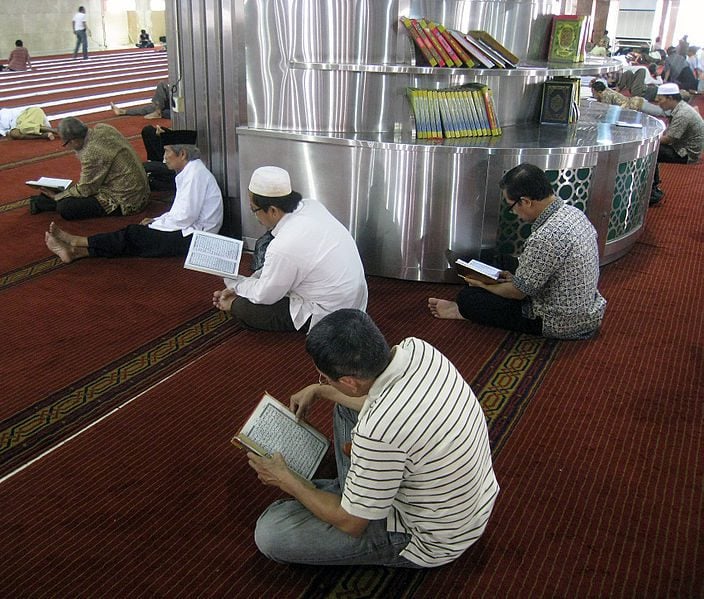
Reading the Qur’an in an Indonesian mosque after prayer
(Photo by Gunawan Kartapranata, Wikimedia CC)
Continuing with my summary of the nature and sources of the shari‘a:
This is important because Islamic law covers a far wider range of actions than anything we know of as law in our own experience. After centuries of analysis and refinement, Muslim legal thinkers worked out a system in which all possible human acts were placed into one or another of five classes. Some were “obligatory” These actions must be done by every person. (Prayer might serve as a good example.) Others were merely “desirable.” It would be good to perform these acts, but a person would not be punished if he or she did not do so. While becoming a scholar of Islamic law is a good thing, for instance, a peasant will not be punished because he is not such a scholar. Nor, among educated people, will a doctor or an engineer be condemned simply because he or she has chosen a different but respectable career path. A third category comprises acts to which the law is “indifferent.” Whether a man or woman performs one or another of these acts is of no concern to Islam. (Should Mahmud work as an accountant, or should he seek to be a doctor? The law doesn’t care.) There are also actions that the law considers “objectionable.” People who act in such ways will not be punished, but it would be better if they avoided such actions. (Slurping one’s soup is not a moral offense and will not land anybody in Hell, but it is still not exactly admirable behavior.) Finally, there are actions like adultery and murder that are simply “prohibited.” This fifth category of actions consists of things that all people should avoid and for which, if they do not, they will be punished.
Only two of these five categories of action fall within the scope of enforceable law, either in the West or the Middle East.[1] Our own legal system speaks of things that are obligatory (paying taxes, for instance) and of things that are prohibited (such as murder), but it is generally silent when it comes to mere recommendations and certainly has nothing to say about matters of indifference. The shariah, however, speaks explicitly about all these things and thus includes much more than our Western law. It makes no real distinction between legal matters as we understand them and things that we would tend to think of as purely religious. Its provisions cover religious duties—what Muslims call “acts of worship,” such as ablution, prayer, and pilgrimage—but also embrace criminal law and rules of inheritance. It is a remarkable construction, and even where I disagree, I must confess that I admire the shariah’s vastness and intricacy, its comprehensive effort to show, in all aspects of life, what is involved in being a true Muslim. We might therefore think of it as a “grand ideal,” a portrait of the ideal human life and the ideal human society. And even though such ideals have certainly not been reached in Islam any more than they have been achieved in the West, it can be safely said that the shariah permeates all social life in Islamic countries even today and affects all aspects of their cultures.
[1] Adultery no longer seems to fall under this category in Western law—although it once did, and although it seems to be a clear case of breach of contract at the very least.
Previous Post

February 10, 2018
An alternative to the infinite multiverse?
Next Post
February 11, 2018 Two "Sticks"
Browse Our Archives
Select a Category Uncategorized
Select a Month October 2026 September 2026 August 2026 July 2026 June 2026 May 2026 April 2026 March 2026 February 2026 January 2026 December 2025 November 2025 October 2025 September 2025 August 2025 July 2025 June 2025 May 2025 April 2025 March 2025 February 2025 January 2025 December 2024 November 2024 October 2024 September 2024 August 2024 July 2024 June 2024 May 2024 April 2024 March 2024 February 2024 January 2024 December 2023 November 2023 October 2023 September 2023 August 2023 July 2023 June 2023 May 2023 April 2023 March 2023 February 2023 January 2023 December 2022 November 2022 October 2022 September 2022 August 2022 July 2022 June 2022 May 2022 April 2022 March 2022 February 2022 January 2022 December 2021 November 2021 October 2021 September 2021 August 2021 July 2021 June 2021 May 2021 April 2021 March 2021 February 2021 January 2021 December 2020 November 2020 October 2020 September 2020 August 2020 July 2020 June 2020 May 2020 April 2020 March 2020 February 2020 January 2020 December 2019 November 2019 October 2019 September 2019 August 2019 July 2019 June 2019 May 2019 April 2019 March 2019 February 2019 January 2019 December 2018 November 2018 October 2018 September 2018 August 2018 July 2018 June 2018 May 2018 April 2018 March 2018 February 2018 January 2018 December 2017 November 2017 October 2017 September 2017 August 2017 July 2017 June 2017 May 2017 April 2017 March 2017 February 2017 January 2017 December 2016 November 2016 October 2016 September 2016 August 2016 July 2016 June 2016 May 2016 April 2016 March 2016 February 2016 January 2016 December 2015 November 2015 October 2015 September 2015 August 2015 July 2015 June 2015 May 2015 April 2015 March 2015 February 2015 January 2015 December 2014 November 2014 March 2014 August 2013 February 2012
Follow Us!
TAKE THE
Religious Wisdom Quiz
What does the Bible say about greed?
Select your answer to see how you score.
It is best It helps you win It is always wise It leads to ruin
Related posts from Sic et Non

Islam in America or Islam versus America?

A basic working chronology of Islamic-era Iran

Actual Data and Actual Crusades

TRENDING AT PATHEOS Latter-day Saint

The First Eucharistic Controversy: Christ’s Real Presence
For Catholics, the Eucharist is the source and summit of the Christian...

What a Stop Sign Can Teach Us About...
How to Make a Decision When You Can't Hear God Main point:...

Archdiocese Hosts Military Marriage Retreat in Germany
RASTATT, Germany — The transient military lifestyle, with its frequent deployments and...

Nearly every morning, I make the drive to Detroit with my high-school-age...

The Real AI Story Is Adoption Without Trust
Artificial intelligence has crossed a political threshold. It is no longer a...

A new article, written by Jeff Lindsay and Gale L. Pooley,...
view all Latter-day Saint blogs
Ad-Free & Subscriber Log-In Subscription Support
- About Us
- 2026 Calendar
- Videos
- Podcasts
- Library of World Religions
- Faith In Media Tracker
- Advertise With Us
- Write for Us
- Privacy Policy
- Terms of Service
- Do Not Sell My Data
- Contact Us
- Radiant Digital
- Manage Newsletter Subscriptions
- Unsubscribe From Notifications
- Sitemap
Copyright 2008-2026, Patheos. All rights reserved.
Subscription Support Ad-Free & Subscriber Log-In
Follow Patheos