
BuddhistCatholicContemplativeEvangelicalGeneral ChristianHinduJewishLatter-day SaintMuslimNew VisionsProgressive Christian
Beliefs
- Buddhist
- Catholic
- Contemplative
- Evangelical
- General Christian
- Hindu
- Jewish
- Latter-day Saint
- More Voices
- Muslim
- New Visions
- Pagan
- Progressive Christian
Topics
- Religion News
- Food and Religion
- Sports and Religion
- Religious Art
- Religious Music and Entertainment
- Religious Events
- History and Religion
- Style and Religion
- Politics and Religion
- Women in Religion
- Recreation Outdoors and Religion
- Business Finance and Religion
- Careers Workplace and Religion
- Education and Religion
- Family Parenting and Religion
- Health Fitness and Religion
- Home and Religion
- Relationships and Religion
- Technology and Religion
- Travel and Religion
Columnists
- Buddhist Columnists
- Business Finance and Religion Columnists
- Careers Workplace and Religion Columnists
- Catholic Columnists
- Contemplative Columnists
- Education and Religion Columnists
- Evangelists Columnists
- Family Parenting and Religion Columnists
- General Christian Columnists
- Health Fitness and Religion Columnists
- Hindu Columnists
- History and Religion Columnists
- Home and Religion Columnists
- Jewish Columnists
- More Voices Columnists
- Latter Day Columnists
- Muslim Columnists
- New Visions Columnists
- Nonreligious Columnists
- Pagan Columnists
- Politics and Religion Columnists
- Progressive Columnists
- Recreation Outdoors and Religion Columnists
- Relationships and Religion Columnists
- Religion News Columnists
- Religious Art Columnists
- Religious Events Columnists
- Religious Music and Entertainment Columnists
- Sports and Religion Columnists
- Style and Religion Columnists
- Technology and Religion Columnists
- Travel and Religion Columnists
- Women in Religion Columnists
Resource Library
- 2026 Calendar
- Library of World Religions
- The 100 Most Holy Places on Earth
- Patheos Answers
- Podcasts
- Videos
- Faith Leaders Database
- Anglican Episcopalian
- Bahai
- Baptist
- Buddhism
- Christianity
- Confucianism
- Eastern Orthodoxy
- Hinduism
- Holiness and Pentecostal
- ISKCON
- Islam
- Judaism
- Lutheran
- Methodist
- The Church of Jesus Christ of Latter-day Saints
- New Age
- Paganism
- Presbytarian and Reformed
- Protestantism
- Religion Behind the Scenes
- Roman Catholic
- Scientology
- Shia Islam
- Sikhism
- Sufism
- Sunni Islam
- Taoism
- Zen
- See all religions
Research Tools
 Ad-Free & Subscriber Log-In Subscription Support
Ad-Free & Subscriber Log-In Subscription Support
Follow Patheos 

- Trending:
- Forgiveness
- |
- Marriage
- |
- Consciousness
- |
- Death Penalty
- |
- Election
- |
- Halloween

- Home
- Latter-day Saint
- Enter the Abbasids (Part 2)
Enter the Abbasids (Part 2)
Last updated on: February 20, 2018 at 12:28 am by Dan Peterson
Enter the Abbasids (Part 2) 2018-02-20T00:28:08-07:00 Dan Peterson
Patheos Explore the world's faith through different perspectives on religion and spirituality! Patheos has the views of the prevalent religions and spiritualities of the world.
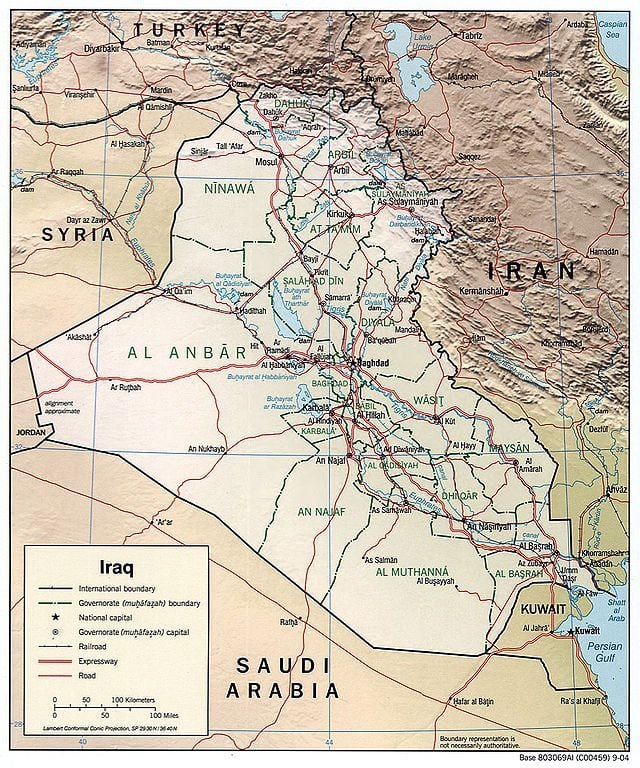
A 2004 CIA (public domain) political map of Iraq. Baghdad is located near the center of the modern nation.
Proceeding with my manuscript on Islam for Mormons, including some further comments on the shari‘a :
With the dependence of the Abbasids on eastern or Persian support, and with physical movement in the direction of Iran, it is not surprising that the Abbasid caliph, surrounded by pomp, came eventually to be a model Sassanid-style king, very much in the style of the old Persian absolute monarchy. He was a benevolent despot, generally, but a despot nonetheless. And he was a far cry from the old Arab shaykh, or the early caliphs. Equality and egalitarian ideals were implicit in Islam, as well as in the Arab tradition, and these were completely ignored by the Abbasid caliph. But he did meet some of the demands of those who, in opposition to the Umayyads, had supported the Abbasid revolution. Taxes, for instance, were made considerably more fair. And there was no more delegating them out to rapacious “tax-farmers” who, like the publicans during New Testament times, kept any money they extorted from the population beyond the revenue quota they turned over to the government. Furthermore, strong central authority could defend the weak against oppression. The new regime made no distinction between mawali (new) Muslims and old Arab Muslims. In clear distinction to their predecessors, who had run the empire to benefit themselves and their followers in Syria, no province was preferred by the Abbasids over another province. Absolute monarchy, by its very nature, aids in breaking down distinctions, and this was certainly true of the Abbasids. The caliph was far above all his subjects, who were all equally nothing before him. All alike were subject to the caliph’s absolute power.
The more pious Muslims continued to find themselves in opposition to the regime, usually silently but occasionally (and briefly) in the open. Prominent among these were the intellectuals or thinkers who came to be known collectively as ulama. It will be recalled that the Arabic word ulama means “learned (ones)” and that the main focus of their learning was Islamic law (shariah) and jurisprudence. But they were devoted, as well, to Arabic grammar (for better understanding of the precise meaning of the Qur’an, especially now that so many nonnative speakers of the language were embracing Islam) and to certain kinds of history.
The emphasis of the ulama on history and law set the tone of Islam from that time forward. Islam has been, like Judaism, a religion that emphasizes orthopraxis, right behavior, more than it concentrates on orthodoxy, or right belief. Like Judaism, it has been far less interested in theological speculation than is mainstream Christianity In this respect, it seems to me that Islam and Judaism have remained true to what we might loosely call their “Semitic character.” Christianity, on the other hand, has departed from that character to a certain degree. In his classic Hibbert lectures of 1888, the Oxford scholar Edwin Hatch argued, with reference to the history of the early Church, that “the change in the centre of gravity from conduct to belief is coincident with the transference of Christianity from a Semitic to a Greek soil.”[1]
It is impossible for any one, whether he be a student of history or no, to fail to notice a difference of both form and content between the Sermon on the Mount and the Nicene Creed. The Sermon on the Mount is the promulgation of a new law of conduct; it assumes beliefs rather than formulates them; the theological conceptions which underlie it belong to the ethical rather than the speculative side of theology; metaphysics are wholly absent. The Nicene Creed is a statement partly of historical facts and partly of dogmatic inferences; the metaphysical terms which it contains would probably have been unintelligible to the first disciples; ethics have no place in it. The one belongs to a world of Syrian peasants, the other to a world of Greek philosophers. The contrast is patent… [T]he question why an ethical sermon stood in the forefront of the teaching of Jesus Christ, and a metaphysical creed in the forefront of the Christianity of the fourth century, is a problem which claims investigation.[2]
[1] Hatch, The Influence of Greek Ideas on Christianity (New York: Harper and Row, 1957), 2.
[2] Hatch, The Influence of Greek Ideas on Christianity, 1.
Posted from Oceanside, California
Previous Post

February 17, 2018
An "irrelevant shouting match"?
Next Post
February 18, 2018 Sidney Rigdon and the Book of Mormon
Browse Our Archives
Select a Category Uncategorized
Select a Month October 2026 September 2026 August 2026 July 2026 June 2026 May 2026 April 2026 March 2026 February 2026 January 2026 December 2025 November 2025 October 2025 September 2025 August 2025 July 2025 June 2025 May 2025 April 2025 March 2025 February 2025 January 2025 December 2024 November 2024 October 2024 September 2024 August 2024 July 2024 June 2024 May 2024 April 2024 March 2024 February 2024 January 2024 December 2023 November 2023 October 2023 September 2023 August 2023 July 2023 June 2023 May 2023 April 2023 March 2023 February 2023 January 2023 December 2022 November 2022 October 2022 September 2022 August 2022 July 2022 June 2022 May 2022 April 2022 March 2022 February 2022 January 2022 December 2021 November 2021 October 2021 September 2021 August 2021 July 2021 June 2021 May 2021 April 2021 March 2021 February 2021 January 2021 December 2020 November 2020 October 2020 September 2020 August 2020 July 2020 June 2020 May 2020 April 2020 March 2020 February 2020 January 2020 December 2019 November 2019 October 2019 September 2019 August 2019 July 2019 June 2019 May 2019 April 2019 March 2019 February 2019 January 2019 December 2018 November 2018 October 2018 September 2018 August 2018 July 2018 June 2018 May 2018 April 2018 March 2018 February 2018 January 2018 December 2017 November 2017 October 2017 September 2017 August 2017 July 2017 June 2017 May 2017 April 2017 March 2017 February 2017 January 2017 December 2016 November 2016 October 2016 September 2016 August 2016 July 2016 June 2016 May 2016 April 2016 March 2016 February 2016 January 2016 December 2015 November 2015 October 2015 September 2015 August 2015 July 2015 June 2015 May 2015 April 2015 March 2015 February 2015 January 2015 December 2014 November 2014 March 2014 August 2013 February 2012
Follow Us!
TAKE THE
Religious Wisdom Quiz
What sign marked the houses to be spared during Passover?
Select your answer to see how you score.
A red ribbon A dove symbol A lit candle Blood on doorposts
Related posts from Sic et Non

Islam in America or Islam versus America?

A basic working chronology of Islamic-era Iran

Actual Data and Actual Crusades

TRENDING AT PATHEOS Latter-day Saint

The First Eucharistic Controversy: Christ’s Real Presence
For Catholics, the Eucharist is the source and summit of the Christian...

What a Stop Sign Can Teach Us About...
How to Make a Decision When You Can't Hear God Main point:...

Archdiocese Hosts Military Marriage Retreat in Germany
RASTATT, Germany — The transient military lifestyle, with its frequent deployments and...

Nearly every morning, I make the drive to Detroit with my high-school-age...

The Real AI Story Is Adoption Without Trust
Artificial intelligence has crossed a political threshold. It is no longer a...

A new article, written by Jeff Lindsay and Gale L. Pooley,...
view all Latter-day Saint blogs
Ad-Free & Subscriber Log-In Subscription Support
- About Us
- 2026 Calendar
- Videos
- Podcasts
- Library of World Religions
- Faith In Media Tracker
- Advertise With Us
- Write for Us
- Privacy Policy
- Terms of Service
- Do Not Sell My Data
- Contact Us
- Radiant Digital
- Manage Newsletter Subscriptions
- Unsubscribe From Notifications
- Sitemap
Copyright 2008-2026, Patheos. All rights reserved.
Subscription Support Ad-Free & Subscriber Log-In
Follow Patheos