
BuddhistCatholicContemplativeEvangelicalGeneral ChristianHinduJewishLatter-day SaintMuslimNew VisionsProgressive Christian
Beliefs
- Buddhist
- Catholic
- Contemplative
- Evangelical
- General Christian
- Hindu
- Jewish
- Latter-day Saint
- More Voices
- Muslim
- New Visions
- Pagan
- Progressive Christian
Topics
- Religion News
- Food and Religion
- Sports and Religion
- Religious Art
- Religious Music and Entertainment
- Religious Events
- History and Religion
- Style and Religion
- Politics and Religion
- Women in Religion
- Recreation Outdoors and Religion
- Business Finance and Religion
- Careers Workplace and Religion
- Education and Religion
- Family Parenting and Religion
- Health Fitness and Religion
- Home and Religion
- Relationships and Religion
- Technology and Religion
- Travel and Religion
Columnists
- Buddhist Columnists
- Business Finance and Religion Columnists
- Careers Workplace and Religion Columnists
- Catholic Columnists
- Contemplative Columnists
- Education and Religion Columnists
- Evangelists Columnists
- Family Parenting and Religion Columnists
- General Christian Columnists
- Health Fitness and Religion Columnists
- Hindu Columnists
- History and Religion Columnists
- Home and Religion Columnists
- Jewish Columnists
- More Voices Columnists
- Latter Day Columnists
- Muslim Columnists
- New Visions Columnists
- Nonreligious Columnists
- Pagan Columnists
- Politics and Religion Columnists
- Progressive Columnists
- Recreation Outdoors and Religion Columnists
- Relationships and Religion Columnists
- Religion News Columnists
- Religious Art Columnists
- Religious Events Columnists
- Religious Music and Entertainment Columnists
- Sports and Religion Columnists
- Style and Religion Columnists
- Technology and Religion Columnists
- Travel and Religion Columnists
- Women in Religion Columnists
Resource Library
- 2026 Calendar
- Library of World Religions
- The 100 Most Holy Places on Earth
- Patheos Answers
- Podcasts
- Videos
- Faith Leaders Database
- Anglican Episcopalian
- Bahai
- Baptist
- Buddhism
- Christianity
- Confucianism
- Eastern Orthodoxy
- Hinduism
- Holiness and Pentecostal
- ISKCON
- Islam
- Judaism
- Lutheran
- Methodist
- The Church of Jesus Christ of Latter-day Saints
- New Age
- Paganism
- Presbytarian and Reformed
- Protestantism
- Religion Behind the Scenes
- Roman Catholic
- Scientology
- Shia Islam
- Sikhism
- Sufism
- Sunni Islam
- Taoism
- Zen
- See all religions
Research Tools
 Ad-Free & Subscriber Log-In Subscription Support
Ad-Free & Subscriber Log-In Subscription Support
Follow Patheos 

- Trending:
- Forgiveness
- |
- Marriage
- |
- Consciousness
- |
- Death Penalty
- |
- Election
- |
- Halloween

- Home
- Latter-day Saint
- “Nothing comes from nothing. Nothing ever could.”
“Nothing comes from nothing. Nothing ever could.”
Last updated on: January 17, 2018 at 1:43 pm by Dan Peterson
“Nothing comes from nothing. Nothing ever could.” 2018-01-17T13:43:12-07:00 Dan Peterson
Patheos Explore the world's faith through different perspectives on religion and spirituality! Patheos has the views of the prevalent religions and spiritualities of the world.
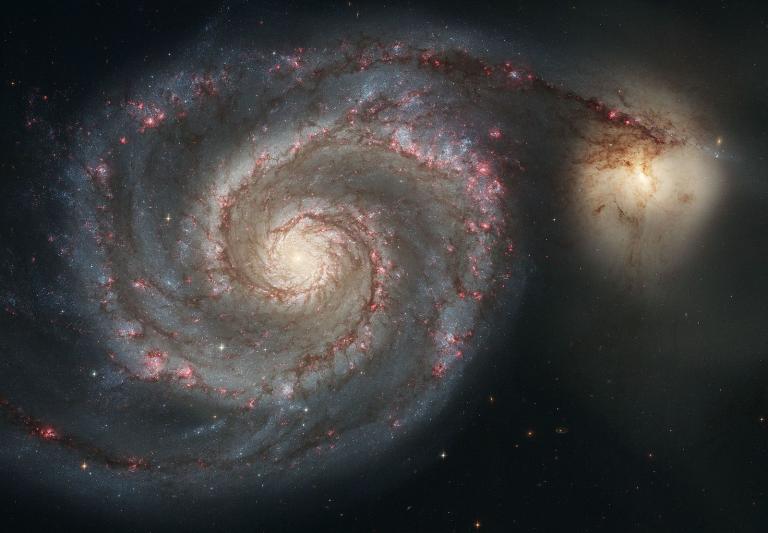
The classic spiral Whirlpool Galaxy (M51), with the smaller yellowish galaxy NGC 5195 drifting behind it in the upper right of this Hubble satellite image. (Wikimedia Commons public domain)
Lawrence Krauss is a physicist at Arizona State University — and a very vocal atheist who believes that the universe came out of “nothing” (or, at least, could have done so) without the aid of a divine creator (e.g., in his A Universe from Nothing: Why There Is Something Rather Than Nothing [2012]).
Amir Aczel (1950-2015) was an Israeli-born American mathematician and historian of mathematics — author of, among numerous other books, Fermat’s Last Theorem: Unlocking the Secret of an Ancient Mathematical Problem (1997); Entanglement: The Greatest Mystery in Physics (2002); Present at the Creation: The Story of CERN and the Large Hadron Collider (2010); and A Strange Wilderness: The Lives of the Great Mathematicians (2011).
In his book Why Science Does Not Disprove God (New York: William Morrow HarperCollins, 2014), Dr. Aczel takes aim at Professor Krauss with regard to what he sees as Krauss’s sloppy — even cheating — definition of “nothingness”:
In set theory, the foundational structure of mathematics, there is one basic concept called the empty set, also known as the null set. The empty set is that which contains no elements at all. This is as close as the human mind can come to understanding nothingness. Pure nothingness is defined as the contents of the empty set. This unique set contains nothing at all: no space, no time, no directions, no elements, no forces, no substance, no ideas, no notions, no rules. Nothing!
If you want to get a feel for this kind of complete and unqualified emptiness, draw a circle as a “something” — it contains a piece of space: it is a something, not a nothing. Now, shrink this circle slowly until it becomes a single point. Once the point is the only thing left, erase it. Now you have emptiness: not a piece of paper — that is gone, too, along with the space, directions such as up and down and left and right, and any elements whatsoever.
Such complete emptiness means nothingness — no space and no points and no directions. From such a complete emptiness, no universe can ever arise. It is here that Krauss and others go wrong. Pure emptiness is something so deeply devoid of any entity that nothing can come out of it. In the Vilenkin model, on which Krauss’s universe-from-nothing theory is based, a preexisting quantum foam must exist. And yet the mathematical empty set is far emptier than the quantum foam: it stands for complete and unqualified emptiness. It is a “nothing,” while the quantum foam is, of course, a “something,” leaving open the big question of how the universe and its particles of matter were ever created. (225-226)
By the way, does anybody out there recognize the source of the title of this blog entry?
***
There’s a whole lot out there that we don’t know and haven’t even seen:
“Voyage into the dark sector: A hidden world of particles awaits.”
***
A note on science and public policy:
“How Free Markets Neutralize Junk Science”
***
I can’t say that I’m particularly surprised:
For a society marked by the rise of the religious “nones,” particularly among Millennials and younger members of Gen X, there is inevitably a hunger for meaning and for guidance. Astrology offers both, but without commitments, without moral demands (especially as regards sexual behavior), and without the sometimes irksome demands of belonging to a community.
In my view, advocates of traditional religion — among whom, for my purposes here, I classify myself and other believing Latter-day Saints — should pay attention to such phenomena as this. They offer openings, ways of appealing to an audience for whom the usual approaches have lost appeal.
***
This article seems closely related:
“Using the Internet May Prompt Religious ‘Tinkering’ Rather than Belief in Only One Religion”
Previous Post

January 16, 2018
Star Stuff
Next Post
January 17, 2018 Regarding Jihad
Browse Our Archives
Select a Category Uncategorized
Select a Month October 2026 September 2026 August 2026 July 2026 June 2026 May 2026 April 2026 March 2026 February 2026 January 2026 December 2025 November 2025 October 2025 September 2025 August 2025 July 2025 June 2025 May 2025 April 2025 March 2025 February 2025 January 2025 December 2024 November 2024 October 2024 September 2024 August 2024 July 2024 June 2024 May 2024 April 2024 March 2024 February 2024 January 2024 December 2023 November 2023 October 2023 September 2023 August 2023 July 2023 June 2023 May 2023 April 2023 March 2023 February 2023 January 2023 December 2022 November 2022 October 2022 September 2022 August 2022 July 2022 June 2022 May 2022 April 2022 March 2022 February 2022 January 2022 December 2021 November 2021 October 2021 September 2021 August 2021 July 2021 June 2021 May 2021 April 2021 March 2021 February 2021 January 2021 December 2020 November 2020 October 2020 September 2020 August 2020 July 2020 June 2020 May 2020 April 2020 March 2020 February 2020 January 2020 December 2019 November 2019 October 2019 September 2019 August 2019 July 2019 June 2019 May 2019 April 2019 March 2019 February 2019 January 2019 December 2018 November 2018 October 2018 September 2018 August 2018 July 2018 June 2018 May 2018 April 2018 March 2018 February 2018 January 2018 December 2017 November 2017 October 2017 September 2017 August 2017 July 2017 June 2017 May 2017 April 2017 March 2017 February 2017 January 2017 December 2016 November 2016 October 2016 September 2016 August 2016 July 2016 June 2016 May 2016 April 2016 March 2016 February 2016 January 2016 December 2015 November 2015 October 2015 September 2015 August 2015 July 2015 June 2015 May 2015 April 2015 March 2015 February 2015 January 2015 December 2014 November 2014 March 2014 August 2013 February 2012
Follow Us!
TAKE THE
Religious Wisdom Quiz
Which king of Judah destroyed Nehushtan, the bronze serpent?
Select your answer to see how you score.
Josiah Hezekiah Uzziah Manasseh
Related posts from Sic et Non


Learning more about a region of which I've...

From Serbia's "White City," Belgrade

TRENDING AT PATHEOS Latter-day Saint

The First Eucharistic Controversy: Christ’s Real Presence
For Catholics, the Eucharist is the source and summit of the Christian...

How to Make a Decision When You Can't...
Main point: It’s much more valuable to stay close to God so...

Archdiocese Hosts Military Marriage Retreat in Germany
RASTATT, Germany — The transient military lifestyle, with its frequent deployments and...

Nearly every morning, I make the drive to Detroit with my high-school-age...

The Real AI Story Is Adoption Without Trust
Artificial intelligence has crossed a political threshold. It is no longer a...

A new article, written by Jeff Lindsay and Gale L. Pooley,...
view all Latter-day Saint blogs
Ad-Free & Subscriber Log-In Subscription Support
- About Us
- 2026 Calendar
- Videos
- Podcasts
- Library of World Religions
- Faith In Media Tracker
- Advertise With Us
- Write for Us
- Privacy Policy
- Terms of Service
- Do Not Sell My Data
- Contact Us
- Radiant Digital
- Manage Newsletter Subscriptions
- Unsubscribe From Notifications
- Sitemap
Copyright 2008-2026, Patheos. All rights reserved.
Subscription Support Ad-Free & Subscriber Log-In
Follow Patheos