
BuddhistCatholicContemplativeEvangelicalGeneral ChristianHinduJewishLatter-day SaintMuslimNew VisionsProgressive Christian
Beliefs
- Buddhist
- Catholic
- Contemplative
- Evangelical
- General Christian
- Hindu
- Jewish
- Latter-day Saint
- More Voices
- Muslim
- New Visions
- Pagan
- Progressive Christian
Topics
- Religion News
- Food and Religion
- Sports and Religion
- Religious Art
- Religious Music and Entertainment
- Religious Events
- History and Religion
- Style and Religion
- Politics and Religion
- Women in Religion
- Recreation Outdoors and Religion
- Business Finance and Religion
- Careers Workplace and Religion
- Education and Religion
- Family Parenting and Religion
- Health Fitness and Religion
- Home and Religion
- Relationships and Religion
- Technology and Religion
- Travel and Religion
Columnists
- Buddhist Columnists
- Business Finance and Religion Columnists
- Careers Workplace and Religion Columnists
- Catholic Columnists
- Contemplative Columnists
- Education and Religion Columnists
- Evangelists Columnists
- Family Parenting and Religion Columnists
- General Christian Columnists
- Health Fitness and Religion Columnists
- Hindu Columnists
- History and Religion Columnists
- Home and Religion Columnists
- Jewish Columnists
- More Voices Columnists
- Latter Day Columnists
- Muslim Columnists
- New Visions Columnists
- Nonreligious Columnists
- Pagan Columnists
- Politics and Religion Columnists
- Progressive Columnists
- Recreation Outdoors and Religion Columnists
- Relationships and Religion Columnists
- Religion News Columnists
- Religious Art Columnists
- Religious Events Columnists
- Religious Music and Entertainment Columnists
- Sports and Religion Columnists
- Style and Religion Columnists
- Technology and Religion Columnists
- Travel and Religion Columnists
- Women in Religion Columnists
Resource Library
- 2026 Calendar
- Library of World Religions
- The 100 Most Holy Places on Earth
- Patheos Answers
- Podcasts
- Videos
- Faith Leaders Database
- Anglican Episcopalian
- Bahai
- Baptist
- Buddhism
- Christianity
- Confucianism
- Eastern Orthodoxy
- Hinduism
- Holiness and Pentecostal
- ISKCON
- Islam
- Judaism
- Lutheran
- Methodist
- The Church of Jesus Christ of Latter-day Saints
- New Age
- Paganism
- Presbytarian and Reformed
- Protestantism
- Religion Behind the Scenes
- Roman Catholic
- Scientology
- Shia Islam
- Sikhism
- Sufism
- Sunni Islam
- Taoism
- Zen
- See all religions
Research Tools
 Ad-Free & Subscriber Log-In Subscription Support
Ad-Free & Subscriber Log-In Subscription Support
Follow Patheos 

- Trending:
- Forgiveness
- |
- Marriage
- |
- Consciousness
- |
- Death Penalty
- |
- Election
- |
- Halloween

- Home
- Latter-day Saint
- Can science (or any other discipline) ever be without unproven assumptions?
Can science (or any other discipline) ever be without unproven assumptions?
Last updated on: January 27, 2018 at 10:54 am by Dan Peterson
Can science (or any other discipline) ever be without unproven assumptions? 2018-01-27T10:54:26-07:00 Dan Peterson
Patheos Explore the world's faith through different perspectives on religion and spirituality! Patheos has the views of the prevalent religions and spiritualities of the world.
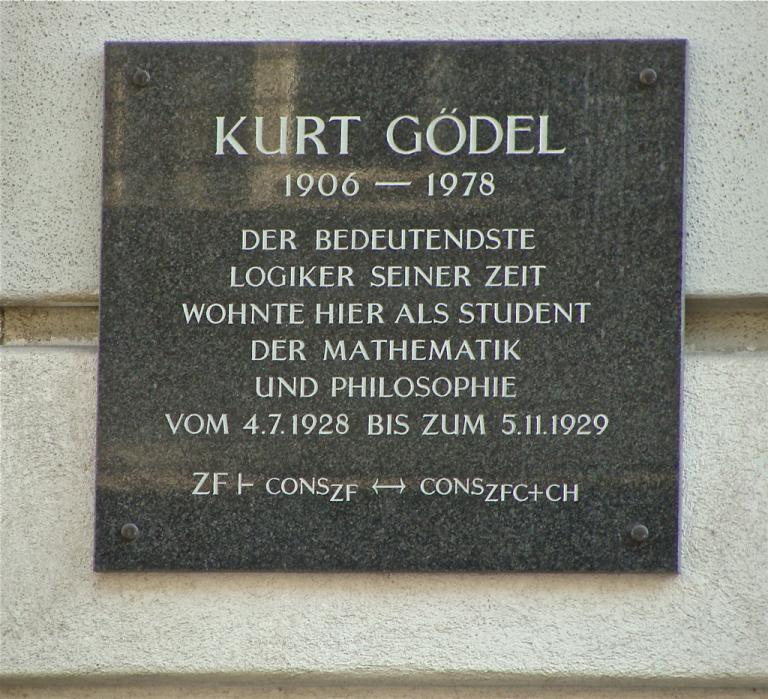
“The most significant logician of his time lived here as a student of mathematics and philosophy from 4 July 1928 until 5 November 1929.” Lange Gasse 72, 8th District, Vienna
(Wikimedia Commons)
A few days ago, I discovered that David Grandy, now an emeritus professor of philosophy at Brigham Young University and the author, previously, of books on such topics as Magic, Mystery, and Science: The Occult in Western Civilization (2003), The Speed of Light: Constancy and Cosmos (2009), and Everyday Quantum Reality (2010), had dropped off a new, self-published book of his (Worlds Without Number: An LDS Perspective on Infinity) at my office.
Here are some notes drawn from one section of the book, pages 132-134. Dr. Grandy begins with a reference to G. W. Leibniz (1646-1716):
His dream, according to Rudy Rucker, was to find a “universal system” of reasoning that would straightforwardly decide all disputes, whether philosophical, scientific, political, or religious. This dream continued to inspire thinkers well into the 20th century. In 1925 David Hilbert, a leading mathematician, proposed that mathematics could be formalized or packaged in a perfectly complete and consistent manner. No loose ends, no stray paradoxes, no leaps of faith, no fingerprint of human fallibility.
Among other things, Hilbert was concerned about self-referential scenarios like the liar’s paradox, a classic expression of which is found in the New Testament. Paul informs Titus that the people of Crete are “always liars” and quotes a Cretan statesman as his source for this allegation. But if Cretans are always liars, would not the statesman’s claim itself be a lie? Or, consider the sentence, “This statement is not true.” For those who assume that every truth claim can be straightforwardly adjudicated as true or false, the statement is problematic owing to its self-referential nature. Poke it with one characterization and it turns over, almost like a living creature, to announce the opposite. If the statement is true then it is not true, where not true may mean false, silly, meaningless, contradictory, or unverifiable. But if it is not true — that is, if the claim it makes regarding itself is not true — then it is true, which characterization flips it back to being not true, and so on.
After a few lines describing Hilbert’s unsuccessful attempt to deal with the liar’s paradox, Dr. Grandy continues:
In the early 1930s, . . . he saw his program shot out of the water by Kurt Gödel, who demonstrated that formal systems of thought (Euclidean geometry, for example) inevitably depend upon more truth than they can prove. In the words of one commentator, “There will always be truth beyond the reach of proof.”
That last line stuck out in my mind because one frequent commenter on this blog, an ideological atheist who is committed to as rigid and unadorned a version of scientism as I’ve personally encountered, has been insisting, repeatedly, that anything that cannot be demonstrated is not true but is mere imagination. (Of course, his rule that “anything that cannot be demonstrated is not true but is mere imagination” is, itself, beyond proof.) So the upshot of Gödel’s famous 1931 “incompleteness theorems,” that “There will always be truth beyond the reach of proof,” is of some particular current interest to me.
As David Grandy puts it,
Gödel produced a proof that rules against the absolute hegemony of proof. Our best thinking, our best arguments, our most celebrated intellectual triumphs, are not ultimately decisive because they cannot lock themselves into place from within; that is, using nothing more than the axioms they are built on and the rules of inference that supply their conclusions. To achieve their results they invariably gather in unprovable truth from the outside so as to keep the game of understanding in play. “New questions” accordingly come “into view,” writes one of Gödel’s biographers.
Previous Post

January 27, 2018
Contrasting Mormonism and Islam (Part Two)
Next Post
January 27, 2018 A reminiscence from Katharine Smith Salisbury
Browse Our Archives
Select a Category Uncategorized
Select a Month October 2026 September 2026 August 2026 July 2026 June 2026 May 2026 April 2026 March 2026 February 2026 January 2026 December 2025 November 2025 October 2025 September 2025 August 2025 July 2025 June 2025 May 2025 April 2025 March 2025 February 2025 January 2025 December 2024 November 2024 October 2024 September 2024 August 2024 July 2024 June 2024 May 2024 April 2024 March 2024 February 2024 January 2024 December 2023 November 2023 October 2023 September 2023 August 2023 July 2023 June 2023 May 2023 April 2023 March 2023 February 2023 January 2023 December 2022 November 2022 October 2022 September 2022 August 2022 July 2022 June 2022 May 2022 April 2022 March 2022 February 2022 January 2022 December 2021 November 2021 October 2021 September 2021 August 2021 July 2021 June 2021 May 2021 April 2021 March 2021 February 2021 January 2021 December 2020 November 2020 October 2020 September 2020 August 2020 July 2020 June 2020 May 2020 April 2020 March 2020 February 2020 January 2020 December 2019 November 2019 October 2019 September 2019 August 2019 July 2019 June 2019 May 2019 April 2019 March 2019 February 2019 January 2019 December 2018 November 2018 October 2018 September 2018 August 2018 July 2018 June 2018 May 2018 April 2018 March 2018 February 2018 January 2018 December 2017 November 2017 October 2017 September 2017 August 2017 July 2017 June 2017 May 2017 April 2017 March 2017 February 2017 January 2017 December 2016 November 2016 October 2016 September 2016 August 2016 July 2016 June 2016 May 2016 April 2016 March 2016 February 2016 January 2016 December 2015 November 2015 October 2015 September 2015 August 2015 July 2015 June 2015 May 2015 April 2015 March 2015 February 2015 January 2015 December 2014 November 2014 March 2014 August 2013 February 2012
Follow Us!
TAKE THE
Religious Wisdom Quiz
Which harvest festival is also called the Feast of Booths?
Select your answer to see how you score.
Purim Hanukkah Passover Sukkot
Related posts from Sic et Non

The Iron Gates and the Lion of the...


Learning more about a region of which I've...

From Serbia's "White City," Belgrade
TRENDING AT PATHEOS Latter-day Saint

The Iron Gates and the Lion of the...
Yesterday, I didn't finish my report about, well, yesterday. So I'll...

Dolly Parton’s Last Song Wins Dove Award with...
Bluegrass band The Grascals, speaking on the red carpet at the 57th...

The Image: On the Horror of Capitalism and...
The Image Then went the Pharisees, and took counsel how they might...

We are approaching the date of our new American national holiday: October...

Letters on Living the Faith by C.S. Lewis
Most of us met C.S. Lewis as a public intellectual. Mere Christianity....

When Halloween Unmasks Married Hearts
Written by Dr. David K. Ewen from Eternal Truth Bible College Behind...
view all Latter-day Saint blogs
Ad-Free & Subscriber Log-In Subscription Support
- About Us
- 2026 Calendar
- Videos
- Podcasts
- Library of World Religions
- Faith In Media Tracker
- Advertise With Us
- Write for Us
- Privacy Policy
- Terms of Service
- Do Not Sell My Data
- Contact Us
- Radiant Digital
- Manage Newsletter Subscriptions
- Unsubscribe From Notifications
- Sitemap
Copyright 2008-2026, Patheos. All rights reserved.
Subscription Support Ad-Free & Subscriber Log-In
Follow Patheos