
BuddhistCatholicContemplativeEvangelicalGeneral ChristianHinduJewishLatter-day SaintMuslimNew VisionsProgressive Christian
Beliefs
- Buddhist
- Catholic
- Contemplative
- Evangelical
- General Christian
- Hindu
- Jewish
- Latter-day Saint
- More Voices
- Muslim
- New Visions
- Pagan
- Progressive Christian
Topics
- Religion News
- Food and Religion
- Sports and Religion
- Religious Art
- Religious Music and Entertainment
- Religious Events
- History and Religion
- Style and Religion
- Politics and Religion
- Women in Religion
- Recreation Outdoors and Religion
- Business Finance and Religion
- Careers Workplace and Religion
- Education and Religion
- Family Parenting and Religion
- Health Fitness and Religion
- Home and Religion
- Relationships and Religion
- Technology and Religion
- Travel and Religion
Columnists
- Buddhist Columnists
- Business Finance and Religion Columnists
- Careers Workplace and Religion Columnists
- Catholic Columnists
- Contemplative Columnists
- Education and Religion Columnists
- Evangelists Columnists
- Family Parenting and Religion Columnists
- General Christian Columnists
- Health Fitness and Religion Columnists
- Hindu Columnists
- History and Religion Columnists
- Home and Religion Columnists
- Jewish Columnists
- More Voices Columnists
- Latter Day Columnists
- Muslim Columnists
- New Visions Columnists
- Nonreligious Columnists
- Pagan Columnists
- Politics and Religion Columnists
- Progressive Columnists
- Recreation Outdoors and Religion Columnists
- Relationships and Religion Columnists
- Religion News Columnists
- Religious Art Columnists
- Religious Events Columnists
- Religious Music and Entertainment Columnists
- Sports and Religion Columnists
- Style and Religion Columnists
- Technology and Religion Columnists
- Travel and Religion Columnists
- Women in Religion Columnists
Resource Library
- 2026 Calendar
- Library of World Religions
- The 100 Most Holy Places on Earth
- Patheos Answers
- Podcasts
- Videos
- Faith Leaders Database
- Anglican Episcopalian
- Bahai
- Baptist
- Buddhism
- Christianity
- Confucianism
- Eastern Orthodoxy
- Hinduism
- Holiness and Pentecostal
- ISKCON
- Islam
- Judaism
- Lutheran
- Methodist
- The Church of Jesus Christ of Latter-day Saints
- New Age
- Paganism
- Presbytarian and Reformed
- Protestantism
- Religion Behind the Scenes
- Roman Catholic
- Scientology
- Shia Islam
- Sikhism
- Sufism
- Sunni Islam
- Taoism
- Zen
- See all religions
Research Tools
 Ad-Free & Subscriber Log-In Subscription Support
Ad-Free & Subscriber Log-In Subscription Support
Follow Patheos 

- Trending:
- Forgiveness
- |
- Marriage
- |
- Consciousness
- |
- Death Penalty
- |
- Election
- |
- Halloween

- Home
- Latter-day Saint
- The passing of a truly remarkable Latter-day Saint
The passing of a truly remarkable Latter-day Saint
Last updated on: December 28, 2017 at 10:50 am by Dan Peterson
The passing of a truly remarkable Latter-day Saint 2017-12-28T10:50:15-07:00 Dan Peterson
Patheos Explore the world's faith through different perspectives on religion and spirituality! Patheos has the views of the prevalent religions and spiritualities of the world.
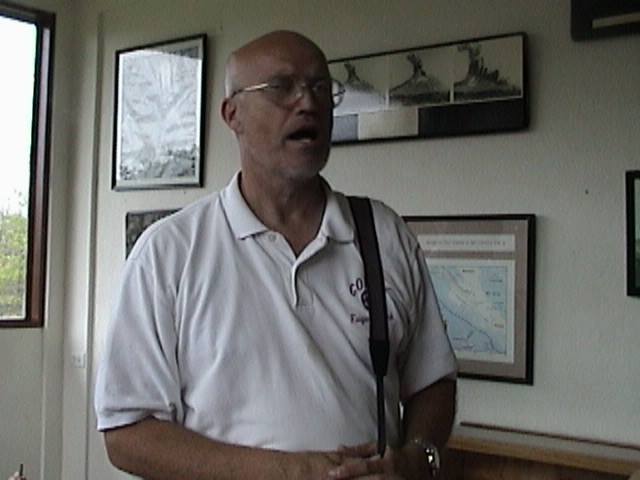
Dr. Eugene E. Clark
This item, written by Darvell Rowley (whom I do not know) reached me via a circuitous route on social media a few days ago. I hope that he won’t mind my sharing it; I’ve been unable to reach him. I’ve also borrowed some of the photographs that accompanied his comments.
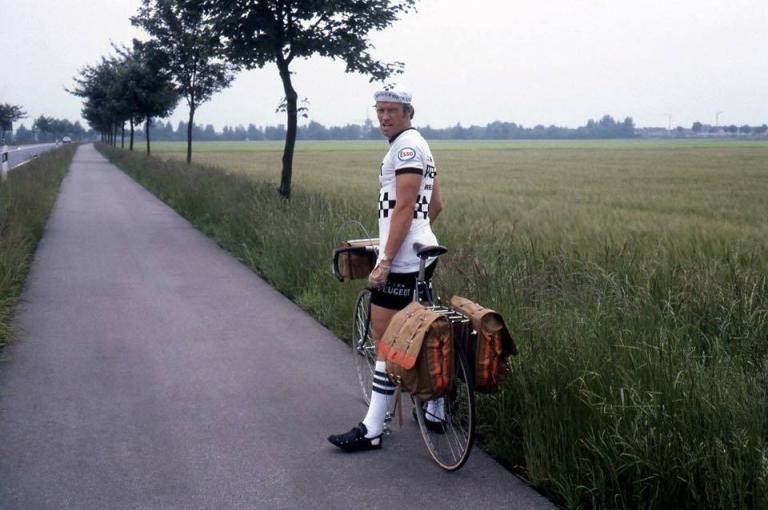
Gene Clark as a young cyclist in Europe.
I have some very sad news for those who remember Mr Clark, the greatest teacher ever at Mountain View High School, for all things Physics, Geology, Astronomy, and Environmental Science.
Eugene Clark and his wife had to return from their second LDS Mission early in March of this year, this one in Argentina, they found a tumor the size of a tennis ball in the middle of his brain. They left Argentina the next day, he was diagnosed with Stage 4 Terminal Glioblastoma (brain cancer).
Mr. Clark passed away yesterday afternoon, leaving the universe just slightly dimmer for the lack of his energy, his enthusiasm, his light.
Mr. Clark was the most influential teacher I ever had. He taught me how to use my mind to think critically, view life from unbiased perspectives, take in all things around us as data, sort it, make sense of it. Even after graduation from high school, Mr Clark invited me and my friends, all former students, to go along on his annual Grand Canyon Geology Field Trip, as chaperones. He instilled within me a love for road tripping, planted in me the desire to travel, showed me how to plan properly, efficiently use the allotted time to see as much as possible, be aware of my surroundings. I was fortunate enough to have him invite me along on two separate trips to study volcanoes in Costa Rica, again as chaperone, despite the fact that I had gained a computer career and did not become the Geophysicist, Geological Engineer, or Astrophysicist I was absolutely certain I was going to become. He taught me how to continue to look at the land all around, to make sense of it, to notice fault lines, volcanic intrusions, conglomerate formations, talus piles, entrenched meanders, moraines, to attempt to identify all types of rock and understand how they got there. He took us all over the country in Costa Rica, saw both oceans, tried surfing at Jaco beach, fed crocodiles, experienced ziplines thru the cloud forests of Monteverde, hiked Vulcans Poas, Hirazu, Arenal, witnessed the magical beauty of hot springs of Tabacon. I can still vividly remember hiking thru the jungle in front of him, up the steep sides of an ancient volcano, holding onto roots and plants, jumping around, laughing, him telling us stories of the crazy hikes and rock climbing he did in his youth, mapping sections of the Colorado River in the Grand Canyon, joking about his age and the struggles of the hike, despite successfully getting a couple dozen eager students and chaperones to the top of the volcano to view a crater filled with rain water. His countenance would immediately change, once again assuming the role of Teacher, and with unrivaled passion, exciting lectures would pour forth.
I think I can speak for everyone who ever had any of his classes, that we could all listen to Mr Clark speak for hours, so much knowledge and wisdom in his mind, never lacking a moment. I took all of his classes, every subject he offered, was even his teacher’s aide senior year despite that I had enough credits to not be there, I couldn’t get enough. He had an uncanny ability to make complicated dry subjects come to life, be fascinating, make sense, be clear. In a world of public education with underpaid teachers, Mr Clark was the diamond that out shined every other teacher without even trying to do so, a humble soul, his love for science radiated, inspired. I never met a student who didn’t enjoy his lectures. I am certain he was certainly beloved by all.
I was fortunate enough to stay in touch with him via email this last decade, eagerly awaiting for him to get off his mission February 2018 so that I could visit with him again, tell him of my travels, my wanderings, my journeys. I didn’t hear from him for quite some time, I wasn’t sure why the silence, it didn’t seem in character of him not to respond. Yesterday, his daughter reached out to me in morning with the bad news, Eugene Clark was quickly slipping from this world. I had no idea that he’d been fighting for his life these last 9 months.
It’s easy to live life and say “no regrets”, that being said I regret not getting to see him one last time, so much I wanted to say to him, so much I wanted to ask. Mr Clark, you are already missed, thank you so much for changing my life, for inspiring me. Rest in peace.
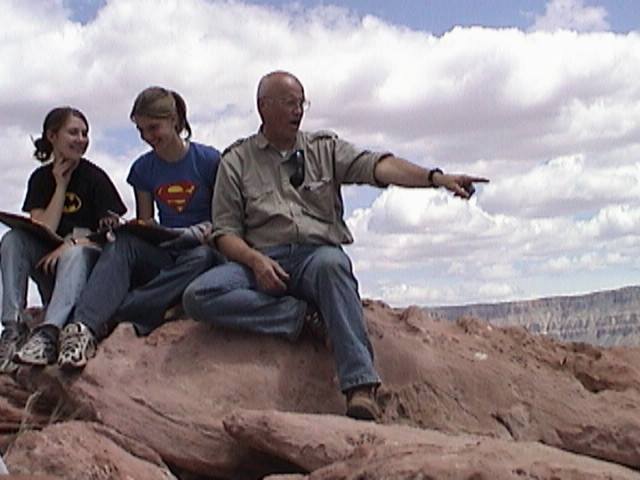
Mr. Clark with students, on one of his remarkable field trips.
Now for my own commentary:
Unfortunately, I did not know Mr. Clark very well. But two of my sons were able to go with him on his remarkable field trips to Costa Rica — and I accompanied the second son’s group as one of its chaperones. (It was a spur-of-the-moment decision, urged on me by a friend and fellow parent who was going. My son was not pleased. It turned out that he had a secret girlfriend who was also in the group; he scarcely acknowledged my existence for the entire trip.)
I had heard wonderful things about Gene Clark, but I was even more deeply impressed during our time in Costa Rica. Mr. Clark was one of the most remarkable people I’ve ever met. He was an accomplished geologist — actually, he was Dr. Clark, with a Ph.D. from the University of London — who already had a substantial career behind him, including serious academic publications, in private industry when he came to Mountain View High School following a downturn in oil prices and some sort of lay-off. His two principal geographical interests were, I believe, Oman and Costa Rica. Brigham Young University recruited him to teach several courses, but he found that he actually loved teaching high school students.
And he was phenomenal at it. I well recall recruiting my father-in-law, an exceptionally resourceful engineer, to help our eldest son build a melon-hurling catapult for one of Mr. Clark’s competitions. (I remember that catapult with special clarity because — long story — I broke a couple of ribs in connection with it.)
I think that it would be fair and accurate to say that my sons revered him.
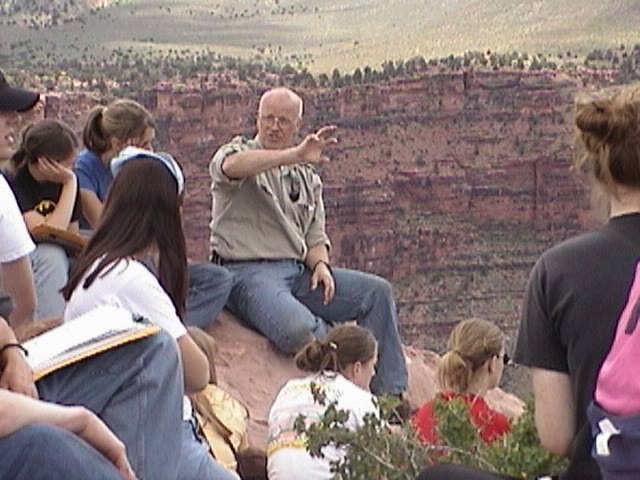
Mr. Clark as I envision him, a great teacher and a remarkable reader of landscapes.
A few of you may be aware of the old pulp fiction character Doc Savage, the incredibly brilliant, unbelievably strong crime-fighting forerunner to many subsequent superheroes. (Surely a film about him must be in development, somewhere?) As I watched Mr. Clark in Costa Rica, comparisons to Doc Savage kept coming to mind. He was, beyond question, extraordinarily intelligent and deeply versed not only in geology but other sciences. But he could also out-hike his students; he bicycled long distances every day to and from work. He seemed superhuman, omni-competent.
He told me one evening as we relaxed in a Costa Rican hot tub after a day of hiking (in an area that he had been studying for decades) that he had once dreamed of being a historian. But he found reading difficult, because he was dyslexic. He was, though, a genuine historian — of the natural landscape. He could read the geology of an area and explain its story, how it came to look the way it did, as well as, or better than, anybody I’ve ever encountered. It was a wonderful experience to listen to him.
He was also a man of faith and commitment. He had, I’m told, even been a stake president. Twice — once in London and once in Texas. And a Spanish-speaking mission early in his life had powerfully affected him in ways both spiritual and secular.
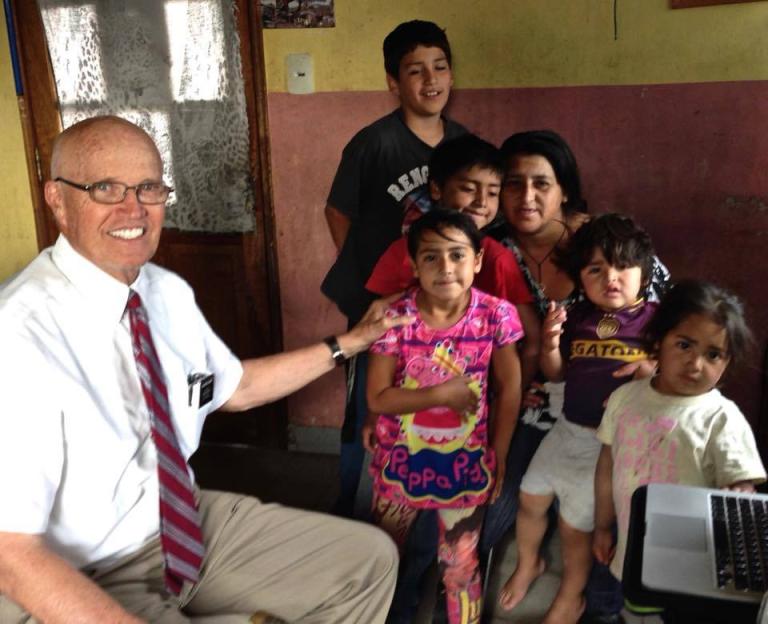
Elder Clark on one of his Spanish-speaking missions.
And he had been involved, to at least a slight degree, with the old Foundation for Ancient Research and Mormon Studies (or FARMS) in its glory days. Here’s a passage from Warren P. Aston’s 2015 book Lehi and Sariah in Arabia: The Old World Setting of the Book of Mormon:
A 1995 visit to Oman by FARMS-sponsored geologist Eugene E. Clark had resulted in a FARMS Preliminary Report that gave an updated assessment of the geology of the Dhofar region, without any focus on the candidate areas for Nephi’s Bountiful. Clark’s paper noted the existence of minor iron deposits east of Salalah and that they were likely to be present in association with manganese and carbon. Such a combination would result in high-grade steel suitable for tools.
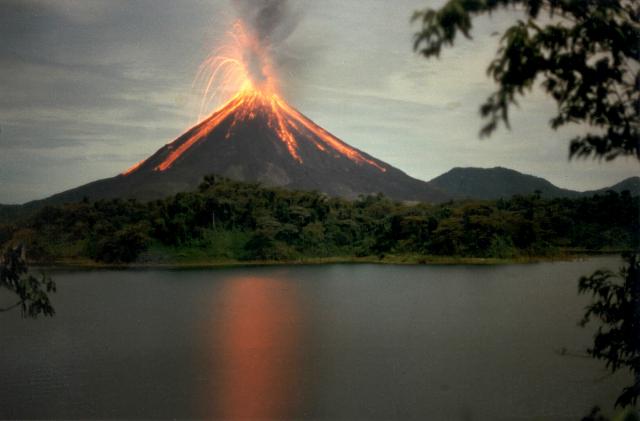
Costa Rica’s Mount Arenal (Wikimedia Commons)
Perhaps my single favorite memory of Mr. Clark is of sitting with him while watching the continually erupting Mt. Arenal, in Costa Rica. We were staying at the Volcano Observatory on an adjacent ridge. He was taking notes, with a cassette player sitting next to him blaring out Wagner’s Ride of the Valkyries. Perfect background music for a mad scientist.
He had already told me of trying to reach the summit of Mount Arenal some time before. He and his hiking companion, a Costa Rican botanist whom I had met, had finally abandoned the attempt when a basalt block about the size of a school bus had landed a few dozen yards from them. (The volcano was, at the time, spitting such blocks out about every two minutes or so.)
A question occurred to me:
“If the volcano were to explode right now, as you predict it will within the next few decades at most, what would happen to us?”
“We would be obliterated. Vaporized.”
“Would there be anything we could do?”
“Sure! We could run toward the top of the ridge, trying to get to the protection on the other side.”
“Would that help?”
“No. The pyroclastic flow would be coming toward us at about 100-150 miles per hour. But it might help us to feel a bit better during our last seconds of life.”
“Well,” I observed, “we must be pretty safe here right now. Otherwise, if they had reason to expect an imminent eruption, the staff of the Observatory would have abandoned the place.”
“Oh,” Mr. Clark responded. “You misunderstand. There’s no staff here. They’re not that crazy. This place is automated. The staff monitor the instruments from San Jose, about 150 miles away.”
Gene Clark was one of the most alive, most vivid, most energetic, and most interesting people I have ever encountered. The world is, indeed, dimmed and impoverished by his passing.
I’m reminded of a comment made by C. S. Lewis in a letter that he wrote roughly two weeks after the unexpected death of his friend (and fellow “Inkling”) Charles Williams:
Death has done nothing to my idea of him, but he has done – oh, I can’t say what – to my idea of death. It has made the next world much more real and palpable.
When death meets someone as vital and alive as Gene Clark, death seems somehow diminished. But so, unfortunately, does this mortal sphere. And so we mourn.
Previous Post

December 27, 2017
Dispensations
Next Post
December 27, 2017 Why Christmas is necessary
Browse Our Archives
Select a Category Uncategorized
Select a Month October 2026 September 2026 August 2026 July 2026 June 2026 May 2026 April 2026 March 2026 February 2026 January 2026 December 2025 November 2025 October 2025 September 2025 August 2025 July 2025 June 2025 May 2025 April 2025 March 2025 February 2025 January 2025 December 2024 November 2024 October 2024 September 2024 August 2024 July 2024 June 2024 May 2024 April 2024 March 2024 February 2024 January 2024 December 2023 November 2023 October 2023 September 2023 August 2023 July 2023 June 2023 May 2023 April 2023 March 2023 February 2023 January 2023 December 2022 November 2022 October 2022 September 2022 August 2022 July 2022 June 2022 May 2022 April 2022 March 2022 February 2022 January 2022 December 2021 November 2021 October 2021 September 2021 August 2021 July 2021 June 2021 May 2021 April 2021 March 2021 February 2021 January 2021 December 2020 November 2020 October 2020 September 2020 August 2020 July 2020 June 2020 May 2020 April 2020 March 2020 February 2020 January 2020 December 2019 November 2019 October 2019 September 2019 August 2019 July 2019 June 2019 May 2019 April 2019 March 2019 February 2019 January 2019 December 2018 November 2018 October 2018 September 2018 August 2018 July 2018 June 2018 May 2018 April 2018 March 2018 February 2018 January 2018 December 2017 November 2017 October 2017 September 2017 August 2017 July 2017 June 2017 May 2017 April 2017 March 2017 February 2017 January 2017 December 2016 November 2016 October 2016 September 2016 August 2016 July 2016 June 2016 May 2016 April 2016 March 2016 February 2016 January 2016 December 2015 November 2015 October 2015 September 2015 August 2015 July 2015 June 2015 May 2015 April 2015 March 2015 February 2015 January 2015 December 2014 November 2014 March 2014 August 2013 February 2012
Follow Us!
TAKE THE
Religious Wisdom Quiz
What is a "cubit's" approximate length according to the Bible?
Select your answer to see how you score.
12 inches 24 inches 18 inches 36 inches
Related posts from Sic et Non

Learning more about a region of which I've...

From Serbia's "White City," Belgrade

TRENDING AT PATHEOS Latter-day Saint

Swimfan: Forgotten Aughts Pleasures
This is a recovery effort. In 2002, My Big Fat Greek Wedding...

Top Three Anti-Catholic Lies About Catholicism
This is my initial transcript for the video, "THE 3 WORST...

Pope Leo Celebrates Mass for Nurses & Docs...
I don't have any idea how he did it, but Pope Leo...

The Sermon on the Mount, Part I: Matthew...
The Sermon on the Mount, Part I (Matthew 4:12-5:12) St. Matthew moves...

What's up from Crossway: Reviewing some of their latest A few weeks...

Janie Learns the Way of the Cross: A...
Teaching children about Jesus' Passion can be challenging. Many parents and educators...
view all Latter-day Saint blogs
Ad-Free & Subscriber Log-In Subscription Support
- About Us
- 2026 Calendar
- Videos
- Podcasts
- Library of World Religions
- Faith In Media Tracker
- Advertise With Us
- Write for Us
- Privacy Policy
- Terms of Service
- Do Not Sell My Data
- Contact Us
- Radiant Digital
- Manage Newsletter Subscriptions
- Unsubscribe From Notifications
- Sitemap
Copyright 2008-2026, Patheos. All rights reserved.
Subscription Support Ad-Free & Subscriber Log-In
Follow Patheos