
BuddhistCatholicContemplativeEvangelicalGeneral ChristianHinduJewishLatter-day SaintMuslimNew VisionsProgressive Christian
Beliefs
- Buddhist
- Catholic
- Contemplative
- Evangelical
- General Christian
- Hindu
- Jewish
- Latter-day Saint
- More Voices
- Muslim
- New Visions
- Pagan
- Progressive Christian
Topics
- Religion News
- Food and Religion
- Sports and Religion
- Religious Art
- Religious Music and Entertainment
- Religious Events
- History and Religion
- Style and Religion
- Politics and Religion
- Women in Religion
- Recreation Outdoors and Religion
- Business Finance and Religion
- Careers Workplace and Religion
- Education and Religion
- Family Parenting and Religion
- Health Fitness and Religion
- Home and Religion
- Relationships and Religion
- Technology and Religion
- Travel and Religion
Columnists
- Buddhist Columnists
- Business Finance and Religion Columnists
- Careers Workplace and Religion Columnists
- Catholic Columnists
- Contemplative Columnists
- Education and Religion Columnists
- Evangelists Columnists
- Family Parenting and Religion Columnists
- General Christian Columnists
- Health Fitness and Religion Columnists
- Hindu Columnists
- History and Religion Columnists
- Home and Religion Columnists
- Jewish Columnists
- More Voices Columnists
- Latter Day Columnists
- Muslim Columnists
- New Visions Columnists
- Nonreligious Columnists
- Pagan Columnists
- Politics and Religion Columnists
- Progressive Columnists
- Recreation Outdoors and Religion Columnists
- Relationships and Religion Columnists
- Religion News Columnists
- Religious Art Columnists
- Religious Events Columnists
- Religious Music and Entertainment Columnists
- Sports and Religion Columnists
- Style and Religion Columnists
- Technology and Religion Columnists
- Travel and Religion Columnists
- Women in Religion Columnists
Resource Library
- 2026 Calendar
- Library of World Religions
- The 100 Most Holy Places on Earth
- Patheos Answers
- Podcasts
- Videos
- Faith Leaders Database
- Anglican Episcopalian
- Bahai
- Baptist
- Buddhism
- Christianity
- Confucianism
- Eastern Orthodoxy
- Hinduism
- Holiness and Pentecostal
- ISKCON
- Islam
- Judaism
- Lutheran
- Methodist
- The Church of Jesus Christ of Latter-day Saints
- New Age
- Paganism
- Presbytarian and Reformed
- Protestantism
- Religion Behind the Scenes
- Roman Catholic
- Scientology
- Shia Islam
- Sikhism
- Sufism
- Sunni Islam
- Taoism
- Zen
- See all religions
Research Tools
 Ad-Free & Subscriber Log-In Subscription Support
Ad-Free & Subscriber Log-In Subscription Support
Follow Patheos 

- Trending:
- Forgiveness
- |
- Marriage
- |
- Consciousness
- |
- Death Penalty
- |
- Election
- |
- Halloween

- Home
- Latter-day Saint
- “Hey, Mormons — leave dead Jews alone!”
“Hey, Mormons — leave dead Jews alone!”
Last updated on: December 28, 2017 at 12:47 pm by Dan Peterson
“Hey, Mormons — leave dead Jews alone!” 2017-12-28T12:47:33-07:00 Dan Peterson
Patheos Explore the world's faith through different perspectives on religion and spirituality! Patheos has the views of the prevalent religions and spiritualities of the world.
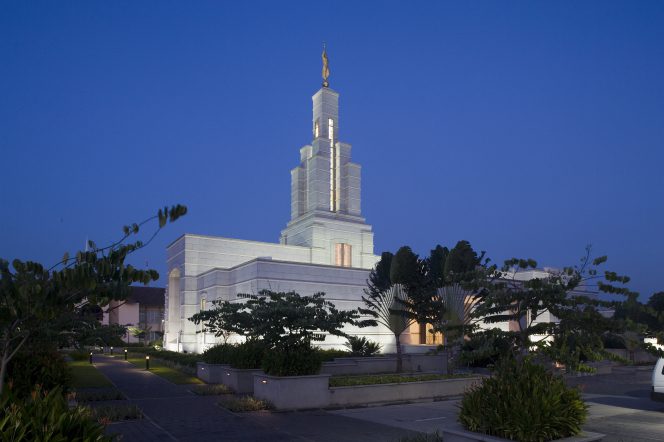
The Accra Ghana Temple (LDS Media Library)
I realize that this is a thankless task, and that it can only serve to confirm the position of those who already agree with me and to further inflame those who already don’t. I recognize, too, that doing so will expose me to inevitable accusations of insensitivity and disrespect and even, from my worst critics, of anti-Semitism. But I’m going to comment once again — see also my prior entry, titled “On performing baptisms for Jewish Holocaust victims” — on this profoundly misguided article by Rabbi Jeffrey Salkin:
“Hey, Mormons — leave dead Jews alone!”
First of all, there’s his fundamental factual error:
As any even minimally informed member of the Church of Jesus Christ of Latter-day Saints would have happily explained to Rabbi Salkin, we believe that vicarious Mormon baptisms for the dead offer the choice to deceased persons — whom we believe to survive as free, conscious, personal agents — of accepting or rejecting the Gospel of Jesus Christ. And we do not presume to know what choice they make.
Thus, contrary to Rabbi Salkin’s article, there is literally no way in Mormon doctrine for anybody to be an “unwitting” or “unwilling” member of the Church of Jesus Christ of Latter-day Saints. Nobody in the Church teaches that such vicarious baptisms “effectively make the dead posthumous Mormons.” No Mormons “claim our [Jewish] dead as their own.” We do not enroll those for whom vicarious baptisms have been performed as members of the Church. Accordingly, describing a “researcher [who] comes to believe that Anne Frank was actually Mormon” simply because an ordinance was performed on her behalf as “less than competent” would be an absurd understatement. Such a “researcher” could not possibly be taken seriously by anybody who actually knows anything about the subject.
Second, there’s Rabbi Salkin’s tone:
He’s free, of course, to say (as he does) that he dislikes our theology and our practices. Nobody is forced to be tolerant or respectful. But I was saddened to see his description as “contemptible” of a central element of our theology and a vitally important aspect of our practice. I cannot imagine myself using such language to characterize any fundamental teaching or mitzvah of Judaism nor of any other significant religious tradition. I would never, for example, describe Catholic masses or prayers for the dead as “contemptible.” It is “a holy and wholesome thought to pray for the dead, that they may be loosed from sins,” says the very Jewish book of 2 Maccabees (12:46).
Some have derided our practice of vicarious temple baptisms as “silly.” Others have denounced it as “unbiblical.” That’s their right, of course, as it is our right to disagree with them. (Although I would never deride as “silly” the Jewish practice of saying kaddish “for the merit of the departed soul of one’s father or mother.”)
Some have suggested that vicarious baptisms for the dead should be legally banned — which proposes an extension of government power whose tyranny would be absolutely breathtaking in its implications. Would such people favor the prohibition of requiem masses? Are Mozart’s Requiem and Verdi’s Requiem “contemptible” and “silly”? Are such composers jailbait?
Here is the text of Pie Jesu from Andrew Lloyd Webber’s Requiem:
Pie Jesu, pie Jesu, pie Jesu, pie Jesu
Qui tollis peccata mundi
Dona eis requiem, dona eis requiem
Pie Jesu, pie Jesu, pie Jesu, pie Jesu
Qui tollis peccata mundi
Dona eis requiem, dona eis requiem
Agnus Dei, Agnus Dei, Agnus Dei, Agnus Dei
Qui tollis peccata mundi
Dona eis requiem, dona eis requiem
Sempiternam
Sempiternam
Requiem
Merciful Jesus, merciful Jesus, merciful Jesus, merciful Jesus
Father, who takes away the sins of the world
Grant them rest, grant them rest
Merciful Jesus, merciful Jesus, merciful Jesus, merciful Jesus
Father, who takes away the sins of the world
Grant them rest, grant them rest
Lamb of God, Lamb of God, Lamb of God, Lamb of God
Father, who takes away the sins of the world
Grant them rest, grant them rest
everlasting
everlasting
Rest
Here is the Russian soprano Anna Netrebko (Анна Нетребко) performing Pie Jesu:
A vicarious baptism offered to the dead is no different, in principle, from a prayer or a mass intended to benefit or implore blessing upon the dead.
Are the sentiments expressed in Pie Jesu “contemptible” or “silly”? Should Ms. Netrebko be in jail?
Should police patrol Catholic churches to ensure that no such masses be said, to guarantee that no candles be lit on behalf of the deceased?
Finally, Rabbi Salkin would have been wise to listen to the judgment of Rabbi Gary Greenebaum, the former national director of interreligious affairs at the American Jewish Committee, who monitors the LDS database on behalf of the World Gathering of Jewish Holocaust Survivors (and who receives a monthly report from the Church on submissions of Holocaust victims, including updates on how each case is resolved — a gesture of respect to Jewish sensibilities that, in my opinion, is strikingly generous).
Rabbi Greenebaum defends the Church against such critics as Rabbi Salkin, pointing out that the number of names found by the anti-Mormon zealot Helen Radkey after months and months of work is “infinitesimal” and declaring that the church has “an astonishingly good record.”
“I find it sort of extraordinary that someone is still wanting to say that the church is not acting in good faith,” Greenebaum comments, “because I think it is acting in extraordinarily good faith.”
(For Rabbi Greenebaum’s comments, see here.)
Is the process perfect? No. Do unauthorized submissions still get through? Yes. (And I don’t rule out the possibility that they’re the result of deliberate actions by the agent-provocateur Helen Radkey and her accomplices.) But what process in this life is perfect? Roughly 130 genetic mutations occur with every human conception. Between 500-1000 airline fatalities happen each year. For every million people vaccinated against influenza, one or two cases of Guillain-Barré syndrome appear. In 2016, there were approximately 12.5 deaths per billion vehicle miles.
That’s life in a fallen world.
Previous Post

December 27, 2017
Why Christmas is necessary
Next Post
December 28, 2017 Tempering Iron
Browse Our Archives
Select a Category Uncategorized
Select a Month October 2026 September 2026 August 2026 July 2026 June 2026 May 2026 April 2026 March 2026 February 2026 January 2026 December 2025 November 2025 October 2025 September 2025 August 2025 July 2025 June 2025 May 2025 April 2025 March 2025 February 2025 January 2025 December 2024 November 2024 October 2024 September 2024 August 2024 July 2024 June 2024 May 2024 April 2024 March 2024 February 2024 January 2024 December 2023 November 2023 October 2023 September 2023 August 2023 July 2023 June 2023 May 2023 April 2023 March 2023 February 2023 January 2023 December 2022 November 2022 October 2022 September 2022 August 2022 July 2022 June 2022 May 2022 April 2022 March 2022 February 2022 January 2022 December 2021 November 2021 October 2021 September 2021 August 2021 July 2021 June 2021 May 2021 April 2021 March 2021 February 2021 January 2021 December 2020 November 2020 October 2020 September 2020 August 2020 July 2020 June 2020 May 2020 April 2020 March 2020 February 2020 January 2020 December 2019 November 2019 October 2019 September 2019 August 2019 July 2019 June 2019 May 2019 April 2019 March 2019 February 2019 January 2019 December 2018 November 2018 October 2018 September 2018 August 2018 July 2018 June 2018 May 2018 April 2018 March 2018 February 2018 January 2018 December 2017 November 2017 October 2017 September 2017 August 2017 July 2017 June 2017 May 2017 April 2017 March 2017 February 2017 January 2017 December 2016 November 2016 October 2016 September 2016 August 2016 July 2016 June 2016 May 2016 April 2016 March 2016 February 2016 January 2016 December 2015 November 2015 October 2015 September 2015 August 2015 July 2015 June 2015 May 2015 April 2015 March 2015 February 2015 January 2015 December 2014 November 2014 March 2014 August 2013 February 2012
Follow Us!
TAKE THE
Religious Wisdom Quiz
Why did Jesus often use parables?
Select your answer to see how you score.
To confuse listeners To show off To entertain only To reveal truths to those open to God
Related posts from Sic et Non

The Iron Gates and the Lion of the...


Learning more about a region of which I've...

From Serbia's "White City," Belgrade
TRENDING AT PATHEOS Latter-day Saint

The Problem with False Prophets
Miller’s Station UMC| 10/18/26| Anchor Verse: Jeremiah 23: 1, 9-23 I...

Emotion in Early Christianity by Andrew Crislip
Andrew Crislip’s Emotion in Early Christianity examines an often overlooked dimension of...

16 Spiritual Touchstones for a More Grounded Life
After decades of spiritual study, here are 16 principles I try...

Catholic Evangelization: Sharing Your Faith Every Day
Welcome back to the Graceful Awakening mini-series called, “From Faith to Mission.” ...

The Pillar of the Boatmen: the Ancient Monument...
The Pillar of the Boatmen is a Romano-Gaulish sculpture that dates from...

In one sense walking into Westminster Abbey is like walking down the...
view all Latter-day Saint blogs
Ad-Free & Subscriber Log-In Subscription Support
- About Us
- 2026 Calendar
- Videos
- Podcasts
- Library of World Religions
- Faith In Media Tracker
- Advertise With Us
- Write for Us
- Privacy Policy
- Terms of Service
- Do Not Sell My Data
- Contact Us
- Radiant Digital
- Manage Newsletter Subscriptions
- Unsubscribe From Notifications
- Sitemap
Copyright 2008-2026, Patheos. All rights reserved.
Subscription Support Ad-Free & Subscriber Log-In
Follow Patheos