
BuddhistCatholicContemplativeEvangelicalGeneral ChristianHinduJewishLatter-day SaintMuslimNew VisionsProgressive Christian
Beliefs
- Buddhist
- Catholic
- Contemplative
- Evangelical
- General Christian
- Hindu
- Jewish
- Latter-day Saint
- More Voices
- Muslim
- New Visions
- Pagan
- Progressive Christian
Topics
- Religion News
- Food and Religion
- Sports and Religion
- Religious Art
- Religious Music and Entertainment
- Religious Events
- History and Religion
- Style and Religion
- Politics and Religion
- Women in Religion
- Recreation Outdoors and Religion
- Business Finance and Religion
- Careers Workplace and Religion
- Education and Religion
- Family Parenting and Religion
- Health Fitness and Religion
- Home and Religion
- Relationships and Religion
- Technology and Religion
- Travel and Religion
Columnists
- Buddhist Columnists
- Business Finance and Religion Columnists
- Careers Workplace and Religion Columnists
- Catholic Columnists
- Contemplative Columnists
- Education and Religion Columnists
- Evangelists Columnists
- Family Parenting and Religion Columnists
- General Christian Columnists
- Health Fitness and Religion Columnists
- Hindu Columnists
- History and Religion Columnists
- Home and Religion Columnists
- Jewish Columnists
- More Voices Columnists
- Latter Day Columnists
- Muslim Columnists
- New Visions Columnists
- Nonreligious Columnists
- Pagan Columnists
- Politics and Religion Columnists
- Progressive Columnists
- Recreation Outdoors and Religion Columnists
- Relationships and Religion Columnists
- Religion News Columnists
- Religious Art Columnists
- Religious Events Columnists
- Religious Music and Entertainment Columnists
- Sports and Religion Columnists
- Style and Religion Columnists
- Technology and Religion Columnists
- Travel and Religion Columnists
- Women in Religion Columnists
Resource Library
- 2026 Calendar
- Library of World Religions
- The 100 Most Holy Places on Earth
- Patheos Answers
- Podcasts
- Videos
- Faith Leaders Database
- Anglican Episcopalian
- Bahai
- Baptist
- Buddhism
- Christianity
- Confucianism
- Eastern Orthodoxy
- Hinduism
- Holiness and Pentecostal
- ISKCON
- Islam
- Judaism
- Lutheran
- Methodist
- The Church of Jesus Christ of Latter-day Saints
- New Age
- Paganism
- Presbytarian and Reformed
- Protestantism
- Religion Behind the Scenes
- Roman Catholic
- Scientology
- Shia Islam
- Sikhism
- Sufism
- Sunni Islam
- Taoism
- Zen
- See all religions
Research Tools
 Ad-Free & Subscriber Log-In Subscription Support
Ad-Free & Subscriber Log-In Subscription Support
Follow Patheos 

- Trending:
- Forgiveness
- |
- Marriage
- |
- Consciousness
- |
- Death Penalty
- |
- Election
- |
- Halloween

- Home
- Latter-day Saint
- The final nail in the Book of Mormon’s coffin
The final nail in the Book of Mormon’s coffin
Last updated on: December 11, 2017 at 11:02 am by Dan Peterson
The final nail in the Book of Mormon’s coffin 2017-12-11T11:02:29-07:00 Dan Peterson
Patheos Explore the world's faith through different perspectives on religion and spirituality! Patheos has the views of the prevalent religions and spiritualities of the world.
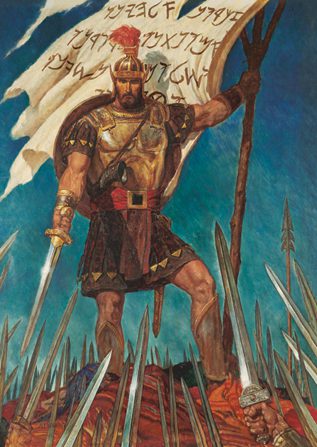
“Captain Moroni and the Title of Liberty”
(Arnold Friberg, LDS Media Library)
I’ve located the source that Joseph Smith used to create his fictional “Captain Moroni.”
But, first, a little background:
Ernst Gombrich (Sir Ernst Hans Josef Gombrich**,** 1909-2001) was a very famous Austrian-born art historian who fled the Nazis to Britain in 1939, became a naturalized British subject in 1947, and spent most of his career at the prestigious Warburg Institute in London.
When he was still in his twenties, though, he wrote Eine kurze Weltgeschichte für junge Leser — A Brief History of the World for Young Readers.
I had never heard of this book until I found it in a Swiss bookstore a short while ago, but I’ve lately been reading a bit in it every night before bed.
And it was last night that I made my stunning discovery.
I was reading about Greek resistance to the expansion of the Persian empire in the early fifth century BC — leading up, first, to the famous battle of Marathon — when I came upon these two sentences:
“Die Athener hatten einen Feldherrn mit Namen Miltiades, einen mutigen, gescheiten Mann, der lange unter den Persern gelebt hatte und ihre Art zu kämpfen genau kannte. Und alle Athener wußten, worum es ging: um ihre Freiheit, um ihr Leben, um das ihrer Frauen und Kinder.”
“The Athenians had a field commander by the name of Miltiades, a courageous and clever man who had lived for a long time among the Persians and who was well acquainted with their manner of fighting. And all of the Athenians understood what this was about: It was about their freedom, their lives, and the lives of their wives and children.”
I immediately recognized the affinities of this passage to the Book of Mormon’s description of “Captain Moroni.”
First of all, it’s not difficult to see that the names Miltiades and Moroni are essentially the same: Simply replace -iltiades with -oroni while maintaining the initial M- and there’s no difference at all. (This phenomenon is common in linguistics: Replace the -ook of book with -ible, for instance, and the result is Bible — the Book. Take the word baseball, replace the interior -e- with the infix -ket-, and you have basketball.)
Moreover, their military offices are identical: Miltiades was the Athenian “Feldherr” or “field commander” and “Moroni” was “the chief captain over the Nephites” (Alma 43:16).
But to proceed:
The occurrence of the essentially identical names Miltiades and Moroni is an important clue, of course, as is their identical position as Feldherr/field commander/captain. That, however, is just the beginning.
Miltiades, for instance, is described as “courageous and clever.” Similarly, “Moroni” is famous for his stratagems. (See Alma 43:16-30;
In the story of “Moroni,” the goal of the Lamanite leader Zerahemnah is to “gain power over the Nephites by bringing them into bondage” (Alma 43:8). And this was definitely the goal of the Persian king Darius I.
By contrast, the Athenians were only seeking to defend “their freedom, their lives, and the lives of their wives and children.”
This is the clincher.
“The design of the Nephites was to support their lands, and their houses, and their wives, and their children, that they might preserve them from the hands of their enemies; and also that they might preserve their rights and their privileges, yea, and also their liberty, that they might worship God according to their desires.” (Alma 43:9)
“It was the only desire of the Nephites to preserve their lands, and their liberty, and their church.” (Alma 43:30)
“They were not fighting for monarchy nor power but they were fighting for their homes and their liberties, their wives and their children, and their all, yea, for their rites of worship and their church.” (Alma 43:45)
“They cried with one voice unto the Lord their God, for their liberty and their freedom from bondage.” (Alma 43:49)
And, later on, when Moroni rends his coat and hoists it upon a pole as the famous “title of liberty,” he writes the following on it: “In memory of our God, our religion, and freedom, and our peace, our wives, and our children.” In other words, as Ernst Gombrich writes about the battle of Marathon, “It was about their freedom, their lives, and the lives of their wives and children.”
Plainly, Ernst Gombrich’s Eine kurze Weltgeschichte für junge Leser is the source that Joseph Smith used in order to forge his Book of Mormon.
A few minor problems — but only a few — remain. For example, Eine kurze Weltgeschichte für junge Leser was first published in 1935. Some diehards will insist that this is too late for the book to have influenced Joseph Smith, who was murdered in 1844 and who published his Book of Mormon in 1830. I will leave it to other scholars to deal with this frivolous objection.
And some will point out that Joseph Smith doesn’t appear to have known German in the late 1820s or early 1830s and that Ernst Gombrich’s Eine kurze Weltgeschichte für junge Leser wasn’t published in English until Yale University Press issued it in 2008 as A Little History of the World.
But such trivial and desperate arguments are easily disposed of. Three decades ago, for example, two intrepid researchers suggested that the cosmological ideas in the Book of Abraham derive from Joseph Smith’s “information environment,” which they defined by using a 1728 entry in Benjamin Franklin’s unpublished personal papers as well as an obscure 1755 work by the German philosopher Immanuel Kant that was barely noticed in Germany and wasn’t published in English until 1900.
Previous Post

December 10, 2017
Qur’anic Christmas Stories
Next Post
December 11, 2017 "The Lost World of Genesis One"
Browse Our Archives
Select a Category Uncategorized
Select a Month October 2026 September 2026 August 2026 July 2026 June 2026 May 2026 April 2026 March 2026 February 2026 January 2026 December 2025 November 2025 October 2025 September 2025 August 2025 July 2025 June 2025 May 2025 April 2025 March 2025 February 2025 January 2025 December 2024 November 2024 October 2024 September 2024 August 2024 July 2024 June 2024 May 2024 April 2024 March 2024 February 2024 January 2024 December 2023 November 2023 October 2023 September 2023 August 2023 July 2023 June 2023 May 2023 April 2023 March 2023 February 2023 January 2023 December 2022 November 2022 October 2022 September 2022 August 2022 July 2022 June 2022 May 2022 April 2022 March 2022 February 2022 January 2022 December 2021 November 2021 October 2021 September 2021 August 2021 July 2021 June 2021 May 2021 April 2021 March 2021 February 2021 January 2021 December 2020 November 2020 October 2020 September 2020 August 2020 July 2020 June 2020 May 2020 April 2020 March 2020 February 2020 January 2020 December 2019 November 2019 October 2019 September 2019 August 2019 July 2019 June 2019 May 2019 April 2019 March 2019 February 2019 January 2019 December 2018 November 2018 October 2018 September 2018 August 2018 July 2018 June 2018 May 2018 April 2018 March 2018 February 2018 January 2018 December 2017 November 2017 October 2017 September 2017 August 2017 July 2017 June 2017 May 2017 April 2017 March 2017 February 2017 January 2017 December 2016 November 2016 October 2016 September 2016 August 2016 July 2016 June 2016 May 2016 April 2016 March 2016 February 2016 January 2016 December 2015 November 2015 October 2015 September 2015 August 2015 July 2015 June 2015 May 2015 April 2015 March 2015 February 2015 January 2015 December 2014 November 2014 March 2014 August 2013 February 2012
Follow Us!
TAKE THE
Religious Wisdom Quiz
How much was Judas paid to betray Jesus?
Select your answer to see how you score.
20 pieces of silver 30 pieces of silver 10 pieces of silver 12 pieces of silver
Related posts from Sic et Non

The Iron Gates and the Lion of the...


Learning more about a region of which I've...

From Serbia's "White City," Belgrade
TRENDING AT PATHEOS Latter-day Saint

'Super Scam Me' Exposes AI Jon Bon Jovi...
Leslie Pickett believed she was in a relationship with Jon Bon Jovi....

The Brazilian Remake of Kendricks' 'Flywheel' Opens in...
“Flywheel,” the story that launched the Kendrick Brothers’ filmmaking career is getting...

The Dangers of Gradual Accommodation (Winking at Sin)
Recently, the “law of gradualness” resurfaced during the opening of a weeklong,...

The Iron Gates and the Lion of the...
Yesterday, I didn't finish my report about, well, yesterday. So I'll...

The Image: On the Horror of Capitalism and...
The Image Then went the Pharisees, and took counsel how they might...

We are approaching the date of our new American national holiday: October...
view all Latter-day Saint blogs
Ad-Free & Subscriber Log-In Subscription Support
- About Us
- 2026 Calendar
- Videos
- Podcasts
- Library of World Religions
- Faith In Media Tracker
- Advertise With Us
- Write for Us
- Privacy Policy
- Terms of Service
- Do Not Sell My Data
- Contact Us
- Radiant Digital
- Manage Newsletter Subscriptions
- Unsubscribe From Notifications
- Sitemap
Copyright 2008-2026, Patheos. All rights reserved.
Subscription Support Ad-Free & Subscriber Log-In
Follow Patheos