
BuddhistCatholicContemplativeEvangelicalGeneral ChristianHinduJewishLatter-day SaintMuslimNew VisionsProgressive Christian
Beliefs
- Buddhist
- Catholic
- Contemplative
- Evangelical
- General Christian
- Hindu
- Jewish
- Latter-day Saint
- More Voices
- Muslim
- New Visions
- Pagan
- Progressive Christian
Topics
- Religion News
- Food and Religion
- Sports and Religion
- Religious Art
- Religious Music and Entertainment
- Religious Events
- History and Religion
- Style and Religion
- Politics and Religion
- Women in Religion
- Recreation Outdoors and Religion
- Business Finance and Religion
- Careers Workplace and Religion
- Education and Religion
- Family Parenting and Religion
- Health Fitness and Religion
- Home and Religion
- Relationships and Religion
- Technology and Religion
- Travel and Religion
Columnists
- Buddhist Columnists
- Business Finance and Religion Columnists
- Careers Workplace and Religion Columnists
- Catholic Columnists
- Contemplative Columnists
- Education and Religion Columnists
- Evangelists Columnists
- Family Parenting and Religion Columnists
- General Christian Columnists
- Health Fitness and Religion Columnists
- Hindu Columnists
- History and Religion Columnists
- Home and Religion Columnists
- Jewish Columnists
- More Voices Columnists
- Latter Day Columnists
- Muslim Columnists
- New Visions Columnists
- Nonreligious Columnists
- Pagan Columnists
- Politics and Religion Columnists
- Progressive Columnists
- Recreation Outdoors and Religion Columnists
- Relationships and Religion Columnists
- Religion News Columnists
- Religious Art Columnists
- Religious Events Columnists
- Religious Music and Entertainment Columnists
- Sports and Religion Columnists
- Style and Religion Columnists
- Technology and Religion Columnists
- Travel and Religion Columnists
- Women in Religion Columnists
Resource Library
- 2026 Calendar
- Library of World Religions
- The 100 Most Holy Places on Earth
- Patheos Answers
- Podcasts
- Videos
- Faith Leaders Database
- Anglican Episcopalian
- Bahai
- Baptist
- Buddhism
- Christianity
- Confucianism
- Eastern Orthodoxy
- Hinduism
- Holiness and Pentecostal
- ISKCON
- Islam
- Judaism
- Lutheran
- Methodist
- The Church of Jesus Christ of Latter-day Saints
- New Age
- Paganism
- Presbytarian and Reformed
- Protestantism
- Religion Behind the Scenes
- Roman Catholic
- Scientology
- Shia Islam
- Sikhism
- Sufism
- Sunni Islam
- Taoism
- Zen
- See all religions
Research Tools
 Ad-Free & Subscriber Log-In Subscription Support
Ad-Free & Subscriber Log-In Subscription Support
Follow Patheos 

- Trending:
- Forgiveness
- |
- Marriage
- |
- Consciousness
- |
- Death Penalty
- |
- Election
- |
- Halloween

- Home
- Latter-day Saint
- “Charles Dickens and the Invention of Christmas”
“Charles Dickens and the Invention of Christmas”
Last updated on: December 25, 2017 at 5:45 pm by Dan Peterson
“Charles Dickens and the Invention of Christmas” 2017-12-25T17:45:38-07:00 Dan Peterson
Patheos Explore the world's faith through different perspectives on religion and spirituality! Patheos has the views of the prevalent religions and spiritualities of the world.
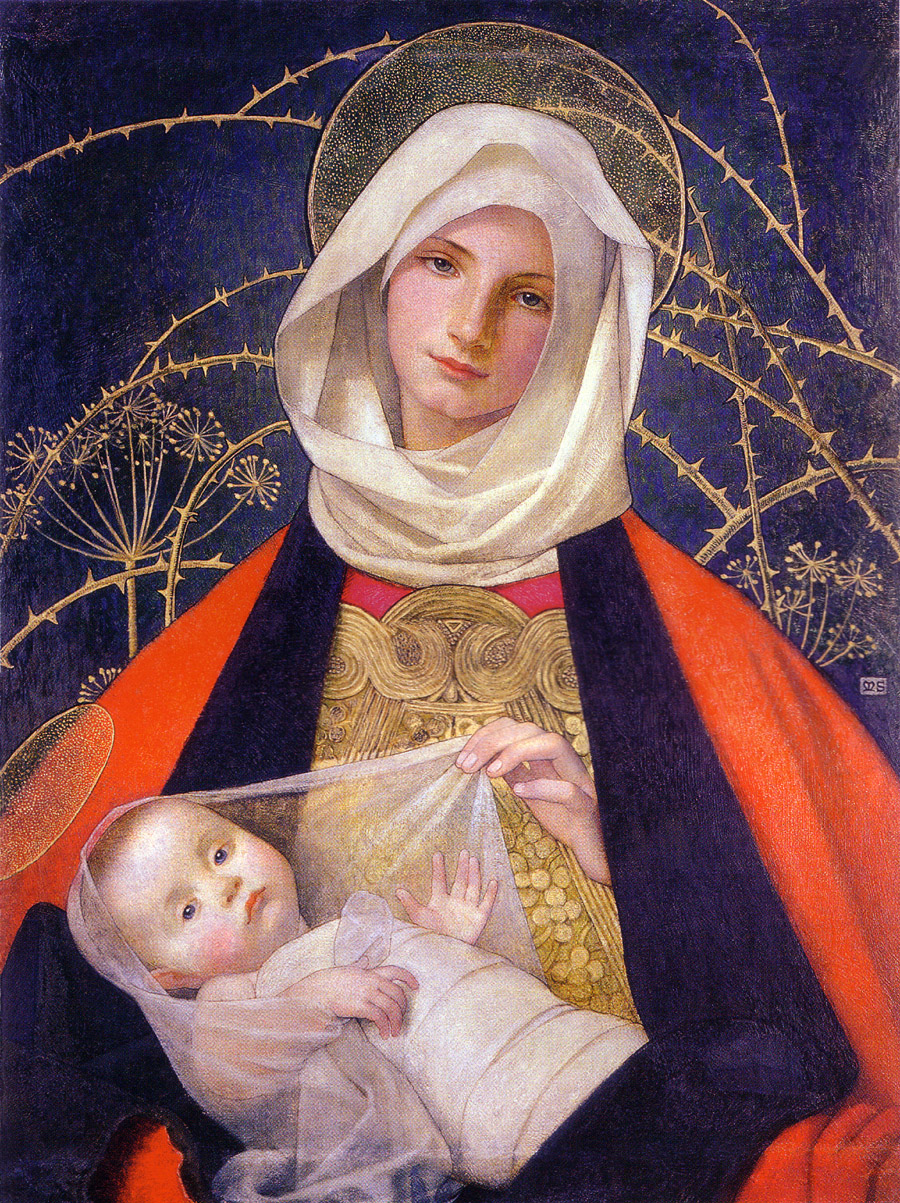
“Madonna and Child,” by the Austrian-born English painter Marianne Stokes (1855-1927)
Wikimedia Commons
My wife and I watched The Muppet Christmas Carol this afternoon. Honest. We did.
In that connection, I call your attention to an interesting article to which my friend and Interpreter Foundation colleague Craig Foster alerted me the other day:
“The Story Behind the Music of The Muppet Christmas Carol”
***
I was really pleased to read about this:
“Kirtland Nativity event with nearly 1,000 creches draws Christmas lovers”
***
But this is even better:
***
Here’s the theme for today, the twenty-fifth and last day of the “Light the World” Christmas initiative:
***
I offer, too, a column that Bill Hamblin and I published in the Deseret News on 14 December 2013:
“Charles Dickens and the invention of Christmas”
Owing to the huge immigration of villagers into rapidly growing cities caused by the Industrial Revolution, traditional observance of Christmas had been declining in England since the late 1700s. Leaving their ancestral customs and social networks behind, these new urban dwellers were often poor, and they worked long and exhausting hours in increasingly mechanized factories.
Moreover, their employers — of whom the fictional Ebenezer Scrooge is a fairly typical representative in this respect — weren’t especially inclined to grant them paid leave on Christmas Day. Time is money.
Writers such as Sir Walter Scott, in 1808, and the American Washington Irving, in 1820, lamented the decline of English country Christmases. But others welcomed it. Conservative reformed Protestants, for example, regarded Christmas as unbiblical, dangerously Catholic (“Christ’s mass”) and even immoral.
In fact, during the brief interval when they ruled England under Oliver Cromwell in the mid-1600s, they actually abolished it — which isn’t altogether surprising, given the drunkenness, hooliganism, extravagance and sexual license that (rather like some Mardi Gras festivities today) often accompanied rural English celebrations of Christmas in the 16th and 17th centuries.
By the 1840s, however, many Englishmen were growing nostalgic for “jolly olde England” as it had existed before the arrival of the railroad and the dirty, noisy factories (William Blake’s “dark satanic mills”) of rising industrial Britain. Charles Dickens, entering into middle age, was plainly among them. He wrote extensively and often about Christmas, far beyond the famous 1843 tale of Scrooge and those tutoring ghosts; his enormous audience demanded a Christmas article or story from him every year.
Dickens’ descriptions of Christmas plainly rest upon idealized memories of his own childhood, which was, actually, partially spent in a workhouse while his father languished in Southwark’s Marshalsea debtors’ prison. (Many of his stories are, in part, autobiographical.)
A hearty meal of goose or turkey, hot wine or cider, games, dancing, sleighs, carriages, country inns, good cheer and gifts, a loving family gathered around a blazing Yule log while all is cold outside — these are images of an essentially early Victorian rural Christmas that Dickens bequeathed to us and that still, for many, form the iconic visual image of the holiday. Even our common expectation that a proper Christmas greeting card depict snow may rest, to some extent, upon the fact that, rather unusually for his native climate, his first eight childhood Christmases were white.
Curiously, Christmas cards themselves seem to have their origin at about the same time, although they didn’t really catch on and go into commercial production until about four decades later. The story is well documented: In 1843, Sir Henry Cole, too busy, he thought, to be able to write substantial Christmas letters to his friends, commissioned an artist to design decorated cards for him on which he would write brief notes. Sir Henry ordered a thousand of them — as it happened, many more than he needed — and sent the remainder to a stationer’s shop on London’s Old Bond Street for sale.
Perhaps strangely to us today, the celebrations in Dickens’s “Christmas Carol” feature no Christmas trees. German-born Queen Charlotte introduced this new element of “traditional” Christmas into the English royal household in 1800, but its popularity soared only after December 1840, when Queen Victoria’s consort, Prince Albert, also from Germany, set up and decorated several trees in the royal palace. (Victoria and Albert had been married the previous February.) “That pretty German toy,” as Dickens would eventually call it, fit in very nicely with the holly and the mistletoe that had formed part of mid-winter celebrations in Britain since the fifth century.
One of the author’s sons later recalled that, for Dickens, Christmas was “a great time, a really jovial time, and my father was always at his best, a splendid host, bright and jolly as a boy and throwing his heart and soul into everything that was going on. … And then the dance! There was no stopping him!”
It’s very largely thanks to Charles Dickens and his England that, despite the historical origins of Christmas — probably in the spring and certainly in a Mediterranean climate — modern Americans tend to celebrate Jesus Christ’s Nativity as an idealized early Victorian mid-winter family feast. But there’s much good in the holiday customs he helped to preserve and spread, because, as Dickens himself wrote of the repentant Ebenezer Scrooge, “he knew how to keep Christmas well if any man alive possessed the knowledge.”
Next Post

December 25, 2017 Gratitude for Our Moon
Browse Our Archives
Select a Category Uncategorized
Select a Month October 2026 September 2026 August 2026 July 2026 June 2026 May 2026 April 2026 March 2026 February 2026 January 2026 December 2025 November 2025 October 2025 September 2025 August 2025 July 2025 June 2025 May 2025 April 2025 March 2025 February 2025 January 2025 December 2024 November 2024 October 2024 September 2024 August 2024 July 2024 June 2024 May 2024 April 2024 March 2024 February 2024 January 2024 December 2023 November 2023 October 2023 September 2023 August 2023 July 2023 June 2023 May 2023 April 2023 March 2023 February 2023 January 2023 December 2022 November 2022 October 2022 September 2022 August 2022 July 2022 June 2022 May 2022 April 2022 March 2022 February 2022 January 2022 December 2021 November 2021 October 2021 September 2021 August 2021 July 2021 June 2021 May 2021 April 2021 March 2021 February 2021 January 2021 December 2020 November 2020 October 2020 September 2020 August 2020 July 2020 June 2020 May 2020 April 2020 March 2020 February 2020 January 2020 December 2019 November 2019 October 2019 September 2019 August 2019 July 2019 June 2019 May 2019 April 2019 March 2019 February 2019 January 2019 December 2018 November 2018 October 2018 September 2018 August 2018 July 2018 June 2018 May 2018 April 2018 March 2018 February 2018 January 2018 December 2017 November 2017 October 2017 September 2017 August 2017 July 2017 June 2017 May 2017 April 2017 March 2017 February 2017 January 2017 December 2016 November 2016 October 2016 September 2016 August 2016 July 2016 June 2016 May 2016 April 2016 March 2016 February 2016 January 2016 December 2015 November 2015 October 2015 September 2015 August 2015 July 2015 June 2015 May 2015 April 2015 March 2015 February 2015 January 2015 December 2014 November 2014 March 2014 August 2013 February 2012
Follow Us!
TAKE THE
Religious Wisdom Quiz
Which Christian denomination is most associated with the Reformation led by Martin Luther?
Select your answer to see how you score.
Orthodox Anglican Catholic Lutheran
Related posts from Sic et Non

The Iron Gates and the Lion of the...


Learning more about a region of which I've...

From Serbia's "White City," Belgrade
TRENDING AT PATHEOS Latter-day Saint

In one sense walking into Westminster Abbey is like walking down the...

'Super Scam Me' Exposes AI Jon Bon Jovi...
Leslie Pickett believed she was in a relationship with Jon Bon Jovi....

The Brazilian Remake of Kendricks' 'Flywheel' Opens in...
“Flywheel,” the story that launched the Kendrick Brothers’ filmmaking career is getting...

The Dangers of Gradual Accommodation (Winking at Sin)
Recently, the “law of gradualness” resurfaced during the opening of a weeklong,...

The Iron Gates and the Lion of the...
Yesterday, I didn't finish my report about, well, yesterday. So I'll...

The Image: On the Horror of Capitalism and...
The Image Then went the Pharisees, and took counsel how they might...
view all Latter-day Saint blogs
Ad-Free & Subscriber Log-In Subscription Support
- About Us
- 2026 Calendar
- Videos
- Podcasts
- Library of World Religions
- Faith In Media Tracker
- Advertise With Us
- Write for Us
- Privacy Policy
- Terms of Service
- Do Not Sell My Data
- Contact Us
- Radiant Digital
- Manage Newsletter Subscriptions
- Unsubscribe From Notifications
- Sitemap
Copyright 2008-2026, Patheos. All rights reserved.
Subscription Support Ad-Free & Subscriber Log-In
Follow Patheos