
BuddhistCatholicContemplativeEvangelicalGeneral ChristianHinduJewishLatter-day SaintMuslimNew VisionsProgressive Christian
Beliefs
- Buddhist
- Catholic
- Contemplative
- Evangelical
- General Christian
- Hindu
- Jewish
- Latter-day Saint
- More Voices
- Muslim
- New Visions
- Pagan
- Progressive Christian
Topics
- Religion News
- Food and Religion
- Sports and Religion
- Religious Art
- Religious Music and Entertainment
- Religious Events
- History and Religion
- Style and Religion
- Politics and Religion
- Women in Religion
- Recreation Outdoors and Religion
- Business Finance and Religion
- Careers Workplace and Religion
- Education and Religion
- Family Parenting and Religion
- Health Fitness and Religion
- Home and Religion
- Relationships and Religion
- Technology and Religion
- Travel and Religion
Columnists
- Buddhist Columnists
- Business Finance and Religion Columnists
- Careers Workplace and Religion Columnists
- Catholic Columnists
- Contemplative Columnists
- Education and Religion Columnists
- Evangelists Columnists
- Family Parenting and Religion Columnists
- General Christian Columnists
- Health Fitness and Religion Columnists
- Hindu Columnists
- History and Religion Columnists
- Home and Religion Columnists
- Jewish Columnists
- More Voices Columnists
- Latter Day Columnists
- Muslim Columnists
- New Visions Columnists
- Nonreligious Columnists
- Pagan Columnists
- Politics and Religion Columnists
- Progressive Columnists
- Recreation Outdoors and Religion Columnists
- Relationships and Religion Columnists
- Religion News Columnists
- Religious Art Columnists
- Religious Events Columnists
- Religious Music and Entertainment Columnists
- Sports and Religion Columnists
- Style and Religion Columnists
- Technology and Religion Columnists
- Travel and Religion Columnists
- Women in Religion Columnists
Resource Library
- 2026 Calendar
- Library of World Religions
- The 100 Most Holy Places on Earth
- Patheos Answers
- Podcasts
- Videos
- Faith Leaders Database
- Anglican Episcopalian
- Bahai
- Baptist
- Buddhism
- Christianity
- Confucianism
- Eastern Orthodoxy
- Hinduism
- Holiness and Pentecostal
- ISKCON
- Islam
- Judaism
- Lutheran
- Methodist
- The Church of Jesus Christ of Latter-day Saints
- New Age
- Paganism
- Presbytarian and Reformed
- Protestantism
- Religion Behind the Scenes
- Roman Catholic
- Scientology
- Shia Islam
- Sikhism
- Sufism
- Sunni Islam
- Taoism
- Zen
- See all religions
Research Tools
 Ad-Free & Subscriber Log-In Subscription Support
Ad-Free & Subscriber Log-In Subscription Support
Follow Patheos 

- Trending:
- Forgiveness
- |
- Marriage
- |
- Consciousness
- |
- Death Penalty
- |
- Election
- |
- Halloween

- Home
- Latter-day Saint
- “On science’s perpetual triumphs over religion,” Part One
“On science’s perpetual triumphs over religion,” Part One
Last updated on: November 12, 2017 at 9:29 pm by Dan Peterson
“On science’s perpetual triumphs over religion,” Part One 2017-11-12T21:29:59-07:00 Dan Peterson
Patheos Explore the world's faith through different perspectives on religion and spirituality! Patheos has the views of the prevalent religions and spiritualities of the world.
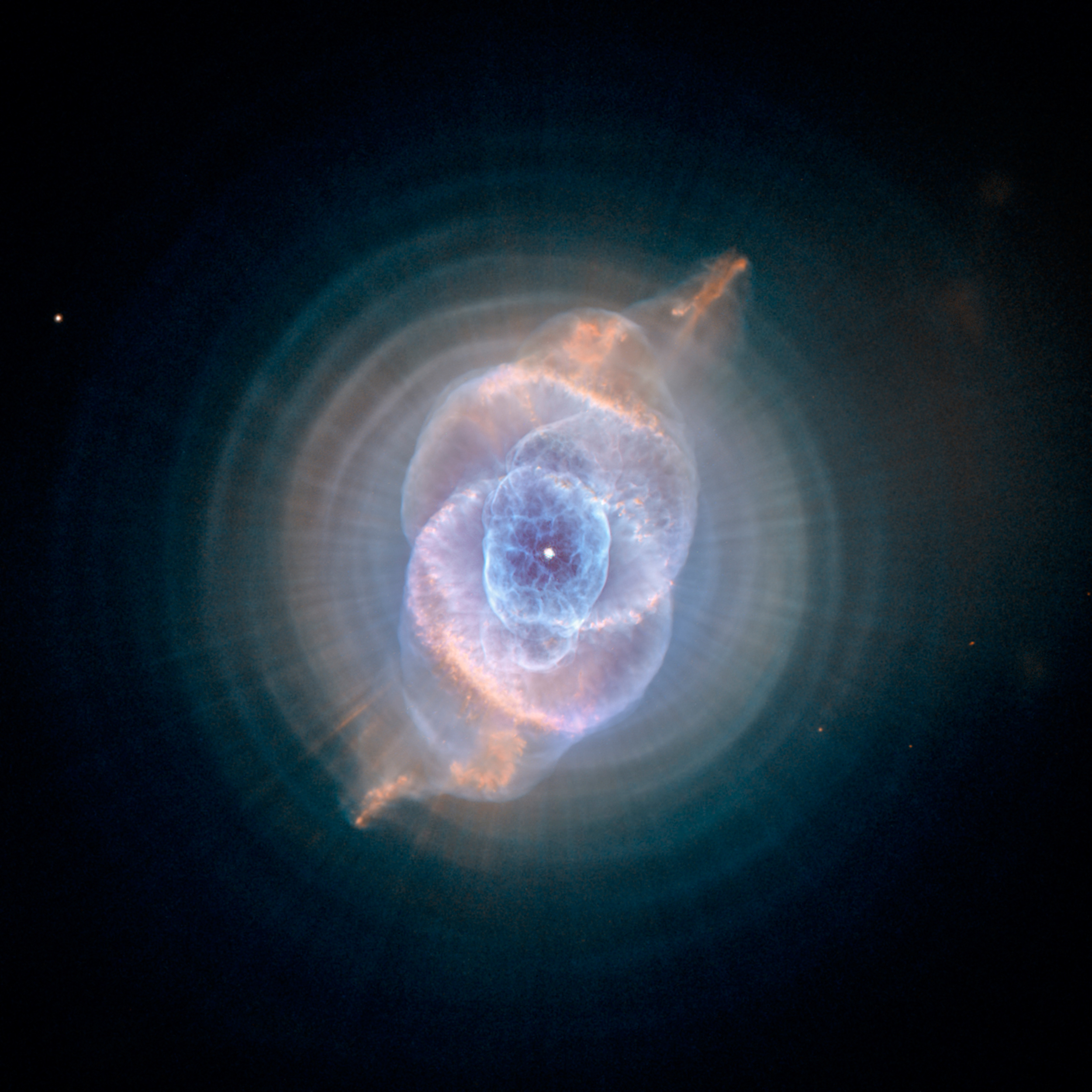
The Cat’s Eye Nebula, one of the first planetary nebulae discovered, also has one of the most complex forms known to this kind of nebula. Eleven rings, or shells, of gas make up the Cat’s Eye.
Credit: NASA, ESA, HEIC, and The Hubble Heritage Team (STScI/AURA)
Acknowledgment: R. Corradi (Isaac Newton Group of Telescopes, Spain) and Z. Tsvetanov (NASA)
I sometimes get a kick out of the online comments of a fellow who espouses a particularly crude and simplistic scientism. He recently posted the following:
You won’t find even one instance where science has had to say it was wrong, and someones sacred scriptures from antiquity got it right. Not. one. time. not. one. item.
Well . . .
My response will occupy three blog posts.
I’ll start with an extended quotation from the prolific Alister McGrath, one of whose many excellent books I’m currently reading. (And, for the benefit of a certain online critic of mine, who has recently taken to suggesting that, in quoting Dr. McGrath, I’m quoting a scientifically ignorant Anglican priest in an attack on science, I’ll mention – again – that, prior to his ordination and his acquisition of Oxford doctorates in divinity and intellectual history, McGrath first earned an Oxford doctorate in molecular biophysics.)
Once upon a time, people thought that the universe had always been here. That was what the great philosopher Aristotle taught. Early Christian writers, committed to a notion of the divine creation of the universe, thought that Aristotle was wrong. During the first five centuries, they insisted that the universe was not eternal but had come into being. Nobody seems to have taken much notice of them.
Augustine of Hippo (354-430), probably the greatest and certainly the most influential Christian thinker of that age, taught that, since time was part of the created order, God could not be said to have created the universe in time; rather, God created the universe with time. . . .
Augustine argued that God brought everything into existence in a single moment of creation. Yet this created order was not static. God endowed it with the capacity to develop. The creation is meant to change over time, becoming what God intended it to be, rather than having been created in its final definitive form.
When the great intellectual renaissance of the Middle Ages began, Augustine’s approaches to the evolution of the created order and the nature of time did not fit the dominant philosophical narrative of the day, and so were marginalized. Augustine was seen as a major – indeed, the major – theological authority of that age. Yet Aristotle was widely regarded as the supreme scientific authority, and his ideas came to dominate the scientific theories of the time. Medieval science was thus committed to the idea of the eternity of the world, because this was such a significant feature of Aristotle’s thought. This put Christian theologians in a difficult position. They liked Aristotle, especially his ideas on intellectual method. But they could not go along with his core belief that the universe had always existed. It seemed like an irreconcilable difference between science and religion – between Aristotle and Augustine. Both sides remained committed to their positions, and no reconciliation was really achieved.
By the end of the nineteenth century, the scientific consensus remained roughly the same on the issue of the eternity of the universe. The great Swedish physicist Svante Arrhenius (1859-1927), who won the Nobel Prize for chemistry in 1903, wrote a best-selling work entitled Worlds in the Making (1906). In this he argued for an infinite, self-perpetuating universe without beginning or end, based partly on the recently discovered principle of the “indestructibility of energy.” Arrhenius made clear his fundamental “conviction that the Universe in its essence has always been what it is now. Matter, energy, and life have only varied as to shape and position in space.” Matter and energy might move around the universe; there was, however, no overall change within the system as a whole.
Alister McGrath, The Big Question: Why We Can’t Stop Talking about Science, Faith and God (New York: St. Martin’s Press, 2015), 78-80.
Thus ends Part One of Three.
Previous Post

November 11, 2017
"I was acquainted with Joseph Smith for years."
Next Post
November 12, 2017 "On science's perpetual triumphs over religion," Part Two
Browse Our Archives
Select a Category Uncategorized
Select a Month October 2026 September 2026 August 2026 July 2026 June 2026 May 2026 April 2026 March 2026 February 2026 January 2026 December 2025 November 2025 October 2025 September 2025 August 2025 July 2025 June 2025 May 2025 April 2025 March 2025 February 2025 January 2025 December 2024 November 2024 October 2024 September 2024 August 2024 July 2024 June 2024 May 2024 April 2024 March 2024 February 2024 January 2024 December 2023 November 2023 October 2023 September 2023 August 2023 July 2023 June 2023 May 2023 April 2023 March 2023 February 2023 January 2023 December 2022 November 2022 October 2022 September 2022 August 2022 July 2022 June 2022 May 2022 April 2022 March 2022 February 2022 January 2022 December 2021 November 2021 October 2021 September 2021 August 2021 July 2021 June 2021 May 2021 April 2021 March 2021 February 2021 January 2021 December 2020 November 2020 October 2020 September 2020 August 2020 July 2020 June 2020 May 2020 April 2020 March 2020 February 2020 January 2020 December 2019 November 2019 October 2019 September 2019 August 2019 July 2019 June 2019 May 2019 April 2019 March 2019 February 2019 January 2019 December 2018 November 2018 October 2018 September 2018 August 2018 July 2018 June 2018 May 2018 April 2018 March 2018 February 2018 January 2018 December 2017 November 2017 October 2017 September 2017 August 2017 July 2017 June 2017 May 2017 April 2017 March 2017 February 2017 January 2017 December 2016 November 2016 October 2016 September 2016 August 2016 July 2016 June 2016 May 2016 April 2016 March 2016 February 2016 January 2016 December 2015 November 2015 October 2015 September 2015 August 2015 July 2015 June 2015 May 2015 April 2015 March 2015 February 2015 January 2015 December 2014 November 2014 March 2014 August 2013 February 2012
Follow Us!
TAKE THE
Religious Wisdom Quiz
Who was the first king of Judah after Israel split?
Select your answer to see how you score.
Ahab Jeroboam Asa Rehoboam
Related posts from Sic et Non


Learning more about a region of which I've...

From Serbia's "White City," Belgrade

TRENDING AT PATHEOS Latter-day Saint

When Halloween Unmasks Married Hearts
Written by Dr. David K. Ewen from Eternal Truth Bible College Behind...

Aristotle. He’s been called the father of logic, the father of the...

Methodist Central Hall and Westminster Abbey
Situated on the same square is Methodist Central Hall and Westminster Abbey. ...

57th Dove Awards Honor Dolly Parton, Crown New...
On gospel music’s biggest night, the 57th annual GMA Dove Awards honored...

The First Eucharistic Controversy: Christ’s Real Presence
For Catholics, the Eucharist is the source and summit of the Christian...

What a Stop Sign Can Teach Us About...
How to Make a Decision When You Can't Hear God Main point:...
view all Latter-day Saint blogs
Ad-Free & Subscriber Log-In Subscription Support
- About Us
- 2026 Calendar
- Videos
- Podcasts
- Library of World Religions
- Faith In Media Tracker
- Advertise With Us
- Write for Us
- Privacy Policy
- Terms of Service
- Do Not Sell My Data
- Contact Us
- Radiant Digital
- Manage Newsletter Subscriptions
- Unsubscribe From Notifications
- Sitemap
Copyright 2008-2026, Patheos. All rights reserved.
Subscription Support Ad-Free & Subscriber Log-In
Follow Patheos