
BuddhistCatholicContemplativeEvangelicalGeneral ChristianHinduJewishLatter-day SaintMuslimNew VisionsProgressive Christian
Beliefs
- Buddhist
- Catholic
- Contemplative
- Evangelical
- General Christian
- Hindu
- Jewish
- Latter-day Saint
- More Voices
- Muslim
- New Visions
- Pagan
- Progressive Christian
Topics
- Religion News
- Food and Religion
- Sports and Religion
- Religious Art
- Religious Music and Entertainment
- Religious Events
- History and Religion
- Style and Religion
- Politics and Religion
- Women in Religion
- Recreation Outdoors and Religion
- Business Finance and Religion
- Careers Workplace and Religion
- Education and Religion
- Family Parenting and Religion
- Health Fitness and Religion
- Home and Religion
- Relationships and Religion
- Technology and Religion
- Travel and Religion
Columnists
- Buddhist Columnists
- Business Finance and Religion Columnists
- Careers Workplace and Religion Columnists
- Catholic Columnists
- Contemplative Columnists
- Education and Religion Columnists
- Evangelists Columnists
- Family Parenting and Religion Columnists
- General Christian Columnists
- Health Fitness and Religion Columnists
- Hindu Columnists
- History and Religion Columnists
- Home and Religion Columnists
- Jewish Columnists
- More Voices Columnists
- Latter Day Columnists
- Muslim Columnists
- New Visions Columnists
- Nonreligious Columnists
- Pagan Columnists
- Politics and Religion Columnists
- Progressive Columnists
- Recreation Outdoors and Religion Columnists
- Relationships and Religion Columnists
- Religion News Columnists
- Religious Art Columnists
- Religious Events Columnists
- Religious Music and Entertainment Columnists
- Sports and Religion Columnists
- Style and Religion Columnists
- Technology and Religion Columnists
- Travel and Religion Columnists
- Women in Religion Columnists
Resource Library
- 2026 Calendar
- Library of World Religions
- The 100 Most Holy Places on Earth
- Patheos Answers
- Podcasts
- Videos
- Faith Leaders Database
- Anglican Episcopalian
- Bahai
- Baptist
- Buddhism
- Christianity
- Confucianism
- Eastern Orthodoxy
- Hinduism
- Holiness and Pentecostal
- ISKCON
- Islam
- Judaism
- Lutheran
- Methodist
- The Church of Jesus Christ of Latter-day Saints
- New Age
- Paganism
- Presbytarian and Reformed
- Protestantism
- Religion Behind the Scenes
- Roman Catholic
- Scientology
- Shia Islam
- Sikhism
- Sufism
- Sunni Islam
- Taoism
- Zen
- See all religions
Research Tools
 Ad-Free & Subscriber Log-In Subscription Support
Ad-Free & Subscriber Log-In Subscription Support
Follow Patheos 

- Trending:
- Forgiveness
- |
- Marriage
- |
- Consciousness
- |
- Death Penalty
- |
- Election
- |
- Halloween

- Home
- Latter-day Saint
- A note on scientistic reductionism
A note on scientistic reductionism
Last updated on: October 16, 2017 at 7:49 pm by Dan Peterson
A note on scientistic reductionism 2017-10-16T19:49:11-06:00 Dan Peterson
Patheos Explore the world's faith through different perspectives on religion and spirituality! Patheos has the views of the prevalent religions and spiritualities of the world.

An aerial view of the East Campus of the Massachusetts Institute of Technology (MIT) and the Charles River, facing Back Bay and central Boston. The Harvard Bridge is at the bottom right.
(Wikimedia Commons public domain photo by Nick Allen)
Dr. Ian H. Hutchinson is Professor of Nuclear Science and Engineering at the Massachusetts Institute of Technology, with a primary research interest in plasma physics. In this passage from his book Monopolizing Knowledge, he takes aim at “reductionism”:
It is the assertion, or more usually unspoken presumption, that when a satisfactory scientific explanation at a reduced level exists, such an explanation trumps, invalidates, or explains away understanding at higher levels: that the higher level descriptions lose their force or relevance. This is certainly what, for example, Donald MacKay in his The clockwork image (1974) is complaining about, and why he coined the disparaging but descriptive phrase “nothing-buttery” to refer to ontological reductionism. “Nothing-buttery is characterized by the notion that by reducing any phenomenon to its components you not only explain it, but explain it away.” It is definitely helpful to analyze animal bodies in terms of their cells, but it is unhelpful, and fundamentally untrue, to conclude that if one completes such an analysis, then animals are demonstrated to be nothing but assemblies of cells. The presumption that reduced level explanations explain away higher level descriptions generally operates inconsistently. It must do so, because science is full of descriptions and explanations that are actually not reductionist in the senses identified by [Richard] Dawkins and [Michael] Ruse. Nothing-buttery usually operates in such a way as to discriminate against the descriptions that don’t conform to the ideals of science. We shall examine later some examples of this process at work, but here we simply draw attention to the fact that it is a trait of scientism.
(Ian Hutchinson, Monopolizing Knowledge [Belmont, MA: Fias Publishing, 2011], 1-3)
Illustrative specimens that come to mind might include, among almost infinitely many others, any painting by Leonardo da Vinci. Nobody, I trust, would seriously propose that one had really thoroughly understood his “fresco” of The Last Supper by measuring it precisely, calculating the chemical composition of the various pigments, determining their depth on the wall, and so forth, while excluding Leonardo’s purpose in creating it and in making it just as it is, the historical background of the painting (including the New Testament story that it represents), the intentions of those who commissioned it, its function in the room of Milan’s Convent of Santa Maria delle Grazie where it appears, the function of that room itself, the economy of late-fifteenth-century Florence, and a host of other potentially fruitful approaches.
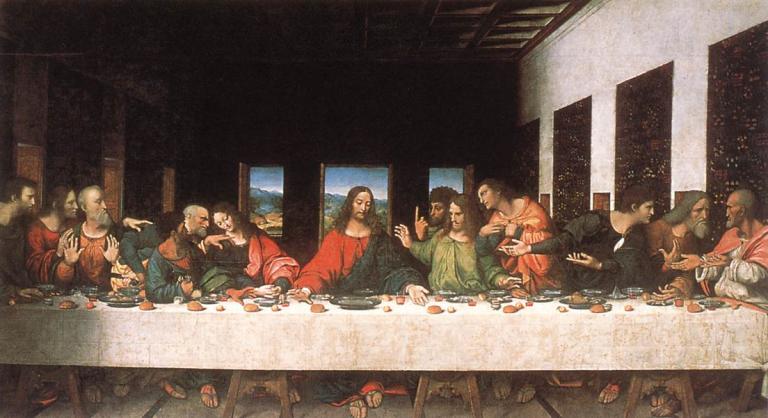
Leonardo da Vinci’s late fifteenth-century mural of “The Last Supper”
(Wikimedia Commons public domain)
If one could somehow construct an exhaustive and accurate account of the synaptic firings in Shakespeare’s brain (or the Earl of Oxford’s, or whatever author you prefer) during the time that he was writing King Lear, would doing so actually help very much, if at all, in fully understanding or appreciating that very great play?
Previous Post

October 16, 2017
The epitome of pre-Islamic Arabian generosity
Next Post
October 16, 2017 'The Mormon Hierarchy: Wealth & Corporate Power'
Browse Our Archives
Select a Category Uncategorized
Select a Month October 2026 September 2026 August 2026 July 2026 June 2026 May 2026 April 2026 March 2026 February 2026 January 2026 December 2025 November 2025 October 2025 September 2025 August 2025 July 2025 June 2025 May 2025 April 2025 March 2025 February 2025 January 2025 December 2024 November 2024 October 2024 September 2024 August 2024 July 2024 June 2024 May 2024 April 2024 March 2024 February 2024 January 2024 December 2023 November 2023 October 2023 September 2023 August 2023 July 2023 June 2023 May 2023 April 2023 March 2023 February 2023 January 2023 December 2022 November 2022 October 2022 September 2022 August 2022 July 2022 June 2022 May 2022 April 2022 March 2022 February 2022 January 2022 December 2021 November 2021 October 2021 September 2021 August 2021 July 2021 June 2021 May 2021 April 2021 March 2021 February 2021 January 2021 December 2020 November 2020 October 2020 September 2020 August 2020 July 2020 June 2020 May 2020 April 2020 March 2020 February 2020 January 2020 December 2019 November 2019 October 2019 September 2019 August 2019 July 2019 June 2019 May 2019 April 2019 March 2019 February 2019 January 2019 December 2018 November 2018 October 2018 September 2018 August 2018 July 2018 June 2018 May 2018 April 2018 March 2018 February 2018 January 2018 December 2017 November 2017 October 2017 September 2017 August 2017 July 2017 June 2017 May 2017 April 2017 March 2017 February 2017 January 2017 December 2016 November 2016 October 2016 September 2016 August 2016 July 2016 June 2016 May 2016 April 2016 March 2016 February 2016 January 2016 December 2015 November 2015 October 2015 September 2015 August 2015 July 2015 June 2015 May 2015 April 2015 March 2015 February 2015 January 2015 December 2014 November 2014 March 2014 August 2013 February 2012
Follow Us!
TAKE THE
Religious Wisdom Quiz
What is the meaning of "Jerusalem"?
Select your answer to see how you score.
Place of Kings Mountain of God Foundation of Peace City of Truth
Related posts from Sic et Non


Learning more about a region of which I've...

From Serbia's "White City," Belgrade

TRENDING AT PATHEOS Latter-day Saint

57th Dove Awards Honor Dolly Parton, Crown New...
On gospel music’s biggest night, the 57th annual GMA Dove Awards honored...

The First Eucharistic Controversy: Christ’s Real Presence
For Catholics, the Eucharist is the source and summit of the Christian...

What a Stop Sign Can Teach Us About...
How to Make a Decision When You Can't Hear God Main point:...

Archdiocese Hosts Military Marriage Retreat in Germany
RASTATT, Germany — The transient military lifestyle, with its frequent deployments and...

Nearly every morning, I make the drive to Detroit with my high-school-age...

The Real AI Story Is Adoption Without Trust
Artificial intelligence has crossed a political threshold. It is no longer a...
view all Latter-day Saint blogs
Ad-Free & Subscriber Log-In Subscription Support
- About Us
- 2026 Calendar
- Videos
- Podcasts
- Library of World Religions
- Faith In Media Tracker
- Advertise With Us
- Write for Us
- Privacy Policy
- Terms of Service
- Do Not Sell My Data
- Contact Us
- Radiant Digital
- Manage Newsletter Subscriptions
- Unsubscribe From Notifications
- Sitemap
Copyright 2008-2026, Patheos. All rights reserved.
Subscription Support Ad-Free & Subscriber Log-In
Follow Patheos