
BuddhistCatholicContemplativeEvangelicalGeneral ChristianHinduJewishLatter-day SaintMuslimNew VisionsProgressive Christian
Beliefs
- Buddhist
- Catholic
- Contemplative
- Evangelical
- General Christian
- Hindu
- Jewish
- Latter-day Saint
- More Voices
- Muslim
- New Visions
- Pagan
- Progressive Christian
Topics
- Religion News
- Food and Religion
- Sports and Religion
- Religious Art
- Religious Music and Entertainment
- Religious Events
- History and Religion
- Style and Religion
- Politics and Religion
- Women in Religion
- Recreation Outdoors and Religion
- Business Finance and Religion
- Careers Workplace and Religion
- Education and Religion
- Family Parenting and Religion
- Health Fitness and Religion
- Home and Religion
- Relationships and Religion
- Technology and Religion
- Travel and Religion
Columnists
- Buddhist Columnists
- Business Finance and Religion Columnists
- Careers Workplace and Religion Columnists
- Catholic Columnists
- Contemplative Columnists
- Education and Religion Columnists
- Evangelists Columnists
- Family Parenting and Religion Columnists
- General Christian Columnists
- Health Fitness and Religion Columnists
- Hindu Columnists
- History and Religion Columnists
- Home and Religion Columnists
- Jewish Columnists
- More Voices Columnists
- Latter Day Columnists
- Muslim Columnists
- New Visions Columnists
- Nonreligious Columnists
- Pagan Columnists
- Politics and Religion Columnists
- Progressive Columnists
- Recreation Outdoors and Religion Columnists
- Relationships and Religion Columnists
- Religion News Columnists
- Religious Art Columnists
- Religious Events Columnists
- Religious Music and Entertainment Columnists
- Sports and Religion Columnists
- Style and Religion Columnists
- Technology and Religion Columnists
- Travel and Religion Columnists
- Women in Religion Columnists
Resource Library
- 2026 Calendar
- Library of World Religions
- The 100 Most Holy Places on Earth
- Patheos Answers
- Podcasts
- Videos
- Faith Leaders Database
- Anglican Episcopalian
- Bahai
- Baptist
- Buddhism
- Christianity
- Confucianism
- Eastern Orthodoxy
- Hinduism
- Holiness and Pentecostal
- ISKCON
- Islam
- Judaism
- Lutheran
- Methodist
- The Church of Jesus Christ of Latter-day Saints
- New Age
- Paganism
- Presbytarian and Reformed
- Protestantism
- Religion Behind the Scenes
- Roman Catholic
- Scientology
- Shia Islam
- Sikhism
- Sufism
- Sunni Islam
- Taoism
- Zen
- See all religions
Research Tools
 Ad-Free & Subscriber Log-In Subscription Support
Ad-Free & Subscriber Log-In Subscription Support
Follow Patheos 

- Trending:
- Forgiveness
- |
- Marriage
- |
- Consciousness
- |
- Death Penalty
- |
- Election
- |
- Halloween
 Off the Cushion
- Home
- Buddhist
- My Five Favorite Dharma Books of 2013
My Five Favorite Dharma Books of 2013
Last updated on: January 9, 2014 at 12:30 pm by dannyfisher
My Five Favorite Dharma Books of 2013 2014-01-09T12:30:42-07:00 dannyfisher
Patheos Explore the world's faith through different perspectives on religion and spirituality! Patheos has the views of the prevalent religions and spiritualities of the world.
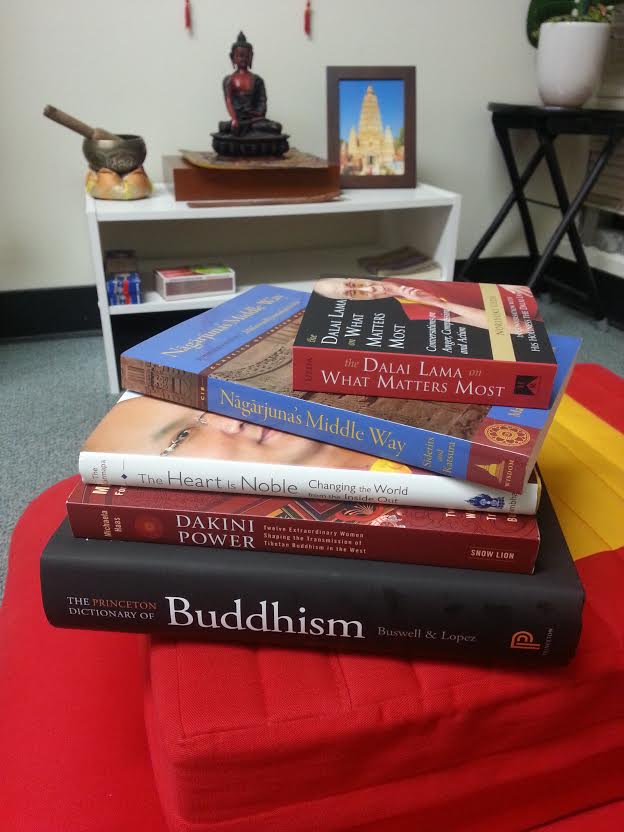 Continuing the end-of-the-year lists for 2013, here are five of my favorite dharma books from 2013. (Unlike my list of five favorite films, I haven’t ranked these — they’re just listed alphabetically again this year just as they were last year.) Once again, I find that five is a hard number for trying to represent a broad spectrum of Buddhist traditions and perspectives — for example, there’s not really a title from the Theravada/Insight perspective this year (though both Mindfulness: A Practical Guide to Awakening by Joseph Goldstein and The Birth of Insight: Meditation, Modern Buddhism, and the Burmese Monk Ledi Sayadaw by Erik Braun would certainly be on the list if I were doing a “top ten”) — but I think it’s probably better to keep these things short and sweet. Every year will undoubtedly be different, too. Besides, I really want to know what your favorites were this year too, and I hope you’ll share them with us in the comments of this post.
* * *
**** Dakini Power: Twelve Extraordinary Women Shaping the Transmission of Tibetan Buddhism in the West* by Michaela Haas**
A two-time interviewee and a dear friend, Michaela Haas (who gifted me with a copy of the book) has produced an extraordinary volume with Dakini Power: a history and modern hagiography (in the best sense) of several women who have been important in terms of bringing Tibetan Buddhism to the Western world — among them, Pema Chödron, Khandro Rinpoche, Thubten Chödron, Lama Tsultrim Allione, Roshi Joan Halifax, and others. As engaging and inspiring as it is informative, this is a uniquely wonderful book that should prove to play a large role in encouraging and helping to develop more Buddhist leaders who are women. We should all be very grateful indeed to Dr. Haas.
**** The Dalai Lama on What Matters Most: Conversations on Anger, Compassion, and Action* by Noriyuki Ueda**
Japanese cultural anthropologist Ueda’s lively, book-length conversation with His Holiness the Dalai Lama is an essential in its excellent, way-better-than-average questions and equally exciting answers. For those of us interested in the intersection of social justice and Buddhism, there are quite a few magnificent exchanges here, as well as some forceful statements from His Holiness. Here’s one we highlighted last year: “When faced with economic or any other kind of injustice, it is totally wrong for a religious person to remain indifferent. Religious people must struggle to solve these problems.” This is a quick, supremely pleasant read that stays with the reader and forever ups the ante on conversations with Buddhist leaders.
**** The Heart is Noble: Changing the World from the Inside Out* by His Holiness the 17th Karmapa, Ogyen Trinley Dorje**
Just as Ueda’s conversation with His Holiness the Dalai Lama raises the bar for interviews, His Holiness the Karmapa’s book (which Shambhala Publications provided me with a free copy of) raises the bar for books by Buddhist leaders. Ranging from issues of person spirituality (such as meaningful living and healthy relationships) to larger social concerns (such as climate change, food justice, gender and sexuality, consumerism and inequality, and so on), His Holiness teaches us that our vision of practice must be larger than simply our own lives. More importantly, he makes the connection between personal practice and global suffering in a gentle, compelling way. A lot of expectation is on the shoulders of this young teacher, and, if this book is any indication, he’ll have no problem at all living up to it.
**** Nāgārjuna’s Middle Way: Mūlamadhyamakakārikā* by Mark Siderits and Shoryu Katsura**
With several excellent translations of Nāgārjuna’s masterpiece already available, what sets Siderits and Katsura’s translation apart? Its synthesis of a lot of important scholarship, its accessibility, and its thoroughness for starters. Scholar and practitioner-friendly, this is now, as blurb writer and Buddhologist Dan Arnold says, “the go-to translation of one of the most important works of the Indian Buddhist philosophical tradition.” Bravo, gentlemen — you’ve done a great service to those who care about Buddhist thought. And bravo also to Wisdom Publications, whose Classics of Indian Buddhism series just keeps getting better and better.
**** The Princeton Dictionary of Buddhism* by Robert E. Buswell, Jr., and Donald S. Lopez, Jr.**
“5,000 entries.” “Over a million words.” The first such volume to “cover terms from all canonical Buddhist languages and traditions,” as well as “selected terms and names in Thai, Burmese, Vietnamese, Lao, Khmer, Sinhalese, Newar, and Mongolian.” Assembled by two of the titans of modern Buddhist Studies. Need we say more? Like Siderits and Katsura’s translation of the Mūlamadhyamakakārikā, this is an absolutely indispensable new resource for scholars, practitioners, and scholar-practitioners alike. Ever year brings us exciting and important new dharma books and works of Buddhist Studies, but I have a feeling that 2013 might be remembered as the Year of The Princeton Dictionary of Buddhism.
Previous Post

January 8, 2014
My Five Favorite Films of 2013
Next Post
January 20, 2014 The International Dharma Teachers’ Statement on Climate Change
Browse Our Archives
Select a Category Uncategorized
Select a Month March 2015 December 2014 August 2014 July 2014 June 2014 May 2014 April 2014 March 2014 February 2014 January 2014 December 2013 November 2013 October 2013 September 2013 August 2013 July 2013 June 2013 May 2013 April 2013 March 2013 February 2013 January 2013 December 2012 November 2012 October 2012 September 2012 August 2012 July 2012 June 2012 April 2012 March 2012 February 2012 January 2012 December 2011
Follow Us!
TAKE THE
Religious Wisdom Quiz
Who was told to prophesy to the mountains and valleys of Israel?
Select your answer to see how you score.
Micah Ezekiel Daniel Hosea
Related posts from Off the Cushion

On Quitting Things (Including This Blog)

Who Are My Heroes of 2014? Maybe You...

A Roundabout Defense of the “Mandala Form” for...
TRENDING AT PATHEOS Buddhist

On Taking Refuge in the Dharma
(Here I continue the feature of sharing talks and essays by teachers...

(Continuing my intention to share talks and essays by other members of Empty...
The Subtle Art of Bowing: A Dharma Discourse
(This presentation was first offered by my dear friend Dharma Holder Tom...

Internal Family Systems Can Heal you Mentally &...
How IFS Helped Me Stop Fighting Myself Internal Family Systems (IFS) is...

The Bible No One Spoke About: A Family’s...
A mysterious family Bible, unspoken faith, and a journey from curiosity to...

How Uncertainty Can Transform Your Life in 2025
Embracing Uncertainty: A New Year’s Resolution for the Brave As 2025 approaches,...
view all Buddhist blogs
Ad-Free & Subscriber Log-In Subscription Support
- About Us
- 2026 Calendar
- Videos
- Podcasts
- Library of World Religions
- Faith In Media Tracker
- Advertise With Us
- Write for Us
- Privacy Policy
- Terms of Service
- Do Not Sell My Data
- Contact Us
- Radiant Digital
- Manage Newsletter Subscriptions
- Unsubscribe From Notifications
- Sitemap
Copyright 2008-2026, Patheos. All rights reserved.
Subscription Support Ad-Free & Subscriber Log-In
Follow Patheos