
BuddhistCatholicContemplativeEvangelicalGeneral ChristianHinduJewishLatter-day SaintMuslimNew VisionsProgressive Christian
Beliefs
- Buddhist
- Catholic
- Contemplative
- Evangelical
- General Christian
- Hindu
- Jewish
- Latter-day Saint
- More Voices
- Muslim
- New Visions
- Pagan
- Progressive Christian
Topics
- Religion News
- Food and Religion
- Sports and Religion
- Religious Art
- Religious Music and Entertainment
- Religious Events
- History and Religion
- Style and Religion
- Politics and Religion
- Women in Religion
- Recreation Outdoors and Religion
- Business Finance and Religion
- Careers Workplace and Religion
- Education and Religion
- Family Parenting and Religion
- Health Fitness and Religion
- Home and Religion
- Relationships and Religion
- Technology and Religion
- Travel and Religion
Columnists
- Buddhist Columnists
- Business Finance and Religion Columnists
- Careers Workplace and Religion Columnists
- Catholic Columnists
- Contemplative Columnists
- Education and Religion Columnists
- Evangelists Columnists
- Family Parenting and Religion Columnists
- General Christian Columnists
- Health Fitness and Religion Columnists
- Hindu Columnists
- History and Religion Columnists
- Home and Religion Columnists
- Jewish Columnists
- More Voices Columnists
- Latter Day Columnists
- Muslim Columnists
- New Visions Columnists
- Nonreligious Columnists
- Pagan Columnists
- Politics and Religion Columnists
- Progressive Columnists
- Recreation Outdoors and Religion Columnists
- Relationships and Religion Columnists
- Religion News Columnists
- Religious Art Columnists
- Religious Events Columnists
- Religious Music and Entertainment Columnists
- Sports and Religion Columnists
- Style and Religion Columnists
- Technology and Religion Columnists
- Travel and Religion Columnists
- Women in Religion Columnists
Resource Library
- 2026 Calendar
- Library of World Religions
- The 100 Most Holy Places on Earth
- Patheos Answers
- Podcasts
- Videos
- Faith Leaders Database
- Anglican Episcopalian
- Bahai
- Baptist
- Buddhism
- Christianity
- Confucianism
- Eastern Orthodoxy
- Hinduism
- Holiness and Pentecostal
- ISKCON
- Islam
- Judaism
- Lutheran
- Methodist
- The Church of Jesus Christ of Latter-day Saints
- New Age
- Paganism
- Presbytarian and Reformed
- Protestantism
- Religion Behind the Scenes
- Roman Catholic
- Scientology
- Shia Islam
- Sikhism
- Sufism
- Sunni Islam
- Taoism
- Zen
- See all religions
Research Tools
 Ad-Free & Subscriber Log-In Subscription Support
Ad-Free & Subscriber Log-In Subscription Support
Follow Patheos 

- Trending:
- Forgiveness
- |
- Marriage
- |
- Consciousness
- |
- Death Penalty
- |
- Election
- |
- Halloween
 Off the Cushion
- Home
- Buddhist
- Misogyny and Sexual Assault are Still Missing Links in Conversations about Sangha Scandals
Misogyny and Sexual Assault are Still Missing Links in Conversations about Sangha Scandals
Last updated on: September 16, 2013 at 6:05 pm by dannyfisher
Misogyny and Sexual Assault are Still Missing Links in Conversations about Sangha Scandals 2013-09-16T18:05:43-07:00 dannyfisher
Patheos Explore the world's faith through different perspectives on religion and spirituality! Patheos has the views of the prevalent religions and spiritualities of the world.
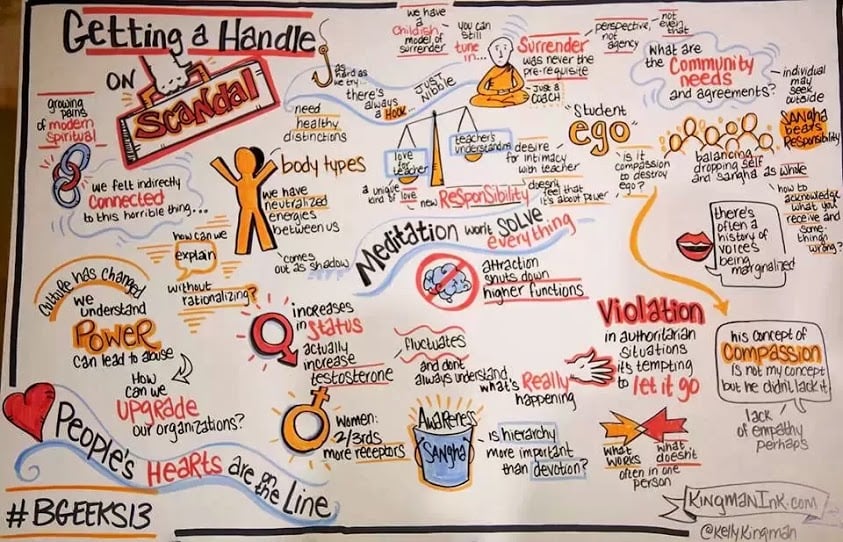
Image from the 2013 Buddhist Geeks Conference.
Two conversations about sex scandals in American Buddhist sanghas took place recently: one during the 2013 Buddhist Geeks Conference, and one in the pages of latest issue of Tricycle: The Buddhist Review (in which I also have an interview with Somaly Mam). You can follow the links provided for full video and full transcript, respectively. The Tricycle piece is a conversation between Jack Kornfield, Myoan Grace Schireson, Lama Palden, and Shinzen Young, moderated by Emma Varvaloucas. The Buddhist Geeks discussion, entitled “Getting a Handle on Scandal” and moderated by Diane Musho Hamilton, features Shinzen Young (again), Sofia Diaz, Kenneth Folk, and Michael Zimmerman, as well as questions and comments from audience members.
Cutting right to the chase, I was sorry not to see misogyny and sexual assault discussed more fully in these conversations as aspects of scandals being alluded to / openly discussed. Sadly, it is often the case misogyny and sexual assault are barely or not at all addressed in these sorts of discussions. In other instances, they are outright marginalized as subjects. So, for those wanting to hear more about misogyny and sexual assault, there’s nothing new in these conversations, really.
Not long ago, I wrote about the Joshu Sasaki Roshi scandal and my surprise that the phrase “sexual assault” was not coming up in conversations about it anywhere — especially since so many of the allegations in that instance were allegations of sexual assault specifically. (The legal definition of sexual assault, according to the United States Department of Justice’s Office on Violence Against Women, is “any type of sexual contact or behavior that occurs without the explicit consent of the recipient…[including, but not limited to] forced sexual intercourse, forcible sodomy, child molestation, incest, fondling, and attempted rape.”) I noted that most of the public conversation about it in Buddhist circles instead revolved around the usual, separate issues: the perennial question of sexual/romantic relationships between teachers and students, for example, and whether these relationships constitute a kind of sexual misconduct (in the Buddhist sense). I saw these as worthwhile issues for discussion generally, and somewhat relevant, but very peripheral to the Sasaki cases. What was much more primarily at issue in these cases, I insisted, was misogyny and sexual assault — but the naming of those things just wasn’t happening, strangely. One of two things seemed to me to be going on: (1) either we, as responding Buddhists, were badly ignorant of the distinctions between consensual sexual relationships between equals, sexual assault and rape, and all that is in between, and in need of better education; or (2) we weren’t talking about misogyny and sexual assault because we think Buddhist teachers are somehow immune to holding abhorrent views about women and committing acts of violence against them (“Well, of course, Buddhist teachers can’t be misogynists and/or criminals, so we can move right along to other conversation areas…”).
The problem with the latter view, that Buddhist teachers couldn’t possibly be misogynists or perpetrators of sexual assault, is that it’s wildly out of step with reality. According to the American Medical Association, sexual assault is “the most rapidly growing violent crime in America.” In addition, RAINN (Rape, Abuse and Incest National Network) reports that someone in the U.S. is sexually assaulted every two minutes, as well as the striking fact that “73% of sexual assaults [are] perpetrated by a non-stranger.” In a comment that she wrote beneath my Sasaki post, the mighty Buddhist blogger (and my friend / former student / colleague) Monica Sanford — the Dharma Cowgirl herself! — put it perfectly when she said:
It’s NORMAL in our culture for one in every four or five women to be sexually assaulted in her lifetime. It is NORMAL for one in four men to report in confidential surveys that they did something which met the legal definition of rape (without calling it ‘rape’)… Can we step towards on another and agree that if it happens to ONE person, it is unacceptable and must be addressed immediately by the entire community? Violence doesn’t happen in a vacuum. We, as Buddhists, should understand that only too well. We should, therefore, comprehend that it will take all of us to work towards the kind of world where this type of violence is, in fact, abnormal, outliers, uncommon.
A good bit of time has passed since the initial conversations about the Sasaki controversy, so how did the Tricycle and Buddhist Geeks conversations do?
The always-on-target Emma Varvaloucas, to her great credit, introduced the subject directly in the Tricycle interview, and Myoan Grace Schireson offered a powerful response, culminating with, “We…have to educate our brothers in the sangha”; somewhat less satisfying (though not altogether unhelpful), were the other two responses to the question, from Lama Palden and Jack Kornfield, in which the former put the onus on women to “assess whether [a sexual relationship with a teacher is] appropriate…We have to educate women that they aren’t always going to hear the truth” and the latter stated that “it’s not about educating women or educating men; it’s about educating everybody” and noting that women “abuse their role as teacher as well…[albeit] not as frequent[ly].” No response to the question from Shinzen Young appeared in the article if there was one. Ultimately, there wasn’t as much there as there could have been, despite an excellent tee up from Emma.
The Buddhist Geeks conversation, however, seemed to me to have more problems…though it had its moments too. Starting with the good stuff first, Diane Musho Hamilton cautioned against anything that might “legitimize” abusive behavior right off the bat. Sofia Diaz, while saying (questionably, I think) that it is possible for a teacher to be “more realized than the culture may allow,” was very effective in making clearer for the audience the arguments of many teachers who cross boundaries in ways that makes sense in their context, but perhaps not in a secular one: “[They say that their kind of] love is unique…[it] liberates you permanently from radically torturous egoity.” In response, Shinzen Young argued that it is “not true — not even remotely” that one needs to “surrender to a teacher to make progress.” Kenneth Folk similarly cautioned against some teachers and others who claim that “subjective experience is everything,” saying that this is “not true” and “not going to solve social injustice.” “Who says if you meditate enough it’s all going to come out right?” he asked. In response to a question from an audience member about the responsibilities of victims and teachers, especially those who may not understand abuse in the American context, all of the teachers seemed united behind Michael Zimmerman in saying that sanghas must “have to have a code of conduct… every sangha has to put in place structures.”
Elsewhere, though, things were, in my view, significantly less helpful. Part of the trouble was a decision on the panel early on to “name names”: most of the discussion revolved around Sasaki specifically. So, again, right away that says to me the conversation should have been about sexual assault and not, say, sex, love, and radical teaching techniques. In talking about the notion that “the most compassionate thing [a teacher] can do is destroy boundaries,” Shinzen Young said “[Sasaki’s] compassion is not my concept of compassion.” For me, this begs the question: why insist on interpreting his behavior as an act of compassion at all? Is there any way of talking about sexual assault as an act of compassion that isn’t wrongheaded?
Things continued in a more flippant and distasteful — or, as she put it, “politically incorrect” — direction with Diane Musho Hamilton saying about the 106-year-old Sasaki, “The dude has some life force!” Again, this seemed to badly confuse healthy sexuality with the misogyny, violence, and criminality of sexual assault. The American College of Obstetricians and Gynecologist’s committee opinion on sexual assault clarifies this distinction: “Sexual assault is a crime of violence and aggression, not passion, and encompasses a continuum of sexual activity that ranges from sexual coercion to contact abuse (unwanted kissing, touching, or fondling) to forcible rape” (emphasis added).
Even more problematic was what followed from there. “While we’re saying things we’re not supposed to say,” said Shinzen Young, “[I’ve often thought] gee, I wish I was a woman with [Sasaki].” Diane Musho Hamilton confirmed that he was talking about the “intimacy” and “attention” these women received from him. Michael Zimmerman said that he could identify with the feeling, saying that often there is a “love” and “closeness” in these situations that, to him, “does not feel like it’s about power.” In my view, this is a reprehensible line of thinking. “I wish I was a woman with him.” Really? Unwanted fondling and groping, sexual coercion and harassment, sexism and misogyny, all the other things that are being alleged — this is something to envy? That’s ridiculous, not to mention very insensitive to the victims.
In short, it seems that misogyny and sexual assault are still very much missing links in conversations about sangha scandals.
Whenever I write about the issue of sangha scandals, I always end up quoting something my friend Roshi Joan Halifax wrote in a guest post for my personal website back when the Eido Shimano scandal broke. In it, one of the things she says is:
It is not only a matter of the sexual violation of women and the painful violation of boundaries that are based in trust between teacher and student, it is as well a matter of the violation of the core of human goodness; for [the offending teachers’] behavior is also a violation of the entire Buddhist community, as well as the teachings of the Buddha which are uncompromising with respect to the unviability of killing, lying, sexual misconduct, wrongful speech, and consuming intoxicants of body, speech and mind. The northstar of goodness has been lost from sight in the long and recent past, and we are all suffering because we cannot see how deep the wound is to the heart of our world and to the coming generations.
Protections, dialogue, education are all necessary at this time. And a commitment to not forgetting……… as well as vowing to not repeat the mistakes of the past, and to practice a compassion that is clear and brave, liberating and just.
I’ve always thought Roshi Joan was right on, and that the practice she asks us to undertake here — “compassion that is clear and brave, liberating and just” — is essential. It’s hard work, but we’ve got to do it if we truly believe in and practice the teachings of the Buddha. We have so much work yet to do, in terms of protecting our sanghas and looking fearlessly inward.
Finally, once again, if someone engages in any type of sexual contact or behavior with you without your explicit consent, it is not a teaching. It is an act of violence and it’s against the law. For help or support, please call the National Sexual Assault Hotline at 1-800-656-HOPE or the National Sexual Violence Resource Center (NSVRC) at 1-877-739-3895.
Previous Post

September 15, 2013
Jack Kornfield Demands Clean Power Now -- Join Him!
Browse Our Archives
Select a Category Uncategorized
Select a Month March 2015 December 2014 August 2014 July 2014 June 2014 May 2014 April 2014 March 2014 February 2014 January 2014 December 2013 November 2013 October 2013 September 2013 August 2013 July 2013 June 2013 May 2013 April 2013 March 2013 February 2013 January 2013 December 2012 November 2012 October 2012 September 2012 August 2012 July 2012 June 2012 April 2012 March 2012 February 2012 January 2012 December 2011
Follow Us!
TAKE THE
Religious Wisdom Quiz
How many times does the book of Genesis mention "God created"?
Select your answer to see how you score.
5 7 11 9
Related posts from Off the Cushion

On Quitting Things (Including This Blog)
Who Are My Heroes of 2014? Maybe You...

A Roundabout Defense of the “Mandala Form” for...
TRENDING AT PATHEOS Buddhist

On Taking Refuge in the Dharma
(Here I continue the feature of sharing talks and essays by teachers...

(Continuing my intention to share talks and essays by other members of Empty...
The Subtle Art of Bowing: A Dharma Discourse
(This presentation was first offered by my dear friend Dharma Holder Tom...

Internal Family Systems Can Heal you Mentally &...
How IFS Helped Me Stop Fighting Myself Internal Family Systems (IFS) is...

The Bible No One Spoke About: A Family’s...
A mysterious family Bible, unspoken faith, and a journey from curiosity to...

How Uncertainty Can Transform Your Life in 2025
Embracing Uncertainty: A New Year’s Resolution for the Brave As 2025 approaches,...
view all Buddhist blogs
Ad-Free & Subscriber Log-In Subscription Support
- About Us
- 2026 Calendar
- Videos
- Podcasts
- Library of World Religions
- Faith In Media Tracker
- Advertise With Us
- Write for Us
- Privacy Policy
- Terms of Service
- Do Not Sell My Data
- Contact Us
- Radiant Digital
- Manage Newsletter Subscriptions
- Unsubscribe From Notifications
- Sitemap
Copyright 2008-2026, Patheos. All rights reserved.
Subscription Support Ad-Free & Subscriber Log-In
Follow Patheos