
BuddhistCatholicContemplativeEvangelicalGeneral ChristianHinduJewishLatter-day SaintMuslimNew VisionsProgressive Christian
Beliefs
- Buddhist
- Catholic
- Contemplative
- Evangelical
- General Christian
- Hindu
- Jewish
- Latter-day Saint
- More Voices
- Muslim
- New Visions
- Pagan
- Progressive Christian
Topics
- Religion News
- Food and Religion
- Sports and Religion
- Religious Art
- Religious Music and Entertainment
- Religious Events
- History and Religion
- Style and Religion
- Politics and Religion
- Women in Religion
- Recreation Outdoors and Religion
- Business Finance and Religion
- Careers Workplace and Religion
- Education and Religion
- Family Parenting and Religion
- Health Fitness and Religion
- Home and Religion
- Relationships and Religion
- Technology and Religion
- Travel and Religion
Columnists
- Buddhist Columnists
- Business Finance and Religion Columnists
- Careers Workplace and Religion Columnists
- Catholic Columnists
- Contemplative Columnists
- Education and Religion Columnists
- Evangelists Columnists
- Family Parenting and Religion Columnists
- General Christian Columnists
- Health Fitness and Religion Columnists
- Hindu Columnists
- History and Religion Columnists
- Home and Religion Columnists
- Jewish Columnists
- More Voices Columnists
- Latter Day Columnists
- Muslim Columnists
- New Visions Columnists
- Nonreligious Columnists
- Pagan Columnists
- Politics and Religion Columnists
- Progressive Columnists
- Recreation Outdoors and Religion Columnists
- Relationships and Religion Columnists
- Religion News Columnists
- Religious Art Columnists
- Religious Events Columnists
- Religious Music and Entertainment Columnists
- Sports and Religion Columnists
- Style and Religion Columnists
- Technology and Religion Columnists
- Travel and Religion Columnists
- Women in Religion Columnists
Resource Library
- 2026 Calendar
- Library of World Religions
- The 100 Most Holy Places on Earth
- Patheos Answers
- Podcasts
- Videos
- Faith Leaders Database
- Anglican Episcopalian
- Bahai
- Baptist
- Buddhism
- Christianity
- Confucianism
- Eastern Orthodoxy
- Hinduism
- Holiness and Pentecostal
- ISKCON
- Islam
- Judaism
- Lutheran
- Methodist
- The Church of Jesus Christ of Latter-day Saints
- New Age
- Paganism
- Presbytarian and Reformed
- Protestantism
- Religion Behind the Scenes
- Roman Catholic
- Scientology
- Shia Islam
- Sikhism
- Sufism
- Sunni Islam
- Taoism
- Zen
- See all religions
Research Tools
 Ad-Free & Subscriber Log-In Subscription Support
Ad-Free & Subscriber Log-In Subscription Support
Follow Patheos 

- Trending:
- Forgiveness
- |
- Marriage
- |
- Consciousness
- |
- Death Penalty
- |
- Election
- |
- Halloween
 Off the Cushion
- Home
- Buddhist
- SPECIAL REPORT: The California Prison Hunger Strike Demands Our Attention
SPECIAL REPORT: The California Prison Hunger Strike Demands Our Attention
Last updated on: August 11, 2013 at 10:37 pm by dannyfisher
SPECIAL REPORT: The California Prison Hunger Strike Demands Our Attention 2013-08-11T22:37:26-07:00 dannyfisher
Patheos Explore the world's faith through different perspectives on religion and spirituality! Patheos has the views of the prevalent religions and spiritualities of the world.

Actor and activist Danny Glover speaks at the International Day of Action in Solidarity with the CA Prisoner Hunger Strikers and Justice for Trayvon Martin’s Family Members near the Downtown Los Angeles Federal Building, July 31, 2013. Photo by the author.
In case you’ve missed news coverage about it — and you might have, as the media has not been granted interviews with striking prisoners — a coordinated, mass hunger strike by 400 California prisoners is now in its second month. The prisoners have five demands (which I will explain in full later), but which primarily have to do with what they see as violations of their human rights by the California prison system (especially the state’s use of what are called “Security Housing Units,” or SHUs). Because the hunger strike has been going on for so long, the health of the strikers is now of great concern. As the Guardian reported this week, “Some [of the prisoners] have been hospitalized as their bodies, stripped of fat, now consume muscle, a point when health can be permanently damaged.” In addition, one prisoner, Bill Sell, has died of an apparent suicide, and there are conflicting reports about whether or not he was a participant in this protest.
The editorial board of the Los Angeles Times published an opinion this weekend about the hunger strike. While being both diplomatic and a little cautious in light of another recent editorial in their pages by California Department of Corrections and Rehabilitation head Jeffrey Beard, the editors were nonetheless forceful and clear. They write:
In so-called Supermax prisons, inmates are held, some for years at a time, in solitary confinement, deprived of human contact for 22½ hours a day. Correspondence with the outside world is restricted.
Given the prevalence of mental illness among the general population of state prisoners — an estimated 30% of such inmates have significant mental illness — it is reasonable to assume that at least some of those who are placed in secure housing units already have mental problems, and psychologists and other experts assert that even the healthiest of people are pushed to the edge by such treatment.
Prison officials argue that these units are necessary to prevent gang leaders from ordering killings or other crimes. In a Times op-ed Tuesday, California prisons chief Jeffrey Beard argued that the hunger strike was an attempt by leaders of four violent prison gangs to regain power. And we should not be naive; harsh measures may indeed be necessary to prevent shot-callers from continuing their criminal ways when locked up. But when inmates face the possibility of a lifetime in solitary confinement, as they still do, and when the key to returning to the general prison population is to “snitch” on another inmate — although that virtually guarantees gang retaliation — there is a legitimate question as to whether the institutions and the personnel we pay to do our most difficult tasks are living up to our ideal of justice.
A hunger strike may be the only way inmates in solitary can reach us with their message of protest. We may find their complaints warranted. Or we may not. But if we care about justice, we should listen.
I agree, and it was this want to listen and respond that brought me to the International Day of Action in Solidarity with the CA Prisoner Hunger Strikers and Justice for Trayvon Martin’s Family Members in downtown Los Angeles almost two weeks ago.

Protestors at the International Day of Action in Solidarity with the CA Prisoner Hunger Strikers and Justice for Trayvon Martin’s Family Members near the Downtown Los Angeles Federal Building, July 31, 2013. Photo by the author.
Endorsed by James Cromwell, Angela Davis, Mike Farrell, Danny Glover, Elliott Gould, Chris Hedges, Alice Walker, and Dr. Cornel West, as well as many other individuals and organizations, this action, taken simultaneously by communities across the country, was for fasting in solidarity with the prisoners, raising awareness about their five core demands, and pointing to connections between the injustice in the prison-industrial complex and Trayvon Martin’s death. The prisoners’ demands are:
- End group punishment and administrative abuse
- Abolish the debriefing policy, and modify active/inactive gang status criteria
- Comply with the U.S. Commission on Safety and Abuse in America’s Prisons 2006 recommendations regarding an end to long-term solitary confinement
- Provide adequate and nutritious food
- Expand and provide constructive programming and privileges for indefinite SHU status inmates

A child protestor at the International Day of Action in Solidarity with the CA Prisoner Hunger Strikers and Justice for Trayvon Martin’s Family Members near the Downtown Los Angeles Federal Building, July 31, 2013. Photo by the author.
The Los Angeles action was attended by several dozen people, including endorsers/actors/activists Danny Glover (of the Lethal Weapon film series) and Mike Farrell (of TV’s M*A*S*H), former prisoners, spouses and family of prisoners, media representatives, and others. The event was emceed by Margaret Prescod, host of the Sojourner Truth Show on KPFK and representative of Women of Color Global Women’s Strike, who connected the dots between the prison hunger strike and Trayvon Martin. “We know the criminalization that killed Trayvon Martin, and the criminalization that justifies torture of prisoners, is one and the same.” Subsequent speakers, including Dolores Canales, an organizer with the California Families Against Solidarity Confinement (CFASC), and former prisoner Ernest “Big Ern” Shepard III, called on California Governor Jerry Brown to step in. “Governor Brown, how much longer can you ignore what is going on in the state of California?” asked Canales. “I am looking forward to this historical event, in the coming together of all races as we work toward bringing an end to injustices everywhere, from solitary confinement to racial profiling to mass incarceration.”
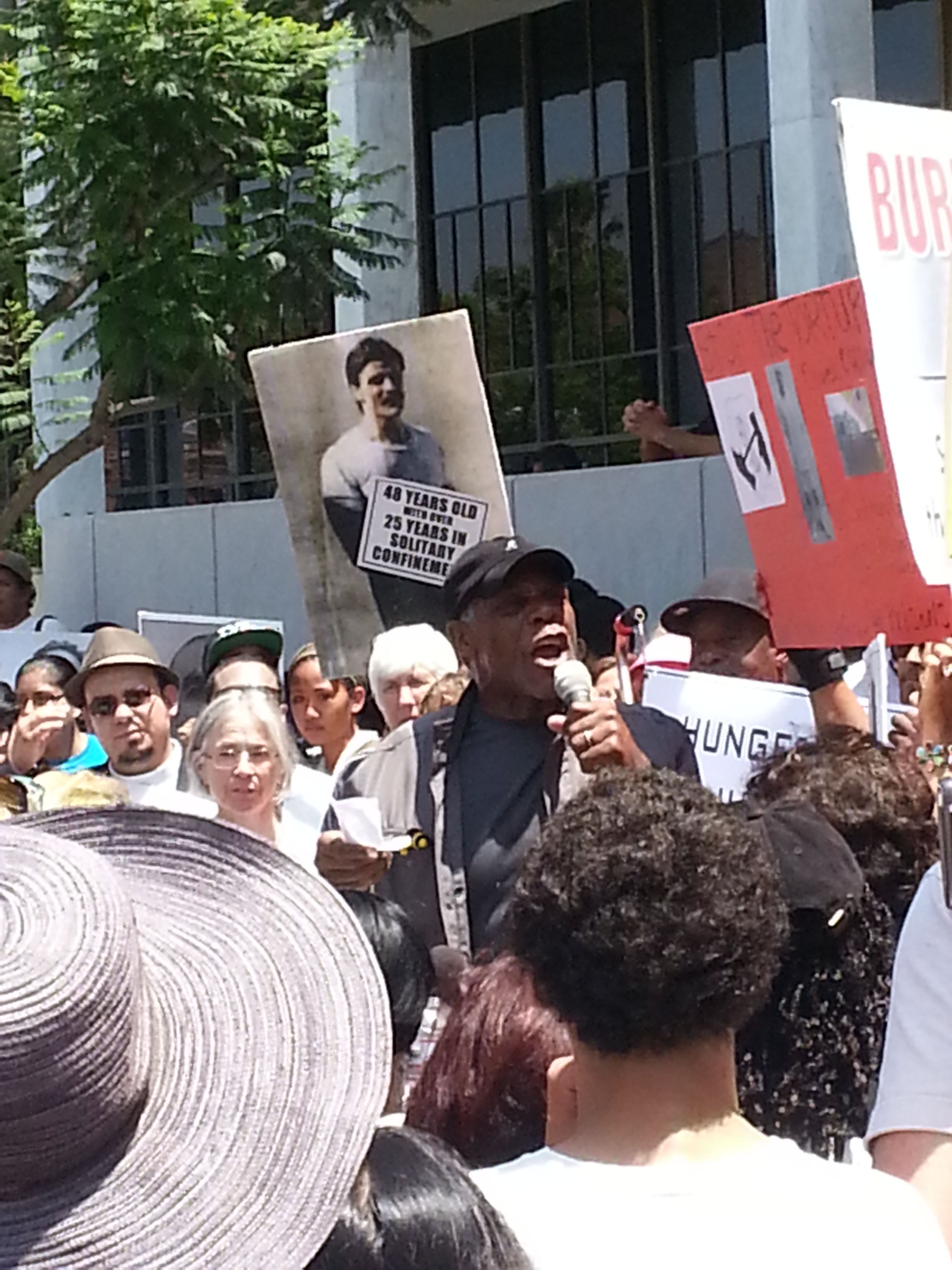
Danny Glover speaks at the International Day of Action in Solidarity with the CA Prisoner Hunger Strikers and Justice for Trayvon Martin’s Family Members near the Downtown Los Angeles Federal Building, July 31, 2013. Photo by the author.
Mr. Glover too spoke about making sure to understand the connections between Trayvon Martin’s death and the prisoners’ hunger strike, urging the crowd “not to be fooled” by those who want to make them separate issues. Neon Tommy, a digital news service of the USC Annenberg School of Communication, quoted him as saying, “We have to draw connections between disenfranchised people… It is for us at this particular point to put these pieces together and keep going.” Elsewhere, in the pages of the Los Angeles Times, he was quoted as saying, “Malcolm X said, ‘We talk about jail, we all in jail. We in jail because the power defines us! We have to create a system that works for us.”
Mr. Farrell introduced the crowd to an attendee who had spent time in prison and experienced solitary confinement, only to later be found not guilty, and then offered words of inspiration for the determined activists in attendance.
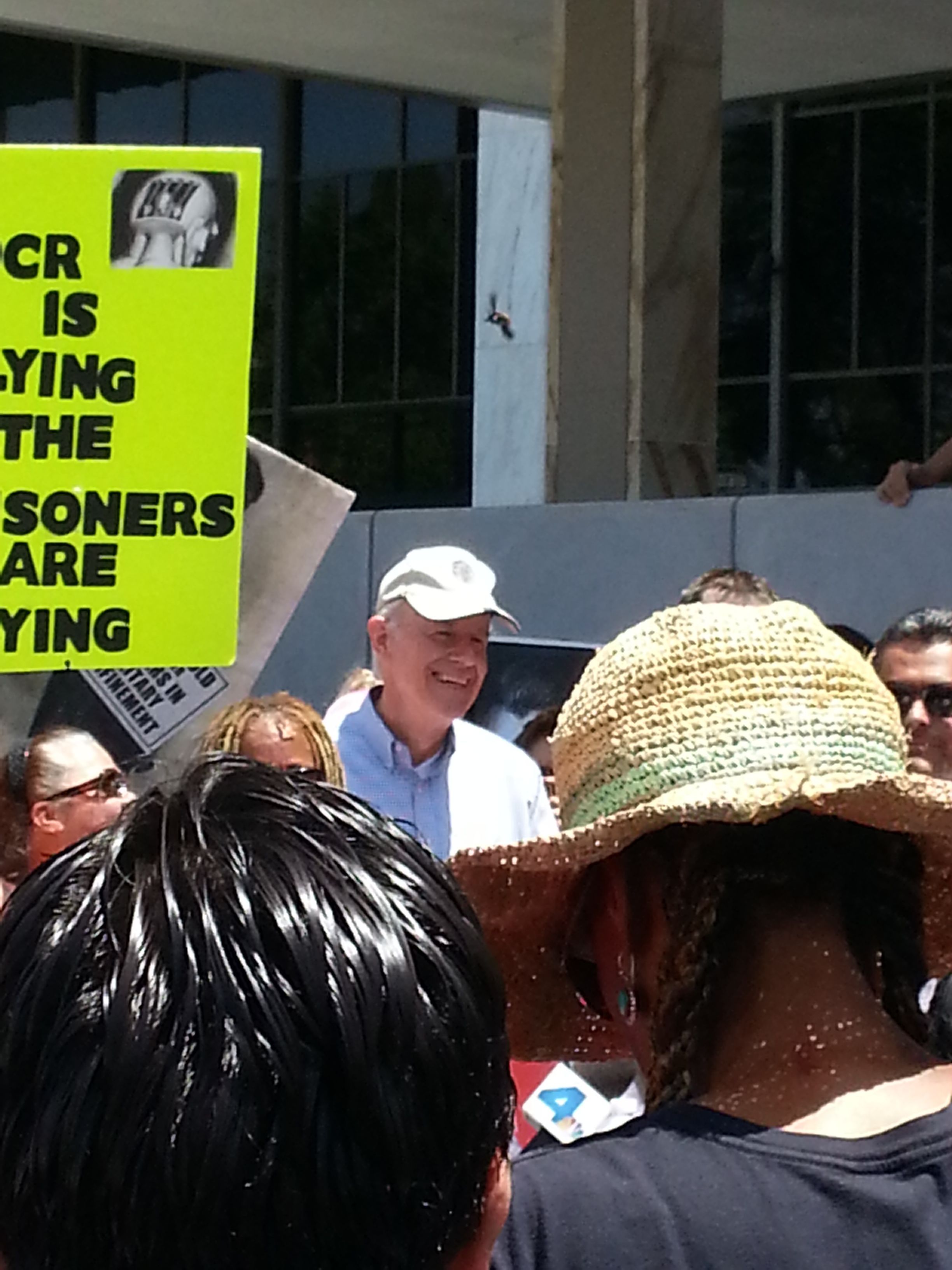
Actor and activist Mike Farrell speaks at the International Day of Action in Solidarity with the CA Prisoner Hunger Strikers and Justice for Trayvon Martin’s Family Members near the Downtown Los Angeles Federal Building, July 31, 2013. Photo by the author.
On that note, one might wonder what sorts of things they can do to be of support and help get this issue the attention that it deserves. Among them, you can contact Governor Brown here, sign two petitions from Change.Org and Californians United for a Responsible Budget (CURB), and keep an eye out for other actions at prisonerhungerstrikesolidarity.wordpress.com. In addition, action organizers recommend learning more about how you can assist and join solidarity organizations such as CURB, CFASC, Families to Amend California’s Three Strikes (FACTS), and Homie UP – Universidad Popular Homie Edition.
I would certainly encourage you to get involved however you are willing and able. Admittedly, prison work has long been a personal interest of mine — since college days, in fact, when I worked with my campus’ chapters of Anti-Racist Action and Amnesty International on prison issues in Ohio, and authored a summer project on Buddhist ministry in prisons around the globe. In addition, this fall, at University of the West, my dear and super-brilliant colleague in Religious Studies, Dr. Jane Naomi Iwamura, and I will co-teach a class for our Buddhist Chaplaincy graduate students entitled “Buddhist Ministry and the Prison-Industrial Complex.”
But, bringing it back to you the reader, it’s vital that we all talk about what’s happening in California’s prison system right now — especially Buddhists, who have been so wonderfully active in prison work (as various organizations and projects and books and films and other things will attest). This is an important moment to remember that the edicts scrawled on the ancient pillars of the Indian King Ashoka, which make up the earliest archaeological record of Buddhism in the entire world, take time to promote the humane treatment of prisoners. The great Buddhist monarch hoped that his provincial governors would be “fearless and impartial” in the administration of their duties, and that they might help prisoners and their families find whatever “happiness” they could in this life or in “the next world.” It seems to me this is not a bad standard to hold California to today.
May all be beings be happy.
May all beings be well.
May all beings be peaceful.
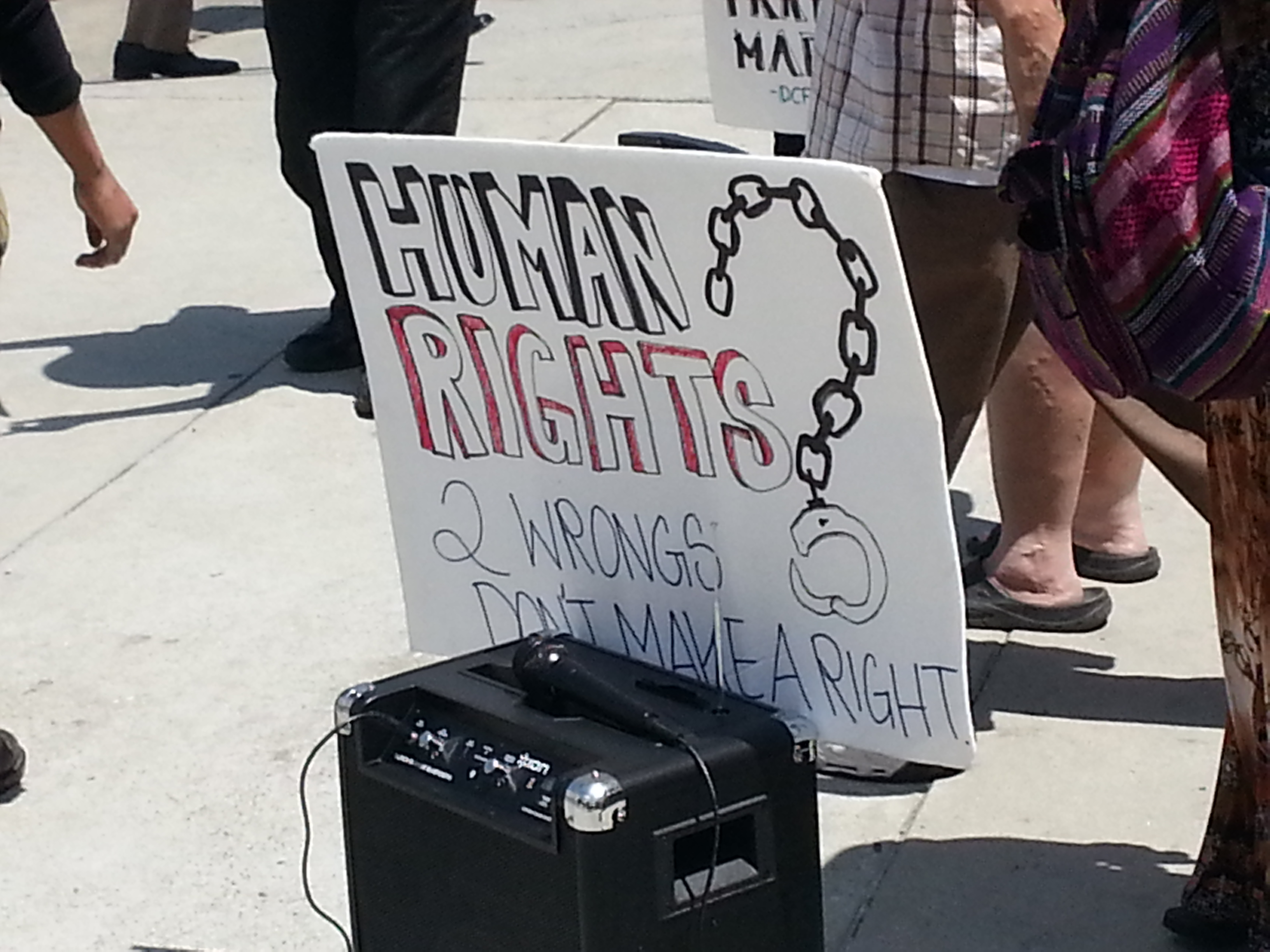
A sign at the International Day of Action in Solidarity with the CA Prisoner Hunger Strikers and Justice for Trayvon Martin’s Family Members near the Downtown Los Angeles Federal Building, July 31, 2013. Photo by the author.
Previous Post

August 10, 2013
"A Visual Storybook of Buddhist Women"
Browse Our Archives
Select a Category Uncategorized
Select a Month March 2015 December 2014 August 2014 July 2014 June 2014 May 2014 April 2014 March 2014 February 2014 January 2014 December 2013 November 2013 October 2013 September 2013 August 2013 July 2013 June 2013 May 2013 April 2013 March 2013 February 2013 January 2013 December 2012 November 2012 October 2012 September 2012 August 2012 July 2012 June 2012 April 2012 March 2012 February 2012 January 2012 December 2011
Follow Us!
TAKE THE
Religious Wisdom Quiz
Who cried at the tomb of Lazarus?
Select your answer to see how you score.
Peter John David Jesus
Related posts from Off the Cushion

On Quitting Things (Including This Blog)
Who Are My Heroes of 2014? Maybe You...

A Roundabout Defense of the “Mandala Form” for...

TRENDING AT PATHEOS Buddhist

On Taking Refuge in the Dharma
(Here I continue the feature of sharing talks and essays by teachers...

(Continuing my intention to share talks and essays by other members of Empty...
The Subtle Art of Bowing: A Dharma Discourse
(This presentation was first offered by my dear friend Dharma Holder Tom...

Internal Family Systems Can Heal you Mentally &...
How IFS Helped Me Stop Fighting Myself Internal Family Systems (IFS) is...

The Bible No One Spoke About: A Family’s...
A mysterious family Bible, unspoken faith, and a journey from curiosity to...

How Uncertainty Can Transform Your Life in 2025
Embracing Uncertainty: A New Year’s Resolution for the Brave As 2025 approaches,...
view all Buddhist blogs
Ad-Free & Subscriber Log-In Subscription Support
- About Us
- 2026 Calendar
- Videos
- Podcasts
- Library of World Religions
- Faith In Media Tracker
- Advertise With Us
- Write for Us
- Privacy Policy
- Terms of Service
- Do Not Sell My Data
- Contact Us
- Radiant Digital
- Manage Newsletter Subscriptions
- Unsubscribe From Notifications
- Sitemap
Copyright 2008-2026, Patheos. All rights reserved.
Subscription Support Ad-Free & Subscriber Log-In
Follow Patheos