
BuddhistCatholicContemplativeEvangelicalGeneral ChristianHinduJewishLatter-day SaintMuslimNew VisionsProgressive Christian
Beliefs
- Buddhist
- Catholic
- Contemplative
- Evangelical
- General Christian
- Hindu
- Jewish
- Latter-day Saint
- More Voices
- Muslim
- New Visions
- Pagan
- Progressive Christian
Topics
- Religion News
- Food and Religion
- Sports and Religion
- Religious Art
- Religious Music and Entertainment
- Religious Events
- History and Religion
- Style and Religion
- Politics and Religion
- Women in Religion
- Recreation Outdoors and Religion
- Business Finance and Religion
- Careers Workplace and Religion
- Education and Religion
- Family Parenting and Religion
- Health Fitness and Religion
- Home and Religion
- Relationships and Religion
- Technology and Religion
- Travel and Religion
Columnists
- Buddhist Columnists
- Business Finance and Religion Columnists
- Careers Workplace and Religion Columnists
- Catholic Columnists
- Contemplative Columnists
- Education and Religion Columnists
- Evangelists Columnists
- Family Parenting and Religion Columnists
- General Christian Columnists
- Health Fitness and Religion Columnists
- Hindu Columnists
- History and Religion Columnists
- Home and Religion Columnists
- Jewish Columnists
- More Voices Columnists
- Latter Day Columnists
- Muslim Columnists
- New Visions Columnists
- Nonreligious Columnists
- Pagan Columnists
- Politics and Religion Columnists
- Progressive Columnists
- Recreation Outdoors and Religion Columnists
- Relationships and Religion Columnists
- Religion News Columnists
- Religious Art Columnists
- Religious Events Columnists
- Religious Music and Entertainment Columnists
- Sports and Religion Columnists
- Style and Religion Columnists
- Technology and Religion Columnists
- Travel and Religion Columnists
- Women in Religion Columnists
Resource Library
- 2026 Calendar
- Library of World Religions
- The 100 Most Holy Places on Earth
- Patheos Answers
- Podcasts
- Videos
- Faith Leaders Database
- Anglican Episcopalian
- Bahai
- Baptist
- Buddhism
- Christianity
- Confucianism
- Eastern Orthodoxy
- Hinduism
- Holiness and Pentecostal
- ISKCON
- Islam
- Judaism
- Lutheran
- Methodist
- The Church of Jesus Christ of Latter-day Saints
- New Age
- Paganism
- Presbytarian and Reformed
- Protestantism
- Religion Behind the Scenes
- Roman Catholic
- Scientology
- Shia Islam
- Sikhism
- Sufism
- Sunni Islam
- Taoism
- Zen
- See all religions
Research Tools
 Ad-Free & Subscriber Log-In Subscription Support
Ad-Free & Subscriber Log-In Subscription Support
Follow Patheos 

- Trending:
- Forgiveness
- |
- Marriage
- |
- Consciousness
- |
- Death Penalty
- |
- Election
- |
- Halloween
 Off the Cushion
- Home
- Buddhist
- INTERVIEW: Pamela Ayo Yetunde, Creator of the Dharma Care Website
INTERVIEW: Pamela Ayo Yetunde, Creator of the Dharma Care Website
Last updated on: December 13, 2012 at 8:32 pm by dannyfisher
INTERVIEW: Pamela Ayo Yetunde, Creator of the Dharma Care Website 2012-12-13T20:32:32-07:00 dannyfisher
Patheos Explore the world's faith through different perspectives on religion and spirituality! Patheos has the views of the prevalent religions and spiritualities of the world.

Pamela Ayo Yetunde
My friend Pamela Ayo Yetunde is the creator of the Dharma Care website, which she describes as both “a resource for Buddhist pastoral counseling” and “a myth-buster” (more on both later).
Ayo has served as a volunteer with Zen Hospice Project, Pathways Home Care and Hospice, and other locations, and she completed Clinical Pastoral Education (CPE) at Alta Bates Summit Medical Center (all in the San Francisco Bay Area). Ayo holds a certificate in Buddhist chaplaincy from the Sati Center for Buddhist Studies, a certificate in spiritual direction from Mercy Center, and a M.A. in Culture and Spirituality from Holy Names University. She is board certified by the College of Pastoral Supervision and Psychology, and is currently completing her doctorate in Pastoral Counseling at the Columbia Theological Seminary. In addition, Ayo is a graduate of the Community Dharma Leaders program at Spirit Rock Meditation Center.
Ayo is also the author of three books: Vigil: Spiritual Reflections on Your Money and Sanity, The Inheritance: A Stock-Picking Story and Beyond 40 Acres and Another Pair of Shoes: For Smart Sisters Who Think Too Much and Do Too Little about Their Money.
Ayo and I have seen each other at past Buddhist Chaplaincy Symposiums at the Sati Center in Redwood City, CA. We also both participated in the Religious Diversity Leadership Workshop at Hartford Seminary in Hartford, CT, this past summer. You can find Ayo in the photo below (click to enlarge), second from the left in the front row. (You’ll just have to see if you can spot me…)
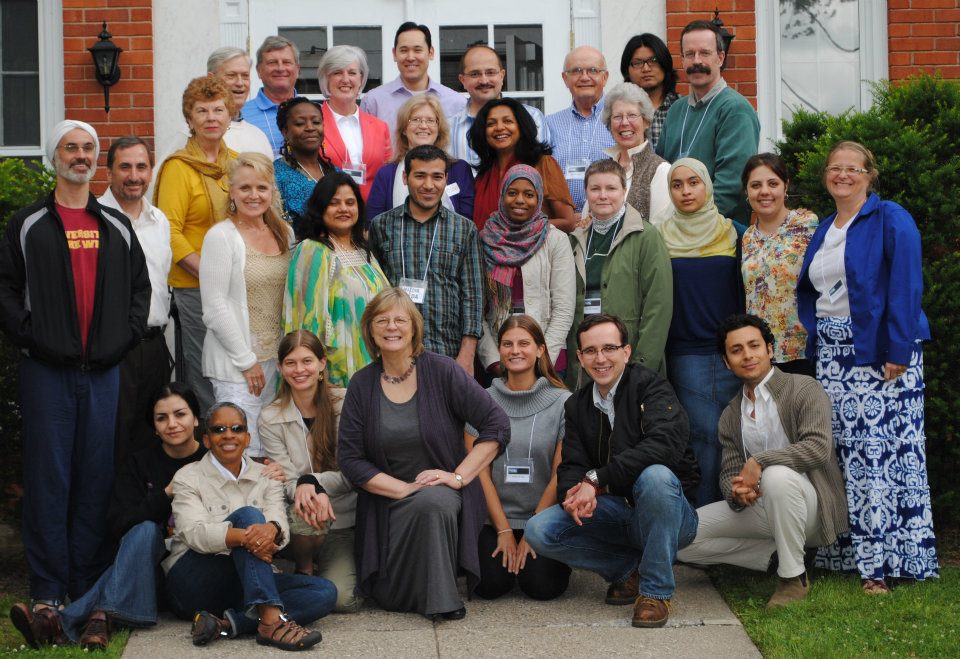
Image by Hartford Seminary.
After Ayo unveiled the Dharma Care website, I contacted her about an interview. We exchanged questions and answers over Facebook messages recently, and I’m happy to be able to present this interview with her about the site. Enjoy!
*
Ayo, would you please introduce us to Dharma Care? What is it?
www.dharmacare.com is a website created for Insight Meditation teachers, leaders, chaplains, counselors and care council members interested in utilizing the Buddhist pastoral care and counseling tradition in their sanghas and other places where they provide spiritual and religious care.
Please tell us about Dharma Care as a “myth buster.” I love that phrase.
I read a scholarly article written by a well-respected Christian pastoral theologian who wrote that the pastoral tradition belonged exclusively to the Christian tradition. It is the case that many people, including Buddhists, also believe that myth. The Pali Canon contains numerous suttas on how to be pastoral, through the use of the cowherd metaphor. Christians use the sheep metaphor. The point in both traditions is that a leader should learn how to gather and maintain the community.
There’s a section at the site called “Why Pastoral Counseling?” Certain aspects of long-term pastoral counseling have been largely unexplored in the world of Buddhist chaplaincy. Would you please say a bit about pastoral counseling and your emphasis on it at the site and in your work?
The rise in Buddhist chaplains is encouraging. Chaplains from all traditions typically work in situations where they encounter people once or a few times, for brief visits, to engage in a ritual or rite. Chaplains become objects in the minds of those they serve, and those we serve become objects in our minds. In settings where chaplains see people many times, over many months, even years, we may become one of the people, if not the only person, who is an anchor in their lives. As relationships endure, people tend to reveal more, reflect more, check in more, develop more. We do the same thing. In these longer-term situations, we move from objects to subjects. More unconscious material gets stirred up and revealed. Meanings and interpretations are sought. Identities get formed and personalities displayed. My hope is that www.dharmacare.com can be a resource for spiritual caregivers who want to reflect on the intersubjective situations they find themselves in in longer-term situations, from a Buddhist perspective.
Would you please also say something about “creating an alliance?” Again, I’m really struck by the language there.
There is a tension between some Buddhist teachings and the work provided by spiritual caregivers. The tension is about emotional connection. Does being emotionally connected to the ones we serve cause suffering? If so, should we be unemotionally attached and if so, what kind of attachment exists without emotion? Also, Buddhists are taught to be about “the truth,” but how likely is it that we will know “the truth” of the people we serve? Creating an alliance is about letting go of knowing the truth and allowing ourselves to be emotionally connected, through lovingkindness and compassion, but not in a deluded sense. We also need to cultivate wisdom, knowing that emotional connection can lead to suffering when the connection is lost. Our work is full of losses, therefore in this work, we have to be committed to taking care of ourselves.
Finally, Ayo, what is your hope for the site? How can readers help or get involved?
I intend to continue adding to the site. My hope is that www.dharmacare.com will be used as a resource, just as a book is used, by caregiving professions, students, and non-Buddhist. If Buddhist caregivers want to contribute an article, they can do so.
*
On behalf of readers: Thank you, Ayo!
Be sure to visit the Dharma Care website at www.dharmacare.com.
Next Post

December 14, 2012 "Too Many Times..."
Browse Our Archives
Select a Category Uncategorized
Select a Month March 2015 December 2014 August 2014 July 2014 June 2014 May 2014 April 2014 March 2014 February 2014 January 2014 December 2013 November 2013 October 2013 September 2013 August 2013 July 2013 June 2013 May 2013 April 2013 March 2013 February 2013 January 2013 December 2012 November 2012 October 2012 September 2012 August 2012 July 2012 June 2012 April 2012 March 2012 February 2012 January 2012 December 2011
Follow Us!
TAKE THE
Religious Wisdom Quiz
What was the name of the river where Ezekiel saw his vision?
Select your answer to see how you score.
Euphrates River Jordan River Nile River River Chebar
Related posts from Off the Cushion

On Quitting Things (Including This Blog)
Who Are My Heroes of 2014? Maybe You...

A Roundabout Defense of the “Mandala Form” for...
TRENDING AT PATHEOS Buddhist

On Taking Refuge in the Dharma
(Here I continue the feature of sharing talks and essays by teachers...

(Continuing my intention to share talks and essays by other members of Empty...
The Subtle Art of Bowing: A Dharma Discourse
(This presentation was first offered by my dear friend Dharma Holder Tom...

Internal Family Systems Can Heal you Mentally &...
How IFS Helped Me Stop Fighting Myself Internal Family Systems (IFS) is...

The Bible No One Spoke About: A Family’s...
A mysterious family Bible, unspoken faith, and a journey from curiosity to...

How Uncertainty Can Transform Your Life in 2025
Embracing Uncertainty: A New Year’s Resolution for the Brave As 2025 approaches,...
view all Buddhist blogs
Ad-Free & Subscriber Log-In Subscription Support
- About Us
- 2026 Calendar
- Videos
- Podcasts
- Library of World Religions
- Faith In Media Tracker
- Advertise With Us
- Write for Us
- Privacy Policy
- Terms of Service
- Do Not Sell My Data
- Contact Us
- Radiant Digital
- Manage Newsletter Subscriptions
- Unsubscribe From Notifications
- Sitemap
Copyright 2008-2026, Patheos. All rights reserved.
Subscription Support Ad-Free & Subscriber Log-In
Follow Patheos