
BuddhistCatholicContemplativeEvangelicalGeneral ChristianHinduJewishLatter-day SaintMuslimNew VisionsProgressive Christian
Beliefs
- Buddhist
- Catholic
- Contemplative
- Evangelical
- General Christian
- Hindu
- Jewish
- Latter-day Saint
- More Voices
- Muslim
- New Visions
- Pagan
- Progressive Christian
Topics
- Religion News
- Food and Religion
- Sports and Religion
- Religious Art
- Religious Music and Entertainment
- Religious Events
- History and Religion
- Style and Religion
- Politics and Religion
- Women in Religion
- Recreation Outdoors and Religion
- Business Finance and Religion
- Careers Workplace and Religion
- Education and Religion
- Family Parenting and Religion
- Health Fitness and Religion
- Home and Religion
- Relationships and Religion
- Technology and Religion
- Travel and Religion
Columnists
- Buddhist Columnists
- Business Finance and Religion Columnists
- Careers Workplace and Religion Columnists
- Catholic Columnists
- Contemplative Columnists
- Education and Religion Columnists
- Evangelists Columnists
- Family Parenting and Religion Columnists
- General Christian Columnists
- Health Fitness and Religion Columnists
- Hindu Columnists
- History and Religion Columnists
- Home and Religion Columnists
- Jewish Columnists
- More Voices Columnists
- Latter Day Columnists
- Muslim Columnists
- New Visions Columnists
- Nonreligious Columnists
- Pagan Columnists
- Politics and Religion Columnists
- Progressive Columnists
- Recreation Outdoors and Religion Columnists
- Relationships and Religion Columnists
- Religion News Columnists
- Religious Art Columnists
- Religious Events Columnists
- Religious Music and Entertainment Columnists
- Sports and Religion Columnists
- Style and Religion Columnists
- Technology and Religion Columnists
- Travel and Religion Columnists
- Women in Religion Columnists
Resource Library
- 2026 Calendar
- Library of World Religions
- The 100 Most Holy Places on Earth
- Patheos Answers
- Podcasts
- Videos
- Faith Leaders Database
- Anglican Episcopalian
- Bahai
- Baptist
- Buddhism
- Christianity
- Confucianism
- Eastern Orthodoxy
- Hinduism
- Holiness and Pentecostal
- ISKCON
- Islam
- Judaism
- Lutheran
- Methodist
- The Church of Jesus Christ of Latter-day Saints
- New Age
- Paganism
- Presbytarian and Reformed
- Protestantism
- Religion Behind the Scenes
- Roman Catholic
- Scientology
- Shia Islam
- Sikhism
- Sufism
- Sunni Islam
- Taoism
- Zen
- See all religions
Research Tools
 Ad-Free & Subscriber Log-In Subscription Support
Ad-Free & Subscriber Log-In Subscription Support
Follow Patheos 

- Trending:
- Forgiveness
- |
- Marriage
- |
- Consciousness
- |
- Death Penalty
- |
- Election
- |
- Halloween
 Buddhist-Christian-Quaker
- Home
- Progressive Christian
- Calling for Barabbas
Calling for Barabbas
Last updated on: June 5, 2017 at 4:46 pm by Daniel P. (Danny) Coleman
Calling for Barabbas 2017-06-05T16:46:51-07:00 Daniel P. (Danny) Coleman
Patheos Explore the world's faith through different perspectives on religion and spirituality! Patheos has the views of the prevalent religions and spiritualities of the world.
Back in mid-April I was driving in the car and flipped the radio to the local AM Christian station, as I occasionally do. Generally their programming ranges from prerecorded sermons to shows about parenting and marriage advice to “current events” programs which tend to mirror whatever the latest point of outrage on conservative talk radio is (Liberals! Gays! Intellectuals!). On this particular afternoon the topic of the show in progress was ISIS (or ISIL or the so-called Islamic State or Daesh).
The guest on the show, a “global security expert” whom I’ve never heard of, was making the case that the U.S. and Europe needs to “get into the gutter” and use the same “cold-blooded” tactics of brutality that ISIS uses. “If you don’t want to fight the way they fight, you’re going to end up being a victim,” the expert warned. “Well, we should learn that from history,” the host responded, bringing up the guerilla warfare tactics used by Colonialists against British Redcoats in the Revolutionary War. The host then asked rhetorically, “Do you go to the gutter and fight them there, or do you fight them in our neighborhoods?” implying that failure to match ISIS’s brutality will result in them invading American suburbs. The two Christian radio pundits went on to extol the merits of waterboarding and carpet-bombing. In order to maintain a spiritual component in the show, the host then had a different guest on to briefly talk about “our most powerful weapon against ISIS, which is prayer.”
At no point was any consideration given to Jesus’ teaching that we must love our enemies (which I think includes not torturing and bombing them) or Christ’s command to “put away your sword” or the Apostle Paul’s instruction that “we do not wage war as the world does” (2 Cor. 10) or the consistent position of the early church that Christians were not to engage in violent retribution (for example, Clement of Alexandria: “Above all, Christians are not allowed to correct with violence the delinquencies of sins.” and Justin Martyr: “We who were filled with war, and mutual slaughter, and every wickedness, have each through the whole earth changed our warlike weapons,—our swords into plowshares, and our spears into implements of tillage,—and we cultivate piety, righteousness, philanthropy, faith, and hope, which we have from the Father Himself through Him who was crucified. …we do not wage war against our enemies…” and Origen: “He [Christ] nowhere teaches that it is right for His own disciples to offer violence to any one, however wicked.” etc, etc.). None of this was mentioned by either the host or the “expert” guest on this Christian radio program.
Since it was a couple of days before Good Friday and Easter when I heard this radio conversation, it got me to thinking about Barabbas, a man mentioned in all four Gospels. Barabbas is sometimes depicted as a robber but he was actually a Jewish insurrectionist against the Romans, charged with treason and murder. At the time of Jesus there was much violent sentiment among the Jews towards their Roman overlords. The Roman occupation was brutal, the “Jewish” king Herod was a puppet tyrant, and the religious temple system in Jerusalem was corrupt. The rank-and-file Jewish people were desperately poor, oppressed and over-taxed. A common dilemma was to lose one’s land as a result of tax debt and become destitute. The average Jew hated the Romans and hated those among them who collaborated with the Romans (such as tax collectors). They dreamed of a messiah–a leader appointed by God–who would arise to command them in battle to drive the Romans from their land and restore their kingdom and temple to its former glory. There was a growing movement of Zealots who were actively engaging in riots, confrontations with Roman soldiers and assassinations of Roman citizens.
Yet Jesus, popular as he was with many, continuously spoke of an altogether different type of kingdom: one marked by non-violence, peacemaking, compassion, forgiveness, fair and equal justice for everyone, care for the poor and the sick and the marginalized and the outsiders,–in a word, a kingdom characterized by shalom. Jesus and his followers traveled throughout Judea speaking of and demonstrating this kingdom, and when they came to Jerusalem they re-enacted the ritual processional celebration of a new king entering the city to take his throne. Then they occupied the temple (after Jesus had chased out the money-changers). Jesus and his followers were directly challenging the oppressive power structures and it didn’t take long for those in power to react by arresting him on trumped up charges and turning him over to the Romans as an agitator of rebellion. Jesus’s followers were scattered.
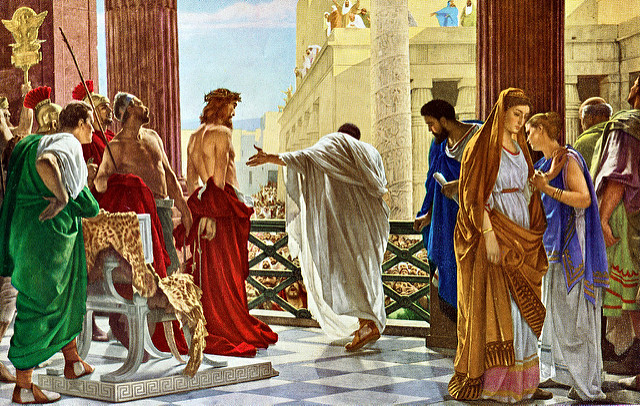
When the presiding Roman government official, Pontius Pilate, interviewed Jesus, he realized the innocence of the man brought before him. Rather than subject Jesus to crucifixion (a punishment typically reserved for insurrectionists, and meant to send a chilling message to the populace), Pilate offered, in accordance with a once-a-year Passover tradition, to release him. The crowd instead demanded the release of Barabbas. In choosing Barabbas, the crowd was choosing the man of violence over the man of peace. Barabbas’ and the Zealots’ ethos was that violence was the expedient action required to deal with the crisis of Roman occupation. Jesus’ solutions were impractical.
History tells us that the people of Judea, by-and-large, continued down the road of Barabbas. Eventually an all-out rebellion broke out. Jewish freedom fighters attacked Roman garrisons. The Romans responded with a crushing scorched-earth military campaign that culminated in the horrific siege of Jerusalem and the destruction of the Jewish temple–the place which Jews considered to be the locus of God’s presence on earth. A few decades later, the Jews regrouped and, led by a messiah named Simon bar Kokhba, mounted another rebellion, sure that God would fight on their behalf. This time Jerusalem was utterly flattened by the Romans, hundreds of thousands of Jews died, tens of thousands were taken away into slavery and the region of Judea was, to a large extent, depopulated.
Jesus had come to his people as a prophet warning against adopting violence as a means of solving their problems. The majority instead chose the way of Barabbas. Their choice bore the dreadful fruit of suffering, devastation and death. Again and again.
And so it is mystifying to me how in these days there are so many like the radio pundits I heard, who claim to be followers of Jesus–the Prince of Peace–but who have joined the mob calling for Barabbas.
Previous Post

May 31, 2017
Selective Grace
Next Post

June 8, 2017 Morality
Browse Our Archives
Select a Category Uncategorized
Select a Month August 2017 July 2017 June 2017 May 2017 April 2017
Follow Us!
TAKE THE
Religious Wisdom Quiz
What was worn as a sign of mourning in biblical times?
Select your answer to see how you score.
Sackcloth Purple robe Linen Fur
Related posts from Buddhist-Christian-Quaker


TRENDING AT PATHEOS Progressive Christian

Why Christians Have a Sacred Duty to Vote:...
The Bible offers strong support for the sacred duty to vote. Here...

What Being a Modern-Day Apostle Means to Me
In my last column, I discussed the ins and outs of modern-day...

Did Ancient China Once Worship the God of...
Across human history, a common thread weaves through the origins of the...

Love Your Neighbor – Including Earth-Kin: Lev. 19,...
God’s command to love your neighbor means acting in an ethical and...

Lead a Church Study of “Jesus and Lao...
Guest writer Jack Thomas (The Irreverent Reverend) reflects on leading his church...

Principles for Understanding the Apostolic Ministry Today
Whenever people discover that my formal ministry title is "apostle," as in...
view all Progressive Christian blogs
Ad-Free & Subscriber Log-In Subscription Support
- About Us
- 2026 Calendar
- Videos
- Podcasts
- Library of World Religions
- Faith In Media Tracker
- Advertise With Us
- Write for Us
- Privacy Policy
- Terms of Service
- Do Not Sell My Data
- Contact Us
- Radiant Digital
- Manage Newsletter Subscriptions
- Unsubscribe From Notifications
- Sitemap
Copyright 2008-2026, Patheos. All rights reserved.
Subscription Support Ad-Free & Subscriber Log-In
Follow Patheos