
BuddhistCatholicContemplativeEvangelicalGeneral ChristianHinduJewishLatter-day SaintMuslimNew VisionsProgressive Christian
Beliefs
- Buddhist
- Catholic
- Contemplative
- Evangelical
- General Christian
- Hindu
- Jewish
- Latter-day Saint
- More Voices
- Muslim
- New Visions
- Pagan
- Progressive Christian
Topics
- Religion News
- Food and Religion
- Sports and Religion
- Religious Art
- Religious Music and Entertainment
- Religious Events
- History and Religion
- Style and Religion
- Politics and Religion
- Women in Religion
- Recreation Outdoors and Religion
- Business Finance and Religion
- Careers Workplace and Religion
- Education and Religion
- Family Parenting and Religion
- Health Fitness and Religion
- Home and Religion
- Relationships and Religion
- Technology and Religion
- Travel and Religion
Columnists
- Buddhist Columnists
- Business Finance and Religion Columnists
- Careers Workplace and Religion Columnists
- Catholic Columnists
- Contemplative Columnists
- Education and Religion Columnists
- Evangelists Columnists
- Family Parenting and Religion Columnists
- General Christian Columnists
- Health Fitness and Religion Columnists
- Hindu Columnists
- History and Religion Columnists
- Home and Religion Columnists
- Jewish Columnists
- More Voices Columnists
- Latter Day Columnists
- Muslim Columnists
- New Visions Columnists
- Nonreligious Columnists
- Pagan Columnists
- Politics and Religion Columnists
- Progressive Columnists
- Recreation Outdoors and Religion Columnists
- Relationships and Religion Columnists
- Religion News Columnists
- Religious Art Columnists
- Religious Events Columnists
- Religious Music and Entertainment Columnists
- Sports and Religion Columnists
- Style and Religion Columnists
- Technology and Religion Columnists
- Travel and Religion Columnists
- Women in Religion Columnists
Resource Library
- 2026 Calendar
- Library of World Religions
- The 100 Most Holy Places on Earth
- Patheos Answers
- Podcasts
- Videos
- Faith Leaders Database
- Anglican Episcopalian
- Bahai
- Baptist
- Buddhism
- Christianity
- Confucianism
- Eastern Orthodoxy
- Hinduism
- Holiness and Pentecostal
- ISKCON
- Islam
- Judaism
- Lutheran
- Methodist
- The Church of Jesus Christ of Latter-day Saints
- New Age
- Paganism
- Presbytarian and Reformed
- Protestantism
- Religion Behind the Scenes
- Roman Catholic
- Scientology
- Shia Islam
- Sikhism
- Sufism
- Sunni Islam
- Taoism
- Zen
- See all religions
Research Tools
 Ad-Free & Subscriber Log-In Subscription Support
Ad-Free & Subscriber Log-In Subscription Support
Follow Patheos 

- Trending:
- Forgiveness
- |
- Marriage
- |
- Consciousness
- |
- Death Penalty
- |
- Election
- |
- Halloween
 Danielle Kingstrom
- Home
- Progressive Christian
- Do Christians Make an Idol out of Jesus?
Do Christians Make an Idol out of Jesus?
Last updated on: February 3, 2022 at 11:49 am by Danielle Kingstrom
Do Christians Make an Idol out of Jesus? 2022-02-03T11:49:02-06:00 Danielle Kingstrom
Patheos Explore the world's faith through different perspectives on religion and spirituality! Patheos has the views of the prevalent religions and spiritualities of the world.
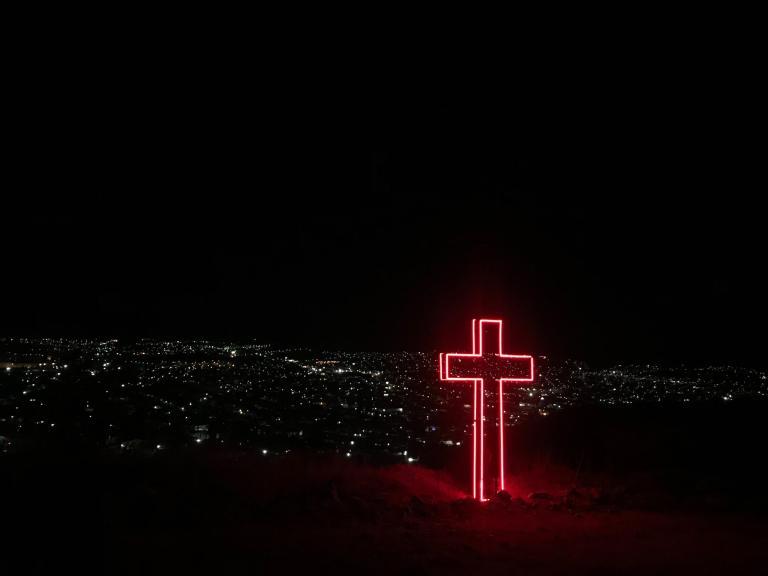
Photo by Diana Vargas on Unsplash
There are many things about the Christian faith that leave people confused. The structure, the symbolism, and even the songs. But one idea stands out for most and that is the odd double standard of worshipping Jesus despite the Commandment, “You shall have no other gods before me.”
Why do so many Christians worship Jesus? Why does the worship of Jesus take precedent over the worship of God? Is there a right way to follow Jesus that doesn’t imitate idolatry? And if there is, are there many models of this practice?
Let us first ensure we are using like terms here so we can reduce misunderstanding. We must first ask, “what is idolatry?” before we can ask, “Am I making an idol of Jesus?”
Idolatry, as defined by Webster: The worship of a physical object as a god. Immoderate attachment or devotion to something. Synonyms of idolatry include hero-worship, or simply, worship.
Worship, as defined by Webster: To honor or show reverence for as a divine being or supernatural power. To regard with great or extravagant respect, honor, or devotion.
It seems then, worship can lead to idolatry. This is what we must examine and explore.
Children require images to help them understand the world around them. That is why we use picture books as the first teaching tools for our children. We must show them because they are too immature to develop images in their head of things they have not yet encountered—things they have not seen. This means that images and representations are not necessarily bad, as they are useful tools for developing minds. With children, as well as adults, seeing is believing, or at least comprehending.
Does looking at an image automatically mean you are idolizing it? Of course not. In the same way we can appreciate beauty without objectifying it, we can use images and representations in an effective way without idolizing them.
Images are important. We human beings are very images of God, are we not? So, if hanging a picture of Jesus (preferably a culturally accurate depiction of Jesus) in your house is automatic idolatry, then what would we say about hanging pictures of our family members in our homes?
But still, how do we reconcile this very severe verse from Exodus? “You shall not make unto thee any graven image or any likeness of anything that is in heaven above, or that is in the earth beneath, or that is in the water under the earth; you shall not bow to them nor serve them. For I, the LORD your God, am a jealous God.”
(Exodus 20:4-5, KJV)
Some Christian sects would say that the glory of God is diminished by an image. That it makes God less than what God is. When we use symbolic representations of God, or even if you are into astrology and symbolic representations of protection, like I am, some would say this reduces the wholeness of the eternal, omnipotent Creator of the Universe.
But then again, so many Christians believe that Jesus is God. And therefore, the worship of Jesus is the same as the worship of God. However, many other Christians do not believe Jesus is God and therefore the worship of Jesus is idolatry. What we see here is a divorce of ideas from the same Christian faith. Some believe that images and symbols help a believer, others suggest it harms their potential salvation from an eternal hell.
I would say the first question to ask is not what is the importance of the object or representation at hand? Rather, we should ask, “What will one do with such representations and symbols?” and, “How might they be used as weapons against others?”
It’s not so much that I believe Christians idolize Jesus, but some Christians do weaponize Jesus. I think what happens is there is a program built into the religion of Christianity that suggests you must defend the beliefs at all costs. And since Jesus was persecuted, and the developing religion was met with such hostility and aggression for the first few hundred years, the assumption is, that is exactly what awaits anyone in present-day Christianity.
Like so many individuals who exponentially exploit race and attribute any means of rejection or disagreement with ideas as “racist” or “white supremacy”, too often, Christians attribute any form of opposition or rejection to their religion as persecution. Religions tend to bring out the Oppression Olympics in the same way secular societies do for the sake of social justice.
Jesus is then weaponized as the hierarchical Savior that, if not worshipped and followed to the T, becomes the sentencer for eternal damnation. Here’s where I want to interject. Jesus never said he was going to send anyone to hell. And while many translations of the Bible suggest that “hell” is a place God sends the “bad” people, it’s not an accurate interpretation of what is actually written in the Bible. Here, we can see how Christians have weaponized their faith to use it as a punishment against those who don’t believe exactly the same way. (I’d like to point out that our US government officials have repeatedly utilized the same spin against those who disagree with government policy- remember the “winter of death” threat Biden spoke about in December 2021?)
Somewhere along the timelines, individuals began viewing opposition to their beliefs as a rejection of who they are as individuals. Perhaps for the same reason so many people in present-day take disagreement with their principles and philosophies as a direct attack on who they are as a person. Meaning, if you disagree with me, you are dividing yourself from me and my ideas. If you’re not with me, you’re against me, essentially. And I get it, Jesus did say something similar, and so did Dr. Anthony Fauci. But that’s not how belief works. You can’t force beliefs upon others. Faith is derived through an internal conviction, not a policy of compliance, and not through a verse from the Bible.
Worship for someone or something is meant to be an energetic performance that extends appreciation and gratitude beyond the self—directed toward something bigger than the self, like God or an all-powerful Creator of the Universe. However, in many events, worship becomes something else entirely. My friend Jack Coleman says that “When someone believes certain beings should be worshipped, they ultimately cast (negative) judgment upon those that disagree with their perspectives. It will also create a subconscious need of being worshipped themselves but usually found in some other area of life, such as at a workplace or even within a romantic relationship.”
When you demand someone else worship what or who you worship, you have effectively attached yourself (your character, your personality, your principles, and beliefs) to the object of worship and the practice of worship. If your version of worship doesn’t reflect an open-minded acceptance that not all people will believe as you do, it’s not worship. It has turned into idolatry. When you focus more on ensuring others worship what and who you do, rather than holding a state of reverence for what is yours alone—your belief, your faith— you have weaponized your beliefs.
It’s no longer about what you believe, it’s about who agrees with you about what you believe. And I sometimes wonder if people care more about what they believe or if they care more about others believing what they believe. And to that, I would ask, does it matter what other people believe? Does it matter that people believe differently than you? Do you think that if someone disbelieves that it makes your belief any less true? If that’s the case, then maybe it’s time to reevaluate what you believe. And here’s the final question I ask to all who call themselves Christian- if someone else doesn’t believe in God, will God no longer exist?

About Danielle M Kingstrom
Danielle is a writer, podcaster, and home-school teacher. She lives in rural Minnesota on a farm with her husband and five children. Together, they maintain a fourth generation legacy farm and raise chickens and cattle. When she is not reading, writing, or self-educating; she can be found outdoors in nature’s naked elements. Danielle is an avid gardener, a lover of art, knowledge, and always a student. She is active in revitalization projects within her community, partnering with committees to bridge the Rural Divide. Unafraid of sparking controversy, Danielle is a frequently published author, appearing regularly in her community’s local newspaper; writing about provocative issues and asking challenging questions that raise a few eyebrows. She is currently working on two books. You can read more about the author here.
Previous Post

January 12, 2022
How to Make Friends without Expectations
Next Post
February 3, 2022 Jesus & Joe Rogan: They're the Same
Browse Our Archives
Select a Category Authentic Connection Ego Love Self Suffering Uncategorized
Select a Month October 2022 September 2022 August 2022 July 2022 June 2022 April 2022 March 2022 February 2022 January 2022 December 2021 November 2021 September 2021 July 2021 June 2021 May 2021 April 2021 March 2021 February 2021 January 2021 December 2020 November 2020 October 2020 September 2020 August 2020 July 2020 June 2020 May 2020 April 2020 March 2020 February 2020 January 2020 December 2019 November 2019 October 2019 September 2019 August 2019 July 2019 June 2019 May 2019 April 2019 March 2019
TAKE THE
Religious Wisdom Quiz
Which mountain did Jesus ascend from at His ascension?
Select your answer to see how you score.
Mount Sinai Mount Carmel Mount of Olives Mount Zion
Related posts from Danielle Kingstrom


The Greatest in the Kingdom of Heaven: Confidence...

Lens on Life: Do You See Abundance or...

Debt Forgiveness and the Parable of the Unmerciful...
TRENDING AT PATHEOS Progressive Christian

Why Christians Have a Sacred Duty to Vote:...
The Bible offers strong support for the sacred duty to vote. Here...

What Being a Modern-Day Apostle Means to Me
In my last column, I discussed the ins and outs of modern-day...

Did Ancient China Once Worship the God of...
Across human history, a common thread weaves through the origins of the...

Love Your Neighbor – Including Earth-Kin: Lev. 19,...
God’s command to love your neighbor means acting in an ethical and...

Lead a Church Study of “Jesus and Lao...
Guest writer Jack Thomas (The Irreverent Reverend) reflects on leading his church...

Principles for Understanding the Apostolic Ministry Today
Whenever people discover that my formal ministry title is "apostle," as in...
view all Progressive Christian blogs
Ad-Free & Subscriber Log-In Subscription Support
- About Us
- 2026 Calendar
- Videos
- Podcasts
- Library of World Religions
- Faith In Media Tracker
- Advertise With Us
- Write for Us
- Privacy Policy
- Terms of Service
- Do Not Sell My Data
- Contact Us
- Radiant Digital
- Manage Newsletter Subscriptions
- Unsubscribe From Notifications
- Sitemap
Copyright 2008-2026, Patheos. All rights reserved.
Subscription Support Ad-Free & Subscriber Log-In
Follow Patheos