
BuddhistCatholicContemplativeEvangelicalGeneral ChristianHinduJewishLatter-day SaintMuslimNew VisionsProgressive Christian
Beliefs
- Buddhist
- Catholic
- Contemplative
- Evangelical
- General Christian
- Hindu
- Jewish
- Latter-day Saint
- More Voices
- Muslim
- New Visions
- Pagan
- Progressive Christian
Topics
- Religion News
- Food and Religion
- Sports and Religion
- Religious Art
- Religious Music and Entertainment
- Religious Events
- History and Religion
- Style and Religion
- Politics and Religion
- Women in Religion
- Recreation Outdoors and Religion
- Business Finance and Religion
- Careers Workplace and Religion
- Education and Religion
- Family Parenting and Religion
- Health Fitness and Religion
- Home and Religion
- Relationships and Religion
- Technology and Religion
- Travel and Religion
Columnists
- Buddhist Columnists
- Business Finance and Religion Columnists
- Careers Workplace and Religion Columnists
- Catholic Columnists
- Contemplative Columnists
- Education and Religion Columnists
- Evangelists Columnists
- Family Parenting and Religion Columnists
- General Christian Columnists
- Health Fitness and Religion Columnists
- Hindu Columnists
- History and Religion Columnists
- Home and Religion Columnists
- Jewish Columnists
- More Voices Columnists
- Latter Day Columnists
- Muslim Columnists
- New Visions Columnists
- Nonreligious Columnists
- Pagan Columnists
- Politics and Religion Columnists
- Progressive Columnists
- Recreation Outdoors and Religion Columnists
- Relationships and Religion Columnists
- Religion News Columnists
- Religious Art Columnists
- Religious Events Columnists
- Religious Music and Entertainment Columnists
- Sports and Religion Columnists
- Style and Religion Columnists
- Technology and Religion Columnists
- Travel and Religion Columnists
- Women in Religion Columnists
Resource Library
- 2026 Calendar
- Library of World Religions
- The 100 Most Holy Places on Earth
- Patheos Answers
- Podcasts
- Videos
- Faith Leaders Database
- Anglican Episcopalian
- Bahai
- Baptist
- Buddhism
- Christianity
- Confucianism
- Eastern Orthodoxy
- Hinduism
- Holiness and Pentecostal
- ISKCON
- Islam
- Judaism
- Lutheran
- Methodist
- The Church of Jesus Christ of Latter-day Saints
- New Age
- Paganism
- Presbytarian and Reformed
- Protestantism
- Religion Behind the Scenes
- Roman Catholic
- Scientology
- Shia Islam
- Sikhism
- Sufism
- Sunni Islam
- Taoism
- Zen
- See all religions
Research Tools
 Ad-Free & Subscriber Log-In Subscription Support
Ad-Free & Subscriber Log-In Subscription Support
Follow Patheos 

- Trending:
- Forgiveness
- |
- Marriage
- |
- Consciousness
- |
- Death Penalty
- |
- Election
- |
- Halloween
 Danielle Kingstrom
- Home
- Progressive Christian
- Communication is Lubrication: Dare to Ask Questions
Communication is Lubrication: Dare to Ask Questions
Last updated on: April 27, 2021 at 9:38 am by Danielle Kingstrom
Communication is Lubrication: Dare to Ask Questions 2021-04-27T09:38:56-06:00 Danielle Kingstrom
Patheos Explore the world's faith through different perspectives on religion and spirituality! Patheos has the views of the prevalent religions and spiritualities of the world.
 The internet influence of insta-reaction, anticipated reactions, and counterarguments drastically erode eroticism. Our society has graciously accepted this new way to interact with individuals that we do not know and collectively, we have endorsed this way as an anti-erotic engagement program that interrupts our most important connections.
It trickles into our intimate relationships. This is one of many reasons why couples struggle to really dig into bigger conversations about their relationship. We initiate vulnerable conversations with our partners by imitating our exterior discourse dynamic. Let it be known that this approach blatantly violates the principles of mutual recognition.
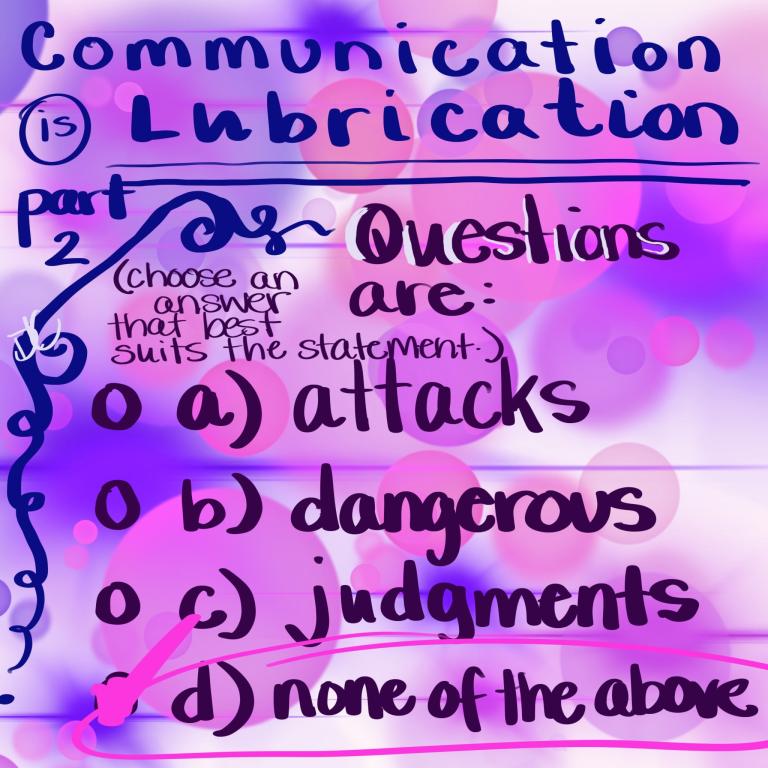
Questions are often discouraged in many areas of our daily interactions. They take up time and energy, they take the focus off the topic at hand, and in many instances, questions are deemed dangerous and even radical. Many are downright insulted by questions altogether, “Is that really the question you are going to ask?” or “How dare you question my experience!”
Questions are a part of conversations. Naturally, the sharing of our stories will arouse curiosity in the listener of our speech. You say, “I broke my leg.” As the listener, I would respond, “Oh no! Are you okay? What happened? Which leg?” You would naturally answer my questions, “Yeah, it hurts bad, but I’ll be OK. They gave me pain meds. My right leg. I just totally missed a step bringing groceries in the house and fell just the right way to crack! Broke a bone.”
However, the rules of engagement are often different outside of our intimate relationships. If you take the social media realm, for instance, questions are often received, not as clarity-seeking interrogative sentences, but as judgments. In simpler terms, the assumed equation is that questions=judgments. In other pockets, a simpler formula posits questions= disbelief.
Let’s go back to the broken leg. You say, “I broke my leg.” I respond, “Oh no! Are you okay? What happened? Which leg?” If we were engaged on Twitter, for example, your typical response would go something like this, “Are you judging me? So, I am somehow less of a person and lazy because I broke my leg?” Another example could go like this, “Why are you asking that? Don’t you believe me? I said I broke my leg. Believe me.”
This is a common way that humans interact with one another on daily basis. We feel threatened by questions. Many say that questions infer judgment, but I think that has more to do with the individual feeling judged by the questions. Maybe that person was once judged for not asking a question and has attached the two terms, “judgment” and “question” together in a negative way. Maybe this person was judged for not asking the “right” questions. It could even be that in the past, this individual received a judgment after answering questions. There are so many possibilities, but I think the judger carries the burden here.
Some say that questions only “revictimize” an individual when they are asked to recall their experience. But the reality is that when we recall our experience and share of pain, say breaking a leg, or being held at gunpoint (like my grandmother was) for instance, it can actually enable healing.
Sharing our experience with another in fuller detail brings the listener into the story. In return, they let us know that we are both seen and heard. This is an important reciprocal process of developed intimate relationships.
Why Ask Why?
The reason we ask questions is so that we can gain clarity, clarity adds definition, and definition helps us better envision and understand the fullness of the story and the pain. Isn’t that what we are after when we share any story? Don’t we want it validated? Aren’t we seeking resonance with another when we share our stories, even if they are just about broken legs?
Asking questions has nothing to do with belief. Questions do not invalidate the initial declarative statement. This idea that “belief” must be present in an exchange of information is a bit extreme, anyway. One cannot believe what one does not yet know or understand. If someone tells you that they were held at gunpoint and robbed, as a police officer, for example, you’d have to ask several questions to collect information for an investigation. It’s about acquiring information. Information is important for intimacy development in relationships.
This Model is Flawed
If you are in a relationship where this model of engagement is utilized in intimate conversations, having deeper, bigger conversations are going to be a great challenge. Questions that are deemed dangerous are often dubbed this way by cult leaders and religious zealots. If your relationship has a regulation against asking questions, then what is being pursued is a kind of blind conformity. Relationships require the development of mutual recognition and respect and one cannot develop such components without the ability to come from a place of curiosity and care and ask questions.
We must unlearn this idea that questions accuse, attack, condemn, or judge an individual. Questions humanize the individual. This means that not asking questions dehumanizes a person. Why wouldn’t you want to ask questions when someone shares an experience with you, I wonder? Isn’t that how one shows interest in another? This call to cancel questions has me wondering if we are intentionally dehumanizing the experiences of others. As if we don’t want to be able to understand and relate to another’s story.
However, the more we add to the story, the more we understand where the person is coming from. The more we understand where a person is coming from, the better we can relate to their experience and be affected, changed, and/or moved by it. This creates a shared experience and produces a vicarious experience I can participate in mentally and emotionally. It is in this space that connection and relationship development takes place.
The ability to share in a vicarious experience is essential for sharing sexual fantasies with our partners. The ability to receive questions as a demonstration of our partner’s curiosity and care rather than disbelief and judgment is what facilitates an erotic evolution within a relationship.
Ultimately, we want to get beyond the space of just asking surface or testimonial questions in our relationships so that we can utilize this amazing feature of conversation as lubrication. It’s in this space that the questions we ask change drastically and open a new space for bigger conversations about arousal, desire, fantasy, and novelty. We greet questions as invitations for more. When someone asks me more about something I care about, to me, it says they are interested in what I have to say and how that experience impacted me.
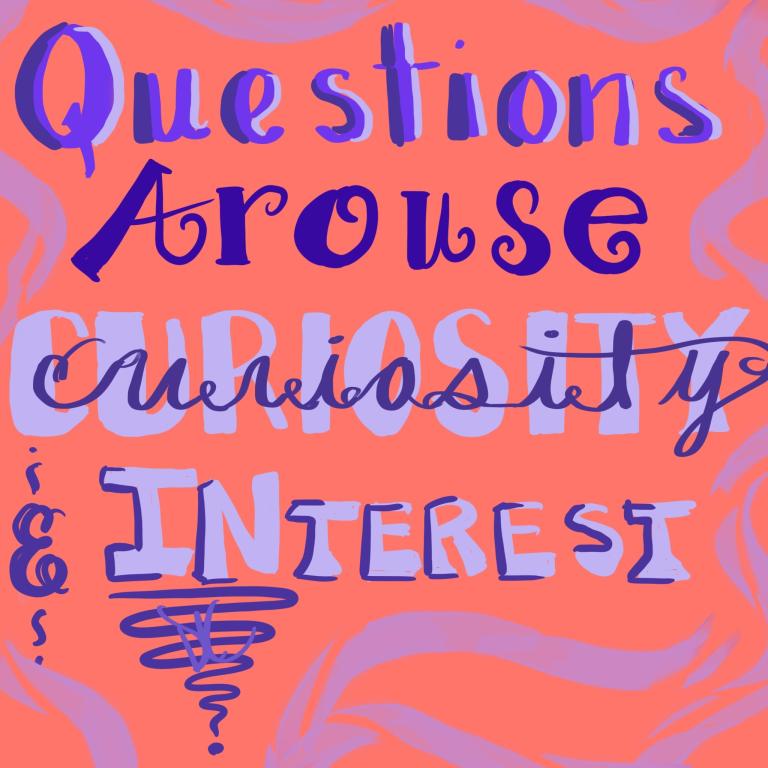
Let us take into consideration that questions will bring us closer. Questions reveal curiosity and care, interest, and offer invitations to continue sharing space.
Follow me on TikTok

About Danielle M Kingstrom
Danielle is a writer, podcaster, and home-school teacher. She lives in rural Minnesota on a farm with her husband and five children. Together, they maintain a fourth generation legacy farm and raise chickens and cattle. When she is not reading, writing, or self-educating; she can be found outdoors in nature’s naked elements. Danielle is an avid gardener, a lover of art, knowledge, and always a student. She is active in revitalization projects within her community, partnering with committees to bridge the Rural Divide. Unafraid of sparking controversy, Danielle is a frequently published author, appearing regularly in her community’s local newspaper; writing about provocative issues and asking challenging questions that raise a few eyebrows. She is currently working on two books. You can read more about the author here.
Previous Post

April 23, 2021
Done with the Transaction of Deconstruction
Next Post
May 28, 2021 Love is the Antidote
Browse Our Archives
Select a Category Authentic Connection Ego Love Self Suffering Uncategorized
Select a Month October 2022 September 2022 August 2022 July 2022 June 2022 April 2022 March 2022 February 2022 January 2022 December 2021 November 2021 September 2021 July 2021 June 2021 May 2021 April 2021 March 2021 February 2021 January 2021 December 2020 November 2020 October 2020 September 2020 August 2020 July 2020 June 2020 May 2020 April 2020 March 2020 February 2020 January 2020 December 2019 November 2019 October 2019 September 2019 August 2019 July 2019 June 2019 May 2019 April 2019 March 2019
TAKE THE
Religious Wisdom Quiz
Who mocked Nehemiah and the Jews, saying a fox could break their wall?
Select your answer to see how you score.
Geshem Eliashib Tobiah Sanballat
Related posts from Danielle Kingstrom

What is an Accountable Woman? A Look at...

The Absence of Touch: Rejection of Physical Affection...

Threats of Erotic Extermination: Is There an Erotic...

Holding Myself Accountable: An Affirmation of Humility &...
TRENDING AT PATHEOS Progressive Christian

Why Christians Have a Sacred Duty to Vote:...
The Bible offers strong support for the sacred duty to vote. Here...

What Being a Modern-Day Apostle Means to Me
In my last column, I discussed the ins and outs of modern-day...

Did Ancient China Once Worship the God of...
Across human history, a common thread weaves through the origins of the...

Love Your Neighbor – Including Earth-Kin: Lev. 19,...
God’s command to love your neighbor means acting in an ethical and...

Lead a Church Study of “Jesus and Lao...
Guest writer Jack Thomas (The Irreverent Reverend) reflects on leading his church...

Principles for Understanding the Apostolic Ministry Today
Whenever people discover that my formal ministry title is "apostle," as in...
view all Progressive Christian blogs
Ad-Free & Subscriber Log-In Subscription Support
- About Us
- 2026 Calendar
- Videos
- Podcasts
- Library of World Religions
- Faith In Media Tracker
- Advertise With Us
- Write for Us
- Privacy Policy
- Terms of Service
- Do Not Sell My Data
- Contact Us
- Radiant Digital
- Manage Newsletter Subscriptions
- Unsubscribe From Notifications
- Sitemap
Copyright 2008-2026, Patheos. All rights reserved.
Subscription Support Ad-Free & Subscriber Log-In
Follow Patheos