
BuddhistCatholicContemplativeEvangelicalGeneral ChristianHinduJewishLatter-day SaintMuslimNew VisionsProgressive Christian
Beliefs
- Buddhist
- Catholic
- Contemplative
- Evangelical
- General Christian
- Hindu
- Jewish
- Latter-day Saint
- More Voices
- Muslim
- New Visions
- Pagan
- Progressive Christian
Topics
- Religion News
- Food and Religion
- Sports and Religion
- Religious Art
- Religious Music and Entertainment
- Religious Events
- History and Religion
- Style and Religion
- Politics and Religion
- Women in Religion
- Recreation Outdoors and Religion
- Business Finance and Religion
- Careers Workplace and Religion
- Education and Religion
- Family Parenting and Religion
- Health Fitness and Religion
- Home and Religion
- Relationships and Religion
- Technology and Religion
- Travel and Religion
Columnists
- Buddhist Columnists
- Business Finance and Religion Columnists
- Careers Workplace and Religion Columnists
- Catholic Columnists
- Contemplative Columnists
- Education and Religion Columnists
- Evangelists Columnists
- Family Parenting and Religion Columnists
- General Christian Columnists
- Health Fitness and Religion Columnists
- Hindu Columnists
- History and Religion Columnists
- Home and Religion Columnists
- Jewish Columnists
- More Voices Columnists
- Latter Day Columnists
- Muslim Columnists
- New Visions Columnists
- Nonreligious Columnists
- Pagan Columnists
- Politics and Religion Columnists
- Progressive Columnists
- Recreation Outdoors and Religion Columnists
- Relationships and Religion Columnists
- Religion News Columnists
- Religious Art Columnists
- Religious Events Columnists
- Religious Music and Entertainment Columnists
- Sports and Religion Columnists
- Style and Religion Columnists
- Technology and Religion Columnists
- Travel and Religion Columnists
- Women in Religion Columnists
Resource Library
- 2026 Calendar
- Library of World Religions
- The 100 Most Holy Places on Earth
- Patheos Answers
- Podcasts
- Videos
- Faith Leaders Database
- Anglican Episcopalian
- Bahai
- Baptist
- Buddhism
- Christianity
- Confucianism
- Eastern Orthodoxy
- Hinduism
- Holiness and Pentecostal
- ISKCON
- Islam
- Judaism
- Lutheran
- Methodist
- The Church of Jesus Christ of Latter-day Saints
- New Age
- Paganism
- Presbytarian and Reformed
- Protestantism
- Religion Behind the Scenes
- Roman Catholic
- Scientology
- Shia Islam
- Sikhism
- Sufism
- Sunni Islam
- Taoism
- Zen
- See all religions
Research Tools
 Ad-Free & Subscriber Log-In Subscription Support
Ad-Free & Subscriber Log-In Subscription Support
Follow Patheos 

- Trending:
- Forgiveness
- |
- Marriage
- |
- Consciousness
- |
- Death Penalty
- |
- Election
- |
- Halloween
 Danielle Kingstrom
- Home
- Progressive Christian
- The Wounding Effects of Truth-Telling: Michel Foucault & Jesus
The Wounding Effects of Truth-Telling: Michel Foucault & Jesus
Last updated on: January 19, 2021 at 3:04 pm by Danielle Kingstrom
The Wounding Effects of Truth-Telling: Michel Foucault & Jesus 2021-01-19T15:04:59-06:00 Danielle Kingstrom
Patheos Explore the world's faith through different perspectives on religion and spirituality! Patheos has the views of the prevalent religions and spiritualities of the world.
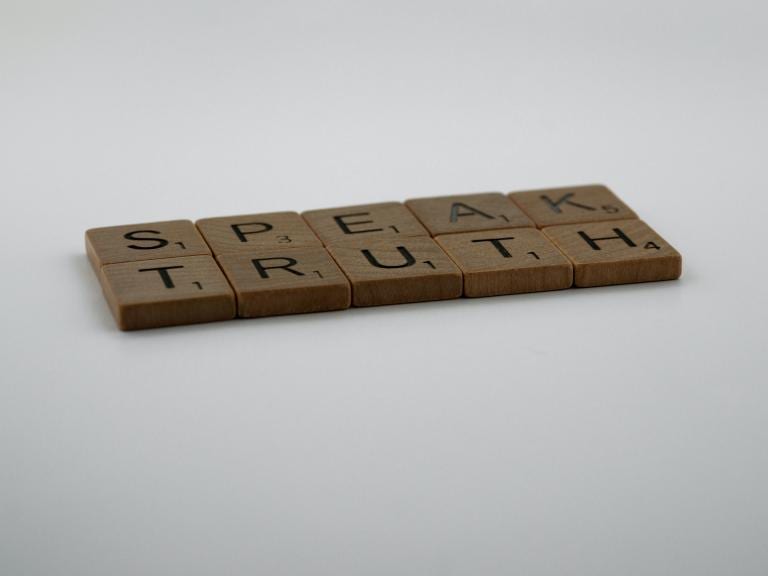
Photo by Brett Jordan on Unsplash
I have spent much time over the week reflecting deeply on the idea of truth. I have been reading from and listening to many great minds articulate truth in such a way that I have come to realize I don’t know much about truth at all. The bold and beautiful thing about this discovery is that when it comes down to it, none of us know much about truth. And that’s a good thing. It means that we have an opportunity to grow and transform our ideas.
I dabbled through some very thick intellectual essays aimed at distinguishing “truth” from fact, others aimed at separating ontological truth from scientific truth. Much ink has been spilled on this idea of truth, but nothing seems to be absolute.
French historian and philosopher Michel Foucault had much to say about truth. And the brilliant deduction of it all is that “truth is never the same.”
In the essay The Courage of Curiosity, or the Heart of Truth (A Mash-Up), Ed Cohen, while paying tribute to the late Eve Sedgwick, addresses the nature of curiosity that so many knew her for. In honoring her “gift of curiosity”, Cohen connects Sedgwick’s nature with Foucault’s philosophy.
Let it be known, prior to stumbling across this essay, I had known very little about Foucault and his philosophies. I had been warned in the past to avoid Foucault as he is often tied with Marxism or at least was attributed in such a way that my “friends” worried reading him would send me down a slippery slope.
Nonetheless, in the last few years of his life, Foucault focused on the Greek concept of parrhesia— truth-telling*.* Of parrhesia, Foucault says, “It is an attitude, a manner of being which concerns virtue, a manner of doing or making.” (Le Courage de la Verité, 15)
What’s rather intriguing to me about this attitude of truth-telling is that it makes truth seem dangerous to reveal. Foucault continues:
“Parrhesia implies a strong and constitutive tie between the one who speaks and what is said and moreover, by the effects of truth themselves, by the wounding effects of truth, the possibility of a rupture of the tie between the one who speaks and the one who is addressed…the parrhesiast would be the courageous speaker of a truth in which the speaker risks him-or herself and his or her relations with the other.” (Le Courage de la Verité, 15- emphasis mine)
So, the truth hurts!
The attitude of truth-telling, as far as I can tell, involves a bit of courage to wound the other (and perhaps, even the self in regard to collective acceptance). And while many of us agree with such a consequence, I think we are using it in a way that the wounding effects of this truth-telling create scars instead of leading to healing.
Foucault said that “Cynicism poses a very grave question: In order to truly be the life of truth, must life not be an other life, a life radically and paradoxically other?… The true life, isn’t it, and mustn’t it be an other life? ((Le Courage de la Verité, 226)
Later, he boldly insists that “there is no instauration of truth without an essential position of otherness; truth is never the same; it can only be truth in the form of the other world or the other life.” (Le Courage de la Verité, 311)
Truth-telling involves risk—the risk of the relation between the speaker and the listener, risk of the self, and all the reputation that follows.
Didn’t Jesus operate like that? I know in a recent blog, I suggested that Jesus is a model we need to update, but in this regard, I see Jesus doing much of what Foucault states that truth-tellers do. Jesus was willing to speak back to power even in the face of death. He was willing to risk the relationship between himself and the audience and being that he only had 12 followers as mentioned in the Gospels, he risked the possibility of a general, majority acceptance.
And then there’s that unanswered question that we have all tried to answer for ourselves and others for so long; the very question Pilate confronts Jesus with before he is sentenced: “What is truth?”
After I spent all weekend immersed in Foucault, I came to this epiphany about that very scene in the Gospel of John. What if Jesus knew what Foucault deduced? Pilate, representing the masses in the government circle, wouldn’t even think about truth in the way that Jesus or Foucault did. Perhaps he would see truth as so many do today, as a black and white statement of verifiable fact. Truth, to many, is simply a mathematical equation. What can be reproduced is therefore truth. What can be figured, factored, or accumulated and counted, there you will find the truth.
Jesus was a witness to truth. And in that very claim, it may have seemed as though he was at odds with facts and equations. How did Jesus witness truth? He did it individually, through the Other. I see Foucault preparing this very prescription for understanding truth through his final works. I might be cramming the two ideas together a bit too hard, but in my mind, there is resonance.
In recent years, and most readily in recent weeks, many of us have been clamoring on and on about “truth”, being “truth-seekers”, and “truth-telling importance.” But if we all have our own truths, if truth is never the same, if the question of “What is truth?” is met with silence from the Savior, what does that mean for us about how we see truth and live truth?
What is courageous about saying the same thing everyone else is saying and calling it truth? If we are all saying the same thing is truth, is it? If we are all in agreement with what the truth is, where is the risk in head-nodding and groupthink?
If the discovery of the truth doesn’t lead us to growth and through transformation if it doesn’t result in healing, is it really the truth? Truth is meant to inspire, not separate. And at the heart of truth, lies love. How far have we strayed from truth if, in our proclamations for what it is, none of it is rooted in love?

About Danielle M Kingstrom
Danielle is the host of the Recorded Conversations podcast. A podcast dedicated to compassionately considering all perspectives while engaging in authentic, connected dialogue. She is also an erotic embodiment advisor with Naked Tree Advising. As an advisor, Danielle assists others in discovering their erotic self and helps answer questions about struggles with sexuality. You can read more about the author here.
Previous Post

January 14, 2021
Recorded Conversations Restructured: 4 Dimensions of a Conversation
Next Post
January 21, 2021 Killing Friendships Over Ideas, not Actions
Browse Our Archives
Select a Category Authentic Connection Ego Love Self Suffering Uncategorized
Select a Month October 2022 September 2022 August 2022 July 2022 June 2022 April 2022 March 2022 February 2022 January 2022 December 2021 November 2021 September 2021 July 2021 June 2021 May 2021 April 2021 March 2021 February 2021 January 2021 December 2020 November 2020 October 2020 September 2020 August 2020 July 2020 June 2020 May 2020 April 2020 March 2020 February 2020 January 2020 December 2019 November 2019 October 2019 September 2019 August 2019 July 2019 June 2019 May 2019 April 2019 March 2019
TAKE THE
Religious Wisdom Quiz
Who was the wife of Abraham?
Select your answer to see how you score.
Leah Rebecca Sarah Rachel
Related posts from Danielle Kingstrom

The Greatest in the Kingdom of Heaven: Confidence...

Lens on Life: Do You See Abundance or...

Debt Forgiveness and the Parable of the Unmerciful...

Threats of Erotic Extermination: Is There an Erotic...
TRENDING AT PATHEOS Progressive Christian

Why Christians Have a Sacred Duty to Vote:...
The Bible offers strong support for the sacred duty to vote. Here...

What Being a Modern-Day Apostle Means to Me
In my last column, I discussed the ins and outs of modern-day...

Did Ancient China Once Worship the God of...
Across human history, a common thread weaves through the origins of the...

Love Your Neighbor – Including Earth-Kin: Lev. 19,...
God’s command to love your neighbor means acting in an ethical and...

Lead a Church Study of “Jesus and Lao...
Guest writer Jack Thomas (The Irreverent Reverend) reflects on leading his church...

Principles for Understanding the Apostolic Ministry Today
Whenever people discover that my formal ministry title is "apostle," as in...
view all Progressive Christian blogs
Ad-Free & Subscriber Log-In Subscription Support
- About Us
- 2026 Calendar
- Videos
- Podcasts
- Library of World Religions
- Faith In Media Tracker
- Advertise With Us
- Write for Us
- Privacy Policy
- Terms of Service
- Do Not Sell My Data
- Contact Us
- Radiant Digital
- Manage Newsletter Subscriptions
- Unsubscribe From Notifications
- Sitemap
Copyright 2008-2026, Patheos. All rights reserved.
Subscription Support Ad-Free & Subscriber Log-In
Follow Patheos