
BuddhistCatholicContemplativeEvangelicalGeneral ChristianHinduJewishLatter-day SaintMuslimNew VisionsProgressive Christian
Beliefs
- Buddhist
- Catholic
- Contemplative
- Evangelical
- General Christian
- Hindu
- Jewish
- Latter-day Saint
- More Voices
- Muslim
- New Visions
- Pagan
- Progressive Christian
Topics
- Religion News
- Food and Religion
- Sports and Religion
- Religious Art
- Religious Music and Entertainment
- Religious Events
- History and Religion
- Style and Religion
- Politics and Religion
- Women in Religion
- Recreation Outdoors and Religion
- Business Finance and Religion
- Careers Workplace and Religion
- Education and Religion
- Family Parenting and Religion
- Health Fitness and Religion
- Home and Religion
- Relationships and Religion
- Technology and Religion
- Travel and Religion
Columnists
- Buddhist Columnists
- Business Finance and Religion Columnists
- Careers Workplace and Religion Columnists
- Catholic Columnists
- Contemplative Columnists
- Education and Religion Columnists
- Evangelists Columnists
- Family Parenting and Religion Columnists
- General Christian Columnists
- Health Fitness and Religion Columnists
- Hindu Columnists
- History and Religion Columnists
- Home and Religion Columnists
- Jewish Columnists
- More Voices Columnists
- Latter Day Columnists
- Muslim Columnists
- New Visions Columnists
- Nonreligious Columnists
- Pagan Columnists
- Politics and Religion Columnists
- Progressive Columnists
- Recreation Outdoors and Religion Columnists
- Relationships and Religion Columnists
- Religion News Columnists
- Religious Art Columnists
- Religious Events Columnists
- Religious Music and Entertainment Columnists
- Sports and Religion Columnists
- Style and Religion Columnists
- Technology and Religion Columnists
- Travel and Religion Columnists
- Women in Religion Columnists
Resource Library
- 2026 Calendar
- Library of World Religions
- The 100 Most Holy Places on Earth
- Patheos Answers
- Podcasts
- Videos
- Faith Leaders Database
- Anglican Episcopalian
- Bahai
- Baptist
- Buddhism
- Christianity
- Confucianism
- Eastern Orthodoxy
- Hinduism
- Holiness and Pentecostal
- ISKCON
- Islam
- Judaism
- Lutheran
- Methodist
- The Church of Jesus Christ of Latter-day Saints
- New Age
- Paganism
- Presbytarian and Reformed
- Protestantism
- Religion Behind the Scenes
- Roman Catholic
- Scientology
- Shia Islam
- Sikhism
- Sufism
- Sunni Islam
- Taoism
- Zen
- See all religions
Research Tools
 Ad-Free & Subscriber Log-In Subscription Support
Ad-Free & Subscriber Log-In Subscription Support
Follow Patheos 

- Trending:
- Forgiveness
- |
- Marriage
- |
- Consciousness
- |
- Death Penalty
- |
- Election
- |
- Halloween
 Danielle Kingstrom
- Home
- Progressive Christian
- Misunderstood but Ever-Understanding: Knowing the Other
Misunderstood but Ever-Understanding: Knowing the Other
Last updated on: November 3, 2019 at 8:49 pm by Danielle Kingstrom
Misunderstood but Ever-Understanding: Knowing the Other 2019-11-03T20:49:06-06:00 Danielle Kingstrom
Patheos Explore the world's faith through different perspectives on religion and spirituality! Patheos has the views of the prevalent religions and spiritualities of the world.

Photo by Belinda Fewings on Unsplash
Sometimes, it seems as if no one can hear you. It’s as if your voice is so small, that no matter how loud you shout, it only makes a very quiet peep. Other times, it seems as if your voice is so off beat, that every word you say sounds like a pitchy, pithy melody to everyone listening.
Do you ever feel like that friends?
Does it ever feel like your voice isn’t validated?
Do you ever feel misunderstood? Does it feel like people just cannot handle all of who you are? Friends—same.
I’ve had my fair share with misunderstanding. I was “Miss Understood” for the longest time. Honestly, I probably still am. But I realized that I didn’t have to be understood in order to understand others. I think that is the web that kept me tangled. I always focused on trying to make others understand me that I failed to understand them. And the secret to being understood is to take yourself out of the equation so that you can understand the Other.
Disclaimer: Working to understand the Other does not guarantee you will be understood immediately or at all. Because if you misunderstand while you are trying to understand it can create a whole new misunderstanding and you end up being further misunderstood. It’s a silly circle but the ego profits from it.
Understanding
What does it mean to understand another? To understand is to form an opinion or reach a conclusion through reasoning and information. It means to comprehend, to grasp, to know. To understand means to appreciate, assimilate, behold, conceive, recognize, see, sense.
Understanding is the ability to get meaning, a friendly or harmonious relationship, the power to make experience intelligible. Understanding means an adjustment of differences.
To understand is to know and to know is to recognize the nature of something or someone. Understanding is a willingness to understand people’s behavior and forgive them.
When I tell a person that I understand them, I am telling them that I can relate to, or can imagine an experience of, or I comprehend the context of what they are describing. I think we use the term improperly when we casually tell another “I understand.” Because why else would we all feel so misunderstood?
We fail to use understanding along side of grace and because of this failure, when we claim to understand someone, we still expect them to give further accounting than what they are expressing. This is especially problematic when someone is sharing an experience with us that we cannot relate to.
It’s interesting to me that only once we have been affected by something similar, are we willing to use understanding collaboratively with grace. It’s as if we have an empathetic understanding that we extend to friends, but with foes or the unknown Other, our understanding lacks a shared sense of knowing.
It reminds me of the passage in Luke: If you love those who love you, what credit is that to you? Even sinners love those who love them.
It seems to me that to understand someone is to know someone. To know the nature of the Other is to see the heart of the Other. I believe that to know the Other is to know God.
Had my husband not been able to understand me, to know the truest part of me, he would have never been able to forgive me for my infidelity. Understanding means that we are willing to stand in grace before the Other and accept the Other fully as Christ accepts the fullness of who we are. Flaws and all.
When we understand the Other, whether it be our partner, our child, a friend, a family member; we see into them—we see the truest nature of who they are. Notably, this form of understanding naturally creates intimacy. Viral relationship expert Esther Perel often phrases intimacy as “into me see.” Intimacy and understanding create connection, and connection is, from my view, the cornerstone of the message of the Christ. Without connection, there can be no love.
True Nature: One in Christ
For all intents and purposes, I am going to assume that as a reader, you recognize that our truest nature is to be One in Christ. With that, we can make some safe assumptions about what that entails. It means that our truest nature is rooted in patience, grace, humility, forbearance, and reason. It means the truest nature of who we are reflects God, who is Love.
Dietrich Bonhoeffer once said, “Because Christ stands between me and an other, I must not long for unmediated community with that person.” This statement reveals a practical and passionate way to encounter the Other: First, encountering is accompanied by a longing to connect. To understand is to connect, and we are longing for connection—it’s written into our DNA. We are creatures that long to understand, to know, the Other.
Second, encountering the Other is encountering Christ. In order to encounter the Other, we must step through Christ, for Christ is between. But consider the imagery at play here. If Christ is always between me and the Other, then for the Other, Christ is always between us as well. Each connection, each way of knowing another is confronting Christ and coming through Christ, into Christ—intimacy with Christ.
Perhaps our sin is that we believe we can know ourselves without knowing Other. Is that where misunderstanding comes into play? Is it a subconscious rejection of Other that creates space for misunderstanding to develop? Do we do that because we believe we fully know God so that we can righteously justify our discernment of those who are of God from those who are not? You know, we Christians know Christians by their deeds and blah, blah, blah.
I readily think that the number one reason we don’t understand another person is because we do not want to understand the Other. We focus more on trying to find ways to get others to understand us that we don’t leave space for the Other. Often, we aren’t even aware that we are acting in a way that signifies our disinterest in understanding the other. We have been programmed to only understand what’s mainstream and acceptable to the majority; so of course, it’s going to be difficult to operate with different sets of condition for understanding.
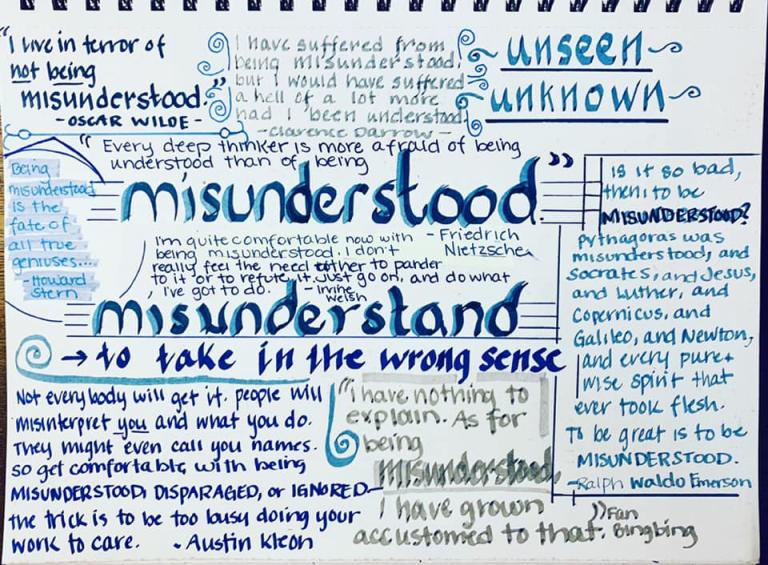
It’s funny, many of us act to ensure that the people who present ideas or beliefs that push against our own, must remain unseen and unknown. We won’t even bother encountering the Other unless we are sure that they are like us. We think we know the Other well enough to know that the Other is not one of us. Isn’t that interesting? But to know is to extend grace to the Other. To know is to mediate, to see, to connect. We cannot possibly know another and reject them if we truly know them.
Somewhere I Belong
To be understood is to belong. When we are misunderstood, it feels as if we do not belong. When others refuse to understand us, it sends us a message: “You do not belong.”
The truth is, you do belong. You are seen. You are known. Once we accept this one truth, it becomes evident that those who reject you, those who don’t understand you; just don’t know that they belong, and are seen, and are known by God.
We rarely encounter the Other with curiosity and care. And when we lack these two crucial components while standing between Christ and the Other, we turn back to the forces that protect the ego from pain, rejection, and judgment.
Paul confronts this overwhelming and powerful force that creeps in to distort the reflection we are called to see. Galatians 4:9:
But now that you know God—or rather are known by God—how is it that you are turning back to those weak and miserable forces? Do you wish to be enslaved by them all over again?
When we remove ourselves from the consideration of being understood, and instead focus our energy toward trying to understand the other, it removes expectation.
We live among technology that urges us to presuppose, to label, and to assume on pretense that explicit words used in a dialogue are indications of what to expect from the Other. So, now more than ever, it is much easier to look for all the things that are not God in an other. Because we know (or think we know) all that God is, we can readily discern all that is not. All things hidden shall be revealed, however. When we encounter the Other with anticipation to reject whatever it is that they are presenting, we come ready to hide our own truths as well.
I know many there are innumerable arguments to be made to reject that which we think we know. Extreme examples are simple enough to consider: “If he’s a known rapist, what is there to understand?” “If she murdered her children, I don’t need to understand her.” “If he can beat his wife, and then lie about it to his congregation, there is no God in him.” “He molested a toddler, there is nothing to know about him other than he is despicable and deserves hell.” “They voted for Trump.” “They voted for Clinton.” “She cheated on her husband.”
It is entirely difficult to approach such scenarios with curiosity and care, especially care. Also, I am encouraging baby steps, not miracles. But consider how quickly you may dismiss an Other based on superficial reasoning; the way one is dressed, the way one speaks, the way one chews their food, the way one votes, prays, or sings.
What about the way an Other reacts to your social media post? Do you long to understand the Other, or do you want to show the Other how they do not belong and will remain unseen and unknown?
Adjustment
Understanding is an adjustment of differences. I would submit that understanding is an appreciation of differences. Unfortunately, in this pseudo-diverse climate that we live in, we hardly extend appreciation for differences. In fact, we appreciate our intolerance of differences more than anything. We assert that it is principled and moral to maintain an abhorrence toward differences—diversity of thought is especially hated.
When we won’t take a pause to invite experience into our lives, when we fail to attend to the Other with curiosity and care; we also fail to be understood. For me, that sends me a loud message: Connection with God interrupted.
But, if you are willing to grant power to make the Other’s experience intelligible to you, if you are willing to see that you, yourself are already known, you can see into the Other so deeply that you see God. Whether or not the Other sees God within and outwardly no longer becomes a concern. Being understood is no longer our goal. Understanding the Other now becomes the goal, which effectively, means love becomes the goal. To understand is to love.
Besides, there are more than enough reasons to be content with being misunderstood.
D. Kingstrom

About Danielle Kingstrom
Danielle is a writer, podcaster, and home-school teacher. She lives in rural Minnesota on a farm with her husband and five children. Together, they maintain a fourth generation legacy farm and raise chickens and cattle. When she is not reading, writing, or self-educating; she can be found outdoors in nature’s naked elements. Danielle is an avid gardener, a lover of art, knowledge, and always a student. She is active in revitalization projects within her community, partnering with committees to bridge the Rural Divide. Unafraid of sparking controversy, Danielle is a frequently published author, appearing regularly in her community’s local newspaper; writing about provocative issues and asking challenging questions that raise a few eyebrows. She is currently working on two books. You can read more about the author here.
Previous Post

October 30, 2019
Love the Shepherd, Love the Enemy
Next Post
November 14, 2019 Desire & the Erotic: Where Does God Fit In?
Browse Our Archives
Select a Category Authentic Connection Ego Love Self Suffering Uncategorized
Select a Month October 2022 September 2022 August 2022 July 2022 June 2022 April 2022 March 2022 February 2022 January 2022 December 2021 November 2021 September 2021 July 2021 June 2021 May 2021 April 2021 March 2021 February 2021 January 2021 December 2020 November 2020 October 2020 September 2020 August 2020 July 2020 June 2020 May 2020 April 2020 March 2020 February 2020 January 2020 December 2019 November 2019 October 2019 September 2019 August 2019 July 2019 June 2019 May 2019 April 2019 March 2019
TAKE THE
Religious Wisdom Quiz
How tall was Goliath according to the Bible?
Select your answer to see how you score.
About 9 feet 9 inches About 8 feet About 10 feet 5 inches About 6 feet 5 inches
Related posts from Danielle Kingstrom

For 2022: Change the Channel from Fear to...

Empathy Erasure: The Remedy is Curiosity

Hey Girl, Can I Tell You Something?

New Scars Remind Me of Old Scars
TRENDING AT PATHEOS Progressive Christian

Why Christians Have a Sacred Duty to Vote:...
The Bible offers strong support for the sacred duty to vote. Here...

What Being a Modern-Day Apostle Means to Me
In my last column, I discussed the ins and outs of modern-day...

Did Ancient China Once Worship the God of...
Across human history, a common thread weaves through the origins of the...

Love Your Neighbor – Including Earth-Kin: Lev. 19,...
God’s command to love your neighbor means acting in an ethical and...

Lead a Church Study of “Jesus and Lao...
Guest writer Jack Thomas (The Irreverent Reverend) reflects on leading his church...

Principles for Understanding the Apostolic Ministry Today
Whenever people discover that my formal ministry title is "apostle," as in...
view all Progressive Christian blogs
Ad-Free & Subscriber Log-In Subscription Support
- About Us
- 2026 Calendar
- Videos
- Podcasts
- Library of World Religions
- Faith In Media Tracker
- Advertise With Us
- Write for Us
- Privacy Policy
- Terms of Service
- Do Not Sell My Data
- Contact Us
- Radiant Digital
- Manage Newsletter Subscriptions
- Unsubscribe From Notifications
- Sitemap
Copyright 2008-2026, Patheos. All rights reserved.
Subscription Support Ad-Free & Subscriber Log-In
Follow Patheos