
BuddhistCatholicContemplativeEvangelicalGeneral ChristianHinduJewishLatter-day SaintMuslimNew VisionsProgressive Christian
Beliefs
- Buddhist
- Catholic
- Contemplative
- Evangelical
- General Christian
- Hindu
- Jewish
- Latter-day Saint
- More Voices
- Muslim
- New Visions
- Pagan
- Progressive Christian
Topics
- Religion News
- Food and Religion
- Sports and Religion
- Religious Art
- Religious Music and Entertainment
- Religious Events
- History and Religion
- Style and Religion
- Politics and Religion
- Women in Religion
- Recreation Outdoors and Religion
- Business Finance and Religion
- Careers Workplace and Religion
- Education and Religion
- Family Parenting and Religion
- Health Fitness and Religion
- Home and Religion
- Relationships and Religion
- Technology and Religion
- Travel and Religion
Columnists
- Buddhist Columnists
- Business Finance and Religion Columnists
- Careers Workplace and Religion Columnists
- Catholic Columnists
- Contemplative Columnists
- Education and Religion Columnists
- Evangelists Columnists
- Family Parenting and Religion Columnists
- General Christian Columnists
- Health Fitness and Religion Columnists
- Hindu Columnists
- History and Religion Columnists
- Home and Religion Columnists
- Jewish Columnists
- More Voices Columnists
- Latter Day Columnists
- Muslim Columnists
- New Visions Columnists
- Nonreligious Columnists
- Pagan Columnists
- Politics and Religion Columnists
- Progressive Columnists
- Recreation Outdoors and Religion Columnists
- Relationships and Religion Columnists
- Religion News Columnists
- Religious Art Columnists
- Religious Events Columnists
- Religious Music and Entertainment Columnists
- Sports and Religion Columnists
- Style and Religion Columnists
- Technology and Religion Columnists
- Travel and Religion Columnists
- Women in Religion Columnists
Resource Library
- 2026 Calendar
- Library of World Religions
- The 100 Most Holy Places on Earth
- Patheos Answers
- Podcasts
- Videos
- Faith Leaders Database
- Anglican Episcopalian
- Bahai
- Baptist
- Buddhism
- Christianity
- Confucianism
- Eastern Orthodoxy
- Hinduism
- Holiness and Pentecostal
- ISKCON
- Islam
- Judaism
- Lutheran
- Methodist
- The Church of Jesus Christ of Latter-day Saints
- New Age
- Paganism
- Presbytarian and Reformed
- Protestantism
- Religion Behind the Scenes
- Roman Catholic
- Scientology
- Shia Islam
- Sikhism
- Sufism
- Sunni Islam
- Taoism
- Zen
- See all religions
Research Tools
 Ad-Free & Subscriber Log-In Subscription Support
Ad-Free & Subscriber Log-In Subscription Support
Follow Patheos 

- Trending:
- Forgiveness
- |
- Marriage
- |
- Consciousness
- |
- Death Penalty
- |
- Election
- |
- Halloween
 Danielle Kingstrom
- Home
- Progressive Christian
- Classification Confusion: Labels are Meant to Divide
Classification Confusion: Labels are Meant to Divide
Last updated on: July 21, 2019 at 7:32 pm by Danielle Kingstrom
Classification Confusion: Labels are Meant to Divide 2019-07-21T19:32:33-06:00 Danielle Kingstrom
Patheos Explore the world's faith through different perspectives on religion and spirituality! Patheos has the views of the prevalent religions and spiritualities of the world.
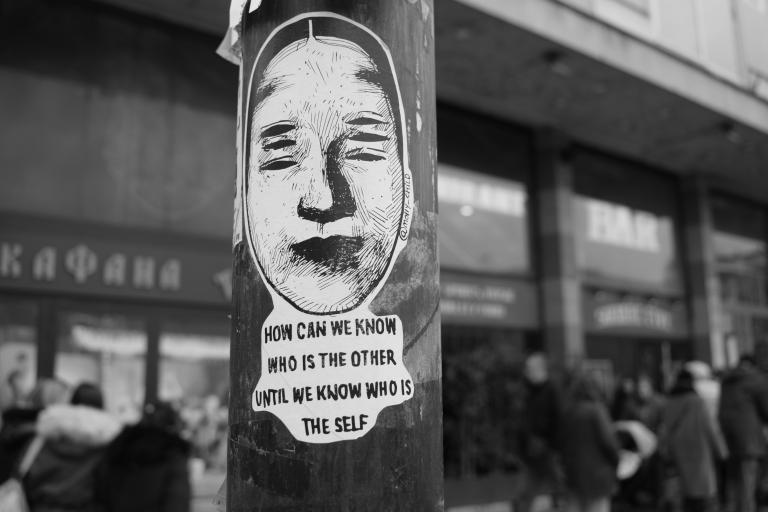
Photo by Marija Zaric on Unsplash
The classification confusion that is permeating our society is creating a general identity crisis for all. Labels are meant to divide and so long as we cling to our categories, so long as we justify the use of labels, we will never bear witness to the kind of equality that resembles Kingdom unity.
Whether you identify as black, brown, or white—it’s just a label.
Whether you call yourself “antiracist”, a “recovering racist” or call someone else a “racist”—it’s still just a label.
Liberal, Progressive, or Conservative; Democrat, Republican, Independent, Libertarian, or even Anarchist—all still labels.
Man, woman, or other—another label. Heterosexual or pansexual; he, she, or they—just labels.
People will argue for their labels. People will say that labels matter. That we need labels to discern, to categorize, to judge, to identify. Sure. We need to identify objects. We need to categorize ideas.
But the truth is, no matter what label we affix to our names, or to our identities, we are all people first. Humans, to be exact. Humans that, for the majority of my audience, also believe in God. Even some will call themselves “believers” in order to distinguish themselves from others.
An even deeper truth is that we use these labels as a way to stay disconnected.
We use labels to judge others not in a discerning matter, not in a way to categorize, but so that we can demonize and dehumanize other people. Labels are exclusionary by definition. And whether we are willing to admit that or not, we use labels to exclude, intentionally. But how often do we use labels to include? I would argue not nearly as much as we do so to demonstrate why we are better-than others.
There’s a great fear that grows when one sees a potential to understand the other. Understanding another requires a connection. If we become comfortable staying disconnected, that means actual connection seems uncomfortable. That which is new to us will feel like an invasion. How odd is it that we find more comfort in disconnection than connection?
Does it have anything to do with how we use the terms “label” and “identity”? Perhaps.
Definitions
According to Merriam-Webster’s definition, the term label means:
- a descriptive or identifying word or phrase: such as: EPITHET
Further searches provide the following definitions:
- a classifying phrase or name applied to a person or thing, especially one that is inaccurate or restrictive.
- assign to a category, especially inaccurately or restrictively.
Not only is the term “label” exclusionary, it is also typically applied to persons or things inaccurately.
But most of us don’t use the term in the negative when we apply it to ourselves, and those who understand the inaccurate and restrictive nature of the term simply opt for a synonym of the word. Such as: identify, identity, and align.
If you flip through the pages of Roget’s International Thesaurus, like I did, you will happen upon some curious variations of the terms identify and identity.
-
In regard to correlation, the term identity means: sameness, selfsameness, no difference, equality, homogeneity.
-
In regard to correlation, the term identify means: make one, unify, unite, join, combine, fuse, and merge.
We use these terms every day in a variety of applications. We use them to indicate, characterize, mark, recognize, distinguish, order, name, classify, pigeonhole, sort, group, grade, and even to order in a chain of being, as in a domain realm or kingdom. We also use the terms identity and identify to divide.
So, essentially, depending upon what we are addressing, we interchangeably use the same word to mean many, many different things. Is it any wonder we are seeing our society struggle to communicate?
I know that many would say that this is how our lexicon works. I understand that. And I won’t argue against that.
What I want to focus on is why labels, identifications, and identities are problematic and divisive.
Identity in Christ
The one identity that I believe matters more than anything is the one that makes us all One. The human identity—the one identity that we all share, that which defines out sameness, our homogeneity. The only one that God called not good, but very good. Genesis 1:27, 31:
So God created [hu]mankind in his own image, in the image of God he created them; male and female he created them…
God saw all that he had made, and it was very good.
God establishes for us, the standard of what is very good—humankind, people. People are good. Which means, for me at least, that we were created to be good, inherently good. God is the Great Gardener that plants the seed of the goodness in each of us. We all grow under the same sun. We are all watered by God’s great rains. We breath the same air. We bleed the same red blood. We are all covered in flesh. We have two eyes, two ears, and one mouth. This is what unifies us. This is what correlates us to one another. This is how we are equal. We are equally very good.
God also made a startling realization. God, in God’s perfect wholeness, created but one man, so Genesis proclaims. But that was “not good”. Genesis 2:18:
The Lord God said, ‘It is not good for the man to be alone.’
Thus, from the rib of the man, woman was created.
Now, we could quibble on and on about the interpretation of Genesis and whether or not one is taking the reading literally. That is not my concern. The point I wish to highlight is that what was deemed “not good” was being alone. What God deemed “very good,” people.
God established the only categorization, label, or identification that was worthy of being recognized. If we are a people that are attempting to be more like God—to be more Christ-like, to be more like Jesus—then we should see that the only way we really need to identify ourselves is the way in which God already identified us. As very good, as God’s children.
God provided the only chain of being that was necessary for this domain realm. Our being is stratified by Kingdom nomenclature. Yet we still grasp for the sorting of social hierarchies and race divisions. We yearn for the status we feel from the definitions of the powers and principalities that work to divide us and confuse us.
Paul reminds us that nothing can separate us from the love of God— Romans 8:35,37-39:
Who shall separate us from the love of Christ? Shall trouble or hardship or persecution or famine or nakedness or danger or sword?
…No, in all these things we are more than conquerors through him who loved us. For I am convinced that neither death nor life, neither angels nor demons, neither the present nor the future, nor any powers, neither in height or depth, nor anything else in all creation, will be able to separate us from the love of God that is in Christ Jesus our Lord.
Yet, we work so hard to separate ourselves from the love of God—the love of God that is in all of us. That’s the inherent goodness, that’s what makes us “very good”. God’s love. When we search for ways to distinguish ourselves from other people, we are effectively looking for ways to separate ourselves from God and God’s love.
God shows us how we are all connected and we seek ways to disconnect from all.
Labels insist that we draw a line, a distinction. We draw a line between the congruity of humanity. We draw a line between very good and good enough to be aligned on my side. God provided the no-difference definition for humanity and humanity demanded that we differentiate.
The nomenclature of the Kingdom states that we are to be known as God’s children. Why do we reject such sameness? What is it that is so alluring about distinguishing ourselves from one another? Who benefits from such divisions and such simplistic ways of sorting and grading humans?
My conclusion leads me to believe that, while we find value in categorizing ourselves, we also create a deficit for humanity. We create more problems, essentially.
We brand each other with labels such as: racist, anti-choice, anti-life, bigot, homophobe, Islamaphobe, xenophobe, sexist, etc. We do this so that we can let others know what we believe certain people should be known as.
The dishonest part of it all is that we do so without ever really knowing who they are. We do so without ever really connecting with them. We do this to remain disconnected, because, let’s be honest, who wants any kind of a connection with a racist, right? But if you truly believe that the labels you are willing to attach to collectives are true, why aren’t you doing anything to stop the assignment of labels? Is it because if we had no one to label, we would have no one to blame?
Recorded Conversations has debuted. Subscribe and stay up to date on all of the conversations.

About Danielle Kingstrom
Danielle Kingstrom is a writer, podcaster, and leg-warmer aficionado. She is the host of "Recorded Conversations", a podcast dedicated to compassionately considering all perspectives while engaging in connected dialogues about societal issues. Current work includes an upcoming book, "Enfleshed: Making Monogamous Relationships Real". You can read more about the author here.
Previous Post

July 18, 2019
Life Sucks: Stop Comparing Suffering!
Next Post
July 23, 2019 Self-Emptying: Erotic Kenosis and Monogamous Relationships
Browse Our Archives
Select a Category Authentic Connection Ego Love Self Suffering Uncategorized
Select a Month October 2022 September 2022 August 2022 July 2022 June 2022 April 2022 March 2022 February 2022 January 2022 December 2021 November 2021 September 2021 July 2021 June 2021 May 2021 April 2021 March 2021 February 2021 January 2021 December 2020 November 2020 October 2020 September 2020 August 2020 July 2020 June 2020 May 2020 April 2020 March 2020 February 2020 January 2020 December 2019 November 2019 October 2019 September 2019 August 2019 July 2019 June 2019 May 2019 April 2019 March 2019
TAKE THE
Religious Wisdom Quiz
What was the primary light source in Biblical times?
Select your answer to see how you score.
Bonfire Candle Torch Oil lamp
Related posts from Danielle Kingstrom

Are We Sacrificing Liberty & Freedom for the...
Do Christians Make an Idol out of Jesus?

Hey Girl, Can I Tell You Something?
TRENDING AT PATHEOS Progressive Christian

Why Christians Have a Sacred Duty to Vote:...
The Bible offers strong support for the sacred duty to vote. Here...

What Being a Modern-Day Apostle Means to Me
In my last column, I discussed the ins and outs of modern-day...

Did Ancient China Once Worship the God of...
Across human history, a common thread weaves through the origins of the...

Love Your Neighbor – Including Earth-Kin: Lev. 19,...
God’s command to love your neighbor means acting in an ethical and...

Lead a Church Study of “Jesus and Lao...
Guest writer Jack Thomas (The Irreverent Reverend) reflects on leading his church...

Principles for Understanding the Apostolic Ministry Today
Whenever people discover that my formal ministry title is "apostle," as in...
view all Progressive Christian blogs
Ad-Free & Subscriber Log-In Subscription Support
- About Us
- 2026 Calendar
- Videos
- Podcasts
- Library of World Religions
- Faith In Media Tracker
- Advertise With Us
- Write for Us
- Privacy Policy
- Terms of Service
- Do Not Sell My Data
- Contact Us
- Radiant Digital
- Manage Newsletter Subscriptions
- Unsubscribe From Notifications
- Sitemap
Copyright 2008-2026, Patheos. All rights reserved.
Subscription Support Ad-Free & Subscriber Log-In
Follow Patheos