
BuddhistCatholicContemplativeEvangelicalGeneral ChristianHinduJewishLatter-day SaintMuslimNew VisionsProgressive Christian
Beliefs
- Buddhist
- Catholic
- Contemplative
- Evangelical
- General Christian
- Hindu
- Jewish
- Latter-day Saint
- More Voices
- Muslim
- New Visions
- Pagan
- Progressive Christian
Topics
- Religion News
- Food and Religion
- Sports and Religion
- Religious Art
- Religious Music and Entertainment
- Religious Events
- History and Religion
- Style and Religion
- Politics and Religion
- Women in Religion
- Recreation Outdoors and Religion
- Business Finance and Religion
- Careers Workplace and Religion
- Education and Religion
- Family Parenting and Religion
- Health Fitness and Religion
- Home and Religion
- Relationships and Religion
- Technology and Religion
- Travel and Religion
Columnists
- Buddhist Columnists
- Business Finance and Religion Columnists
- Careers Workplace and Religion Columnists
- Catholic Columnists
- Contemplative Columnists
- Education and Religion Columnists
- Evangelists Columnists
- Family Parenting and Religion Columnists
- General Christian Columnists
- Health Fitness and Religion Columnists
- Hindu Columnists
- History and Religion Columnists
- Home and Religion Columnists
- Jewish Columnists
- More Voices Columnists
- Latter Day Columnists
- Muslim Columnists
- New Visions Columnists
- Nonreligious Columnists
- Pagan Columnists
- Politics and Religion Columnists
- Progressive Columnists
- Recreation Outdoors and Religion Columnists
- Relationships and Religion Columnists
- Religion News Columnists
- Religious Art Columnists
- Religious Events Columnists
- Religious Music and Entertainment Columnists
- Sports and Religion Columnists
- Style and Religion Columnists
- Technology and Religion Columnists
- Travel and Religion Columnists
- Women in Religion Columnists
Resource Library
- 2026 Calendar
- Library of World Religions
- The 100 Most Holy Places on Earth
- Patheos Answers
- Podcasts
- Videos
- Faith Leaders Database
- Anglican Episcopalian
- Bahai
- Baptist
- Buddhism
- Christianity
- Confucianism
- Eastern Orthodoxy
- Hinduism
- Holiness and Pentecostal
- ISKCON
- Islam
- Judaism
- Lutheran
- Methodist
- The Church of Jesus Christ of Latter-day Saints
- New Age
- Paganism
- Presbytarian and Reformed
- Protestantism
- Religion Behind the Scenes
- Roman Catholic
- Scientology
- Shia Islam
- Sikhism
- Sufism
- Sunni Islam
- Taoism
- Zen
- See all religions
Research Tools
 Ad-Free & Subscriber Log-In Subscription Support
Ad-Free & Subscriber Log-In Subscription Support
Follow Patheos 

- Trending:
- Forgiveness
- |
- Marriage
- |
- Consciousness
- |
- Death Penalty
- |
- Election
- |
- Halloween
 Danielle Kingstrom
- Home
- Progressive Christian
- No Uterus- No Opinion. No, that’s Wrong!
No Uterus- No Opinion. No, that’s Wrong!
Last updated on: May 21, 2019 at 1:16 pm by Danielle Kingstrom
No Uterus- No Opinion. No, that’s Wrong! 2019-05-21T13:16:46-06:00 Danielle Kingstrom
Patheos Explore the world's faith through different perspectives on religion and spirituality! Patheos has the views of the prevalent religions and spiritualities of the world.
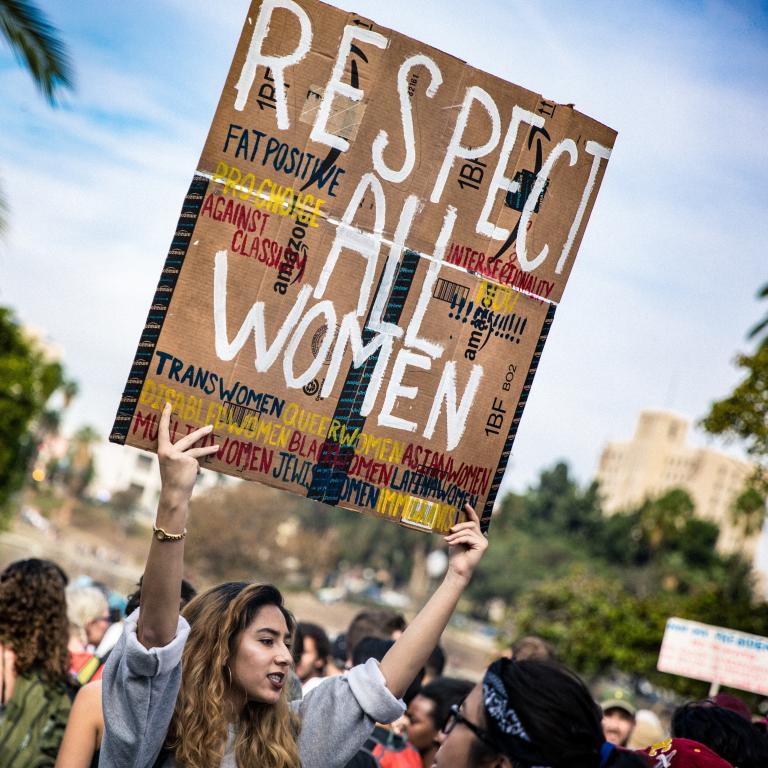
Photo by T. Chick McClure on Unsplash
Inspired by a social-media meme, I was confronted with a blatant truth that forced me to reflect on the idea that no uterus = no opinion necessary.
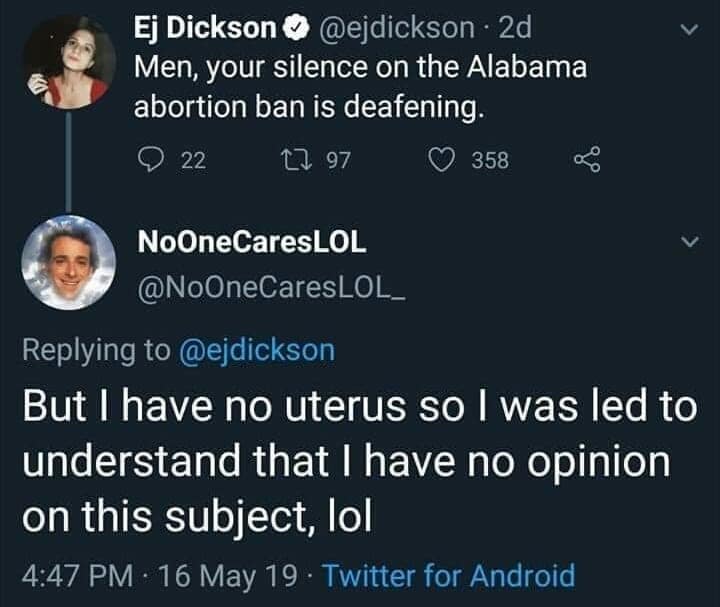
What I came to realize is how wrong of a statement it is to make. Let’s call this one an “about-face” reflection.
I Have the Power to Build You Up or Break You Down
The last week has been an emotional roller-coaster for women across the United States. We are fueled by our outrage, to break down the walls that we believe are being built around our bodies and our freedoms. Unfortunately, this has lead me down a destructive path of breaking a person down- and in this instance, it’s men.
My husband pointed out to me that when it comes to the bare bones of any discussion with me in particular, there are many instances when I have the power to break him down or build him up. He noted that perhaps while railing against the injustices of what is taking place; instead of building others up to increase the volume of our voices, perhaps instead, I was a little too willing to break others down for daring to disagree with me.
It stopped me dead in my tracks. I was forced to ask myself, out loud: “Woman, am I doing something wrong?”.
Why would I ask myself that? Well, if even my husband is cautious about whether or not he can opine on societal issues that are seemingly attacking women; it must mean that my approach and delivery are creating a level of discomfort that not even he is willing to tango with.
No Uterus, No Opinion
My husband and I have survived infidelity (mine) and many other rather stress-inducing experiences during our journey together. We are avid conversationalist. That’s what I enjoy most about him- his ability to talk about everything under the sun. There are no topics we won’t discuss. So, the fact that he was hesitant to engage with me on the issue of abortion must mean that I have some work to do. If I am creating a disconnect by voicing my very loud voice- I am working against my very own goal of creating connection.
For instance, he remarked that my eldest daughter and I had made it pretty clear to him that,
If I don’t have a uterus, I am not entitled to an opinion.
Ugh, what did I do? Women, are we doing that? Are we cutting men out of the equation? Are we forgetting to empathize with the male perspective because we actually believe this is just an attack on our body? Does this act not create a precedence for all bodies?
We Need Men
We need men, don’t we?
Surely, many women would disagree.
We don’t need men, men are the ones who created this problem and it will take women to resolve it!
But I must redirect. Aren’t men the ones in power? Aren’t men the ones legislating bills that all but oppress us and encourage us to be barefoot and pregnant- always? Isn’t that the general consensus that we feministic females often attribute to men?
If we rally against all men- if we create a divide so strong that men retaliate to silence us indefinitely; aren’t we part of the problem? Aren’t we acting as a catalyst? Aren’t we relinquishing our megaphones almost entirely if we silence those who we claim are silencing us?
“All” Men?
Over-correction can lead to extreme polarization. If we are to correct this shift in our country; if we are to continue to raise our voices so that we can be heard- shouldn’t we, at the very least, temper our outcry so that we don’t pit all men against all women? Wouldn’t our voices be louder with the baritone of men?
I do try to not suggest that all men are against women. I do try to use qualifying words: “some men”, “those types of men”, “the men that;” but is that enough of a distinction to remove the potentiality that I don’t mean “all men”?
My husband insists such is not always the case. He stated that, sometimes, men just focus on the word “men” and view it as an attack, despite the qualifiers. (Obviously he doesn’t speak for all men, but that’s his perspective and I am willing to consider it).
Let’s step back, ladies, and ask ourselves this: What happens when we see or hear “women” in any general discussion? For me, I assume that whatever the conversation entails, if you are saying “women”- even if there is a qualifying distinction- I only hear the word “women” and assume that it’s a generalization about all women.
If I know that this is how I respond- how can I honestly assume that men will understand the distinguishing separation of “good men” (or allies) from “bad men”?
The Dark Sides of Empathy
Abortion is one of the heaviest topics of discussion out there, right along with racism. These are tough conversations to engage in, and when we do, our passion presents itself more often than our reason does. Why? As David Hume once offered (and argued for, extensively): “Reason is… a slave of the passions.”
German philosopher Friedrich Nietzsche expounded on such ideas as well, namely that, it is all but impossible to be objective while also empathizing with the another. A point of interest from Nietzsche’s Beyond Good and Evil; referenced by Provost Professor at Indiana University Bloomington, Fritz Breithaupt; is that “women are the true masters of empathy.”
Breithaupt breaks this idea down in the highly anticipated book, The Dark Sides of Empathy. In regard to self-loss, he notes that, based off of Nietzsche’s work, that:
Women play a particular role in the relationship between the strong self and the objective person: they take a third position. In a world of Nietzsche’s thought, women are masters at manipulating the way they are seen by others. They understand how they are observed but, unlike the objective person, the do not comport themselves purely receptively or projectively in the face of observation. Rather they stake a claim to the observations of others by disguising, masking, beautifying, or withholding themselves.
If this observation is valid, I would argue that women have the capacity and maybe even the responsibility (?) to redirect the focus of this topic- which hinges on morality- in such a way that protects us from falling into the traps of “emotional woman syndrome”.
Women ARE Emotional
Women are often viewed as emotional creatures- creatures who change like the moon changes phases. Are we more so ruled by our passions? Are we able to stand back and take a third position; that is ordered by neither objectivity but subjectivity?
Has not society also reinforced this notion that women are ruled by their emotions and that men are ruled by their rationality? I wouldn’t suggest using this supposition as the maxim for “the way things are” by any means but, I surmise that, if this sentiment has been perpetuated throughout our society, then we don’t have to look too deep to understand why abortion is such a divisive issue. If we do act on the expectations that women = emotional and men=rational, that is.
Men have been painted as the objective ones; women as the subjective ones. For all of us, we are already operating with a deficit and a disconnection. Participating in any conversation that delves into morality, sanctity of life, and rights of unborn lives are bound to produce unstable discussions- nonproductive discussions, to be exact.
Perhaps gendered conversations that pit us against each other right from the beginning? These discussions lack empathy and without empathy, it’s hard to see the other as a human.
Empathy: Required
Empathy is what is required to engage in the atmosphere of abortion. The idea that this is a nuanced conversation holds much water. The capacity to look at this from an individual experience versus a collective reality will produce greater results.
For me, this means that I have to stop assuming that, just because 25 white men voted against the choice of a woman, in Alabama; somehow all men agree with such actions. It means that even if a man I know voices his opinion that “abortion is murder, and women who abort are in fact, murderers”; I have to pull back and reflect before I respond (even if he did just call me a murderer). He is, after all, also a human being- made in the image and likeness of God.
It is difficult to grant space to an individual who doesn’t have a uterus; who doesn’t have a lived experience of what it means to be a woman in “a man’s world”. But, “my grace is sufficient for you, for my power is made perfect in weakness.” (2 Corinth. 12:9)
I had not been extending the necessary grace for this topic (and I cannot imagine I am the only one that feels that way).
Glorified Empathy
If, as Breithaupt reflects on, “Schopenhauer’s goal was to break down the ‘wall between You and Me’ with compassion;” and that such a breakdown could only last temporarily; that means that we need to revisit the topic of abortion in a more compassionate way.
We need to recognize a more nuanced approach to tacking the brevity of this issue. It seems we are all forgetting how much attention and awareness is needed to marinate on such a weighty dilemma.
The dark side of empathy is that, not only can it lead to self-loss in such a way that, objectivity cannot compete with the demands of subjectivity- which ultimately leads to empathy; but it can also lead to viewing the world in black and white. Breithaupt notes:
Human beings tend to quickly take sides in conflicts and use empathy to glorify their chose side while condemning and demonizing the other side.
While one side demands that our country empathize with the woman, the other side demands that we empathize with the unborn. On both sides of the spectrum, we would argue that we are being empathetic and that empathy is not the problem.
Is that because we fear that empathy- which leads to understanding- somehow means we must also accept and therefore agree with that which we are empathizing with? (I questioned this particular question in an earlier blog).
Theory of Mind
When we pick a side for abortion, or any other societal topic of interest or issue; we either align ourselves with our political party’s position of the issue, or, we pick the side that offers the least resistance in our personal lives.
Breithaupt defines empathy in a variety of ways; considering methodical approaches with his definitions. I submit for you to consider the definitions:
- From an evolutionary biological and behavioral sciences approach: “Cognitive acts leading to cooperation (altruism) or competition.”
- From a Theory of Mind, philosophical approach: “Understanding the emotions, beliefs, and mental states of others.”
- From a phenomenological approach: “Coexperience of the situation of others.”
In regard to such heated discussions- abortion- I would suggest that we consider implementing empathy (as defined by Breithaupt), particularly defined from a Theory of Mind approach; into our exchange of listening and responding.
The idea that we should allow a collective ruling authority make decisions for morality is already absurd. But the idea that we don’t consider trying to understand “the emotions, beliefs, and mental states of others” while dialoguing with another is just as absurd. How can we dare claim to make any sort of honest conclusion from our conversations if we are not willing to see them as a human being with an experience, and therefore an opinion and perspective worth validating?
Calling Out the Bull-Shit
I am aware that I have exhibited such behavior. I accept that it was mostly, entirely emitted emotively without consideration for the other. I too, have asked “Why are all the men so silent on this topic” after observing a Y chromosome deafening silence (especially from my progressive brothers).
But, didn’t I tell them that their opinion didn’t matter at all solely based on the anatomical fact that these men (probably the majority of them) don’t have uteruses?
If I know anything at all about the men in my life, I know they listen earnestly to my opinion. They hear me when I voice my frustrations about the sexism that I do face. But what I also know about the men in my life is that, they will also call me on my shit and point out my obvious hypocrisy.
Actualize the Third Position
When I was first introduced to Nietzsche, I came across a review of his work that suggested he was sexist. After reading The Dark Sides of Empathy, I cannot help but wonder if Nietzsche was simply pointing out, in a not-so-obvious way, his envy for how a woman could approach the need for empathy and create (and manipulate) a third position so sufficiently.
If such is the case, and I interpret the possibility, then I would submit- at least for myself- that we all accept the invitation to actualize this ability. Otherwise, we are merely acquiescing to the dark sides of empathy.
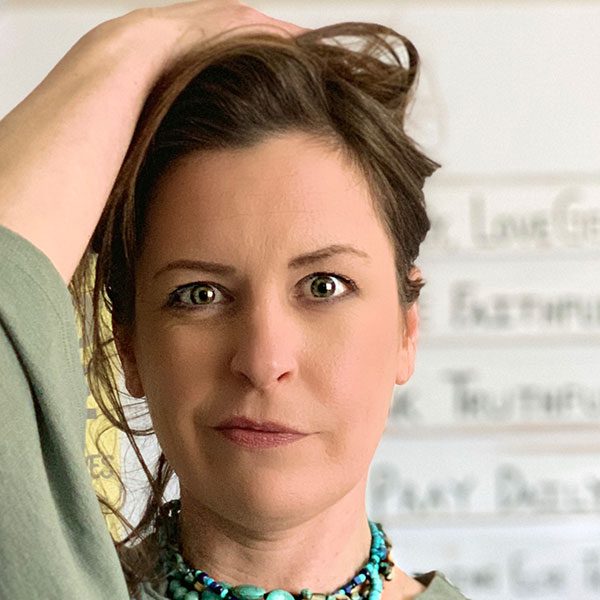
About Danielle Kingstrom
Danielle Kingstrom is an author, podcaster, and home-school teacher. She cohosts the podcast: Book Ish- The Canon Continues. Danielle lives in Minnesota, with her husband Cory, and their five children. You can read more about the author here.
Previous Post

May 16, 2019
Abortion & Alabama- Your Silence Will Not Save You
Next Post
May 27, 2019 Hey! AOC, How About a Little Consistency?
Browse Our Archives
Select a Category Authentic Connection Ego Love Self Suffering Uncategorized
Select a Month October 2022 September 2022 August 2022 July 2022 June 2022 April 2022 March 2022 February 2022 January 2022 December 2021 November 2021 September 2021 July 2021 June 2021 May 2021 April 2021 March 2021 February 2021 January 2021 December 2020 November 2020 October 2020 September 2020 August 2020 July 2020 June 2020 May 2020 April 2020 March 2020 February 2020 January 2020 December 2019 November 2019 October 2019 September 2019 August 2019 July 2019 June 2019 May 2019 April 2019 March 2019
TAKE THE
Religious Wisdom Quiz
What king of Israel was famous for his chariot and for fighting Ahab?
Select your answer to see how you score.
Jeroboam Omri Jehu Joash
Related posts from Danielle Kingstrom


Unrest in the Streets Leads to Unrest in...
You Were Wrong: Why That's Not the End...

Empathy Erasure: The Remedy is Curiosity
TRENDING AT PATHEOS Progressive Christian

Why Christians Have a Sacred Duty to Vote:...
The Bible offers strong support for the sacred duty to vote. Here...

What Being a Modern-Day Apostle Means to Me
In my last column, I discussed the ins and outs of modern-day...

Did Ancient China Once Worship the God of...
Across human history, a common thread weaves through the origins of the...

Love Your Neighbor – Including Earth-Kin: Lev. 19,...
God’s command to love your neighbor means acting in an ethical and...

Lead a Church Study of “Jesus and Lao...
Guest writer Jack Thomas (The Irreverent Reverend) reflects on leading his church...

Principles for Understanding the Apostolic Ministry Today
Whenever people discover that my formal ministry title is "apostle," as in...
view all Progressive Christian blogs
Ad-Free & Subscriber Log-In Subscription Support
- About Us
- 2026 Calendar
- Videos
- Podcasts
- Library of World Religions
- Faith In Media Tracker
- Advertise With Us
- Write for Us
- Privacy Policy
- Terms of Service
- Do Not Sell My Data
- Contact Us
- Radiant Digital
- Manage Newsletter Subscriptions
- Unsubscribe From Notifications
- Sitemap
Copyright 2008-2026, Patheos. All rights reserved.
Subscription Support Ad-Free & Subscriber Log-In
Follow Patheos