
BuddhistCatholicContemplativeEvangelicalGeneral ChristianHinduJewishLatter-day SaintMuslimNew VisionsProgressive Christian
Beliefs
- Buddhist
- Catholic
- Contemplative
- Evangelical
- General Christian
- Hindu
- Jewish
- Latter-day Saint
- More Voices
- Muslim
- New Visions
- Pagan
- Progressive Christian
Topics
- Religion News
- Food and Religion
- Sports and Religion
- Religious Art
- Religious Music and Entertainment
- Religious Events
- History and Religion
- Style and Religion
- Politics and Religion
- Women in Religion
- Recreation Outdoors and Religion
- Business Finance and Religion
- Careers Workplace and Religion
- Education and Religion
- Family Parenting and Religion
- Health Fitness and Religion
- Home and Religion
- Relationships and Religion
- Technology and Religion
- Travel and Religion
Columnists
- Buddhist Columnists
- Business Finance and Religion Columnists
- Careers Workplace and Religion Columnists
- Catholic Columnists
- Contemplative Columnists
- Education and Religion Columnists
- Evangelists Columnists
- Family Parenting and Religion Columnists
- General Christian Columnists
- Health Fitness and Religion Columnists
- Hindu Columnists
- History and Religion Columnists
- Home and Religion Columnists
- Jewish Columnists
- More Voices Columnists
- Latter Day Columnists
- Muslim Columnists
- New Visions Columnists
- Nonreligious Columnists
- Pagan Columnists
- Politics and Religion Columnists
- Progressive Columnists
- Recreation Outdoors and Religion Columnists
- Relationships and Religion Columnists
- Religion News Columnists
- Religious Art Columnists
- Religious Events Columnists
- Religious Music and Entertainment Columnists
- Sports and Religion Columnists
- Style and Religion Columnists
- Technology and Religion Columnists
- Travel and Religion Columnists
- Women in Religion Columnists
Resource Library
- 2026 Calendar
- Library of World Religions
- The 100 Most Holy Places on Earth
- Patheos Answers
- Podcasts
- Videos
- Faith Leaders Database
- Anglican Episcopalian
- Bahai
- Baptist
- Buddhism
- Christianity
- Confucianism
- Eastern Orthodoxy
- Hinduism
- Holiness and Pentecostal
- ISKCON
- Islam
- Judaism
- Lutheran
- Methodist
- The Church of Jesus Christ of Latter-day Saints
- New Age
- Paganism
- Presbytarian and Reformed
- Protestantism
- Religion Behind the Scenes
- Roman Catholic
- Scientology
- Shia Islam
- Sikhism
- Sufism
- Sunni Islam
- Taoism
- Zen
- See all religions
Research Tools
 Ad-Free & Subscriber Log-In Subscription Support
Ad-Free & Subscriber Log-In Subscription Support
Follow Patheos 

- Trending:
- Forgiveness
- |
- Marriage
- |
- Consciousness
- |
- Death Penalty
- |
- Election
- |
- Halloween
 Danielle Kingstrom
- Home
- Progressive Christian
- I Got this Baggage With Me
I Got this Baggage With Me
Last updated on: April 10, 2019 at 8:33 pm by Danielle Kingstrom
I Got this Baggage With Me 2019-04-10T20:33:59-06:00 Danielle Kingstrom
Patheos Explore the world's faith through different perspectives on religion and spirituality! Patheos has the views of the prevalent religions and spiritualities of the world.
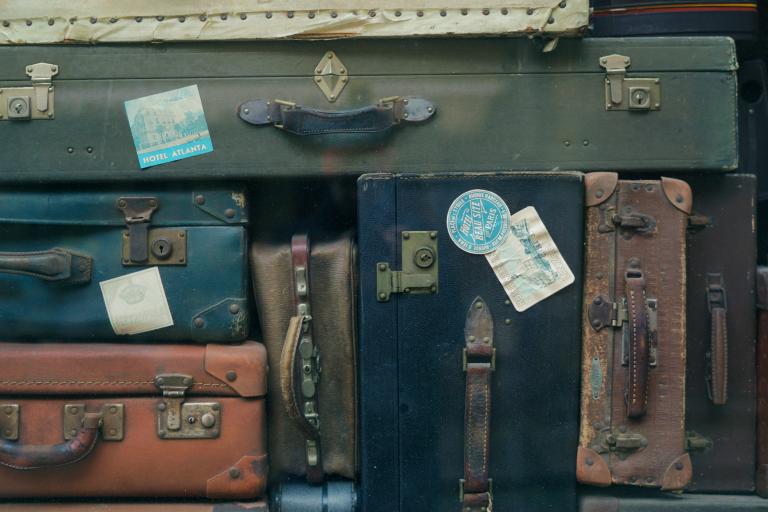
Photo by Erwan Hesry on Unsplash
As far as generalizations go; the generalization that people have baggage is a safe estimation to present. Most of us know what it means when another informs us “I got this baggage with me”, or say “I come with baggage”.
I am referring to emotional baggage– the scars from the past that we carry into the present, either consciously or unconsciously.
An Unmet Need Transforms into Emotional Baggage
In his book Say What You Mean, Nonviolent Communication trainer Oren Jay Sofer, says needs are, essentially, “the core values that motivate our actions” and are the things that “matter most…why we want what we want”. And much of what we have been told is that “our well-being is determined primarily by needs satisfaction;” meaning that we evaluate ourselves based on how well we satisfy our essential needs.
If this is the case- that satisfaction of needs establishes for us our value of our self-worth; then it would follow that, chronic failure to meet those needs would put our well-being at risk and negatively impact our sense of self-worth.
Otherwise stated, when we have unmet needs, we carry them around. That’s emotional baggage. A lot of those unmet needs date back to our childhood. We have had a lot of time to transform those unmet needs into baggage.
Emotional baggage, in its most fundamental sense, is simply the mind’s subconscious way of refusing to let go of a previous unmet need. An unmet need that we once grasped for but could not attain. It’s our luggage of lack.
Blame the Baggage
For those of us that are self-aware of our outbursts and missteps, we tend to blame the baggage for it. We do this because we are seeking flexibility and we want to be understood.
We say that the reason I am feeling a certain way is, ” because…this one time…when I was dating…he did things like you are doing now. ” Rightfully, we are acknowledging that something from our past is having an affect on our present. But we use the past as a way to stay hung up on the past.
It can be used as a manipulation tactic if we are not careful.
Otherwise, we use our past to control our current situation. We rip open old wounds and make ourselves bleed in order to justify why we made another bleed. It’s a cruel game that we aren’t always aware that we are playing. For whatever reason, however, we continue to engage such behavior.
Blaming the baggage and more so, exploiting the baggage, is of the ego. And no matter how much therapy we have had (I have had 7 therapists), we still pull that Louis Vuitton (or thrift store knock-off) behind us, where ever we go- willingly.
I Don’t Have Baggage
And then some of us say that they don’t have baggage. Heck, I have even said that, to my therapist no less! But the reality is, 99% of people have emotional baggage. We just don’t all know it and the rest of us don’t want to admit it.
If we identify our self-worth based on our needs- satisfaction, and we don’t always meet our needs, then surely, even if we haven’t recognized it as baggage, it still exists, archived somewhere in the mind.
Our reactionary tendencies are an amalgamation of past with the present, (sometimes fear of the future, too) it touches on the hot-spots and soft-spots. When we are face-to-face with something in our present that cuts or hits us, it’s like clicking on the “activate” button of archived trauma and pain, in the brain. It quickly opens a window and the surge rises.
That’s Not Baggage, That’s Just Who She Is
In some instances, some of us will attribute such additional luggage as simply a characteristic of “who I am”or “who they are”. Some will say “Oh, he’s just passionate” or “She’s just invested” or “This hits home for her”, “She’s just a grumpy person”.
I don’t buy that. I don’t believe that a normal characteristic of any human is angry, grumpy, or easily set-off. As though anger, resentment, and outrage are merely personality traits that we should acclimate to.
Our emotions are not meant to be personality traits. They are meant to be fleeting. If we are that packed into our suitcases- wearing them as our clothing- that’s a sign that unmet needs of the past are surging and aiming to take over our identity.
Denial of such carry-on is only futile to personal growth. We don’t like to admit it, but we all have tickets to the baggage claim.
I Self-Identify as a Hand-bag
It’s what we might as well say if we won’t let go of the past. We might as well get used to having that bag in the shower with us, at the check-out lane in the grocery store, while we are pumping gas, when we are having sex.
If we wrap our identity up in that baggage, we attach ourselves to the feelings of the past. Living in the past then creates for us, an anxiety for the future. Uncertain of what will come, and uncertain of how to advance forward without our bags in tow, we clothe ourselves in our emotions and cling tightly to the fabric.
We do this because we are afraid to change our minds and let go of something we have spent the last 10 years holding on to. It’s all we ever talked about- how this or that made us feel, how it was a betrayal, how it was an attack against your character, etc. We have made it a part of our daily lives- whatever that emotion is- we carry it with us.
We worry that emptying out some of that baggage might mean we forgive or forget what happened. And if we let that go, we might lose a part of who we are.
Recognition
When our emotional baggage surges to the front of the line- we have a choice. The choice to act to defend ourselves, to protect ourselves, in which we justify insults and attacks toward another. The choice to give control to the ego.
Or, we could choose to step back and recognize why we are hurting and why we are willing to project that hurt onto someone else, especially someone we love and care about.
Recognition of the baggage that we bring to the table when we are trying to solve problems is going to give us more space. Space that we will need to grow. Having emotional baggage isn’t necessarily bad, nor does it need to be emptied all at once. When it is emptied, however, we have to also grant space for reflection.
Reduction by Reflection
Most of us will never be without emotional baggage. The goal isn’t necessarily to not carry baggage, but to reduce its impact in our lives. To take it from bulky luggage to a compact SD card.
We get to this reduction by reflection. We observe, we pause, and we process.
-
Observe the reaction: What need is not being met? Can this need be met? What happens if this need can not be met?
-
Pause: Can you recall another time in your life when this unmet need created conflict or pain for you? Can you see another path to take that will meet this need? Does this need require satisfaction at this very moment, or can you delay the gratification of it?
-
Reflect: How did you process it then, and how can you process it now?
- What steps can be taken to meet this need without impeding on the needs of others?
- How can everybody have their needs met?
- Can you meet this need without involving the other?
Reflection provides breathing room and can help deactivate and deescalate intense situations.
You’ll Always Have a Carry-On
Ultimately, it’s up to you to decide how much additional baggage you want to claim. Unfortunately, (or perhaps fortunately?) we will always carry our past with us. It’ s really up to us- how much and how often it interrupts our present. We can utilize our baggage that can build us a bridge to a new connection, by allowing us to reveal our scars so that another will understand where we are coming from. Or, if we aren’t careful or self-aware, it can be additional weight that topples the bridge to connection.

About Danielle Kingstrom
Danielle Kingstrom is an author, podcaster, and home-school teacher. She cohosts the podcast: Book Ish- The Canon Continues. She lives in Minnesota, with her husband Cory, and their five children. You can read more about the author here.
Previous Post

April 10, 2019
I Bring Fire, not Peace, but Division
Next Post
April 10, 2019 A Box is Still a Box, Even with Glitter On It
Browse Our Archives
Select a Category Authentic Connection Ego Love Self Suffering Uncategorized
Select a Month October 2022 September 2022 August 2022 July 2022 June 2022 April 2022 March 2022 February 2022 January 2022 December 2021 November 2021 September 2021 July 2021 June 2021 May 2021 April 2021 March 2021 February 2021 January 2021 December 2020 November 2020 October 2020 September 2020 August 2020 July 2020 June 2020 May 2020 April 2020 March 2020 February 2020 January 2020 December 2019 November 2019 October 2019 September 2019 August 2019 July 2019 June 2019 May 2019 April 2019 March 2019
TAKE THE
Religious Wisdom Quiz
Which Psalm contains the phrase, "Be still, and know that I am God"?
Select your answer to see how you score.
Psalm 46 Psalm 100 Psalm 8 Psalm 91
Related posts from Danielle Kingstrom
A Chapter on Compartmentalization & Double-mindedness

The Pressure of the Protest: Friendships Can Withstand...

An Invitation to Love through the Night of...

What's Love Got To Do With It?
TRENDING AT PATHEOS Progressive Christian

Why Christians Have a Sacred Duty to Vote:...
The Bible offers strong support for the sacred duty to vote. Here...

What Being a Modern-Day Apostle Means to Me
In my last column, I discussed the ins and outs of modern-day...

Did Ancient China Once Worship the God of...
Across human history, a common thread weaves through the origins of the...

Love Your Neighbor – Including Earth-Kin: Lev. 19,...
God’s command to love your neighbor means acting in an ethical and...

Lead a Church Study of “Jesus and Lao...
Guest writer Jack Thomas (The Irreverent Reverend) reflects on leading his church...

Principles for Understanding the Apostolic Ministry Today
Whenever people discover that my formal ministry title is "apostle," as in...
view all Progressive Christian blogs
Ad-Free & Subscriber Log-In Subscription Support
- About Us
- 2026 Calendar
- Videos
- Podcasts
- Library of World Religions
- Faith In Media Tracker
- Advertise With Us
- Write for Us
- Privacy Policy
- Terms of Service
- Do Not Sell My Data
- Contact Us
- Radiant Digital
- Manage Newsletter Subscriptions
- Unsubscribe From Notifications
- Sitemap
Copyright 2008-2026, Patheos. All rights reserved.
Subscription Support Ad-Free & Subscriber Log-In
Follow Patheos