
BuddhistCatholicContemplativeEvangelicalGeneral ChristianHinduJewishLatter-day SaintMuslimNew VisionsProgressive Christian
Beliefs
- Buddhist
- Catholic
- Contemplative
- Evangelical
- General Christian
- Hindu
- Jewish
- Latter-day Saint
- More Voices
- Muslim
- New Visions
- Pagan
- Progressive Christian
Topics
- Religion News
- Food and Religion
- Sports and Religion
- Religious Art
- Religious Music and Entertainment
- Religious Events
- History and Religion
- Style and Religion
- Politics and Religion
- Women in Religion
- Recreation Outdoors and Religion
- Business Finance and Religion
- Careers Workplace and Religion
- Education and Religion
- Family Parenting and Religion
- Health Fitness and Religion
- Home and Religion
- Relationships and Religion
- Technology and Religion
- Travel and Religion
Columnists
- Buddhist Columnists
- Business Finance and Religion Columnists
- Careers Workplace and Religion Columnists
- Catholic Columnists
- Contemplative Columnists
- Education and Religion Columnists
- Evangelists Columnists
- Family Parenting and Religion Columnists
- General Christian Columnists
- Health Fitness and Religion Columnists
- Hindu Columnists
- History and Religion Columnists
- Home and Religion Columnists
- Jewish Columnists
- More Voices Columnists
- Latter Day Columnists
- Muslim Columnists
- New Visions Columnists
- Nonreligious Columnists
- Pagan Columnists
- Politics and Religion Columnists
- Progressive Columnists
- Recreation Outdoors and Religion Columnists
- Relationships and Religion Columnists
- Religion News Columnists
- Religious Art Columnists
- Religious Events Columnists
- Religious Music and Entertainment Columnists
- Sports and Religion Columnists
- Style and Religion Columnists
- Technology and Religion Columnists
- Travel and Religion Columnists
- Women in Religion Columnists
Resource Library
- 2026 Calendar
- Library of World Religions
- The 100 Most Holy Places on Earth
- Patheos Answers
- Podcasts
- Videos
- Faith Leaders Database
- Anglican Episcopalian
- Bahai
- Baptist
- Buddhism
- Christianity
- Confucianism
- Eastern Orthodoxy
- Hinduism
- Holiness and Pentecostal
- ISKCON
- Islam
- Judaism
- Lutheran
- Methodist
- The Church of Jesus Christ of Latter-day Saints
- New Age
- Paganism
- Presbytarian and Reformed
- Protestantism
- Religion Behind the Scenes
- Roman Catholic
- Scientology
- Shia Islam
- Sikhism
- Sufism
- Sunni Islam
- Taoism
- Zen
- See all religions
Research Tools
 Ad-Free & Subscriber Log-In Subscription Support
Ad-Free & Subscriber Log-In Subscription Support
Follow Patheos 

- Trending:
- Forgiveness
- |
- Marriage
- |
- Consciousness
- |
- Death Penalty
- |
- Election
- |
- Halloween
 Dandelionlady
- Home
- Pagan
- Origins of the Heart Shape: Found in Ecology, Textiles, and the World
Origins of the Heart Shape: Found in Ecology, Textiles, and the World
Last updated on: February 18, 2021 at 3:15 pm by Melissa Hill
Origins of the Heart Shape: Found in Ecology, Textiles, and the World 2021-02-18T15:15:25-04:00 Melissa Hill
Patheos Explore the world's faith through different perspectives on religion and spirituality! Patheos has the views of the prevalent religions and spiritualities of the world.
The heart shape has a strange history. Supposedly it goes back to the year 1250 in French literature. It’s an illustration of a French guy handing a woman a heart shape. Presumably, this is the prototype for all things heart-shaped.
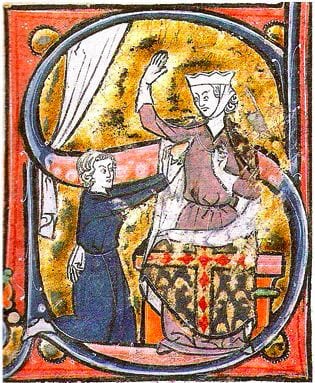
By Atelier du Maître de Bari – MS fr 2186 fol. 41v; immediate source: univ-montp3.fr, Public Domain, https://commons.wikimedia.org/w/index.php?curid=25283099
So romantic, right?
The heart made its way onto decks of cards as one of the four suits by the 15th century, cementing itself in European iconography and fortune-telling. Eventually, I’d love to read this book on the topic, and really delve into the history of cards. Today however I’m only going to brush the surface of the deck and move onward to other ideas.
The Heart Shape’s Greek Origin
There’s another train of thought that argues the heart shape originally comes from the Greeks, in the form of imitation of the shape of the seed of a plant named silphium. It was native to Northern Africa, and was used as a contraceptive at the time. It was literally worth it’s weight in silver, and there are silver coins with the heart shape stamped on it.
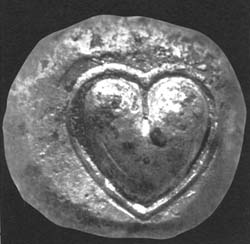
By T. V. Buttrey, via K. Baty. See User talk:Kurt Baty, https://en.wikipedia.org/w/index.php?curid=4074434
The image of a heart shape stamped on a coin, a symbol of the ability to have sex without concern for having children, is one likely the essence of the heart. However, I don’t want to stop there. The heart has become ubiquitous in our society. It’s everywhere, in emojis, teeshirts, logos, and strewn across checkout lanes and end caps for the entire month of February. We may not have a ton of evidence for the heart shape in ancient times, but we sure have a lot of evidence for modern use.
Animism and the Heart Shape
As an animist, I want to know where in the world the heart shape lives? Where does it emerge from the forms of nature and matter? We are allowed to work both ways with our knowledge. We can seek answers in the lore of the ancients, but there are other sources of knowledge.
The experiential world around us is a valid source of understanding. Everything doesn’t have to be an ancient Norse tale to have meaning. Meaning is everywhere, surrounding us every day. As a post-modern white human, I am stuck with the reality that my culture is one of colonialism, my ancestors were WASPs and my ethics and ideals are mostly self-created.
As an animist, I look to the natural world, including the worlds of human creation for my inspiration. Having said that, here’s some of what I’ve learned about that odd bifurcated symmetry we call “the heart shape”.
The Heart Shape in Ecology
The heart shape is basically two inward spirals coming from a single point of origin. Where do we get spirals? Air and water turbulence.
Turbulent flow and Vortex Shedding. Not what you thought you’d read about today, right? But actually, those fancy names are fairly simple concepts of water and airflow. When there’s something flowing, as long as nothing gets in the way it goes straight, but as soon as there’s something in the way, there’s turbulence. Turbulence creates an interesting pattern of fluid dynamics and in particular, something interesting happens in the process of vortex shedding.

By Bob Cahalan, NASA GSFC – http://earthobservatory.nasa.gov/Newsroom/NewImages/images.php3?img_id=3328 (original JPEG), Public Domain
So basically what happens is when water or air moves around a pillar or column shape it creates alternating spiraling patterns. (You see these patterns in a lot of Celtic swirls too) When they move farther away from the origin of the source, eventually they create matching inward-turning double vortices, which is exactly what a heart shape is.
Swan Courting Patterns. It’s so sappy it’s almost ridiculous to mention, and yet, there is it, we all know that a heart shape is formed when two swans bump heads. You can find adorable grandma-y cross-stitch patterns on this motif, but did you know that swans have been associated with marriage for a very long time? The swan is almost trite these days, but in mythology, it was a common symbol for purity and love throughout the Eurasian continent.
Leaf and Seed Shapes. All sorts of seeds and leaves are heart-shaped. Off the top of my head I can name: the violet leaf, the catalpa tree leaf, and the linden tree leaf. Seeds also have heart shapes. The most famous is the Sea Heart, the seed of the South American vine Entada gigas. This seed has all kinds of interesting lore. It is called the Sea Heart because the vines drop their seeds into the sea, where they float vast distances to other places.
The heart symbol doesn’t just emerge from nowhere in 13th century France. Our understanding of reality is rooted in the physical surroundings that we find ourselves in. All our mythology, lore, and history is rooted in the land and the species that surround us. Take some time to see how symbols and motifs emerge in your own life, from the species around you.
The Heart Shape in Embroidery and Textiles
I bring this up because when I was studying Central Asian history with my kids for their homeschool. (it was a thing, we were sick of European history) I noticed something. Hearts emerge from textile patterns. Specifically, when looking at embroidery and ikat patterns you see things that look like hearts All The Time. Interestingly, it seemed these patterns were especially shown on women’s garments and on wedding clothes….
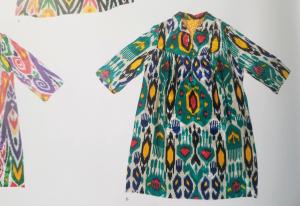
This is ikat. The thread is dyed before it’s woven. check out the hearts!
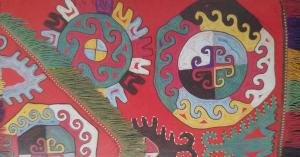
This is a traditional tent decoration. Note how the swirls create a negative heart shape.
Obviously, I’m not an academic. I’m just some lady who likes researching weird stuff. I certainly don’t have the data points to prove anything, nor do I have the money to travel to central Asia and eastern Europe to study garment patterns. I hope someone does.
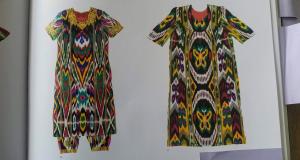
traditional women’s garments, both ikat patterns. Note how the heart shape emerges in the dress on the left.
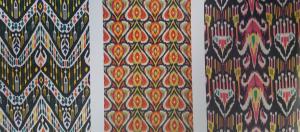
These are fake ikat, printed in Russia to imitate traditional ikat patterns. I love how the fake stuff shows hearts too!
It’s seen particularly on women’s robes and wedding garments, possibly because of the connection of women and a swirling pattern. I can’t say with certainty that the heart shapes on women’s and wedding garments were connected with love. I can say the heart is a traditional shape in central Asian culture. It’s not just some random shape thing that emerged from France in the middle ages.
Relating to the Heart Shape Today
The heart is both ancient and emergent as an ongoing symbol. It’s not going anywhere. Modern pagans and reconstructionists often disdain using symbolism that wasn’t carved on some ancient rock, and yet, I believe Freyja would deeply understand the value of the heart symbol. Aphrodite would understand the importance of a box of chocolates shaped like two swirling vortexes pulling from a single source.
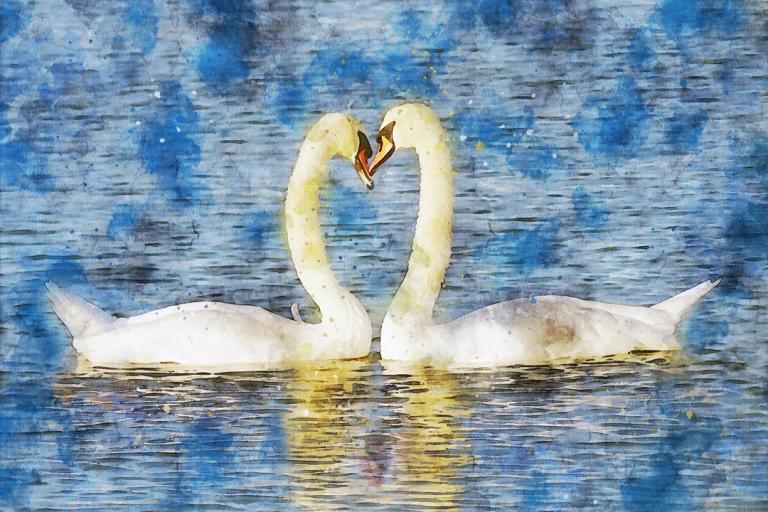
The heart is a negative shape, a void into which life pours. It is the aching, seeking, need for the other. It is the pairing of swirling shapes, the flow of water, and the essence of more than one. When one views the heart in this manner, the fact that the Suit of Cups and the Suit of Hearts both embody emotions makes perfect sense. We see the heart in water, in water birds, in women’s garments, and in the plant shapes of leaf and seed. We can look at the heart shape and build modern meaning that is rooted in the world around us as well as the culture of the past.
How do you work with the symbol of the heart? Where do you see it emerging in your work and in the world around you? Don’t take my word on the heart as a living animistic symbol of the world. Find out where it lives in your own life.
If you’d like to learn more about my work and what I do, or if you’d like to support my researches and an insatiable need to purchase strange books on textiles and swans, sign up here at my Patreon.
Resources:
BBC Where does the Heart Come From
Silk and Cotton Textiles from the Central Asia that Was by Susan Meller
That’s Math: turbulence patterns
Swan in the Grail by Sue Holloway Ph. D.
Previous Post

January 15, 2021
The Heart of Fire, an Imbolc Prayer Based upon the Sacred Heart
Next Post

March 5, 2021 Pagan Baby Blessing Invocation and Ritual for Families and Circles
Browse Our Archives
Select a Category animism Cermony and Liturgy Columns Community Dandelion Seeds Health and Wellness History Holidays Magic Nature pagan parenting plant animism Politics Ritual and Practice symbolism and science Theology, Ethics, Philosophy Uncategorized
Select a Month August 2021 May 2021 April 2021 March 2021 February 2021 January 2021 December 2020 November 2020 October 2020 September 2020 August 2020 July 2020 June 2020 May 2020 April 2020 March 2020 February 2020 January 2020 December 2019 November 2019 October 2019 September 2019 August 2019 July 2019 June 2019 May 2019 April 2019 March 2019 February 2019 January 2019 December 2018 November 2018 October 2018 September 2018 August 2018 June 2018 May 2018 April 2018 March 2018 February 2018 January 2018 December 2017 November 2017 October 2017 September 2017 August 2017 July 2017 June 2017 May 2017 April 2017 March 2017 February 2017 January 2017 December 2016 November 2016 October 2016 September 2016 August 2016 July 2016 June 2016 May 2016 April 2016 March 2016 February 2016 January 2016 December 2015 November 2015 October 2015 September 2015 August 2015 July 2015 June 2015 May 2015 April 2015 March 2015 February 2015 January 2015 December 2014 November 2014 October 2014 September 2014 August 2014 January 2014 October 2013 September 2013 August 2013 July 2013 June 2013 May 2013 April 2013 February 2013 January 2013 July 2012 April 2012 March 2012 February 2012 January 2012 December 2011 November 2011 October 2011 September 2011 August 2011 July 2011 June 2011 May 2011 April 2011 March 2011 February 2011 January 2011 December 2010 November 2010 October 2010 September 2010 August 2010 July 2010 June 2010 May 2010 April 2010 March 2010 February 2010 January 2010 December 2009 November 2009 October 2009 September 2009 August 2009 July 2009 June 2009 May 2009 April 2009 March 2009 February 2009
Follow Us!
TAKE THE
Religious Wisdom Quiz
How did God stop the people from building the Tower of Babel?
Select your answer to see how you score.
Confused their language Struck them with blindness Destroyed the tower with fire Sent a flood
Related posts from Dandelionlady
Use Science and Magic to Empower Your Practice

Working with Your Local River as a Center...
What is Animism: Finding the Spirit of All...
Yule Deer Invocations to Aid and Strengthen Our...
TRENDING AT PATHEOS Pagan

When we talk about Greek religion, we often begin with the dodekatheion—the...

I was recently chatting with someone on Instagram. She asked me what...

While there are many people who share their results, the end of...

On July 23, I saw Christopher Nolan's The Odyssey which is Homer’s...

As I write this two big events have just finished up. One...

Restoring the Watershed of Divine Love
Perhaps cooperation is not something we manufacture through legislation, ideology, or moral...
view all Pagan blogs
Ad-Free & Subscriber Log-In Subscription Support
- About Us
- 2026 Calendar
- Videos
- Podcasts
- Library of World Religions
- Faith In Media Tracker
- Advertise With Us
- Write for Us
- Privacy Policy
- Terms of Service
- Do Not Sell My Data
- Contact Us
- Radiant Digital
- Manage Newsletter Subscriptions
- Unsubscribe From Notifications
- Sitemap
Copyright 2008-2026, Patheos. All rights reserved.
Subscription Support Ad-Free & Subscriber Log-In
Follow Patheos