
BuddhistCatholicContemplativeEvangelicalGeneral ChristianHinduJewishLatter-day SaintMuslimNew VisionsProgressive Christian
Beliefs
- Buddhist
- Catholic
- Contemplative
- Evangelical
- General Christian
- Hindu
- Jewish
- Latter-day Saint
- More Voices
- Muslim
- New Visions
- Pagan
- Progressive Christian
Topics
- Religion News
- Food and Religion
- Sports and Religion
- Religious Art
- Religious Music and Entertainment
- Religious Events
- History and Religion
- Style and Religion
- Politics and Religion
- Women in Religion
- Recreation Outdoors and Religion
- Business Finance and Religion
- Careers Workplace and Religion
- Education and Religion
- Family Parenting and Religion
- Health Fitness and Religion
- Home and Religion
- Relationships and Religion
- Technology and Religion
- Travel and Religion
Columnists
- Buddhist Columnists
- Business Finance and Religion Columnists
- Careers Workplace and Religion Columnists
- Catholic Columnists
- Contemplative Columnists
- Education and Religion Columnists
- Evangelists Columnists
- Family Parenting and Religion Columnists
- General Christian Columnists
- Health Fitness and Religion Columnists
- Hindu Columnists
- History and Religion Columnists
- Home and Religion Columnists
- Jewish Columnists
- More Voices Columnists
- Latter Day Columnists
- Muslim Columnists
- New Visions Columnists
- Nonreligious Columnists
- Pagan Columnists
- Politics and Religion Columnists
- Progressive Columnists
- Recreation Outdoors and Religion Columnists
- Relationships and Religion Columnists
- Religion News Columnists
- Religious Art Columnists
- Religious Events Columnists
- Religious Music and Entertainment Columnists
- Sports and Religion Columnists
- Style and Religion Columnists
- Technology and Religion Columnists
- Travel and Religion Columnists
- Women in Religion Columnists
Resource Library
- 2026 Calendar
- Library of World Religions
- The 100 Most Holy Places on Earth
- Patheos Answers
- Podcasts
- Videos
- Faith Leaders Database
- Anglican Episcopalian
- Bahai
- Baptist
- Buddhism
- Christianity
- Confucianism
- Eastern Orthodoxy
- Hinduism
- Holiness and Pentecostal
- ISKCON
- Islam
- Judaism
- Lutheran
- Methodist
- The Church of Jesus Christ of Latter-day Saints
- New Age
- Paganism
- Presbytarian and Reformed
- Protestantism
- Religion Behind the Scenes
- Roman Catholic
- Scientology
- Shia Islam
- Sikhism
- Sufism
- Sunni Islam
- Taoism
- Zen
- See all religions
Research Tools
 Ad-Free & Subscriber Log-In Subscription Support
Ad-Free & Subscriber Log-In Subscription Support
Follow Patheos 

- Trending:
- Forgiveness
- |
- Marriage
- |
- Consciousness
- |
- Death Penalty
- |
- Election
- |
- Halloween
 Dandelionlady
- Home
- Pagan
- Relating to Animism and Gods: A Way To Think about Connecting Them
Relating to Animism and Gods: A Way To Think about Connecting Them
Last updated on: June 19, 2020 at 1:00 am by Melissa Hill
Relating to Animism and Gods: A Way To Think about Connecting Them 2020-06-05T12:40:47-04:00 Melissa Hill
Patheos Explore the world's faith through different perspectives on religion and spirituality! Patheos has the views of the prevalent religions and spiritualities of the world.
What do we know about Gods and Animism?
As pagans and polytheists we talk about the Gods, we worship them, ignore them, give them offerings, talk to them, and often see them as guiding us and the larger world. We know they’re big and powerful beings who have been worshiped and anthropomorphized as human-like for millennia. They have myths, which are stories we have told about them, attributes, emotive states, special tools, and realms of control. The monotheistic god assumes one sentient omnipresent being as the shaper and creator of every aspect of reality. Unlike monotheism, polytheism has more than one sentient entity with each having a different aspect or aspects of reality that he, she or it, is connected to.
As I discuss the Gods I will also be using the word Godden as created by Rev. Jan Avende as a non-gendered plural that indicates multiple gods who may be female, male, non-gendered, or multi-gendered. I weave between the two words, sometimes using the more gendered and patriarchal Gods as it seems to suit. In the tradition of Mary Daly’s Gyn/Ecology I will be experimenting with new and recreated word forms. However I feel that it is important to weave back and forth between the old and new in order to create verbal bridges into new realities, this is why I use both terms rather than a hard switch to Godden.
The lore from many cultures indicates that deities are not usually all-seeing or omnipresent. In the Illiad at the beginning of the Trojan War, Zeus, the king of gods demands that all godden stay out of the human war. Hera disagrees and encourages Poseidon to interfere, which he does. Zeus only finds out later what a chaotic godden filled mess this war is, and eventually relents. Even though Zeus is the most powerful of all gods, he doesn’t know everything.
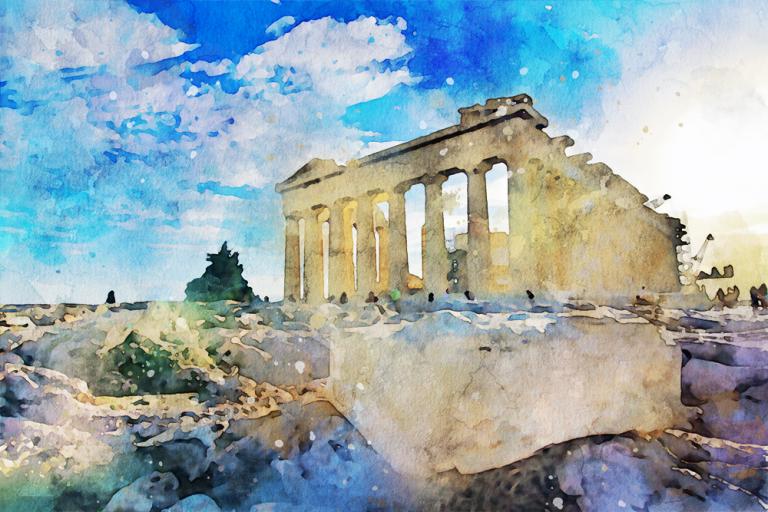
How do Pagans interact with gods?
We assume the Godden are sentient and have aspects that are non-corporeal. We build sacred relationship with them, the proto-Indo European root word *ghosti reflects the primal importance of relationship. It is the root of the words guest and host. It indicates that the back and forth of interaction is of key importance.
We often conceptualize gods as invisible people who have opinions, likes and dislikes, and needs. We do this because it works. In modern paganism, we have concepts like a god-spouse, where humans will marry a god, and dedicate a day or more a week to their love relationship. People interact with the gods like they are mentors, parents, siblings, lovers, guides, and more. Humans see the gods as the forces of nature too. That is where I would like to primarily focus and where I believe we as modern pagans can delve to find deeper and new understandings of what deity is and does.
As a spiritworker and priestess, part of the job is to be able to move between realities. Sometimes that means shifting between the mundane world and the spiritual world. Sometimes it’s traveling between Helheim and Vanaheim. Sometimes it’s viewing the world mathematically or as a narrative. I believe one of the ways that animism can aid us is by reminding us to view the physical, material world as filled with godden.
By moving between polytheism and animism we gain access to a whole other way of viewing and interacting with the gods that move away from the narrative-based anthropomorphic view and moves towards a more biological, mathematical, view. This perspective can aid those of us who are caught in the capitalistic, colonial worldview by allowing us to bridge our modern lives and ideas about mythology and godden into a mental space where we can work to decolonize our spirituality as well as our ethics and actions.

How does one view Gods as a Material Animist?
Let us define material animism: the belief that all matter from stardust to water bears to human babies are sacred and ensouled. Every part of existence has a spiritual component including the screen you’re reading this on and the shit you took this morning.
If we postulate that all matter has soulness or in-spirited-ness, can we flip that? If a tree has an indwelling spirit, does that mean there is a spirit of the tree? Yes, that follows, and we can test it by looking at the lore where we find Greek hamadryads, Slavic leshys, the English Old Man Apple Tree, and Lithuanian Egle, the Fir Tree and Snake Queen. We can also evaluate this statement by our own experiences. As a spiritworker, assuredly, I have talked to many a tree spirit over the years.
Let us define material animism: the belief that all matter from stardust to water bears to human babies are sacred and ensouled.
Animism and Gods: What are Spirits Then? What’s the Difference?
So then what is the difference between a spirit and a god? Mostly the size and importance. The Sun is a great example. All over the world it is almost always classified as a God rather than a spirit. Apollo, Saule, Sunna, and Amaratsu are all excellent examples of the sun as deity, and yet, The Sun is a mass of incandescent gas, a giant nuclear furnace, as science and TMBG have told us. And yet we also know that Apollo is the charioteer who pulls the sun across the sky every day. He is the twin of Artemis, who is the moon or pulls the moon in a chariot. He is a god of music and prophecy and she is a goddess of virginity and the hunt.
However, this gets confusing even within Greek mythology when we start to grapple with Helios, who is also a god of the sun. So which is the real slim shady Apollo or Helios? Then we add in Sunna, the Norse goddess of the sun. She’s an Etin, which is a kind of giant, isn’t associated with prophecy or music, but is related to the moon who is her brother.
We see how different physical phenomena become laden with symbology and meaning within a given culture. These cultural symbols and meanings change over time, and across distances which means that even within a single culture, the meaning and beliefs about the godden can be different.
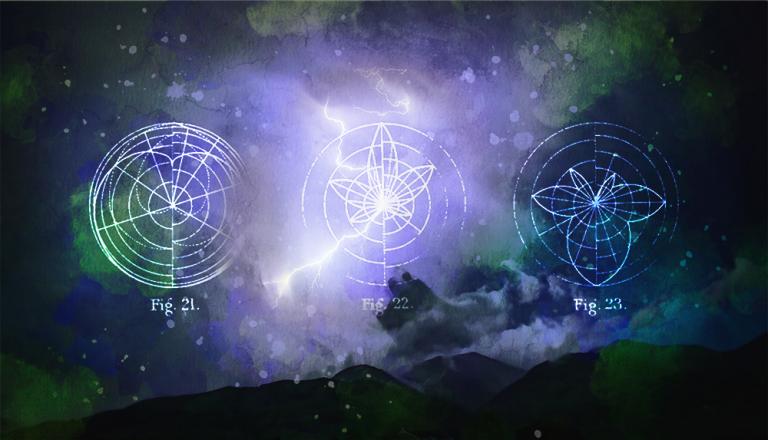
Original Painting by Dandelionlady
Material Animism as the Answer to Which God is the Real Godden?
There is a spirit of the sun, and a spirit of the tree next to your house. There are many gods of the Sun, and many Gods of trees. As modern polytheists some choose to be hard polytheists who believe that each god is a separate entity. Some duotheists classify gods according to gender, where each emanation of deity is categorized as either part of one Great Goddess or otherwise The Great God. This is common in Wicca. Others postulate that gods sort of blend together like ombre patterns, and comparative mythology lays this case out clearly. Thor, Perkunas, and Zeus all are thundergods with a temper and a lightning weapon that can kick the butt of their enemies.
One view does not negate the other. In my experience when we work with concepts that one might term dualistic, it is almost always a reality that the two can be combined into a synthesis of something new. This view is also a great way to work with multidimensional magic. This can be simply expressed by the idea that any created duality can be collapsed or created into some third idea or concept:
Thesis + Antithesis = Synthesis
By nesting this simple equation we can see that you can have an infinite number of variations on any theme because Synthesis we can think of can always have a new duality created with it.
Synthesis A + Antithesis A = Synthesis B
Synthesis B + Antithesis B = Synthesis C
Synthesis C + Some new thing I just came up with = Something even weirder than that
As long as humans can imagine, we can always imagine some new thing. There are patterns to those new things, and if you’re interested in understanding that I suggest researching chaos theory and information systems theory. But what that means is there are infinite ways for us to come up with ideas about the material world.
In this case, I will argue that the essence of polytheism is a combination of human perspectives on reality interacting with the inherent ensouledness of that reality. Gods are a combination of the story we tell about spirit with the spirit itself.
Narrative + Phenomenon in Reality = Godden
This means our understanding of deity can change in two dimensions. We can tell a different story, or we can evolve our understanding of reality. This perspective is another synthesis, wherein I hope to chip away at the damage that Descartes created with the material/spiritual split. In fact, it is the stories that we tell that are the key to the sacred within the material. Because humans need narrative and cannot escape the fact that we understand the world by telling stories about it. The mind/body divide was a bad story, along with many other bad stories.
One of the challenges of being a modern pagan is that we know the gods are patriarchal jerks. We know that western cultural ethics led to colonialism and the creation of modern racism. We know that our stories have flaws that have been writ large on world culture. And yet, we are called by Odin and the Morrigan. We light candles for Brighid on Imbolc. The Godden guide us and protect us. We take joy in honoring Ostara in the spring with dyed eggs and call on Hermes to help us be clever. The Godden are real, meaningful, and powerful in our lives. We can’t just discard them like they never were.
How do we change and evolve our relationship with our flawed and beautiful Gods?
As a reality weaver and magic maker, I have found that reality can only be pushed so far. When I do magic to create a new reality I can only do so much. If I’m in my car and another car is about to hit me, I can’t do magic to make my car fly over it, or magic to suddenly be a mile away. I can do magic at that moment to make it so that the car just happens to miss hitting me, or magic to make it so that it will pull back at the last minute. Those are realities that follow the physical rules of the universe we find ourselves in. If we push reality too far, it just snaps back to the way it was and our magic has failed.
Likewise, we can’t just make our Gods into Godden. Zeus is a stereotypical philandering egotistical patriarch writ large. Part of the work of modern pagan activists and leaders is to lean into the discomfort of the stories we tell about nature and think about how we might retell them.
Zeus, the material animistic phenomenon, is the loud and powerful rainstorm that gives waters to rivers and plants. Zeus the animistic anthropomorphized God has electric weapons that can light the land on fire, as just recently happened in the Australian bush fires. Zeus the hard polytheistic deity is Zeus Olympios, king of the gods who watched over the Olympic games wearing the laurel wreath of triumph, He who rules on high along with the twelve other Olympian gods.
By looking at our gods with the lens of an ensouled reality we allow them to be more than just the stories we tell about them. Zeus is more than an ancient mafia don. He is also the storms that ride across the sky. Modern science tells us that because of climate change and the increase of heat in the atmosphere, the atmosphere can hold more water. That means storms will be bigger and possibly less frequent. It means our modern relationship to rain will be changing. Our relationship with Zeus will be changing, as will our relationship with other Storm Godden.
We can choose to respond to these changes with new ideas that build on old ideas. We can expand our narratives at the same time that we deepen our understanding of modern meteorology and other scientific disciplines. By combining narrative and science we can play with our modern expression of spirituality and find paths to new religious expression that matches our beliefs and values without discarding the power of tradition and ancient ways.
I’d like to leave you with one last algebraic expression which I have found to give me hope:
Anthropomorphic Polytheism + Material Animism = Realityfluid Godden
Good luck and Godden willing, we can change our world.
Resources
Rev. Jan Avende, “The Godden: In You I See Me” https://www.patreon.com/posts/godden-in-you-i-26338484
Homer, The Illiad.
Jaan Puhvel, Comparative Mythology. 1987.
They Might Be Giants. “Why does the Sun Shine?” from the Here Comes Science album.
If you like my work and you’d like to help me keep creating new content, please consider becoming a Patreon. Thank you.

Previous Post

June 12, 2020
Wood Sorrel: An Edible Weed and a Gentle Spirit Friend
Next Post

July 17, 2020 Daylily Spirit, A Delicious and Sturdy Wild Plant Spirit
Browse Our Archives
Select a Category animism Cermony and Liturgy Columns Community Dandelion Seeds Health and Wellness History Holidays Magic Nature pagan parenting plant animism Politics Ritual and Practice symbolism and science Theology, Ethics, Philosophy Uncategorized
Select a Month August 2021 May 2021 April 2021 March 2021 February 2021 January 2021 December 2020 November 2020 October 2020 September 2020 August 2020 July 2020 June 2020 May 2020 April 2020 March 2020 February 2020 January 2020 December 2019 November 2019 October 2019 September 2019 August 2019 July 2019 June 2019 May 2019 April 2019 March 2019 February 2019 January 2019 December 2018 November 2018 October 2018 September 2018 August 2018 June 2018 May 2018 April 2018 March 2018 February 2018 January 2018 December 2017 November 2017 October 2017 September 2017 August 2017 July 2017 June 2017 May 2017 April 2017 March 2017 February 2017 January 2017 December 2016 November 2016 October 2016 September 2016 August 2016 July 2016 June 2016 May 2016 April 2016 March 2016 February 2016 January 2016 December 2015 November 2015 October 2015 September 2015 August 2015 July 2015 June 2015 May 2015 April 2015 March 2015 February 2015 January 2015 December 2014 November 2014 October 2014 September 2014 August 2014 January 2014 October 2013 September 2013 August 2013 July 2013 June 2013 May 2013 April 2013 February 2013 January 2013 July 2012 April 2012 March 2012 February 2012 January 2012 December 2011 November 2011 October 2011 September 2011 August 2011 July 2011 June 2011 May 2011 April 2011 March 2011 February 2011 January 2011 December 2010 November 2010 October 2010 September 2010 August 2010 July 2010 June 2010 May 2010 April 2010 March 2010 February 2010 January 2010 December 2009 November 2009 October 2009 September 2009 August 2009 July 2009 June 2009 May 2009 April 2009 March 2009 February 2009
Follow Us!
TAKE THE
Religious Wisdom Quiz
What animal is commonly associated with Jesus?
Select your answer to see how you score.
Lion Fish Lamb Donkey
Related posts from Dandelionlady
Working with Your Local River as a Center...
What is Animism: Finding the Spirit of All...

The Heart of Fire, an Imbolc Prayer Based...
Yule Deer Invocations to Aid and Strengthen Our...
TRENDING AT PATHEOS Pagan

I was recently chatting with someone on Instagram. She asked me what...

While there are many people who share their results, the end of...

On July 23, I saw Christopher Nolan's The Odyssey which is Homer’s...

As I write this two big events have just finished up. One...

Restoring the Watershed of Divine Love
Perhaps cooperation is not something we manufacture through legislation, ideology, or moral...

Many UUs don’t pray because of bad experiences in a previous religion,...
view all Pagan blogs
Ad-Free & Subscriber Log-In Subscription Support
- About Us
- 2026 Calendar
- Videos
- Podcasts
- Library of World Religions
- Faith In Media Tracker
- Advertise With Us
- Write for Us
- Privacy Policy
- Terms of Service
- Do Not Sell My Data
- Contact Us
- Radiant Digital
- Manage Newsletter Subscriptions
- Unsubscribe From Notifications
- Sitemap
Copyright 2008-2026, Patheos. All rights reserved.
Subscription Support Ad-Free & Subscriber Log-In
Follow Patheos