
BuddhistCatholicContemplativeEvangelicalGeneral ChristianHinduJewishLatter-day SaintMuslimNew VisionsProgressive Christian
Beliefs
- Buddhist
- Catholic
- Contemplative
- Evangelical
- General Christian
- Hindu
- Jewish
- Latter-day Saint
- More Voices
- Muslim
- New Visions
- Pagan
- Progressive Christian
Topics
- Religion News
- Food and Religion
- Sports and Religion
- Religious Art
- Religious Music and Entertainment
- Religious Events
- History and Religion
- Style and Religion
- Politics and Religion
- Women in Religion
- Recreation Outdoors and Religion
- Business Finance and Religion
- Careers Workplace and Religion
- Education and Religion
- Family Parenting and Religion
- Health Fitness and Religion
- Home and Religion
- Relationships and Religion
- Technology and Religion
- Travel and Religion
Columnists
- Buddhist Columnists
- Business Finance and Religion Columnists
- Careers Workplace and Religion Columnists
- Catholic Columnists
- Contemplative Columnists
- Education and Religion Columnists
- Evangelists Columnists
- Family Parenting and Religion Columnists
- General Christian Columnists
- Health Fitness and Religion Columnists
- Hindu Columnists
- History and Religion Columnists
- Home and Religion Columnists
- Jewish Columnists
- More Voices Columnists
- Latter Day Columnists
- Muslim Columnists
- New Visions Columnists
- Nonreligious Columnists
- Pagan Columnists
- Politics and Religion Columnists
- Progressive Columnists
- Recreation Outdoors and Religion Columnists
- Relationships and Religion Columnists
- Religion News Columnists
- Religious Art Columnists
- Religious Events Columnists
- Religious Music and Entertainment Columnists
- Sports and Religion Columnists
- Style and Religion Columnists
- Technology and Religion Columnists
- Travel and Religion Columnists
- Women in Religion Columnists
Resource Library
- 2026 Calendar
- Library of World Religions
- The 100 Most Holy Places on Earth
- Patheos Answers
- Podcasts
- Videos
- Faith Leaders Database
- Anglican Episcopalian
- Bahai
- Baptist
- Buddhism
- Christianity
- Confucianism
- Eastern Orthodoxy
- Hinduism
- Holiness and Pentecostal
- ISKCON
- Islam
- Judaism
- Lutheran
- Methodist
- The Church of Jesus Christ of Latter-day Saints
- New Age
- Paganism
- Presbytarian and Reformed
- Protestantism
- Religion Behind the Scenes
- Roman Catholic
- Scientology
- Shia Islam
- Sikhism
- Sufism
- Sunni Islam
- Taoism
- Zen
- See all religions
Research Tools
 Ad-Free & Subscriber Log-In Subscription Support
Ad-Free & Subscriber Log-In Subscription Support
Follow Patheos 

- Trending:
- Forgiveness
- |
- Marriage
- |
- Consciousness
- |
- Death Penalty
- |
- Election
- |
- Halloween
 Dandelionlady
- Home
- Pagan
- Gerda: the Norse Goddess of Gardening and Horticulture
Gerda: the Norse Goddess of Gardening and Horticulture
Last updated on: May 6, 2019 at 3:01 pm by Melissa Hill
Gerda: the Norse Goddess of Gardening and Horticulture 2019-05-06T15:01:36-04:00 Melissa Hill
Patheos Explore the world's faith through different perspectives on religion and spirituality! Patheos has the views of the prevalent religions and spiritualities of the world.
It smells of spring and wet earth after the rain. I’ve been planting my seeds, and implementing my garden plans. I’ve removed the sod from a number of new garden beds. I’ve transplanted bergamot, echinacea, comfrey, violets, roses, and geraniums into the new spaces. I’ve sweated in sun, felt the rain on the back of my neck, and the mud on my fingers.
I visit my Gerda shrine in gratitude and leave offerings of plant material, sacred water, and stones I have dug up from garden beds for Her.
Working with Gerda can be a powerful lifelong relationship to the land and to gardening. She speaks and I hear the song of peace through strong and careful labor.
She is the Lady of the Walled Garden, the goddess of carefully cultivated spaces. She is a goddess who is defined by the innangard, a Norse word that means land inside spaces set aside for human use. Gerd literally means enclosure. She is The One Who is Fenced In. Often she is associated with the color brown, or the cold earth that is warmed by the love of Freyr.
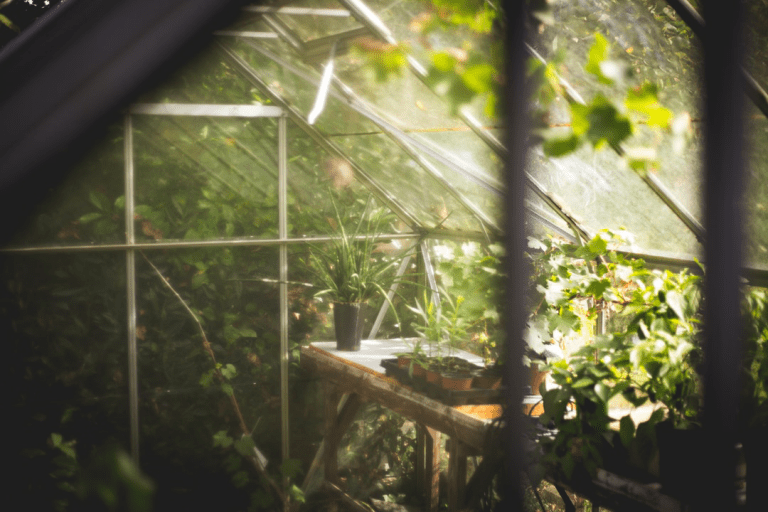
The Greenhouse can be seen as a modern temple to Gerda. (via Adobe Spark)
What We Know From the Lore
Gerda is the daughter of two giants: Gymir and Aurboda. We find Aurboda as one of Mengloth’s maidens in the saga of Svipdagsmál. Mengloth sits on the healing hill with her nine maidens, including the last, our Aurboda, whose name means gold-giver. Some people believe that Mengloth is a guise of Freya, because both are associated with gold, which means that Gerda’s mother may have been a handmaiden of Freya before her daughter became the wife of Freyr. In the poem the Hyndluljóð, it is mentioned that Gerda’s family is related to Thjazi, the jotun who is the father of the Goddess of Winter, Skadi.
In the Eddas the tale of Gerda’s wooing by Freyr is told. Mostly she’s not wooed by Freyr at all. Freyr decides to sit upon the high seat and spies Gerda. He instantly falls sick with love and sends his Elven companion Skirnir to woo her for him. Skirnir agrees to do so, but demands Freyr’s sword first. I find it interesting that we assume Skirnir, the bright one, brings various sorts of treasures, but seeing as her mother is named gold-giver, her family has no need of such things. Eventually he gets desperate, and threatens her with all kinds of cursing and nastiness.
Cruelty and threats are the things that works, by the way. Certainly we can put this in the context of the time and culture, but I also want to sit with the fact that Gerda was threatened into marriage. It seems to me that she is fenced in, just as her name suggests. I wonder if she counter offers for the sword. We don’t actually know what happens with Freyr’s sword. We know Skirnir wanders off with it, having “borrowed” it. We know that Freyr never gets it back because during the battle of Ragnarok Freyr doesn’t have his sword and must fight with a deer antler. Maybe with violence offered, Gerda chose to defuse the possibility of violence by demanding weaponry. Such are the mysteries of ancient epic poetry. We are left to wonder what it was that happened in between the sagas.
Freyr and Gerda are also credited with being the progenitors Yngling dynasty in Sweden. Freyr is listed as a king of Sweden and and Gerda as his wife, with their descendants ruling for generations. When one looks at the lineages, it becomes clear that at least some of the mythology was encoded as history, much as the historicization of Roman mythology with Romulus and Remus.
What I Have Seen In Vision and Learned from Experience
Some scholars state that she is the goddess of all cultivated land, however I believe this is incorrect due to their misunderstanding of how agriculture actually works. I would argue that she is a goddess of the walled garden and horticulture. Those who don’t do a lot of agricultural work often see all growing of plants as basically the same thing. Farmers grow stuff. The end. When one is farming vegetation, there are at least two primary ways. One is field crops. This is where you grow big fields of stuff like grain or soy. We grow most things this way in our age of agribusiness.
The other is horticulture, which is the production of high value crops, usually with high input costs. These are plants that are fragile, susceptible to illness, or that need extra care. In the modern world these are flowers, fruit, herbs, and ornamental plants. As Gerda is the goddess of the enclosure and married to Freyr, the god of fertility, she then is the goddess of enclosed fertility. Her sacred places are greenhouses, conservatories, atriums, botanical gardens, vegetable gardens, flower gardens, urban gardens, and home gardens.

Flower gardens as an offering for Gerda. (via Adobe Spark)
When I visit her on the spiritual planes I see her home as a vast walled garden, usually of red brick. The descriptions from The Secret Garden come to mind. For anyone who is called to serve Gerda, I would highly recommend reading that children’s book. When I wander her halls, I see long walkways with many kinds of gardens. Some are for pleasure and some for useful plants. All are protected from the wild outside. Many things bloom and a gentle moist air is filled with the scent of herbs and fragrant flowers.
I have been calling her garden Urtrsalir from the old norse for herbs, urtr and salir meaning hall, as in Fensalir, Frigga’s hall.
Herself, she often wears sensible clothes. Sometimes it’s very like a monk’s brown robes, sometimes it’s a linen apron over brown trousers. Occasionally Gerda wears a green wool dress with leaves embroidered in infinite shades of green for a subtle patterning like dappled leaves. I enjoy my talks with her, they leave me filled with peace and contentment. In my life where I am constantly balancing many needs and I never have enough time, contentment is a rare gift.
I give her offerings of the first flowers from my garden. I leave the stones that I find in my garden beds in a cairn for her. But most of all, I garden for her. The process of tending plants is the most important offering one can give. I also encourage those who do garden to save seeds and share them with others. Sharing seeds, plants, and knowledge of gardening is a wonderful way to honor Gerda: the Lady of the Walled Garden.
Resources:
The Poetic Edda, Translated by Lee M. Hollander
The Prose Edda, by Snorri Sturluson
The Heimskringla or the Lives of the Norse Kings, by Snorri Sturluson
The Dictionary of Norse Mythology by Rudolf Simek
The Viking Spirit by Daniel McCoy
The Secret Garden by Frances Hodgson Burnett
The Garden Primer by Barbara Damrosch
May the Goddess of the Garden grant you the blessings of strong seedlings and a good harvest. If you would like to grant me the blessing of support, consider pledging over at my Patreon. Thank you.
Previous Post

April 30, 2019
Bird Migrations and the Stars: The Science Behind the Connection
Next Post

May 14, 2019 Meditating on Modern Physics: Mandalas from Scientific Thought
Browse Our Archives
Select a Category animism Cermony and Liturgy Columns Community Dandelion Seeds Health and Wellness History Holidays Magic Nature pagan parenting plant animism Politics Ritual and Practice symbolism and science Theology, Ethics, Philosophy Uncategorized
Select a Month August 2021 May 2021 April 2021 March 2021 February 2021 January 2021 December 2020 November 2020 October 2020 September 2020 August 2020 July 2020 June 2020 May 2020 April 2020 March 2020 February 2020 January 2020 December 2019 November 2019 October 2019 September 2019 August 2019 July 2019 June 2019 May 2019 April 2019 March 2019 February 2019 January 2019 December 2018 November 2018 October 2018 September 2018 August 2018 June 2018 May 2018 April 2018 March 2018 February 2018 January 2018 December 2017 November 2017 October 2017 September 2017 August 2017 July 2017 June 2017 May 2017 April 2017 March 2017 February 2017 January 2017 December 2016 November 2016 October 2016 September 2016 August 2016 July 2016 June 2016 May 2016 April 2016 March 2016 February 2016 January 2016 December 2015 November 2015 October 2015 September 2015 August 2015 July 2015 June 2015 May 2015 April 2015 March 2015 February 2015 January 2015 December 2014 November 2014 October 2014 September 2014 August 2014 January 2014 October 2013 September 2013 August 2013 July 2013 June 2013 May 2013 April 2013 February 2013 January 2013 July 2012 April 2012 March 2012 February 2012 January 2012 December 2011 November 2011 October 2011 September 2011 August 2011 July 2011 June 2011 May 2011 April 2011 March 2011 February 2011 January 2011 December 2010 November 2010 October 2010 September 2010 August 2010 July 2010 June 2010 May 2010 April 2010 March 2010 February 2010 January 2010 December 2009 November 2009 October 2009 September 2009 August 2009 July 2009 June 2009 May 2009 April 2009 March 2009 February 2009
Follow Us!
TAKE THE
Religious Wisdom Quiz
Who boldly risked her life to save her people with the phrase, "If I perish, I perish"?
Select your answer to see how you score.
Esther Hannah Deborah Ruth
Related posts from Dandelionlady

Working with Your Local River as a Center...

What is Animism: Finding the Spirit of All...

The Heart of Fire, an Imbolc Prayer Based...

Yule Deer Invocations to Aid and Strengthen Our...
TRENDING AT PATHEOS Pagan

When we talk about Greek religion, we often begin with the dodekatheion—the...

I was recently chatting with someone on Instagram. She asked me what...

While there are many people who share their results, the end of...

On July 23, I saw Christopher Nolan's The Odyssey which is Homer’s...

As I write this two big events have just finished up. One...

Restoring the Watershed of Divine Love
Perhaps cooperation is not something we manufacture through legislation, ideology, or moral...
view all Pagan blogs
Ad-Free & Subscriber Log-In Subscription Support
- About Us
- 2026 Calendar
- Videos
- Podcasts
- Library of World Religions
- Faith In Media Tracker
- Advertise With Us
- Write for Us
- Privacy Policy
- Terms of Service
- Do Not Sell My Data
- Contact Us
- Radiant Digital
- Manage Newsletter Subscriptions
- Unsubscribe From Notifications
- Sitemap
Copyright 2008-2026, Patheos. All rights reserved.
Subscription Support Ad-Free & Subscriber Log-In
Follow Patheos