
BuddhistCatholicContemplativeEvangelicalGeneral ChristianHinduJewishLatter-day SaintMuslimNew VisionsProgressive Christian
Beliefs
- Buddhist
- Catholic
- Contemplative
- Evangelical
- General Christian
- Hindu
- Jewish
- Latter-day Saint
- More Voices
- Muslim
- New Visions
- Pagan
- Progressive Christian
Topics
- Religion News
- Food and Religion
- Sports and Religion
- Religious Art
- Religious Music and Entertainment
- Religious Events
- History and Religion
- Style and Religion
- Politics and Religion
- Women in Religion
- Recreation Outdoors and Religion
- Business Finance and Religion
- Careers Workplace and Religion
- Education and Religion
- Family Parenting and Religion
- Health Fitness and Religion
- Home and Religion
- Relationships and Religion
- Technology and Religion
- Travel and Religion
Columnists
- Buddhist Columnists
- Business Finance and Religion Columnists
- Careers Workplace and Religion Columnists
- Catholic Columnists
- Contemplative Columnists
- Education and Religion Columnists
- Evangelists Columnists
- Family Parenting and Religion Columnists
- General Christian Columnists
- Health Fitness and Religion Columnists
- Hindu Columnists
- History and Religion Columnists
- Home and Religion Columnists
- Jewish Columnists
- More Voices Columnists
- Latter Day Columnists
- Muslim Columnists
- New Visions Columnists
- Nonreligious Columnists
- Pagan Columnists
- Politics and Religion Columnists
- Progressive Columnists
- Recreation Outdoors and Religion Columnists
- Relationships and Religion Columnists
- Religion News Columnists
- Religious Art Columnists
- Religious Events Columnists
- Religious Music and Entertainment Columnists
- Sports and Religion Columnists
- Style and Religion Columnists
- Technology and Religion Columnists
- Travel and Religion Columnists
- Women in Religion Columnists
Resource Library
- 2026 Calendar
- Library of World Religions
- The 100 Most Holy Places on Earth
- Patheos Answers
- Podcasts
- Videos
- Faith Leaders Database
- Anglican Episcopalian
- Bahai
- Baptist
- Buddhism
- Christianity
- Confucianism
- Eastern Orthodoxy
- Hinduism
- Holiness and Pentecostal
- ISKCON
- Islam
- Judaism
- Lutheran
- Methodist
- The Church of Jesus Christ of Latter-day Saints
- New Age
- Paganism
- Presbytarian and Reformed
- Protestantism
- Religion Behind the Scenes
- Roman Catholic
- Scientology
- Shia Islam
- Sikhism
- Sufism
- Sunni Islam
- Taoism
- Zen
- See all religions
Research Tools
 Ad-Free & Subscriber Log-In Subscription Support
Ad-Free & Subscriber Log-In Subscription Support
Follow Patheos 

- Trending:
- Forgiveness
- |
- Marriage
- |
- Consciousness
- |
- Death Penalty
- |
- Election
- |
- Halloween
 Dandelionlady
- Home
- Pagan
- Norse Swan Spirit Lore and Analysis: Focusing on the Myth of Weyland Smith
Norse Swan Spirit Lore and Analysis: Focusing on the Myth of Weyland Smith
Last updated on: April 23, 2019 at 7:59 am by Melissa Hill
Norse Swan Spirit Lore and Analysis: Focusing on the Myth of Weyland Smith 2019-04-22T13:35:10-04:00 Melissa Hill
Patheos Explore the world's faith through different perspectives on religion and spirituality! Patheos has the views of the prevalent religions and spiritualities of the world.
With the Norse lore you can’t escape having to consider what the difference is between all the various interlocking female spirits. There are Valkyries, Disir, Nornir and swan maidens. Frankly, you could make an argument for the swans to be involved in all the groups, sort of like those kids in high school who can’t pick just one clique. The English word we use for those large white waterbirds is very similar to the old Norse “svan”. When you start reading the old sagas and lore you find swan maidens and women all over the place. Today I’m focusing on the bird women from the Völundarkviða.
These bird women take many forms, including Freyja herself who is called chooser of the slain, and takes the form of a falcon using her feathered cloak. There’s Svanhild from the Völsunga saga, who is the daughter of Sigurd and Gudrun, and the twin of Sigmund. She is referenced in a number of other Norse sagas, including twice in the Poetic Edda. Valkyries seem to take the form of falcon, ravens, and swans.
We encounter swan Valkyries in the Völundarkviða which is the story of Weyland Smith. He and his two brothers encounter three Valkyries sisters named Hervör alvitr, Hlaðguðr Svanhvít, and Ölrún. Let’s look at what those names mean, and what that means for Valkyries and swan maidens.
Sister number one: Hlaðguðr Svanhvít who is Volund’s wife. Her first name name roughly translates as Hlaðguðr Hlad(a) + Gunnr: lace/headdress (to weave) + battle or valkyrie. Her second name is easy enough: Swan White. So we might call her Woven-Headdress-Battle-Woman White-Swan. What a name! There’s a lot for us to go on there, and her name clearly resonates the connection between swans and Valkyries. Weaving is an important element as well, and associated with the battle aspect. There are references to Valkyries knotting the enemy to keep them from fighting, so it may be that this is an expression of battle magic using thread.
Sister number two: Ölrún: this sister’s name is probably related to names like Alruna. The prefix Al- or Ol- is debated, but might mean noble. The latter part of the name refers to rune, meaning secret or hidden knowledge and also the name of the alphabetical and magical system discovered by Odin. We can translate her name as Noble-Secret-Knowledge.
Sister number three: Hervör Alvitr: Herr means army and Vor is spring/woman. Alvitr translates as strange creature or all-wise. I love how these translations work, uniting concepts that we as modern English speakers don’t always understand as related. In an attempt to organize the translation I might say her name was something like: Army-of-the-Spring-Woman Strange-and-Wise.
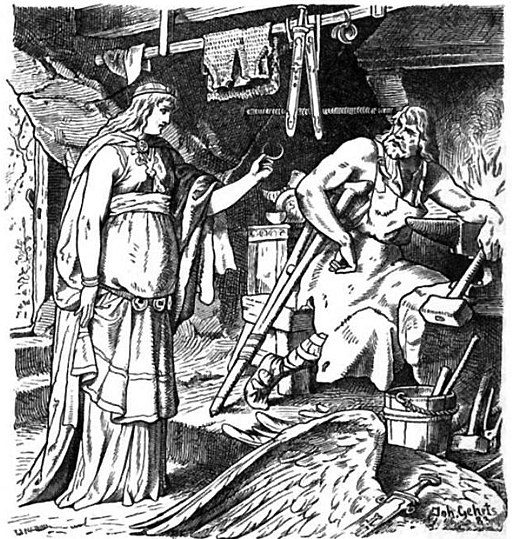
Johannes Gehrts [Public domain] via Wikimedia Commons
In the Volundarkiva, Volund and his brothers marry these swan wives from a place called Myrkvid or “dark wood”. They live together in a place called Ulfdallir or “Wolf dales” for seven years. It is interesting in that the story does a bit of a flip of the standard motif. Usually in the folklore the swan maiden is captured by her husband’s theft of her winged garment. She stays with him until in some way she rediscovers her garment and transforms into a swan again. In this myth there is no indication that the women were forced to stay, but there is a similarity in that the wives stay for a limited time. When we think of marriage, we often think of “til death do we part”. Marriage is a permanent phenomenon. In this case, the women decide to leave of their own volition. After seven years they begin longing for battle. They leave in the ninth year of their marriage.
It’s also interesting to note that in this tale, it is the man that is captured, but only after his wife leaves him. In fact, the bit about the wives is the prequel to the main narrative, which is about Volund’s capture where he is forced to make magic smith-crafted items for the king. Volund is referred to as the King of Elves, connecting the swan maidens to the Elves and to the Vanir. When Volund escapes his capture he makes himself a flying device, either described as a robe or created wings. In the standard swan maiden folklore, she is the one who escapes with a feathered garment. In this myth, it is her ex-husband who does so.
We have a number of the classic elements of a swan maiden story here, but rearranged. It’s hard to date the folklore properly, but because it’s so widespread on the Eurasian continent it’s likely to be very old. It is possible that the writers of the Weyland Smith myths were influenced by the folktale, but it’s also possible that the folktale came later. It’s hard to know for sure with such things. However we can see the connections between the otherworldly beings, a garment of winged transformation, and creative inspiration. These are themes that come up many times in the swan motifs.
If you are interested in supporting the various work I do for interlocking pagan communities, please consider signing up over at my Patreon. I would deeply appreciate it.
Previous Post
April 16, 2019
Working With Swan Maiden Spirit Guides: An Ongoing Journey
Next Post

April 30, 2019 Bird Migrations and the Stars: The Science Behind the Connection
Browse Our Archives
Select a Category animism Cermony and Liturgy Columns Community Dandelion Seeds Health and Wellness History Holidays Magic Nature pagan parenting plant animism Politics Ritual and Practice symbolism and science Theology, Ethics, Philosophy Uncategorized
Select a Month August 2021 May 2021 April 2021 March 2021 February 2021 January 2021 December 2020 November 2020 October 2020 September 2020 August 2020 July 2020 June 2020 May 2020 April 2020 March 2020 February 2020 January 2020 December 2019 November 2019 October 2019 September 2019 August 2019 July 2019 June 2019 May 2019 April 2019 March 2019 February 2019 January 2019 December 2018 November 2018 October 2018 September 2018 August 2018 June 2018 May 2018 April 2018 March 2018 February 2018 January 2018 December 2017 November 2017 October 2017 September 2017 August 2017 July 2017 June 2017 May 2017 April 2017 March 2017 February 2017 January 2017 December 2016 November 2016 October 2016 September 2016 August 2016 July 2016 June 2016 May 2016 April 2016 March 2016 February 2016 January 2016 December 2015 November 2015 October 2015 September 2015 August 2015 July 2015 June 2015 May 2015 April 2015 March 2015 February 2015 January 2015 December 2014 November 2014 October 2014 September 2014 August 2014 January 2014 October 2013 September 2013 August 2013 July 2013 June 2013 May 2013 April 2013 February 2013 January 2013 July 2012 April 2012 March 2012 February 2012 January 2012 December 2011 November 2011 October 2011 September 2011 August 2011 July 2011 June 2011 May 2011 April 2011 March 2011 February 2011 January 2011 December 2010 November 2010 October 2010 September 2010 August 2010 July 2010 June 2010 May 2010 April 2010 March 2010 February 2010 January 2010 December 2009 November 2009 October 2009 September 2009 August 2009 July 2009 June 2009 May 2009 April 2009 March 2009 February 2009
Follow Us!
TAKE THE
Religious Wisdom Quiz
What language was the Old Testament mostly written in?
Select your answer to see how you score.
Latin Aramaic Hebrew Greek
Related posts from Dandelionlady
Working With Swan Maiden Spirit Guides: An Ongoing...
A Wonderful Devotional to the Earth: Early Spring...

Worshipping the Daughters of the Night
Idunn and the Golden Apples: a Retelling
TRENDING AT PATHEOS Pagan

When we talk about Greek religion, we often begin with the dodekatheion—the...

I was recently chatting with someone on Instagram. She asked me what...

While there are many people who share their results, the end of...

On July 23, I saw Christopher Nolan's The Odyssey which is Homer’s...

As I write this two big events have just finished up. One...

Restoring the Watershed of Divine Love
Perhaps cooperation is not something we manufacture through legislation, ideology, or moral...
view all Pagan blogs
Ad-Free & Subscriber Log-In Subscription Support
- About Us
- 2026 Calendar
- Videos
- Podcasts
- Library of World Religions
- Faith In Media Tracker
- Advertise With Us
- Write for Us
- Privacy Policy
- Terms of Service
- Do Not Sell My Data
- Contact Us
- Radiant Digital
- Manage Newsletter Subscriptions
- Unsubscribe From Notifications
- Sitemap
Copyright 2008-2026, Patheos. All rights reserved.
Subscription Support Ad-Free & Subscriber Log-In
Follow Patheos