
BuddhistCatholicContemplativeEvangelicalGeneral ChristianHinduJewishLatter-day SaintMuslimNew VisionsProgressive Christian
Beliefs
- Buddhist
- Catholic
- Contemplative
- Evangelical
- General Christian
- Hindu
- Jewish
- Latter-day Saint
- More Voices
- Muslim
- New Visions
- Pagan
- Progressive Christian
Topics
- Religion News
- Food and Religion
- Sports and Religion
- Religious Art
- Religious Music and Entertainment
- Religious Events
- History and Religion
- Style and Religion
- Politics and Religion
- Women in Religion
- Recreation Outdoors and Religion
- Business Finance and Religion
- Careers Workplace and Religion
- Education and Religion
- Family Parenting and Religion
- Health Fitness and Religion
- Home and Religion
- Relationships and Religion
- Technology and Religion
- Travel and Religion
Columnists
- Buddhist Columnists
- Business Finance and Religion Columnists
- Careers Workplace and Religion Columnists
- Catholic Columnists
- Contemplative Columnists
- Education and Religion Columnists
- Evangelists Columnists
- Family Parenting and Religion Columnists
- General Christian Columnists
- Health Fitness and Religion Columnists
- Hindu Columnists
- History and Religion Columnists
- Home and Religion Columnists
- Jewish Columnists
- More Voices Columnists
- Latter Day Columnists
- Muslim Columnists
- New Visions Columnists
- Nonreligious Columnists
- Pagan Columnists
- Politics and Religion Columnists
- Progressive Columnists
- Recreation Outdoors and Religion Columnists
- Relationships and Religion Columnists
- Religion News Columnists
- Religious Art Columnists
- Religious Events Columnists
- Religious Music and Entertainment Columnists
- Sports and Religion Columnists
- Style and Religion Columnists
- Technology and Religion Columnists
- Travel and Religion Columnists
- Women in Religion Columnists
Resource Library
- 2026 Calendar
- Library of World Religions
- The 100 Most Holy Places on Earth
- Patheos Answers
- Podcasts
- Videos
- Faith Leaders Database
- Anglican Episcopalian
- Bahai
- Baptist
- Buddhism
- Christianity
- Confucianism
- Eastern Orthodoxy
- Hinduism
- Holiness and Pentecostal
- ISKCON
- Islam
- Judaism
- Lutheran
- Methodist
- The Church of Jesus Christ of Latter-day Saints
- New Age
- Paganism
- Presbytarian and Reformed
- Protestantism
- Religion Behind the Scenes
- Roman Catholic
- Scientology
- Shia Islam
- Sikhism
- Sufism
- Sunni Islam
- Taoism
- Zen
- See all religions
Research Tools
 Ad-Free & Subscriber Log-In Subscription Support
Ad-Free & Subscriber Log-In Subscription Support
Follow Patheos 

- Trending:
- Forgiveness
- |
- Marriage
- |
- Consciousness
- |
- Death Penalty
- |
- Election
- |
- Halloween
 Dandelionlady
- Home
- Pagan
- Getting in Touch with the Egregore of your Pagan Group is a Good Thing
Getting in Touch with the Egregore of your Pagan Group is a Good Thing
Last updated on: August 15, 2018 at 1:58 am by Melissa Hill
Getting in Touch with the Egregore of your Pagan Group is a Good Thing 2018-08-15T01:58:46-04:00 Melissa Hill
Patheos Explore the world's faith through different perspectives on religion and spirituality! Patheos has the views of the prevalent religions and spiritualities of the world.
As pagans we talk about spirits that we work with like Grandma Eunice, our house spirit, or the dryad that lives in the oak in the park. We also talk about group dynamics like how Sara is bossy, no one wants to do any work for the harvest festival, and the lack of communication about the website, but we talk about them like they’re seperate things. Group dynamics and spiritual beings are not actually different things.
Your group dynamic has a spirit.
I’m such a darn pantheist, aren’t I? But seriously, this is not just something I’ve hypothesized in order to feel better about the fact that I believe that everything in existence has a soul. It’s come up more than once in my priest work. Particularly in the way of “Woah! That’s a messed up egregore you’ve got there!” Because it’s a word I’ve had to define more than once when discussing such things, let’s talk definitions before we dive into what I’m talking about.
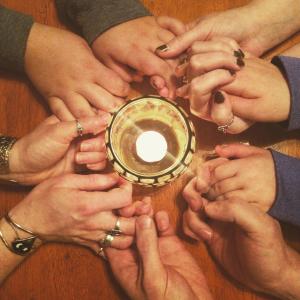
A gathering of people doing the Work. Photo by Rev. Melissa Hill
Egregore is a noun that means the spiritual collective of a group mind. It is a created thoughtform that can, if given enough energy and input, become sentient. It’s a word thrown about a lot by chaos magicians who are some of the experts on created spirits. Egregores can develop naturally or be crafted more carefully. A mascot for a team is one way of shaping an egregore. But they also develop more organically like when a group of people start worshipping together and suddenly realize that they know the perfect name for their coven. An egregore can be the narrative and spirit that holds a group together. It can also get out of control, damage group dynamics, and perpetuate toxic environments so it’s important to think about and to know that you can consciously adjust such things, especially if you have skill sets in lore, narrative building, or magic. Marketing and advertising are good cross trainer skill sets for all those things, since as far as I’m concerned marketing and advertising are modern magic.
Disclaimer: if you are in a group where you’re having communication problems, no one will help, or everyone is just cranky and angry at each other, you still have to confront those very real issues with honesty, active listening, and communication. Contacting your group egregore is no substitute for talking to actual people. However, if you’re doing that and you’re still having problems sometimes addressing egregore issues can be super helpful.
I’m going to make a little leap and create a math equation for how you build a group egregore:
Egregore = (Thoughts + Goals + Vision)of each Individual + chosen Symbols + Patron spirits or gods + created group Narrative
Or using just capital letters and getting fancy with it:
E = I * (T+G+V) + S + P + N
Let us examine each part of the equation:
Thoughts, Goals, and Vision of Each Individual:
In Cedarsong grove, my grove, each person brings their own ideas to the group. Those who take leadership or action have more say and therefore more weight in the outcome of the group, but long time quiet members also have a lot of quiet pull. Humans are actually really accurate at picking out group hierarchies. I trust that you can look at your own group and see pecking orders and who tends to be in charge, even if there isn’t a specific leader. Those people who do more tend to get more say as to the group egregore as well.
This is the part that needs to be addressed by actual group dynamics skills. Active listening, negotiation, project management, and a whole host of techniques and skills can be learned by reading leadership books or surviving a committee meeting for a Pagan Pride Day. Note that this is only a quarter of the entire equation. It’s a complicated bit, because each individual has their own ideas and pulls the group in a unique direction. All too often in modern group dynamics this is the only aspect we talk about. I hope by the end of this article you realize there are other tools you can leverage more intentionally.
Chosen Symbols:
This is where it’s a little easier to get intentional. Often at the beginning of a group there’s a great deal of time spent on picking a name along with a symbol that represents that name. Symbols can emerge and develop over time as well. Often, groves and covens choose symbols that are representative of their chosen deities such as a hammer for Thor or a moon for Artemis. Sometimes they are representative of the land around them or people who have come before. For instance, Cedarsong grove was named for the Red Cedar River and the song of our ancestress, Dell Taylor. Sometime groups are named for animals such as Three Cranes Grove, or trees, like Charter Oak Grove, or any number of other concepts, people, places, or objects.
The challenge, once you have chosen a symbol to identify with, is to actually incorporate it into your group’s identity and egregore successfully. The group is never really done with this process. In a heathy group you must allow it to change and morph as the group changes and morphs. I’ll talk more about this when I’ve gotten through describing each part. I would suggest researching lore from your group’s traditions, and combining it with knowledge of your local ecosystem as well as learning about branding and logo design to create potent symbols.
Patron Spirits or Gods:
This one is a surprisingly big deal, and should be allowed to unfold organically. What I mean is that you shouldn’t assume you can pick this. In many ways you need to have a member, or ideally many members who are intuitive and honest enough to share who wants to hang out with you all. This can be challenging for a number of reasons, since it would be an easy way for a couple of people with faux psychic talent to railroad the direction of the group. This is one of the reasons I think it’s important to teach trancework and divination to all members of a group who want to learn it. It helps to give more psychic “data points” so that the messages from the spirit world are clearer.
Don’t force this one. It’s okay to try things out. In Cedarsong we had the hardest time finding deity to work with. We were supposed to stay within the line of “Indo-European” which meant there was a fairly wide range of Euro-Asian cultures we could align ourselves with. However functionally within our religious structures most groups aligned with Celtic, Norse, or occasionally Greek deity. None of those groups resonated with us and it was very challenging.
After a number of years (Yes, it took years. That’s okay.) We developed relationships with Lithuanian Deities, first with Saule, Menulis, and Ausrine and later with many others. It was after a great deal of time and trance work that we eventually settled into having two primary Grove Deities, Gabija the Lithuanian goddess of the Hearth, and Perkunas, the Lithuanian god of Thunder. We also work heavily with Brighid at Imbolc and Lugh at Lammas, and have in other times worked heavily with Ing Freyr and Freyja. At this point much of our symbolism is tied into Gabija and Perkunas, and that story is core to the next section, Creating Group Narrative.
Creating Group Narrative:
Let me tell you a story about how we built our story. Years ago, at my grove retreat there was a great deal of criticism going around. People were unhappy with each other but were trying hard to be polite in public. There was a very uncomfortable energy in the group and a whole lot of hurt feelings, even though everyone was trying very hard. I was not yet a priest in the group, but was the primary ritual creator at the time. Another member, who also became a priest, came to me with her concerns that the group was fracturing and asked if I could come up with a spell or charm for the evening ritual to bring everyone back together.
I started digging through the mystical junk spell components I had brought along and found a sphere of rose quartz that I had been keeping. It felt good in my hands and I sat and pondered what I could do. I thought about what we needed: more unity and goodwill and to remember each of us was a frail human doing our best. I thought about what we had: the symbol of the intuitive whispers of the wind through the trees which is the Cedarsong, the river we called ourselves for and the gods we had been working with. I saw a fire at the center of that rose quartz and felt an echoing fire within myself, my love for my grove and my people. It was that love that I wanted to focus on and so I started the tradition of the Heart of the Grove. That night and each year afterward we charge that stone as the physical representation of our created egregore using the symbol of the Heartfire as Hearthfire. Each of us tends the hearth of our own hearts and the hearth of our grove. It was an intuitive moment and a shift for the grove.
The Senior Druid, the elected administrative leader in our dynamic, is the keeper and tender of the physical Heart of the Grove. There is also a strong astral component that we interact directly with through trancework and ritual. I’m not going to share too much about that process, because it’s meant for our members. But you can create your own narrative about your group. Are you the people who tend the hearthfire? The people who reach for the stars? The people who are always helpful? Looking at mission statement and visioning concepts can help in the process, but eventually you have to leap off of that kind of more formal work into the land of story, myth, and poetry.
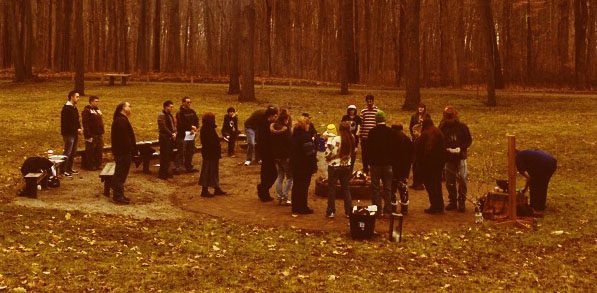
Cedarsong Grove Gathering for Ritual. Photo by Rev. Melissa Hill
Interacting with your Group Egregore
Otherwise known as: Look Mom! We Made a Thing! Now what do we do with it?
Do a ritual to get it rolling. Build energy in the way that your group does that sort of thing and send it towards your chosen symbols and narrative. Don’t worry if you don’t have guardian spirits or gods yet, but do ask friendly spirits from your tradition to be involved.
Work it into your group’s annual celebration cycle and leadership. We always make sure to bring the physical heart of the grove to every high day, but especially at Lammas, which is when we elect our new officers. One of my jobs as priest is to oversee that transition, ritually, magically, and functionally. I make sure the new senior druid knows what they are supposed to do in terms of reports and tech as well as transferring the energetic power of the heart to the next person. The past Senior Druid is the one who hands the new Senior Druid the heart, while I speak about service and remind everyone that without all of our hearts, the heart of the grove will fail.
Lead guided trance work. Interact in a spiritual way with your narrative, patrons, and chosen symbols. Make sure to give plenty of time for each individual to experience these things. Allow people to share their experiences afterwards and particularly note the commonalities between visions. Each person will view spiritual realities in their own unique way. Part of spirit work is honing one’s ability to see past your mental interpretation to spirits beyond. I’m constantly amazed by how powerful actually listening to each other and comparing notes can be in building group narrative.
Ideally, I would suggest using one or two potent symbols to anchor the experience. In my group we have a pathway guarded by Perkunas and guided by Gabija. Other groups connect with different symbols. Three Cranes Grove connects with Garanus the crane, who guides them in trance and magic. Other groups use other symbols. Recently I was consulted when a group’s symbols and dynamic had gotten a bit off, which was what sparked this post.
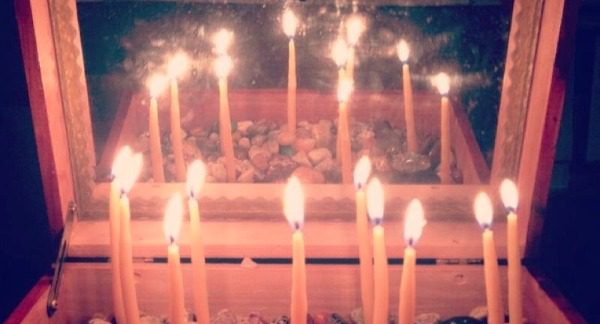
Flame of Hope Image by Melissa Hill
When Egregores Go Awry
Group dynamics and egregores are deeply connected, so when one goes bad, so does the other. This is similar to how the spirits of the land get disturbed and angry when species die or rivers become toxic. That’s why I suggest addressing both the spiritual and the psychological sides of the issue. I’ve certainly experienced bad group dynamics many times, since I was a baby pagan many years ago. Certainly back then I didn’t have the foggiest notion of what an egregore was or how it might function, but for the past half a dozen years or so I’ve been thinking hard about and dealing with such things.
Most recently, I was approached about a group that was having trouble transitioning their leadership. One person had been the leader for a long time and needed to step back, but others were having a hard time stepping up into leadership roles. This group had done the work to choose a symbol that went with the name of their group. It was a tree. It was an actual living tree, that was in their area. Recently it had been cut down and now their group was in something of a crisis.
They were planning on looking for a new tree to dedicate as their special group tree while trying to deal separately with their leadership issues. I saw the whole thing as a combined dynamic of too much focus on the individual in their symbology. By choosing one single tree, they set themselves up for the eventual death of that tree which had been a huge symbolic hit for the group. To quote from The Highlander, they also set up the unconscious suggestion that “There can be only one!” While that makes for fun tv, it’s less useful when you’re trying to survive as a small volunteer driven religious group.
I suggested that the group focus on revamping their group symbol. Instead of focusing on one specific tree, they could choose a species of tree that is significant to the area. I also suggested that the whole group could go plant some trees to honor the tree that had passed. By having everyone participate in planting a group of trees they could shift their symbol to a narrative that was less “tree” and more “grove” which echoes and resonates with the shared leadership they were hoping to cultivate.
Advertising textbooks for both graphic design and copy writing are well worth studying for idea on how to cultivate a cohesive group narrative. The trick is that instead of doing it to sell more stuff you’re using those skills to create the kind of group mind you are consciously choosing to develop.
I have found that it is easier to shift the egregore of a group that is unsettled or young. Eventually habits are built, both in group dynamics and group energetics and the egregore tends to settle. I have found that in particular once it gains sentience, it’s less about directly changing the egregore and more about communicating with it and teaching it things or negotiation. It’s almost as if the egregore itself becomes one of the individuals in the group with it’s own thoughts, goals, and vision. The upside of this is that if your leadership fails or people as individuals are struggling, the group egregore can really hold things together. The downside is that if your group has toxic behaviors or needs to do some serious shadow work all that comes out loud and clear in the personality of the group egregore. It is literally created from those things. Just like humans, spirits are what they eat. When they’re fed a diet of passive aggressive behaviors, gaslighting, or cruelty that is part of what they are even if there are also many good things about a group. Egregores hold up a very clear and honest mirror to the truth of a community. The thing I have seen again and again is that ignoring your egregore or trying to keep it from changing are both very bad ideas.
If you’ve actually made it this far I’m totally impressed, this has turned into a very long post. While there’s a part of me that wants to put out a warning to be careful, to make sure you have the skills you need to interact with such things, I won’t. Even though I’ve seen egregores that can be dangerous, and I’ve seen what happens when they get buried in the the metaphorical back woods, I know that people are going to keep making groups and communities. I hope that this writing is a guidepost or at least a comparison point for those of you doing the hard, brutal, thrilling, crucial work of building pagan community. Good luck.
It takes a lot of work to go from a random phone call to a researched 2000 word blog article with edited photos and grammar-y things. Please consider becoming a Patreon to keep my priestwork and spiritwork posts here and helpful. Thank you.
Previous Post

August 7, 2018
T. Thorn Coyle’s Witches of Portland Series Spoiler Alert: Awesome!
Next Post

August 21, 2018 Postulation and Experimentation with Fairies, Nature Spirits, and Time
Browse Our Archives
Select a Category animism Cermony and Liturgy Columns Community Dandelion Seeds Health and Wellness History Holidays Magic Nature pagan parenting plant animism Politics Ritual and Practice symbolism and science Theology, Ethics, Philosophy Uncategorized
Select a Month August 2021 May 2021 April 2021 March 2021 February 2021 January 2021 December 2020 November 2020 October 2020 September 2020 August 2020 July 2020 June 2020 May 2020 April 2020 March 2020 February 2020 January 2020 December 2019 November 2019 October 2019 September 2019 August 2019 July 2019 June 2019 May 2019 April 2019 March 2019 February 2019 January 2019 December 2018 November 2018 October 2018 September 2018 August 2018 June 2018 May 2018 April 2018 March 2018 February 2018 January 2018 December 2017 November 2017 October 2017 September 2017 August 2017 July 2017 June 2017 May 2017 April 2017 March 2017 February 2017 January 2017 December 2016 November 2016 October 2016 September 2016 August 2016 July 2016 June 2016 May 2016 April 2016 March 2016 February 2016 January 2016 December 2015 November 2015 October 2015 September 2015 August 2015 July 2015 June 2015 May 2015 April 2015 March 2015 February 2015 January 2015 December 2014 November 2014 October 2014 September 2014 August 2014 January 2014 October 2013 September 2013 August 2013 July 2013 June 2013 May 2013 April 2013 February 2013 January 2013 July 2012 April 2012 March 2012 February 2012 January 2012 December 2011 November 2011 October 2011 September 2011 August 2011 July 2011 June 2011 May 2011 April 2011 March 2011 February 2011 January 2011 December 2010 November 2010 October 2010 September 2010 August 2010 July 2010 June 2010 May 2010 April 2010 March 2010 February 2010 January 2010 December 2009 November 2009 October 2009 September 2009 August 2009 July 2009 June 2009 May 2009 April 2009 March 2009 February 2009
Follow Us!
TAKE THE
Religious Wisdom Quiz
Who dreamed of a ladder reaching to heaven?
Select your answer to see how you score.
Paul Daniel Joseph Jacob
Related posts from Dandelionlady

Use Science and Magic to Empower Your Practice

Working with Your Local River as a Center...

What is Animism: Finding the Spirit of All...

The Heart of Fire, an Imbolc Prayer Based...
TRENDING AT PATHEOS Pagan

I was recently chatting with someone on Instagram. She asked me what...

While there are many people who share their results, the end of...

On July 23, I saw Christopher Nolan's The Odyssey which is Homer’s...

As I write this two big events have just finished up. One...

Restoring the Watershed of Divine Love
Perhaps cooperation is not something we manufacture through legislation, ideology, or moral...

Many UUs don’t pray because of bad experiences in a previous religion,...
view all Pagan blogs
Ad-Free & Subscriber Log-In Subscription Support
- About Us
- 2026 Calendar
- Videos
- Podcasts
- Library of World Religions
- Faith In Media Tracker
- Advertise With Us
- Write for Us
- Privacy Policy
- Terms of Service
- Do Not Sell My Data
- Contact Us
- Radiant Digital
- Manage Newsletter Subscriptions
- Unsubscribe From Notifications
- Sitemap
Copyright 2008-2026, Patheos. All rights reserved.
Subscription Support Ad-Free & Subscriber Log-In
Follow Patheos