
BuddhistCatholicContemplativeEvangelicalGeneral ChristianHinduJewishLatter-day SaintMuslimNew VisionsProgressive Christian
Beliefs
- Buddhist
- Catholic
- Contemplative
- Evangelical
- General Christian
- Hindu
- Jewish
- Latter-day Saint
- More Voices
- Muslim
- New Visions
- Pagan
- Progressive Christian
Topics
- Religion News
- Food and Religion
- Sports and Religion
- Religious Art
- Religious Music and Entertainment
- Religious Events
- History and Religion
- Style and Religion
- Politics and Religion
- Women in Religion
- Recreation Outdoors and Religion
- Business Finance and Religion
- Careers Workplace and Religion
- Education and Religion
- Family Parenting and Religion
- Health Fitness and Religion
- Home and Religion
- Relationships and Religion
- Technology and Religion
- Travel and Religion
Columnists
- Buddhist Columnists
- Business Finance and Religion Columnists
- Careers Workplace and Religion Columnists
- Catholic Columnists
- Contemplative Columnists
- Education and Religion Columnists
- Evangelists Columnists
- Family Parenting and Religion Columnists
- General Christian Columnists
- Health Fitness and Religion Columnists
- Hindu Columnists
- History and Religion Columnists
- Home and Religion Columnists
- Jewish Columnists
- More Voices Columnists
- Latter Day Columnists
- Muslim Columnists
- New Visions Columnists
- Nonreligious Columnists
- Pagan Columnists
- Politics and Religion Columnists
- Progressive Columnists
- Recreation Outdoors and Religion Columnists
- Relationships and Religion Columnists
- Religion News Columnists
- Religious Art Columnists
- Religious Events Columnists
- Religious Music and Entertainment Columnists
- Sports and Religion Columnists
- Style and Religion Columnists
- Technology and Religion Columnists
- Travel and Religion Columnists
- Women in Religion Columnists
Resource Library
- 2026 Calendar
- Library of World Religions
- The 100 Most Holy Places on Earth
- Patheos Answers
- Podcasts
- Videos
- Faith Leaders Database
- Anglican Episcopalian
- Bahai
- Baptist
- Buddhism
- Christianity
- Confucianism
- Eastern Orthodoxy
- Hinduism
- Holiness and Pentecostal
- ISKCON
- Islam
- Judaism
- Lutheran
- Methodist
- The Church of Jesus Christ of Latter-day Saints
- New Age
- Paganism
- Presbytarian and Reformed
- Protestantism
- Religion Behind the Scenes
- Roman Catholic
- Scientology
- Shia Islam
- Sikhism
- Sufism
- Sunni Islam
- Taoism
- Zen
- See all religions
Research Tools
 Ad-Free & Subscriber Log-In Subscription Support
Ad-Free & Subscriber Log-In Subscription Support
Follow Patheos 

- Trending:
- Forgiveness
- |
- Marriage
- |
- Consciousness
- |
- Death Penalty
- |
- Election
- |
- Halloween
 Dandelionlady
- Home
- Pagan
- Resilience in times of Crisis
Resilience in times of Crisis
Last updated on: February 28, 2018 at 3:21 pm by Melissa Hill
Resilience in times of Crisis 2018-02-28T15:21:37-04:00 Melissa Hill
Patheos Explore the world's faith through different perspectives on religion and spirituality! Patheos has the views of the prevalent religions and spiritualities of the world.
“Resilience is a process of skillfully navigating through crisis with the ability to psychologically bounce back from times of distress”
Why do we care about resilience? I mean, other than the fact that life is stressful, jobs get lost, things break, love is lost, and generally bad things happen?
We are entering the anthropocene era, and there’s a reason that word reminds you of anthropology or anthropomorphized. Anthro refers to humans and humanity and that’s what it’s saying. We are entering the Age of Humans, where the primary factor shaping the planet is not earthquakes or fish emerging from the sea. The primary force that currently is shaping the earth is us. With rising temperatures, increasing storm intensity, rising sea levels, and drier conditions we are all having to deal with climate realities. This is why I began to try and understand what we as individuals and communities could do in a grassroots effort to both mitigate those effects and live well while they occur.
One of the interlocking parts I have found to help in this process is resiliency.
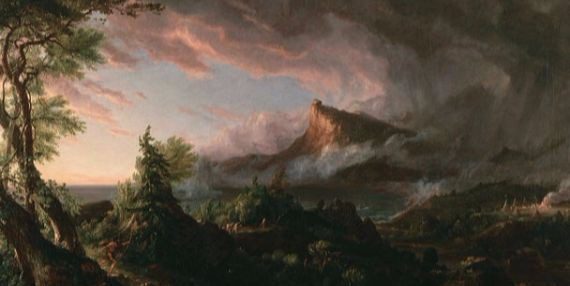
Public Domain: Cole Thomas The Course of Empire The Savage State 1836
What Makes us Resilient?
- accepting the reality of change
- focusing on what can be done
- engaging in meaningful work
- nurturing creativity
- finding others to share the work
In order to make this easy for pagans to remember I decided to organize resilience into four categories that align with the elements: Air (Economic) Fire (Psychological) Water (Magical) and Earth (Environmental)
(Fire) Psychological Resilience
Sorrow prepares you for joy. It violently sweeps everything out of your house, so that new joy can find space to enter. It shakes the yellow leaves from the bough of your heart, so that fresh, green leaves can grow in their place. It pulls up the rotten roots, so that new roots hidden beneath have room to grow. Whatever sorrow shakes from your heart, far better things will take their place
–Rumi
This reminds me of the Norns patching the world tree with mud from the sacred spring and of Esus pruning the branches of the tree.
Turns out that people have researched psychological resilience pretty thoroughly. Crisis response to large scale crises as well as smaller individual and family resilience have been studied. Here’s the list I’ve gleaned from the research:
- Trust: both in yourself and in your community.
- Kind curiosity: this is different than cruel or nosy curiosity. It is filled with wonder.
- Somatic awareness: getting in touch with your senses and your body.
- Creative expression: this can be expressed in many ways, unique to the individual
- Body health: it’s too easy to forget that our body is our mind and our emotions are rooted there.
- Community: having people to be with you in times of crisis is a huge boon to resilience.
(Earth) Environmental Resilience
This is the category that I have the most personal knowledge within. Having studied horticulture and organic production and worked on a number of local farms, I’m pretty well versed in sustainability and food systems. Here’s what I’ve gleaned from my experiences over the years:
- Learning skills: to repair things, to make things, to communicate better. Learn skills that can be applied in the real world. Expect this to take time and expect not to be able to have every skill. This can assist in barter economies.
- Living locally: this means many things, including taking local vacations, supporting local stores, enjoying your local friends, cities, foods, and more.
- Supporting local food systems: I keep this one separate because I want to make it clear that when picking between organic food or local food, pick local food every time.
- Don’t expect magic space crystals to save us: Star Trek taught us that we can dream of living on other planets, but physics and reality tell us that is a difficult and maybe impossible task. Expecting a miracle energy source to save us from our problems is not only unwise, it’s an unethical choice to toss the problems we live with down the road to future generations. I have heard people all too often talk about just leaving this planet as a trash heap and moving on. Don’t be that person.
- Community: it’s impossible to actually grow everything you need on your 5 acres or 20 acres of paradise in the backwoods of wherever. You need people with other skillsets to survive. Go find people with the skills you don’t have and trade with them. It’s called a village. There’s a reason they were popular.
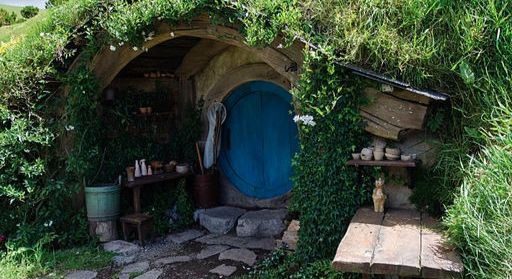
By Jeff Hitchcock (Flickr: Butterfly Catcher) [CC BY 2.0 (http://creativecommons.org/licenses/by/2.0)], via Wikimedia Commons
(Water) Magical Resilience
This is the one I feel my audience probably has the most experience with, but because of the religious aspects of my Druidic practice I have found some things that aren’t always thought of by magic workers.
- Building devotional practices that stick with you: because if your body remembers what to do you can do the thing even when stressed. This is about building mental and physical anchors so that you can do the thing in the real world.
- Memorization of set pieces: in crisis it’s hard to think of good words. If you have words you like memorized you’ll be able to use them.
- Building spirit allies: just like community is important in the people world, community is important in the spirit world.
- Community: are you noticing a theme yet? Community of magical folks can increase the power and meaning of your workings.
(Air) Economic Resilience
Trust me when I say this is not the most boring part of resilience. No really. We are all too often caught in the idea that economic means big business corporate america where the only agency an individual usually has is how to be the best consumer they can be (which ain’t much wiggle room at all) Economics are the social science of resource exchange and there are many ways humans have discovered to exchange.
“Only a crisis produces real change. When that crisis occurs the actions that are taken depend on the ideas that are lying around. That I believe is our basic function: to develop alternatives to existing policies, to keep them alive and available until the politically impossible becomes politically inevitable.“
–Milton Friedman
- Multiple income streams: if/when one income dries up or become unviable you have other options and skills to depend on. You’re not tied so tightly to a corporate structure that may compromise your values, or lay you off at will.
- Thriftiness: using less means having more. This is the opposite of being a good consumer, and I believe that it can be a radical action.
- Don’t count on corporations: they are not there for you. They are there to make money. No matter how much you like one brand or another, always remember you are either the product or the consumer of a product.
- Local local local! Did I say it enough? Celebrate diversity unique to your area. Eat at local restaurants. Every dollar you spend locally helps you and your community.
- Count on your community. Did I say it again? Yup. Community is a part of every list, and an underpinning of resilience in humans. But what that means is that all you pagans out there with your covens and your groves, your circles and councils, you’re doing deeply important work that stretches beyond the spiritual. Thank you to everyone who does that powerful work.
Another interesting idea that comes out of economic thought:
Ever heard of the word antifragile? Antifragility takes resilience to an even further spot, one that we don’t often go to because we don’t have the words for it. That’s what we want to avoid: fragility. We want and need to be able to be strong and to succeed in our lives and communities. Antifragility was coined by an economist named Nicholas Nassim Taleb who originally worked in the stock market and eventually studied chaos systems as they applied to economics and society.
Antifragile is the opposite of fragile. Not robust, not sturdy, not strong. Those are in the middle of a continuum of how people respond to stress and crisis. Fragile means breaking, falling apart and not being able to continue in the face of stress or crisis. It is something we fear. Strong is not breaking like steel or rebar. But on the furthest point on the continuum is antifragile. This is when stress and crisis make us better. It’s seen in nature and this concept has even been used by NASA. This is the ability to adapt to unknown circumstances and do better for the experience. In a world of climate change where we literally have no idea what the future will hold, it’s a really good mental stance to take.
Sometimes just having a word for a concept is enough to help us get to a place, and all the skills listed above are antifragile. So take a page from NASA and dive in!
Conclusions:
Action is shown to build psychological ease. Which means that when you’re doing something about something that stresses you out you feel better. The thing is that it’s very difficult to know what is the correct action in this day and age and sometimes it’s difficult to do anything at all. This is why I like the resiliency model, combined with the sustainability model as a rubric.
Ask yourself:
Is this an action or behavior that I believe my children and their children will be able to do too? Is this an action of behavior that will make me stronger emotionally, or more able to deal with difficult situations?
Will it improve my families long term economic situation? Will it align me in balance with the spirits?
When disaster is met with certain conditions it can actually lead to better outcomes for people, but this is only the case when there is a community response wherein the individual can find themselves as part of a response team taking direct action. These situation can lead to gift economies, non traditional connections and sharing of resources.
Exercises:
Bilateral butterfly tapping technique:
Crossed hands over chest with fingers resting below the collarbones and alternately tap each shoulder.
Guided Trance for Self Compassion and Resiliency:
Close your eyes and feel your body, the edges and the aches and pains. Tighten each muscle group and release it, starting with your feet and working up. Breathe with your belly, deep, calm breaths.
Now think about the things you struggle with, the challenges in your life. Imagine them and note how your body responds to those struggles, what muscles tighten up what feelings emerge, just note them, like an observer watching a bird in the woods.
Whatever your struggle is, mentally say to yourself, “This struggle is valid. My struggle is important and worthwhile.” After a moment, say that statement out loud, and see how your feelings and body change in response.
Know that resiliency can be found in daily life just as easily as in a crisis and that your daily struggles are a worthy challenge. Come back to your breath.
Think about struggles you’ve overcome in the past. What are the three toughest things you’ve done? Remember how you overcame those things and how you felt afterward. These memories can show you your strengths and how you can overcome the challenges that you struggle against now. Let yourself become rooted in those strengths, these are your gifts to the world, as unique as a fingerprint and precious to your community, your family, the earth and yourself. Breathe in the knowledge of your strengths and breathe out.
Now think about your community and the people you’ve counted on to help you in the past, and the people you’ve helped in the past. Imagine each person as a point of light in a network of helping, both giving and receiving. Imagine branching patterns of light moving to and from those lights and branching out to help new lights and to receive help from new lights. Allow yourself to just experience being part of this pulsing glowing network of assistance for a time.
Breathe in, and out and feel the pulse of reciprocity and community. This is the heartbeat of resilience.
Breathe out and feel at peace.
Breathe in, and feel the strength of your skills and everything you have accomplished and struggled against.
Breathe out and feel at peace.
Breathe in, and feel the guidance of the earth beneath you and the spirits around you showing you how to be in right alignment.
Breathe out and feel at peace.
Be it so, be it so, be it so.
References:
Antifragile: Things That Gain from Disorder by Nassim Nicholas Taleb
Emotional Resiliency in the Era of Climate Change: A Clinician’s Guide by Leslie Davenport
“8 Tips to Help you Become More Resilient”
Please Consider Being a Hobbit
If you went to my workshop or appreciate my writings, please consider supporting my work by making a purchase from my etsy shop or signing up to support my priestwork at patreon.
Previous Post

February 18, 2018
Festival Workshop for Teaching Adults Consent
Next Post

March 16, 2018 Idunn and the Golden Apples: a Retelling
Browse Our Archives
Select a Category animism Cermony and Liturgy Columns Community Dandelion Seeds Health and Wellness History Holidays Magic Nature pagan parenting plant animism Politics Ritual and Practice symbolism and science Theology, Ethics, Philosophy Uncategorized
Select a Month August 2021 May 2021 April 2021 March 2021 February 2021 January 2021 December 2020 November 2020 October 2020 September 2020 August 2020 July 2020 June 2020 May 2020 April 2020 March 2020 February 2020 January 2020 December 2019 November 2019 October 2019 September 2019 August 2019 July 2019 June 2019 May 2019 April 2019 March 2019 February 2019 January 2019 December 2018 November 2018 October 2018 September 2018 August 2018 June 2018 May 2018 April 2018 March 2018 February 2018 January 2018 December 2017 November 2017 October 2017 September 2017 August 2017 July 2017 June 2017 May 2017 April 2017 March 2017 February 2017 January 2017 December 2016 November 2016 October 2016 September 2016 August 2016 July 2016 June 2016 May 2016 April 2016 March 2016 February 2016 January 2016 December 2015 November 2015 October 2015 September 2015 August 2015 July 2015 June 2015 May 2015 April 2015 March 2015 February 2015 January 2015 December 2014 November 2014 October 2014 September 2014 August 2014 January 2014 October 2013 September 2013 August 2013 July 2013 June 2013 May 2013 April 2013 February 2013 January 2013 July 2012 April 2012 March 2012 February 2012 January 2012 December 2011 November 2011 October 2011 September 2011 August 2011 July 2011 June 2011 May 2011 April 2011 March 2011 February 2011 January 2011 December 2010 November 2010 October 2010 September 2010 August 2010 July 2010 June 2010 May 2010 April 2010 March 2010 February 2010 January 2010 December 2009 November 2009 October 2009 September 2009 August 2009 July 2009 June 2009 May 2009 April 2009 March 2009 February 2009
Follow Us!
TAKE THE
Religious Wisdom Quiz
Who ruled as king when Jesus was born?
Select your answer to see how you score.
Herod the Great Caesar Augustus Pilate Tiberius
Related posts from Dandelionlady
Healing Prayer for use with Online Rituals for...
How to Plant Your Spring Vegetable Garden
Pagan Baby Blessing Invocation and Ritual for Families...
Radical Herbalism as a Witches Activist Action
TRENDING AT PATHEOS Pagan

I was recently chatting with someone on Instagram. She asked me what...

While there are many people who share their results, the end of...

On July 23, I saw Christopher Nolan's The Odyssey which is Homer’s...

As I write this two big events have just finished up. One...

Restoring the Watershed of Divine Love
Perhaps cooperation is not something we manufacture through legislation, ideology, or moral...

Many UUs don’t pray because of bad experiences in a previous religion,...
view all Pagan blogs
Ad-Free & Subscriber Log-In Subscription Support
- About Us
- 2026 Calendar
- Videos
- Podcasts
- Library of World Religions
- Faith In Media Tracker
- Advertise With Us
- Write for Us
- Privacy Policy
- Terms of Service
- Do Not Sell My Data
- Contact Us
- Radiant Digital
- Manage Newsletter Subscriptions
- Unsubscribe From Notifications
- Sitemap
Copyright 2008-2026, Patheos. All rights reserved.
Subscription Support Ad-Free & Subscriber Log-In
Follow Patheos