
BuddhistCatholicContemplativeEvangelicalGeneral ChristianHinduJewishLatter-day SaintMuslimNew VisionsProgressive Christian
Beliefs
- Buddhist
- Catholic
- Contemplative
- Evangelical
- General Christian
- Hindu
- Jewish
- Latter-day Saint
- More Voices
- Muslim
- New Visions
- Pagan
- Progressive Christian
Topics
- Religion News
- Food and Religion
- Sports and Religion
- Religious Art
- Religious Music and Entertainment
- Religious Events
- History and Religion
- Style and Religion
- Politics and Religion
- Women in Religion
- Recreation Outdoors and Religion
- Business Finance and Religion
- Careers Workplace and Religion
- Education and Religion
- Family Parenting and Religion
- Health Fitness and Religion
- Home and Religion
- Relationships and Religion
- Technology and Religion
- Travel and Religion
Columnists
- Buddhist Columnists
- Business Finance and Religion Columnists
- Careers Workplace and Religion Columnists
- Catholic Columnists
- Contemplative Columnists
- Education and Religion Columnists
- Evangelists Columnists
- Family Parenting and Religion Columnists
- General Christian Columnists
- Health Fitness and Religion Columnists
- Hindu Columnists
- History and Religion Columnists
- Home and Religion Columnists
- Jewish Columnists
- More Voices Columnists
- Latter Day Columnists
- Muslim Columnists
- New Visions Columnists
- Nonreligious Columnists
- Pagan Columnists
- Politics and Religion Columnists
- Progressive Columnists
- Recreation Outdoors and Religion Columnists
- Relationships and Religion Columnists
- Religion News Columnists
- Religious Art Columnists
- Religious Events Columnists
- Religious Music and Entertainment Columnists
- Sports and Religion Columnists
- Style and Religion Columnists
- Technology and Religion Columnists
- Travel and Religion Columnists
- Women in Religion Columnists
Resource Library
- 2026 Calendar
- Library of World Religions
- The 100 Most Holy Places on Earth
- Patheos Answers
- Podcasts
- Videos
- Faith Leaders Database
- Anglican Episcopalian
- Bahai
- Baptist
- Buddhism
- Christianity
- Confucianism
- Eastern Orthodoxy
- Hinduism
- Holiness and Pentecostal
- ISKCON
- Islam
- Judaism
- Lutheran
- Methodist
- The Church of Jesus Christ of Latter-day Saints
- New Age
- Paganism
- Presbytarian and Reformed
- Protestantism
- Religion Behind the Scenes
- Roman Catholic
- Scientology
- Shia Islam
- Sikhism
- Sufism
- Sunni Islam
- Taoism
- Zen
- See all religions
Research Tools
 Ad-Free & Subscriber Log-In Subscription Support
Ad-Free & Subscriber Log-In Subscription Support
Follow Patheos 

- Trending:
- Forgiveness
- |
- Marriage
- |
- Consciousness
- |
- Death Penalty
- |
- Election
- |
- Halloween
 Dandelionlady
- Home
- Pagan
- I am a Priest and I am Called to Truth and Silence.
I am a Priest and I am Called to Truth and Silence.
Last updated on: May 17, 2017 at 12:23 pm by Melissa Hill
I am a Priest and I am Called to Truth and Silence. 2017-05-17T12:23:16-04:00 Melissa Hill
Patheos Explore the world's faith through different perspectives on religion and spirituality! Patheos has the views of the prevalent religions and spiritualities of the world.
As our interlocking Pagan religions continue to emerge we are met with the ongoing challenges of supporting the folk of our religions. My work as a priest, one might even call it my ministry, comes not only from the training and mission of ADF, but more importantly, from the folk who call me their priest. After all, I swore my oath:
To love the land, serve the folk, and honor the gods.
There are many who say that to be a pagan priest is to keep the rites and rituals. They say that above all else a pagan priest should be a ritual specialist. I am a ritual specialist, and good at it. But the congregation that I serve, and druids I speak with all over the country need more than just a ritual specialist. I am called to serve in many ways.
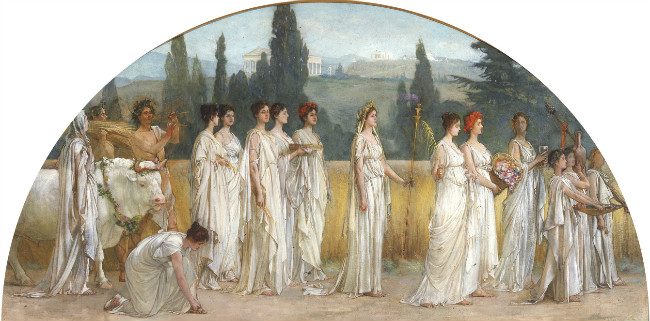
Thesmophoria by Francis Davis Millet Public Domain
One of the most important and radical ways I have been called to serve the folk is to listen.
It was a strange and unnerving experience at first. I had always been a listener, but now with my priesthood things had changed. I now had legal status as a listener. I had to consider confidentiality, and mandated reporting of child abuse. I learned to ask friends if they needed me to put on my “Priesthood Hat” while we were talking so that I would know if they were just chatting friend to friend or instead invoking the sacred relationship of priest and congregant.
I had no context for what was expected of me. I had never gone to church regularly as a child and my entire adult religious experience had been within a pagan framework, so my people, my congregation, had ideas and context for what I was supposed to be that I was missing entirely. I felt carefully ahead like a blind person, keeping much of my revelation to myself in the hopes that I would be able to glean what was expected of me subtly.
It has made me quieter, and more taciturn in many ways. I am not alone in this. I have spoken with other ADF priests and found they experienced much of the same thing. When one is burdened with secrets one becomes the keeper of them much as the ancients kept and tended the sacred flame or idol.
We cannot escape the fact that we are re-developing pagan religion in communities of conversion. The idea of what a priest is has developed within a Christian matrix for many of these people, and the ideas of ministry, spiritual counseling, confession, absolution, sermonizing, and charity work are all integral to what people expect from a priest. We no longer live in the ancient times even though we can glean how the ancients saw their religious leaders from their language about them.
- In the Lithuanian there is the word Vaidilutė which was a fire priestess who tended the sacred flame.
- In the Anglo-Saxon there was the Godi which had associations with leadership as well as being a religious priestly designation, and the word Wéofodþygen which translates as “the keeper of the sacred idol” and was much more about tending a specific sacred place or deity image.
- The Celts had their famous Druids, from which we take our name and much of our identity in ADF. The Druids were both religious specialists and lawgivers, judges as well as repositories of the lore of their people. Since writing sacred knowledge down was a bad thing, everything was passed on orally and memory was trained, much like the Grecian orator.
- In the Greek we have Hiereus or the feminine Hiereia which translates as the masculine and feminine forms of “holy”, rather than Presbuteros or “elder” from which our modern word “Priest” developed. Priests were holy, not necessarily elders in the community. Neokoroi were temple attendants, Hieropoioi were doers of holy things, Naophylakes guarded the temples, and Tamiai looked after the temple’s money.
I don’t have a temple to look after, nor do I function as a lawyer, or even tend a sacred flame, though I know those who do. I create sacred ritual, I teach, encourage, build knowledge, think about theology, build community and very much listen. It’s the listening that is so challenging and in some ways so radical.
It’s clear that our folk require it. One day after a conversation on Facebook about pastoral care I was gifted the money to purchase the standard professional text: Professional Spiritual and Pastoral Care. People were outraged that as priests we might not be trained in pastoral care. I simply expressed that I was unable to afford to purchase a $50.00 textbook on such things and low and behold! I no longer had that problem. Now I had the challenge of learning how to integrate and understand that knowledge.
Listening is a profession all on its own. Psychologists, Therapists, Social Workers, and Psychiatrists are highly trained professionals of the mind. So even though the folk call to me to listen to them, I have to be incredibly careful not to cross the line into therapy. I am not trained for that.
Moving forward into this modern era:
It’s come back to my model of being a Volunteer Priest for me. I see my listening as a form of emotional and spiritual first aid. I am a first responder much like an EMT. It cannot be my job to be a therapist, but it can be my job to listen and suggest that someone might need further professional help.
And that’s where the truth comes in. One of the tools in my kit is divination. It’s something that modern psychology doesn’t include and so I feel that it’s something useful that I can legally and professionally share. I take this quite seriously. When I am in a trance state I must speak as I See. I pray beforehand that my tools be guided by the Gods and Spirits and that my words be true and useful.
First I am silent and listening. I will reflect back what an individual is saying, and ask for clarification, but my focus is on them and their understanding and needs. That which is me is silent and open, but as we say: a gift for a gift. *Ghosti indicates that there must be a return flow and interaction in both directions. Sometimes I suggest further professional resources, or help design magic or devotional practices to help. Sometimes I do divination. Always though I am called to be truthful.
Priesthood can be a heavy burden. I listen and then I know the secrets, the fault lines, the hurts that people carry. I can’t always get permission to share what might be needed to share to convince people that change needs to occur. I can only watch as people walk down the corridors of fate that I warned them about. I have made more than one person cry with what I have read in the cards. Times are hard. The Gods can only gift us with the world we have. Sometimes the only gift I can give is to witness.
I am a priest and I am called to Truth and Silence.
If you find value in my work as a priest please consider visiting my Patreon page and setting up a monthly donation. Thank you.
References:
Of Gods and Holidays; The Baltic Heritage by Jonas Trinkunas
Portrait of a Priestess: Women and Ritual in Ancient Greece by Joan Breton Connelly
Professional Spiritual and Pastoral Care by Rabbi Stephen B. Roberts
TRAVELS THROUGH MIDDLE EARTH: THE PATH OF A SAXON PAGAN by Alaric Albertsson
Previous Post
May 4, 2017
National Day of Prayer
Next Post

June 16, 2017 Harvesting the Verba for Midsummer
Browse Our Archives
Select a Category animism Cermony and Liturgy Columns Community Dandelion Seeds Health and Wellness History Holidays Magic Nature pagan parenting plant animism Politics Ritual and Practice symbolism and science Theology, Ethics, Philosophy Uncategorized
Select a Month August 2021 May 2021 April 2021 March 2021 February 2021 January 2021 December 2020 November 2020 October 2020 September 2020 August 2020 July 2020 June 2020 May 2020 April 2020 March 2020 February 2020 January 2020 December 2019 November 2019 October 2019 September 2019 August 2019 July 2019 June 2019 May 2019 April 2019 March 2019 February 2019 January 2019 December 2018 November 2018 October 2018 September 2018 August 2018 June 2018 May 2018 April 2018 March 2018 February 2018 January 2018 December 2017 November 2017 October 2017 September 2017 August 2017 July 2017 June 2017 May 2017 April 2017 March 2017 February 2017 January 2017 December 2016 November 2016 October 2016 September 2016 August 2016 July 2016 June 2016 May 2016 April 2016 March 2016 February 2016 January 2016 December 2015 November 2015 October 2015 September 2015 August 2015 July 2015 June 2015 May 2015 April 2015 March 2015 February 2015 January 2015 December 2014 November 2014 October 2014 September 2014 August 2014 January 2014 October 2013 September 2013 August 2013 July 2013 June 2013 May 2013 April 2013 February 2013 January 2013 July 2012 April 2012 March 2012 February 2012 January 2012 December 2011 November 2011 October 2011 September 2011 August 2011 July 2011 June 2011 May 2011 April 2011 March 2011 February 2011 January 2011 December 2010 November 2010 October 2010 September 2010 August 2010 July 2010 June 2010 May 2010 April 2010 March 2010 February 2010 January 2010 December 2009 November 2009 October 2009 September 2009 August 2009 July 2009 June 2009 May 2009 April 2009 March 2009 February 2009
Follow Us!
TAKE THE
Religious Wisdom Quiz
We were commanded to send away our foreign wives and children to remain faithful to God. Who are we?
Select your answer to see how you score.
The standing army The Priests The Levites The returning exiles
Related posts from Dandelionlady

Working with Your Local River as a Center...

Origins of the Heart Shape: Found in Ecology,...

The Four Elements In a New Form, Inspired...
Relating to Animism and Gods: A Way To...
TRENDING AT PATHEOS Pagan

I was recently chatting with someone on Instagram. She asked me what...

While there are many people who share their results, the end of...

On July 23, I saw Christopher Nolan's The Odyssey which is Homer’s...

As I write this two big events have just finished up. One...

Restoring the Watershed of Divine Love
Perhaps cooperation is not something we manufacture through legislation, ideology, or moral...

Many UUs don’t pray because of bad experiences in a previous religion,...
view all Pagan blogs
Ad-Free & Subscriber Log-In Subscription Support
- About Us
- 2026 Calendar
- Videos
- Podcasts
- Library of World Religions
- Faith In Media Tracker
- Advertise With Us
- Write for Us
- Privacy Policy
- Terms of Service
- Do Not Sell My Data
- Contact Us
- Radiant Digital
- Manage Newsletter Subscriptions
- Unsubscribe From Notifications
- Sitemap
Copyright 2008-2026, Patheos. All rights reserved.
Subscription Support Ad-Free & Subscriber Log-In
Follow Patheos