
BuddhistCatholicContemplativeEvangelicalGeneral ChristianHinduJewishLatter-day SaintMuslimNew VisionsProgressive Christian
Beliefs
- Buddhist
- Catholic
- Contemplative
- Evangelical
- General Christian
- Hindu
- Jewish
- Latter-day Saint
- More Voices
- Muslim
- New Visions
- Pagan
- Progressive Christian
Topics
- Religion News
- Food and Religion
- Sports and Religion
- Religious Art
- Religious Music and Entertainment
- Religious Events
- History and Religion
- Style and Religion
- Politics and Religion
- Women in Religion
- Recreation Outdoors and Religion
- Business Finance and Religion
- Careers Workplace and Religion
- Education and Religion
- Family Parenting and Religion
- Health Fitness and Religion
- Home and Religion
- Relationships and Religion
- Technology and Religion
- Travel and Religion
Columnists
- Buddhist Columnists
- Business Finance and Religion Columnists
- Careers Workplace and Religion Columnists
- Catholic Columnists
- Contemplative Columnists
- Education and Religion Columnists
- Evangelists Columnists
- Family Parenting and Religion Columnists
- General Christian Columnists
- Health Fitness and Religion Columnists
- Hindu Columnists
- History and Religion Columnists
- Home and Religion Columnists
- Jewish Columnists
- More Voices Columnists
- Latter Day Columnists
- Muslim Columnists
- New Visions Columnists
- Nonreligious Columnists
- Pagan Columnists
- Politics and Religion Columnists
- Progressive Columnists
- Recreation Outdoors and Religion Columnists
- Relationships and Religion Columnists
- Religion News Columnists
- Religious Art Columnists
- Religious Events Columnists
- Religious Music and Entertainment Columnists
- Sports and Religion Columnists
- Style and Religion Columnists
- Technology and Religion Columnists
- Travel and Religion Columnists
- Women in Religion Columnists
Resource Library
- 2026 Calendar
- Library of World Religions
- The 100 Most Holy Places on Earth
- Patheos Answers
- Podcasts
- Videos
- Faith Leaders Database
- Anglican Episcopalian
- Bahai
- Baptist
- Buddhism
- Christianity
- Confucianism
- Eastern Orthodoxy
- Hinduism
- Holiness and Pentecostal
- ISKCON
- Islam
- Judaism
- Lutheran
- Methodist
- The Church of Jesus Christ of Latter-day Saints
- New Age
- Paganism
- Presbytarian and Reformed
- Protestantism
- Religion Behind the Scenes
- Roman Catholic
- Scientology
- Shia Islam
- Sikhism
- Sufism
- Sunni Islam
- Taoism
- Zen
- See all religions
Research Tools
 Ad-Free & Subscriber Log-In Subscription Support
Ad-Free & Subscriber Log-In Subscription Support
Follow Patheos 

- Trending:
- Forgiveness
- |
- Marriage
- |
- Consciousness
- |
- Death Penalty
- |
- Election
- |
- Halloween
 Cultivare
- Home
- Evangelical
- A Dispatch from the World Council of Churches
A Dispatch from the World Council of Churches
Last updated on: November 6, 2013 at 11:05 pm by Kyle Roberts
A Dispatch from the World Council of Churches 2013-11-06T23:05:49-04:00 Kyle Roberts
Patheos Explore the world's faith through different perspectives on religion and spirituality! Patheos has the views of the prevalent religions and spiritualities of the world.
My friend and colleague, Christian Collins Winn (Professor of Historical and Systematic Theology at Bethel University) shares the following “dispatch” from the World Council of Churches assembly.
We are now in the middle of the 10th Assembly of the World Council of Churches, being held in Busan, South Korea, with the initial rush of feeling overwhelmed by the sheer diversity of linguistic, cultural and faith expression finally fading. This is my second Assembly—I attended the 8th Assembly in Harare—and I can say that, this time, I am no longer overwhelmed to the point of being unable to think. I can see clearly that Christian pluriformity is the norm of the world Christian movement.
There are many stories developing at the WCC Assembly. There is the response of the Churches to the convergence document, The Church: Towards a Common Vision issued in 2012 by the commission on Faith and Order. This document has been under 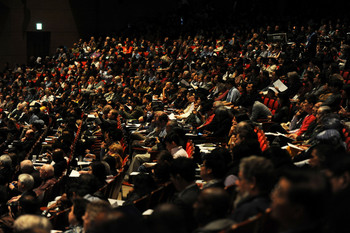 preparation since 1993 and is the second such document to come from Faith and Order since the publication of the seminal Baptism, Eucharist and Ministry document published in 1982. There have been reflections on mission in light of the 2012 WCC statement Together Towards Life: Mission and Evangelism in Changing Landscapes, the second document developed by the WCC on mission, and one marked by dialogue with world Pentecostalism, the Roman Catholic Church, and the World Evangelical Alliance. There has also been some controversy over a speech given by Metropolitan Hilarion of Volokolamsk, of the Moscow Patriarchate. In an address delivered on Friday, November 1, 2013, Hilarion noted that the ecumenical movement faced a serious crisis if it could not forge a common witness around issues like the sanctity of life, and the traditional understanding of marriage: “Are we able to bear this witness if we are so deeply divided in questions of moral teaching, which are as important for salvation as dogma?” The speech drew both praise and protest from the delegates, a fact that shows how diverse and divided, the world Christian family is in regard to these issues.
Perhaps one of the most interesting stories to develop at the assembly has been the participation of the Korean churches in the event. It is fair to say that this event marks a kind of end of the emergence of the significance of Korean Christianity for the world Christian movement. Without the hospitality, organizational work, and financial contribution, the assembly would not have taken place. A significant dimension of this engagement, however, has been the inclusion of more conservative Korean Christian churches. No doubt, there are certainly groups who have chosen not to attend, and there have been a handful of protestors demonstrating from time to time outside—accusing the WCC of perpetuating a single liberal theology, a claim that cannot be substantiated in light of the documents described above, nor in light of the vigorous debates that have occurred over theological and ethical issues in the business plenary sessions where delegates receive committee reports, etc.—but these groups must be considered an anomaly even among conservative Korean churches. This is because of the participation of churches like The Yoido Full Gospel Church, with its one million members, and the Myungsung Presbyterian Church, the largest Presbyterian Church in the world. These churches, both their leadership and members, have been very involved in the Assembly and in the politics of the ecumenical movement more recently. In fact, the senior pastor of Yoido, Pastor Young-hoon Lee, has been intimately involved in the ecumenical movement in South Korea, even serving as the chairman of the National Council of Churches of Korea.
This is a startling change, given the longstanding suspicion towards the ecumenical movement among more conservative Christian groups, including Pentecostals and evangelicals. It should, however, be interpreted as a change as much among Pentecostal and 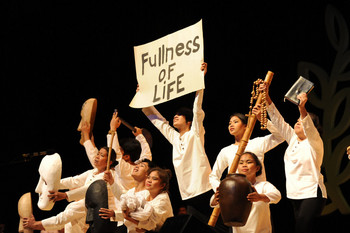 evangelical groups as within the WCC itself. It is to be presumed that most North America evangelicals will simply not know what to think about this, since many of the key institutions of American evangelicalism were founded originally over-against the WCC, including Christianity Today, the NAE, and the WEA. In fact, in preparation for my attending this event, most people had no idea it was even happening (a fact that probably says as much about general antipathy towards the WCC as about widespread lack of knowledge of international affairs among many in the US). That changes are occurring on both sides should be seen as the proper fruit of ecumenical work, wherein different groups engage one another to find out what they really have in common and what really divides them. The new developments in world Christianity and the ecumenical movement—which are really not all that new anymore—should hopefully spell the end of the tired liberal/conservative binary whose explanatory power was always suspect, because now there are groups engaging one another in new ways and finding that they have more in common than not, but also recognizing that the visible unity we seek still awaits us in the future.
Previous Post

November 6, 2013
Pride Goeth Before Destruction
Next Post
November 11, 2013 Learning in Institutional Wartime
Browse Our Archives
Select a Category Alex Blondeau Authors Daniel Harrell Daniel Siedell Dawn Duncan Harrell Kyle Roberts Uncategorized Wyndy Corbin
Select a Month November 2014 October 2014 September 2014 August 2014 July 2014 June 2014 May 2014 April 2014 March 2014 February 2014 January 2014 December 2013 November 2013 October 2013 September 2013 August 2013 July 2013 June 2013 May 2013 April 2013 March 2013 February 2013 January 2013 December 2012 November 2012 October 2012 September 2012 August 2012 July 2012 June 2012 May 2012
TAKE THE
Religious Wisdom Quiz
What Persian king chose Esther as queen?
Select your answer to see how you score.
Xerxes (Ahasuerus) Cyrus Darius Artaxerxes
Related posts from Cultivare


Young Evangelicals and the "Nones": Jumping Ship


Calling For Public Theology (A Brief Convocation Address)
TRENDING AT PATHEOS Evangelical

The REST of Your Life: A Creative Wrestles...
This week I had a conversation with a good friend from church....

How the author of the world's best hymn...
I've been working with John Newton for a while now. This makes...

Long before this Lectio Divina, Psalm 130 - the song - started...

What About the Trees? Another Living Parable
After I finished writing the last article about falling leaves as a...

Why Classical Education Is a Conversation, Not a...
Come and Read: Joy in Classical Education When I was a little...

Cornell University has received a great deal of negative publicity and intense...
view all Evangelical blogs
Ad-Free & Subscriber Log-In Subscription Support
- About Us
- 2026 Calendar
- Videos
- Podcasts
- Library of World Religions
- Faith In Media Tracker
- Advertise With Us
- Write for Us
- Privacy Policy
- Terms of Service
- Do Not Sell My Data
- Contact Us
- Radiant Digital
- Manage Newsletter Subscriptions
- Unsubscribe From Notifications
- Sitemap
Copyright 2008-2026, Patheos. All rights reserved.
Subscription Support Ad-Free & Subscriber Log-In
Follow Patheos