
BuddhistCatholicContemplativeEvangelicalGeneral ChristianHinduJewishLatter-day SaintMuslimNew VisionsProgressive Christian
Beliefs
- Buddhist
- Catholic
- Contemplative
- Evangelical
- General Christian
- Hindu
- Jewish
- Latter-day Saint
- More Voices
- Muslim
- New Visions
- Pagan
- Progressive Christian
Topics
- Religion News
- Food and Religion
- Sports and Religion
- Religious Art
- Religious Music and Entertainment
- Religious Events
- History and Religion
- Style and Religion
- Politics and Religion
- Women in Religion
- Recreation Outdoors and Religion
- Business Finance and Religion
- Careers Workplace and Religion
- Education and Religion
- Family Parenting and Religion
- Health Fitness and Religion
- Home and Religion
- Relationships and Religion
- Technology and Religion
- Travel and Religion
Columnists
- Buddhist Columnists
- Business Finance and Religion Columnists
- Careers Workplace and Religion Columnists
- Catholic Columnists
- Contemplative Columnists
- Education and Religion Columnists
- Evangelists Columnists
- Family Parenting and Religion Columnists
- General Christian Columnists
- Health Fitness and Religion Columnists
- Hindu Columnists
- History and Religion Columnists
- Home and Religion Columnists
- Jewish Columnists
- More Voices Columnists
- Latter Day Columnists
- Muslim Columnists
- New Visions Columnists
- Nonreligious Columnists
- Pagan Columnists
- Politics and Religion Columnists
- Progressive Columnists
- Recreation Outdoors and Religion Columnists
- Relationships and Religion Columnists
- Religion News Columnists
- Religious Art Columnists
- Religious Events Columnists
- Religious Music and Entertainment Columnists
- Sports and Religion Columnists
- Style and Religion Columnists
- Technology and Religion Columnists
- Travel and Religion Columnists
- Women in Religion Columnists
Resource Library
- 2026 Calendar
- Library of World Religions
- The 100 Most Holy Places on Earth
- Patheos Answers
- Podcasts
- Videos
- Faith Leaders Database
- Anglican Episcopalian
- Bahai
- Baptist
- Buddhism
- Christianity
- Confucianism
- Eastern Orthodoxy
- Hinduism
- Holiness and Pentecostal
- ISKCON
- Islam
- Judaism
- Lutheran
- Methodist
- The Church of Jesus Christ of Latter-day Saints
- New Age
- Paganism
- Presbytarian and Reformed
- Protestantism
- Religion Behind the Scenes
- Roman Catholic
- Scientology
- Shia Islam
- Sikhism
- Sufism
- Sunni Islam
- Taoism
- Zen
- See all religions
Research Tools
 Ad-Free & Subscriber Log-In Subscription Support
Ad-Free & Subscriber Log-In Subscription Support
Follow Patheos 

- Trending:
- Forgiveness
- |
- Marriage
- |
- Consciousness
- |
- Death Penalty
- |
- Election
- |
- Halloween
 Cultivare
- Home
- Evangelical
- Reflecting on “The Heavenly Good of Earthly Work”
Reflecting on “The Heavenly Good of Earthly Work”
Last updated on: April 12, 2013 at 12:10 pm by Kyle Roberts
Reflecting on “The Heavenly Good of Earthly Work” 2013-04-12T12:10:12-04:00 Kyle Roberts
Patheos Explore the world's faith through different perspectives on religion and spirituality! Patheos has the views of the prevalent religions and spiritualities of the world.
Does the ordinary work have eternal significance? Do the products and achievements of industry, art, music, education, medicine and (pretty much everything else we could think of) carry on into the new creation (Eschaton)?
This is the question Darrell Cosden addresses in The Heavenly Good of Earthly 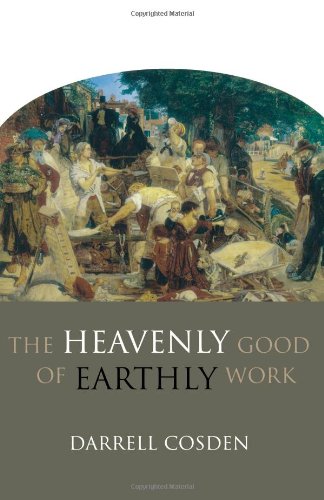 Work (Hendrickson, 2006) and, in a more detailed, deeper way, in A Theology of Work: Work and the New Creation (Wipf and Stock / Paternoster, 2004).
In these works, Cosden tackles a problem common to contemporary Christian life: a dichotomizing of the sacred and the secular spheres, and a lack of real appreciation for “ordinary” work (by which is meant work that is not explicitly tied to the functions of the institutional church and to missionary or evangelistic enterprise). Cosden notes that pastors commonly try to impress upon their parishioners that their everyday work as lawyers, teachers, accountants, factory workers, and so on, is significant–but the message comes through (often through practices rather than words) that “secular” work is only instrumental as serving the higher functions of the institutional church, evangelism, and missions.
Cosden rightly understands that the best way to counter this problem is through developing a theology of work. Further, he recognizes that the best way to develop a theology of work is through reflection on eschatology. He therefore presses into the question of continuity/discontinuity, with respect to what will (possibly) ‘carry over’ into the new heaven and new earth, when Jesus returns to make all things new. Cosden clearly sides with the continuity end of the spectrum, pointing to the resurrection of Jesus (the ‘first-fruits’) as our ultimate paradigm for understanding that at the general resurrection all things will be taken up into God, will be properly ordered, and yet will retain a dimension of recognizability. The work we do now “in the Lord” awaits its culmination at the Eschaton but has lasting, eternal significance in God’s economy.
These two books are excellent contributions to this growing discussion of the meaning of our work and yet, with any book that tackles tough questions, raise a number of questions and points of debate. In future posts, I will point out a few of these and hopefully generate some further discussion about them here.
Previous Post

April 10, 2013
Free Won't
Next Post

April 16, 2013 The Idolatry of the Penultimate
Browse Our Archives
Select a Category Alex Blondeau Authors Daniel Harrell Daniel Siedell Dawn Duncan Harrell Kyle Roberts Uncategorized Wyndy Corbin
Select a Month November 2014 October 2014 September 2014 August 2014 July 2014 June 2014 May 2014 April 2014 March 2014 February 2014 January 2014 December 2013 November 2013 October 2013 September 2013 August 2013 July 2013 June 2013 May 2013 April 2013 March 2013 February 2013 January 2013 December 2012 November 2012 October 2012 September 2012 August 2012 July 2012 June 2012 May 2012
TAKE THE
Religious Wisdom Quiz
What does "Selah" (found in Psalms) most likely mean?
Select your answer to see how you score.
Pause/Reflect Sing Hallelujah Amen
Related posts from Cultivare

Young Evangelicals and the "Nones": Jumping Ship


Calling For Public Theology (A Brief Convocation Address)

Don't Ask How to Grow Your Church
TRENDING AT PATHEOS Evangelical

The REST of Your Life: A Creative Wrestles...
This week I had a conversation with a good friend from church....

How the author of the world's best hymn...
I've been working with John Newton for a while now. This makes...

Long before this Lectio Divina, Psalm 130 - the song - started...

What About the Trees? Another Living Parable
After I finished writing the last article about falling leaves as a...

Why Classical Education Is a Conversation, Not a...
Come and Read: Joy in Classical Education When I was a little...

Cornell University has received a great deal of negative publicity and intense...
view all Evangelical blogs
Ad-Free & Subscriber Log-In Subscription Support
- About Us
- 2026 Calendar
- Videos
- Podcasts
- Library of World Religions
- Faith In Media Tracker
- Advertise With Us
- Write for Us
- Privacy Policy
- Terms of Service
- Do Not Sell My Data
- Contact Us
- Radiant Digital
- Manage Newsletter Subscriptions
- Unsubscribe From Notifications
- Sitemap
Copyright 2008-2026, Patheos. All rights reserved.
Subscription Support Ad-Free & Subscriber Log-In
Follow Patheos