
BuddhistCatholicContemplativeEvangelicalGeneral ChristianHinduJewishLatter-day SaintMuslimNew VisionsProgressive Christian
Beliefs
- Buddhist
- Catholic
- Contemplative
- Evangelical
- General Christian
- Hindu
- Jewish
- Latter-day Saint
- More Voices
- Muslim
- New Visions
- Pagan
- Progressive Christian
Topics
- Religion News
- Food and Religion
- Sports and Religion
- Religious Art
- Religious Music and Entertainment
- Religious Events
- History and Religion
- Style and Religion
- Politics and Religion
- Women in Religion
- Recreation Outdoors and Religion
- Business Finance and Religion
- Careers Workplace and Religion
- Education and Religion
- Family Parenting and Religion
- Health Fitness and Religion
- Home and Religion
- Relationships and Religion
- Technology and Religion
- Travel and Religion
Columnists
- Buddhist Columnists
- Business Finance and Religion Columnists
- Careers Workplace and Religion Columnists
- Catholic Columnists
- Contemplative Columnists
- Education and Religion Columnists
- Evangelists Columnists
- Family Parenting and Religion Columnists
- General Christian Columnists
- Health Fitness and Religion Columnists
- Hindu Columnists
- History and Religion Columnists
- Home and Religion Columnists
- Jewish Columnists
- More Voices Columnists
- Latter Day Columnists
- Muslim Columnists
- New Visions Columnists
- Nonreligious Columnists
- Pagan Columnists
- Politics and Religion Columnists
- Progressive Columnists
- Recreation Outdoors and Religion Columnists
- Relationships and Religion Columnists
- Religion News Columnists
- Religious Art Columnists
- Religious Events Columnists
- Religious Music and Entertainment Columnists
- Sports and Religion Columnists
- Style and Religion Columnists
- Technology and Religion Columnists
- Travel and Religion Columnists
- Women in Religion Columnists
Resource Library
- 2026 Calendar
- Library of World Religions
- The 100 Most Holy Places on Earth
- Patheos Answers
- Podcasts
- Videos
- Faith Leaders Database
- Anglican Episcopalian
- Bahai
- Baptist
- Buddhism
- Christianity
- Confucianism
- Eastern Orthodoxy
- Hinduism
- Holiness and Pentecostal
- ISKCON
- Islam
- Judaism
- Lutheran
- Methodist
- The Church of Jesus Christ of Latter-day Saints
- New Age
- Paganism
- Presbytarian and Reformed
- Protestantism
- Religion Behind the Scenes
- Roman Catholic
- Scientology
- Shia Islam
- Sikhism
- Sufism
- Sunni Islam
- Taoism
- Zen
- See all religions
Research Tools
 Ad-Free & Subscriber Log-In Subscription Support
Ad-Free & Subscriber Log-In Subscription Support
Follow Patheos 

- Trending:
- Forgiveness
- |
- Marriage
- |
- Consciousness
- |
- Death Penalty
- |
- Election
- |
- Halloween
 Cultivare
- Home
- Evangelical
- Relax, People: “The World is Not Ours to Save”
Relax, People: “The World is Not Ours to Save”
Last updated on: March 8, 2013 at 6:01 pm by Kyle Roberts
Relax, People: “The World is Not Ours to Save” 2013-03-08T18:01:28-04:00 Kyle Roberts
Patheos Explore the world's faith through different perspectives on religion and spirituality! Patheos has the views of the prevalent religions and spiritualities of the world.
What are we going to do about all those fired-up youngsters who are running around trying to save the world (and acting like they have only four minutes to do it)?
There has been a sea-change in the church. Like so often happens, Christianity seems to be swinging over to a concern with social justice and activism–at least among the young ones. But what happens when all these energetic, passionate, globally-concerned Christians realize that they can’t actually save the world? When they wake up to the reality that the job is too big, there are too many obstacles in the way, the “system” is unchangeable, and there is no quick fix or code that will crack the world’s problems? What happens when disillusionment sets in?
Tyler Wigg-Stevenson, author of The World is Not Ours to Save, has written a 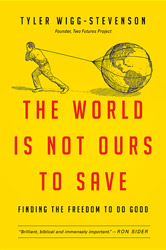 remarkable book, in many ways. As the back cover says, he is the “founding director of the Two Futures Project, a movement of Christians in the global abolition of nuclear weapons.” So yeah, Tyler must know something about trying to save the world. This is a call for realism, sanity, and trusting in God for the final outcome–from a true, dyed-in-the-wool Christian activist.
The book is very well-written: he gives us some lively prose, interspersed with personal stories of his own activist background and passions, and it’s pretty theologically deep too (I wasn’t surprised to discover that he is currently pursuing a Ph.D. in theology). He connects political and social activism with biblical eschatology in a way that is not often done–and that is sorely needed.
One of Wigg-Stevenson’s main themes is that “Christian activism is grounded in claims about God.” I think his best insight, along these lines, has to do not with God per se, but with God’s desired future for creation. That is, his best insight is that Christian activism ought to be based in an adequate eschatology. What is the desired future for society, people, creation, etc.? The kingdom of God is one of peace, wellness of being, love, adequate resources for all, etc. So, we should live in anticipation of that future in the present and it certainly can’t hurt to try as best we can to make the present look like the future it will be. But we should also relax a bit, because the world isn’t ours to save, and we’ll just end up disillusioned if we try to do it ourselves. Accept our limitations. Recognize that only God will bring God’s kingdom–but don’t stop doing what God has impassioned you to do toward the eschatological vision of peace, mutuality, and shared prosperity.
Where Wigg-Stevenson is weakest, it seems to me, is in the choppy way he moves from his discussion of violence and war in the Old Testament to the present. Something seems amiss, or at least left out of the picture. He has an obvious passion for activism toward peace. But he also tells us that the “terrible passages of Scripture teach us that human life belongs wholly and only to God, full stop.” This does not mean, however, that “human beings can never kill.” In fact, the OT gives us examples of “divinely sanctioned life-taking” (indeed it does). He goes on to reason that, “Because all life belongs to God, those who take it must always be acting as God’s proxy, for God’s purposes–whether in the holy wars of the ancient Israelites, to advance God’s salvation history, or in human government, as the ministers of wrath against injustice.” (73). The conclusion of the matter, for this author-activist, is that “to kill outside the boundaries of God’s justice is to take from God, in a way, the time and place of a person’s death.”
The question remains, though, as to how one knows, with any measure of certainty (in the present), whether one is “killing outside the boundaries of God’s justice”? We have heard leaders, for example, proclaim, as they sent their young soldiers into war,  that they were convinced this was God’s will. People would be killed (even thousands of them), because of God’s justice. And of course, one could be a Christian, a Jew, a Muslim, or whatever, and earnestly believe that God is using them to bring about God’s justice through killing others (or commanding the killing of others). But hey, they were just acting as a “proxy for God.” And why should nuclear war be left out of the equation–if God were to requireeven that for the sake of his justice?
Wigg-Stevenson says, “The working of God is often terrible. But God may be terrible because he is holy, and holiness is fearsome to behold. So, what do we name it when we, who are so deeply profane, arrogate to ourselves the right to ape God, to plant our unholy feet in his sacred place and wreak terror and horror? This is abomination because the world is not ours” (74).
But if God used “profane” people to bring about terrible things in the Old Testament (not only defensive wars, but holy wars–*herem–*which required total destruction of all living things), what should prevent “profane” world leaders today from bringing about terrible things, in the name of God’s justice and righteousness?
I empathize with the desire to sustain the tension we see in the Bible. God’s love does not exclude God’s holiness or justice. But unless one is going to say that, after the incarnation of God in Jesus Christ, God never sanctions “profane people” to kill other people (and Wigg-Stevenson doesn’t say this), more needs to be said about what criterion a president, military leader, or anyone else for that matter, would use for discerning whether one is truly hearing from God–before they pull the trigger. To put it more bluntly, what if a world leader, with his or her finger on the nuclear button, felt deep within his or her heart and soul that God was calling for herem on a “wicked” nation, and that this action would pave the way for God to bring about the kingdom? More may need to be said regarding how Jesus and the eschatological vision (which, as the author points out, is also an OT vision), helps us to understand, interpret and sort through the “terrible” things God seems to do in the OT. Only then can we come back to the present day and envision how the eschatological kingdom should orient our approach to violence and war.
For other reflections on this book, check out the Patheos Book Club
Previous Post

March 6, 2013
Playing the Victim
Next Post

March 12, 2013 "You Will Make Bells & I Will Paint Icons"
Browse Our Archives
Select a Category Alex Blondeau Authors Daniel Harrell Daniel Siedell Dawn Duncan Harrell Kyle Roberts Uncategorized Wyndy Corbin
Select a Month November 2014 October 2014 September 2014 August 2014 July 2014 June 2014 May 2014 April 2014 March 2014 February 2014 January 2014 December 2013 November 2013 October 2013 September 2013 August 2013 July 2013 June 2013 May 2013 April 2013 March 2013 February 2013 January 2013 December 2012 November 2012 October 2012 September 2012 August 2012 July 2012 June 2012 May 2012
TAKE THE
Religious Wisdom Quiz
A Samaritan stopped to help a wounded man after a priest and a Levite passed by. Where was the man traveling from and to?
Select your answer to see how you score.
From Bethany to Jerusalem From Galilee to Judea From Samaria to Nazareth From Jerusalem to Jericho
Related posts from Cultivare

Young Evangelicals and the "Nones": Jumping Ship


Calling For Public Theology (A Brief Convocation Address)

Don't Ask How to Grow Your Church
TRENDING AT PATHEOS Evangelical

The REST of Your Life: A Creative Wrestles...
This week I had a conversation with a good friend from church....

How the author of the world's best hymn...
I've been working with John Newton for a while now. This makes...

Long before this Lectio Divina, Psalm 130 - the song - started...

What About the Trees? Another Living Parable
After I finished writing the last article about falling leaves as a...

Why Classical Education Is a Conversation, Not a...
Come and Read: Joy in Classical Education When I was a little...

Cornell University has received a great deal of negative publicity and intense...
view all Evangelical blogs
Ad-Free & Subscriber Log-In Subscription Support
- About Us
- 2026 Calendar
- Videos
- Podcasts
- Library of World Religions
- Faith In Media Tracker
- Advertise With Us
- Write for Us
- Privacy Policy
- Terms of Service
- Do Not Sell My Data
- Contact Us
- Radiant Digital
- Manage Newsletter Subscriptions
- Unsubscribe From Notifications
- Sitemap
Copyright 2008-2026, Patheos. All rights reserved.
Subscription Support Ad-Free & Subscriber Log-In
Follow Patheos