
BuddhistCatholicContemplativeEvangelicalGeneral ChristianHinduJewishLatter-day SaintMuslimNew VisionsProgressive Christian
Beliefs
- Buddhist
- Catholic
- Contemplative
- Evangelical
- General Christian
- Hindu
- Jewish
- Latter-day Saint
- More Voices
- Muslim
- New Visions
- Pagan
- Progressive Christian
Topics
- Religion News
- Food and Religion
- Sports and Religion
- Religious Art
- Religious Music and Entertainment
- Religious Events
- History and Religion
- Style and Religion
- Politics and Religion
- Women in Religion
- Recreation Outdoors and Religion
- Business Finance and Religion
- Careers Workplace and Religion
- Education and Religion
- Family Parenting and Religion
- Health Fitness and Religion
- Home and Religion
- Relationships and Religion
- Technology and Religion
- Travel and Religion
Columnists
- Buddhist Columnists
- Business Finance and Religion Columnists
- Careers Workplace and Religion Columnists
- Catholic Columnists
- Contemplative Columnists
- Education and Religion Columnists
- Evangelists Columnists
- Family Parenting and Religion Columnists
- General Christian Columnists
- Health Fitness and Religion Columnists
- Hindu Columnists
- History and Religion Columnists
- Home and Religion Columnists
- Jewish Columnists
- More Voices Columnists
- Latter Day Columnists
- Muslim Columnists
- New Visions Columnists
- Nonreligious Columnists
- Pagan Columnists
- Politics and Religion Columnists
- Progressive Columnists
- Recreation Outdoors and Religion Columnists
- Relationships and Religion Columnists
- Religion News Columnists
- Religious Art Columnists
- Religious Events Columnists
- Religious Music and Entertainment Columnists
- Sports and Religion Columnists
- Style and Religion Columnists
- Technology and Religion Columnists
- Travel and Religion Columnists
- Women in Religion Columnists
Resource Library
- 2026 Calendar
- Library of World Religions
- The 100 Most Holy Places on Earth
- Patheos Answers
- Podcasts
- Videos
- Faith Leaders Database
- Anglican Episcopalian
- Bahai
- Baptist
- Buddhism
- Christianity
- Confucianism
- Eastern Orthodoxy
- Hinduism
- Holiness and Pentecostal
- ISKCON
- Islam
- Judaism
- Lutheran
- Methodist
- The Church of Jesus Christ of Latter-day Saints
- New Age
- Paganism
- Presbytarian and Reformed
- Protestantism
- Religion Behind the Scenes
- Roman Catholic
- Scientology
- Shia Islam
- Sikhism
- Sufism
- Sunni Islam
- Taoism
- Zen
- See all religions
Research Tools
 Ad-Free & Subscriber Log-In Subscription Support
Ad-Free & Subscriber Log-In Subscription Support
Follow Patheos 

- Trending:
- Forgiveness
- |
- Marriage
- |
- Consciousness
- |
- Death Penalty
- |
- Election
- |
- Halloween
 Cultivare
- Home
- Evangelical
- Morality is a Feeling I Feel
Morality is a Feeling I Feel
Last updated on: March 20, 2013 at 8:47 pm by Daniel Harrell
Morality is a Feeling I Feel 2013-03-20T20:47:03-04:00 Daniel Harrell
Patheos Explore the world's faith through different perspectives on religion and spirituality! Patheos has the views of the prevalent religions and spiritualities of the world.
 Wake Forest University president Nathan Hatch, marking the Sesquicentennial of Boston College, made a few remarks on the case for religion in liberal education. Among them:
The mystique of digital connection keeps us in a constant state of anticipation and interruption. When a beep goes off, our first obligation is to respond. William Powers has written an interesting book on this subject: Hamlet’s BlackBerry: A Practical Philosophy for Building a Good Life in the Digital Age (2010). There he warns that a digital consciousness is the enemy of depth, keeping us constantly distracted. More than any other sort of college or university, religious institutions know the value and the practice of deliberation, concentration, meditation, and solitude. The question with regard to the coming generation is how to create environments for students that make such experiences possible and attractive in the midst of electronic attachments.
The challenge, it seems, it coming to grips with a new reality. If the medium is the message, then the expectation should be that digital consciousness will eventually give way to simply consciousness. Who we are we will be digitally. Can that be right?
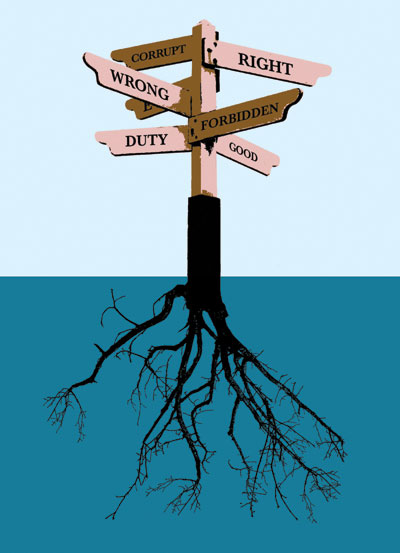
The absolute authority … is the sovereign self. Individuals are autonomous agents who have to deal with one another, but do so as self-directing choosers. The words duty, responsibility, and obligation feel vaguely coercive or puritanical. As one young adult told the researchers, “Morality is how I feel, too.”
How do we get beyond this deep gulf—what Dennis O’Brien (former president of Bucknell University and the University of Rochester) has called “the disappearing moral curriculum”? How do we begin to address the reality behind the stark assessment of the journalist David Brooks that, “on the whole, college students are articulate on every subject save morality”?
My thought would be that creating a curriculum ain’t gonna do it. Morality is one of those things you absorb over time, by way of parents and communities as well as schools. Dismiss the breakdown of societal cohesion at the cost of integrated selves. It’s hard to be your own absolute authority when you have no idea who you are. Identity is not a wholly self-created reality. It demands input from your environments and relationships.
Church and its leadership, we need to show patterns of worship and service that are winsome and life-giving. In a world that preaches that the self is the center of life, we need to show compelling examples that the purpose of life is not to find yourself but to lose yourself: in education, in health reform, in third world development, in building businesses and professions that are genuinely for the common good, and in a myriad of other ways that a creative campus can devise.
This is a beautiful sentiment–and possible. But in America, getting beyond individualism, consumerism, autonomy and personal liberty is a hard sell. Jesus may have been right that to lose your life is to find it. But I need a guarantee that the life I find is the life I want.
Previous Post

March 13, 2013
A Man Had Two Sons
Next Post

March 20, 2013 Space
Browse Our Archives
Select a Category Alex Blondeau Authors Daniel Harrell Daniel Siedell Dawn Duncan Harrell Kyle Roberts Uncategorized Wyndy Corbin
Select a Month November 2014 October 2014 September 2014 August 2014 July 2014 June 2014 May 2014 April 2014 March 2014 February 2014 January 2014 December 2013 November 2013 October 2013 September 2013 August 2013 July 2013 June 2013 May 2013 April 2013 March 2013 February 2013 January 2013 December 2012 November 2012 October 2012 September 2012 August 2012 July 2012 June 2012 May 2012
TAKE THE
Religious Wisdom Quiz
What did the Israelites carry through the wilderness that symbolized God's presence?
Select your answer to see how you score.
Golden Calf Burning torch Scroll of Moses Ark of the Covenant
Related posts from Cultivare




Adam and Science: A Possible Compromise
TRENDING AT PATHEOS Evangelical

The REST of Your Life: A Creative Wrestles...
This week I had a conversation with a good friend from church....

How the author of the world's best hymn...
I've been working with John Newton for a while now. This makes...

Long before this Lectio Divina, Psalm 130 - the song - started...

What About the Trees? Another Living Parable
After I finished writing the last article about falling leaves as a...

Why Classical Education Is a Conversation, Not a...
Come and Read: Joy in Classical Education When I was a little...

Cornell University has received a great deal of negative publicity and intense...
view all Evangelical blogs
Ad-Free & Subscriber Log-In Subscription Support
- About Us
- 2026 Calendar
- Videos
- Podcasts
- Library of World Religions
- Faith In Media Tracker
- Advertise With Us
- Write for Us
- Privacy Policy
- Terms of Service
- Do Not Sell My Data
- Contact Us
- Radiant Digital
- Manage Newsletter Subscriptions
- Unsubscribe From Notifications
- Sitemap
Copyright 2008-2026, Patheos. All rights reserved.
Subscription Support Ad-Free & Subscriber Log-In
Follow Patheos