
BuddhistCatholicContemplativeEvangelicalGeneral ChristianHinduJewishLatter-day SaintMuslimNew VisionsProgressive Christian
Beliefs
- Buddhist
- Catholic
- Contemplative
- Evangelical
- General Christian
- Hindu
- Jewish
- Latter-day Saint
- More Voices
- Muslim
- New Visions
- Pagan
- Progressive Christian
Topics
- Religion News
- Food and Religion
- Sports and Religion
- Religious Art
- Religious Music and Entertainment
- Religious Events
- History and Religion
- Style and Religion
- Politics and Religion
- Women in Religion
- Recreation Outdoors and Religion
- Business Finance and Religion
- Careers Workplace and Religion
- Education and Religion
- Family Parenting and Religion
- Health Fitness and Religion
- Home and Religion
- Relationships and Religion
- Technology and Religion
- Travel and Religion
Columnists
- Buddhist Columnists
- Business Finance and Religion Columnists
- Careers Workplace and Religion Columnists
- Catholic Columnists
- Contemplative Columnists
- Education and Religion Columnists
- Evangelists Columnists
- Family Parenting and Religion Columnists
- General Christian Columnists
- Health Fitness and Religion Columnists
- Hindu Columnists
- History and Religion Columnists
- Home and Religion Columnists
- Jewish Columnists
- More Voices Columnists
- Latter Day Columnists
- Muslim Columnists
- New Visions Columnists
- Nonreligious Columnists
- Pagan Columnists
- Politics and Religion Columnists
- Progressive Columnists
- Recreation Outdoors and Religion Columnists
- Relationships and Religion Columnists
- Religion News Columnists
- Religious Art Columnists
- Religious Events Columnists
- Religious Music and Entertainment Columnists
- Sports and Religion Columnists
- Style and Religion Columnists
- Technology and Religion Columnists
- Travel and Religion Columnists
- Women in Religion Columnists
Resource Library
- 2026 Calendar
- Library of World Religions
- The 100 Most Holy Places on Earth
- Patheos Answers
- Podcasts
- Videos
- Faith Leaders Database
- Anglican Episcopalian
- Bahai
- Baptist
- Buddhism
- Christianity
- Confucianism
- Eastern Orthodoxy
- Hinduism
- Holiness and Pentecostal
- ISKCON
- Islam
- Judaism
- Lutheran
- Methodist
- The Church of Jesus Christ of Latter-day Saints
- New Age
- Paganism
- Presbytarian and Reformed
- Protestantism
- Religion Behind the Scenes
- Roman Catholic
- Scientology
- Shia Islam
- Sikhism
- Sufism
- Sunni Islam
- Taoism
- Zen
- See all religions
Research Tools
 Ad-Free & Subscriber Log-In Subscription Support
Ad-Free & Subscriber Log-In Subscription Support
Follow Patheos 

- Trending:
- Forgiveness
- |
- Marriage
- |
- Consciousness
- |
- Death Penalty
- |
- Election
- |
- Halloween
 Cultivare
- Home
- Evangelical
- Who Are You?
Who Are You?
Last updated on: November 7, 2012 at 11:26 am by Daniel A. Siedell
Who Are You? 2012-11-07T11:26:46-04:00 Daniel A. Siedell
Patheos Explore the world's faith through different perspectives on religion and spirituality! Patheos has the views of the prevalent religions and spiritualities of the world.
Every painting is a self-portrait. Although he may nowhere be seen on the canvas, the artist is everywhere present. Yet it is a self that escapes the artist’s control, transcending (and sometimes even undermining) the artist’s intentions. However, in a self-portrait the artist makes himself present to you and to me, controlling how he is perceived. And given the fact that it is the artist’s disclosure of himself to his audience, a painted justification of who he is in the world, it is profoundly theological.
The self-portrait makes explicit a fundamental aspect of the human condition—our identify is found before the face of God and before the face of our neighbor. Theologian Gerhard Ebeling observes, “the fundamental situation of man is that of a person on trial.” We exist in the world seeking recognition and justification. A self-portrait actualizes this condition through the relationship of the artist depicting himself directing his gaze at us.
The German Renaissance artist Albrecht Dürer (1471-1528) and the Dutch Baroque master Rembrandt van Rijn (1606-1669) produced self-portraits that reveal the extremes of self-portraiture as justification in paint.
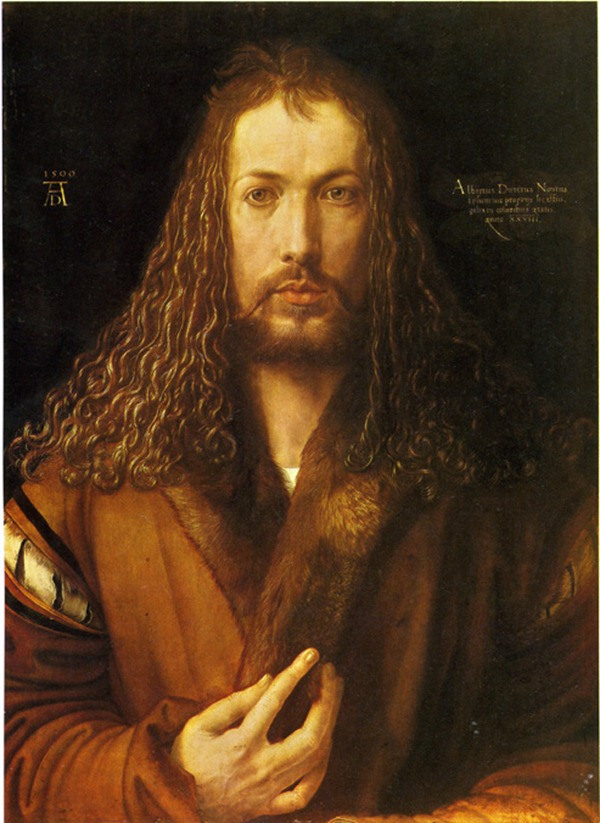
Albrecht Dürer, Self-Portrait, 1500, oil on wood, Alte Pinakotheck, Munich
Painted in 1500 at the height of his artistic powers, the last of three self-portraits he would paint, and as his artistic reputation was growing among patrons and fellow artists, Dürer’s famous self-portrait is the first German Renaissance masterpiece. The artist depicts himself within the genre of the holy icon of Christ, as he confronts us directly and his eyes meet our eyes—one of the most important characteristics of the tradition of the Christ icon. The artist’s beautiful hair and manicured beard present royal stature as does the fur that Dürer’s right hand fondles (the hand of blessing that is now the hand of painting), displaying his remarkable artistic ability to rivals and potential patrons. The artist fills the surface with himself, with his prowess, his authority.
But perhaps the most remarkable presence in the panel is Dürer’s famous monogram AD and inscription, which function as a legal claim to copyright, asserting the artist’s legal authority over all that comes from his hand (and his head). The monogram and inscription reveal a profound anxiety that no amount of Christ-likeness could cover. In fact, his identification of himself as an artist in Christ-like fashion is itself a product of this legal anxiety of maintaining his capacity to receive every penny that his art generated. And so as we stand judged by Dürer’s gaze and awestruck by his artistic authority, we recognize that it is a mask that covers his insecurity, his desperate desire to control and manage his growing reputation and his financial situation. Although he identifies himself with Christ, Dürer’s self-portrait is a legal document presented by a young man on trial to justify his existence, his originality, his value.
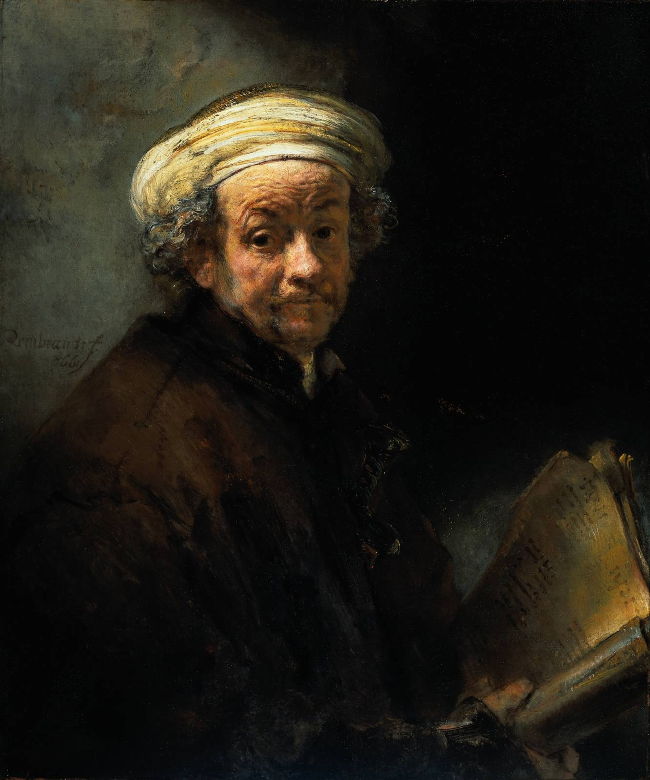
Rembrandt van Rijn, Self-Portrait as the Apostle Paul, oil on canvas, 1661, Rijksmuseum, Amsterdam
A prolific painter of self-portraits, Rembrandt painted over ninety during his lifetime, many because he lacked the financial resources to hire models. Rembrandt was keenly fascinated with the the passage of time and representing the nuances and depth of the human personality. This self-portrait, painted in 1661, seven years before his death, is entitled, Self-Portrait as the Apostle Paul. The contrast with Dürer’s self-portrait could not be more stark. A frail and slightly bewildered Rembrandt catches our gaze as he turns away from the scriptures he is reading. Rembrandt’s dark palette and dramatic lighting obscures clothing—the traditional accoutrements of power and prestige—to reveal his time-worn and grief-ravaged face. His gaze does not so much confront us as passively allow our intrusion. Rembrandt identifies with Saint Paul as the “chief of sinners” (1 Tim 1: 15) and one for whom a battle between the old and new Adam wage war within (Rom 7: 24).
Dürer’s self-portrait is a powerful mask that hides the anxiety of a young man fighting to control his artistic legacy and financial future, whose anxiety is hidden yet bleeds out as a prominent signature. Dürer will know unspeakable success and receive the praise of kings; yet he will also experience physical suffering and struggle with emotional pain, the latter which is revealed in his well-known engraving, Melancholia I, made fourteen years later.
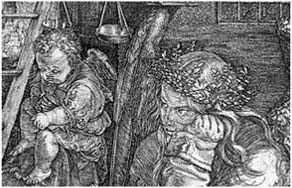
Albrecht Dürer, Melancholia I, 1514, engraving (detail)
Rembrandt’s self-portrait, on the other hand, is a conscious decision by an old man at the end of his life to give up, remove the mask, and lean into his suffering and weakness. Having earned and lost fortunes, achieved and lost reputation, having known personal heartbreak and professional failure in an emerging art market he could not manage, Rembrandt puts on the mask of St. Paul, one who suffered from a “thorn in the flesh” (2 Cor 12:7) and boasted in his weakness. At the end of his life, Rembrandt depicts himself with nothing but God’s promises, the source of his hope, and perhaps, even, a rationalization for his failures.
I would like to suggest that all self-portraits toggle between Dürer’s and Rembrandt’s. They are masks the artist wears before the world—before his contemporaries and before us (and perhaps before God.) If all paintings are, in some sense, self-portraits, then all paintings assert the “artist” before us, whether or not he intends it, and whether or not he can control it. Like these two remarkable self-portraits, all paintings speak of both power and weakness, confidence and anxiety, joy and pain.
Yet the eyes of the artist in a self-portrait engage us, recognizing and judging us. They ask, as all paintings do,
Who are you? What mask do you wear standing here, before me? Before God?
Previous Post

November 1, 2012
Politics and the Narcissist Impulse: Just Make Me a Hero, Please
Next Post
November 6, 2012 I Write Too Many Words
Browse Our Archives
Select a Category Alex Blondeau Authors Daniel Harrell Daniel Siedell Dawn Duncan Harrell Kyle Roberts Uncategorized Wyndy Corbin
Select a Month November 2014 October 2014 September 2014 August 2014 July 2014 June 2014 May 2014 April 2014 March 2014 February 2014 January 2014 December 2013 November 2013 October 2013 September 2013 August 2013 July 2013 June 2013 May 2013 April 2013 March 2013 February 2013 January 2013 December 2012 November 2012 October 2012 September 2012 August 2012 July 2012 June 2012 May 2012
TAKE THE
Religious Wisdom Quiz
I was only seven years old when I became king and reigned for forty years in Jerusalem. Who am I?
Select your answer to see how you score.
Hezekiah Manasseh Joash (or Jehoash) Josiah
Related posts from Cultivare


Young Evangelicals and the "Nones": Jumping Ship


Calling For Public Theology (A Brief Convocation Address)
TRENDING AT PATHEOS Evangelical

The REST of Your Life: A Creative Wrestles...
This week I had a conversation with a good friend from church....

How the author of the world's best hymn...
I've been working with John Newton for a while now. This makes...

Long before this Lectio Divina, Psalm 130 - the song - started...

What About the Trees? Another Living Parable
After I finished writing the last article about falling leaves as a...

Why Classical Education Is a Conversation, Not a...
Come and Read: Joy in Classical Education When I was a little...

Cornell University has received a great deal of negative publicity and intense...
view all Evangelical blogs
Ad-Free & Subscriber Log-In Subscription Support
- About Us
- 2026 Calendar
- Videos
- Podcasts
- Library of World Religions
- Faith In Media Tracker
- Advertise With Us
- Write for Us
- Privacy Policy
- Terms of Service
- Do Not Sell My Data
- Contact Us
- Radiant Digital
- Manage Newsletter Subscriptions
- Unsubscribe From Notifications
- Sitemap
Copyright 2008-2026, Patheos. All rights reserved.
Subscription Support Ad-Free & Subscriber Log-In
Follow Patheos