
BuddhistCatholicContemplativeEvangelicalGeneral ChristianHinduJewishLatter-day SaintMuslimNew VisionsProgressive Christian
Beliefs
- Buddhist
- Catholic
- Contemplative
- Evangelical
- General Christian
- Hindu
- Jewish
- Latter-day Saint
- More Voices
- Muslim
- New Visions
- Pagan
- Progressive Christian
Topics
- Religion News
- Food and Religion
- Sports and Religion
- Religious Art
- Religious Music and Entertainment
- Religious Events
- History and Religion
- Style and Religion
- Politics and Religion
- Women in Religion
- Recreation Outdoors and Religion
- Business Finance and Religion
- Careers Workplace and Religion
- Education and Religion
- Family Parenting and Religion
- Health Fitness and Religion
- Home and Religion
- Relationships and Religion
- Technology and Religion
- Travel and Religion
Columnists
- Buddhist Columnists
- Business Finance and Religion Columnists
- Careers Workplace and Religion Columnists
- Catholic Columnists
- Contemplative Columnists
- Education and Religion Columnists
- Evangelists Columnists
- Family Parenting and Religion Columnists
- General Christian Columnists
- Health Fitness and Religion Columnists
- Hindu Columnists
- History and Religion Columnists
- Home and Religion Columnists
- Jewish Columnists
- More Voices Columnists
- Latter Day Columnists
- Muslim Columnists
- New Visions Columnists
- Nonreligious Columnists
- Pagan Columnists
- Politics and Religion Columnists
- Progressive Columnists
- Recreation Outdoors and Religion Columnists
- Relationships and Religion Columnists
- Religion News Columnists
- Religious Art Columnists
- Religious Events Columnists
- Religious Music and Entertainment Columnists
- Sports and Religion Columnists
- Style and Religion Columnists
- Technology and Religion Columnists
- Travel and Religion Columnists
- Women in Religion Columnists
Resource Library
- 2026 Calendar
- Library of World Religions
- The 100 Most Holy Places on Earth
- Patheos Answers
- Podcasts
- Videos
- Faith Leaders Database
- Anglican Episcopalian
- Bahai
- Baptist
- Buddhism
- Christianity
- Confucianism
- Eastern Orthodoxy
- Hinduism
- Holiness and Pentecostal
- ISKCON
- Islam
- Judaism
- Lutheran
- Methodist
- The Church of Jesus Christ of Latter-day Saints
- New Age
- Paganism
- Presbytarian and Reformed
- Protestantism
- Religion Behind the Scenes
- Roman Catholic
- Scientology
- Shia Islam
- Sikhism
- Sufism
- Sunni Islam
- Taoism
- Zen
- See all religions
Research Tools
 Ad-Free & Subscriber Log-In Subscription Support
Ad-Free & Subscriber Log-In Subscription Support
Follow Patheos 

- Trending:
- Forgiveness
- |
- Marriage
- |
- Consciousness
- |
- Death Penalty
- |
- Election
- |
- Halloween
 Cultivare
- Home
- Evangelical
- The Ladder & The Bridge
The Ladder & The Bridge
Last updated on: December 5, 2012 at 6:58 pm by Daniel A. Siedell
The Ladder & The Bridge 2012-12-05T18:58:36-04:00 Daniel A. Siedell
Patheos Explore the world's faith through different perspectives on religion and spirituality! Patheos has the views of the prevalent religions and spiritualities of the world.
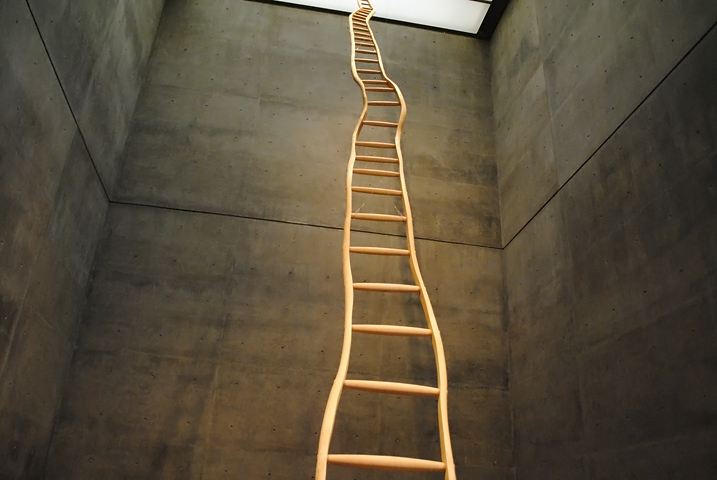
There is a habit of thinking among Christian artists, philosophers, and theologians that conceives of the work of art as a ladder. It uplifts, drawing one closer to God. It is believed to do this in two ways.
First, it operates in the register of philosophy, participating in the timeless ideas and eternal forms of the Good, the True, and the Beautiful. It is a means by which thinking Christians re-invest art with seriousness and significance through the abstract categories of theological aesthetics or worldview.
Second, it encompasses a mystical perspective. Following the tradition of John Climacus (St. John of the Ladder) and Meister Eckert, art is a means by which the artist climbs the ladder of divine devotional ascent. The work of art becomes an aesthetic extension of this inward and upward quest. It is a means by which feeling Christians re-invest art with spiritual significance, demonstrating its necessity for spiritual growth, revealing its liturgical relevance for the church, and arguing for the important role that artists as spiritual creatives play in the church.
The ladder generates a lot of talk in the seminar room about what art (in the abstract) is supposed to be doing theologically and philosophically as well as a lot of talk from artists about the exalted role that art plays in their private spiritual lives. But this image of the ladder and its language of ascent isolate the work of art from the viewer, depriving it of its material integrity in the gallery space, and the power of how the work of art is received.
In both the philosophical and devotional approaches to art, the viewer is left behind as the artist climbs the ladder with her painting. The ladder allows the artist (and the theologian) to move quickly into the rarified air of philosophical and mystical abstractions, leaving the particular work of art—its making as well as its reception—virtually untouched theologically. Yet it is there, in the concrete specificity of the work of art and the relationships that it generates— its coming to be in the studio and its encounter with a viewer in the gallery—that significant, perhaps even unprecedented potential for theological reflection can be found.
But to get at it, we need to put aside the image of the ladder and renew our acquaintance with a fundamental Reformation insight—the distinction between our vertical relationship to God through faith and our horizontal relationship to the world through love. Our posture before the face of God (coram Deo) is a passive one—we receive the faith that the Word creates. Our relationship to the world (coram mundo), as a result, is freed to be active. Justified by God in Christ through faith (vertically), we are liberated to love the world, care and cultivate the creation and love our neighbor (horizontally). Through faith we receive the world as a gift.
For Luther, then, there is no ascent. The ladder is God’s to use, not ours. And as Gerhard Forde has argued, the “fall” was really a “falling upward,” consisting in Adam and Eve’s divine ascent as they lost contact with the world, forgetting their contingency as creatures. A work of art, then, does not lift us up as much as it plants our feet firmly on the ground. Through the gritty materiality of paint, graphite, paper, canvas, and wood, a work of art opens our eyes to the world around us. Art is not a ladder. But, perhaps it is a bridge.
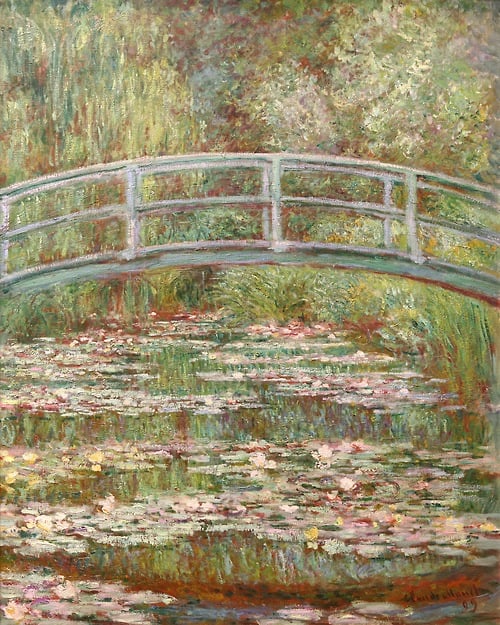
The metaphor of the bridge activates and privileges the horizontal relationship of love, putting artistic practice in the earthy (and ethical) context of loving your neighbor. The work of art, then, is a gift to another, recovering the distinctive and theologically rich relationship between the work of art and the viewer.
For Luther, it was this horizontal relationship of love, disentangled from the burden of participating or proving our justification coram Deo that was the impetus behind his revolutionary doctrine of vocation, which was, in many ways, merely the result of his understanding of justification. It was through our work, and the exercise of our talents and expertise, that we love our neighbor. And it is through this work that God is hidden but busy in the world. Our vocation, whether it consists of making shoes or paintings, exists for our neighbor.
This image returns art to the public sphere, to the community of seers, hearers, and feelers. The mystery of the work of art is that it is indeed made for us (even when the artist does not have an idea of who “we” are). And when it encounters us, even centuries later, it singles me out.
The bridge also acknowledges that as human beings we are cut off from one another, and the work of art, as a gift, spans this existential divide. Rather than a ladder that the artist climbs, leaving the world behind, the work of art connects one human being to another through the material of creation modeled, smeared, and shaped into an artifact. Yet what a work of art connects is not only the personhood of the artist and the viewer, but the human in general. The universality of the human experience, of the human condition, is disclosed by this particular painting, made by this particular artist, confronting that particular viewer. A product of the particular artist’s agency, the painting nevertheless transcends this particular agency, cannot be contained by it.
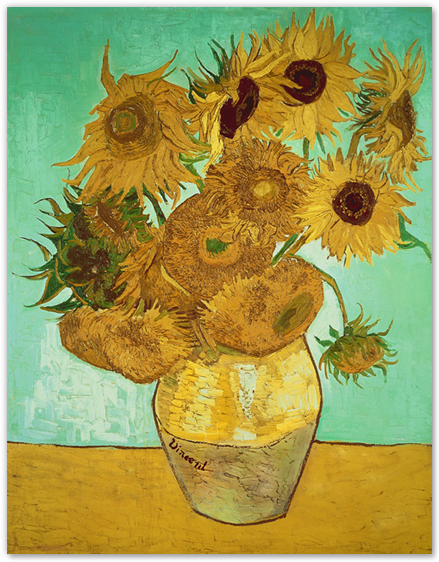
A painting of sunflowers by Van Gogh does not only make the artist himself present to me, but also makes humanity present to me, returns my humanity to me as a blessing, not as an instrument, obstacle, or curse. A painting opens our eyes and ears to the world, awakening our humanity, as creatures, which is returned to us as a gift from our creator.
The image of the bridge does not de-emphasize the sacramentality of the mystical presence of God in the world. It merely reaffirms that it is God who comes to us, in Word and Sacrament through his right-hand work in the church and in paint and canvas (among many other means) through his left-hand work in the world through vocation. Both hands of God are busy at work in the world and he is, as Paul writes, “actually not far from each one of us” (Acts 17: 27). The bridge, therefore, testifies to God’s radical and disruptive grace, for God is here with us, not “up there” somewhere or buried in our hearts. As Heinrich Bornkamm writes,”Grace is the bridge thrown by God across the abyss that separates us from him.”
Both the ladder and the bridge are God’s, to which he graciously comes to us, freeing us to come to our neighbor. Through the love of our neighbor, we are the means by which God is present and active in the world.
And he is present and active in the world through such silly and vulnerable things as a painting, a most mysterious yet often overlooked manifestation of love.
Next Post

November 28, 2012 With Malice Toward None
Browse Our Archives
Select a Category Alex Blondeau Authors Daniel Harrell Daniel Siedell Dawn Duncan Harrell Kyle Roberts Uncategorized Wyndy Corbin
Select a Month November 2014 October 2014 September 2014 August 2014 July 2014 June 2014 May 2014 April 2014 March 2014 February 2014 January 2014 December 2013 November 2013 October 2013 September 2013 August 2013 July 2013 June 2013 May 2013 April 2013 March 2013 February 2013 January 2013 December 2012 November 2012 October 2012 September 2012 August 2012 July 2012 June 2012 May 2012
TAKE THE
Religious Wisdom Quiz
How many chapters does the book of Judges have?
Select your answer to see how you score.
19 23 21 25
Related posts from Cultivare


Young Evangelicals and the "Nones": Jumping Ship


Calling For Public Theology (A Brief Convocation Address)
TRENDING AT PATHEOS Evangelical

The REST of Your Life: A Creative Wrestles...
This week I had a conversation with a good friend from church....

How the author of the world's best hymn...
I've been working with John Newton for a while now. This makes...

Long before this Lectio Divina, Psalm 130 - the song - started...

What About the Trees? Another Living Parable
After I finished writing the last article about falling leaves as a...

Why Classical Education Is a Conversation, Not a...
Come and Read: Joy in Classical Education When I was a little...

Cornell University has received a great deal of negative publicity and intense...
view all Evangelical blogs
Ad-Free & Subscriber Log-In Subscription Support
- About Us
- 2026 Calendar
- Videos
- Podcasts
- Library of World Religions
- Faith In Media Tracker
- Advertise With Us
- Write for Us
- Privacy Policy
- Terms of Service
- Do Not Sell My Data
- Contact Us
- Radiant Digital
- Manage Newsletter Subscriptions
- Unsubscribe From Notifications
- Sitemap
Copyright 2008-2026, Patheos. All rights reserved.
Subscription Support Ad-Free & Subscriber Log-In
Follow Patheos