
BuddhistCatholicContemplativeEvangelicalGeneral ChristianHinduJewishLatter-day SaintMuslimNew VisionsProgressive Christian
Beliefs
- Buddhist
- Catholic
- Contemplative
- Evangelical
- General Christian
- Hindu
- Jewish
- Latter-day Saint
- More Voices
- Muslim
- New Visions
- Pagan
- Progressive Christian
Topics
- Religion News
- Food and Religion
- Sports and Religion
- Religious Art
- Religious Music and Entertainment
- Religious Events
- History and Religion
- Style and Religion
- Politics and Religion
- Women in Religion
- Recreation Outdoors and Religion
- Business Finance and Religion
- Careers Workplace and Religion
- Education and Religion
- Family Parenting and Religion
- Health Fitness and Religion
- Home and Religion
- Relationships and Religion
- Technology and Religion
- Travel and Religion
Columnists
- Buddhist Columnists
- Business Finance and Religion Columnists
- Careers Workplace and Religion Columnists
- Catholic Columnists
- Contemplative Columnists
- Education and Religion Columnists
- Evangelists Columnists
- Family Parenting and Religion Columnists
- General Christian Columnists
- Health Fitness and Religion Columnists
- Hindu Columnists
- History and Religion Columnists
- Home and Religion Columnists
- Jewish Columnists
- More Voices Columnists
- Latter Day Columnists
- Muslim Columnists
- New Visions Columnists
- Nonreligious Columnists
- Pagan Columnists
- Politics and Religion Columnists
- Progressive Columnists
- Recreation Outdoors and Religion Columnists
- Relationships and Religion Columnists
- Religion News Columnists
- Religious Art Columnists
- Religious Events Columnists
- Religious Music and Entertainment Columnists
- Sports and Religion Columnists
- Style and Religion Columnists
- Technology and Religion Columnists
- Travel and Religion Columnists
- Women in Religion Columnists
Resource Library
- 2026 Calendar
- Library of World Religions
- The 100 Most Holy Places on Earth
- Patheos Answers
- Podcasts
- Videos
- Faith Leaders Database
- Anglican Episcopalian
- Bahai
- Baptist
- Buddhism
- Christianity
- Confucianism
- Eastern Orthodoxy
- Hinduism
- Holiness and Pentecostal
- ISKCON
- Islam
- Judaism
- Lutheran
- Methodist
- The Church of Jesus Christ of Latter-day Saints
- New Age
- Paganism
- Presbytarian and Reformed
- Protestantism
- Religion Behind the Scenes
- Roman Catholic
- Scientology
- Shia Islam
- Sikhism
- Sufism
- Sunni Islam
- Taoism
- Zen
- See all religions
Research Tools
 Ad-Free & Subscriber Log-In Subscription Support
Ad-Free & Subscriber Log-In Subscription Support
Follow Patheos 

- Trending:
- Forgiveness
- |
- Marriage
- |
- Consciousness
- |
- Death Penalty
- |
- Election
- |
- Halloween
 Cultivare
- Home
- Evangelical
- Is Free Market Capitalism Always Free? Where Consumer Desire Meets Cheap Labor
Is Free Market Capitalism Always Free? Where Consumer Desire Meets Cheap Labor
Last updated on: November 15, 2012 at 3:35 pm by Kyle Roberts
Is Free Market Capitalism Always Free? Where Consumer Desire Meets Cheap Labor 2012-11-15T15:35:38-04:00 Kyle Roberts
Patheos Explore the world's faith through different perspectives on religion and spirituality! Patheos has the views of the prevalent religions and spiritualities of the world.
I’ve started reading William Cavanaugh’s Being Consumed: Economics and Christian Desire. I’m only half-way in, but I’m pretty sure this is one of those books that anyone who pastors a church in the U.S. really should read, wrestle with, and then figure out how to communicate its message to their congregants–or at least start a conversation about it. I plan to write a series of four posts on this book, corresponding to the four chapters of the book.
Freedom and Unfreedom
Cavanaugh argues that our (western/American, etc.) problem is not that we are greedy materialists who need to possess lots of things. Instead, our problem is that we are restless consumers, driven by a constant, unsettled desire for the next and for the new. We are shoppers, shopaholics, even. Corporations know this, of course, and they cultivate and stimulate those desires with great savvy. Further, they know they must provide products at an affordable (enough) cost to enable us to keep up our insatiable lust for shopping–for the new and the next. This means that corporations also shop for the cheapest labor to make the products they will then sell to the American consumer, who is looking for the best deal.
This is where Rosa Martinez comes in.
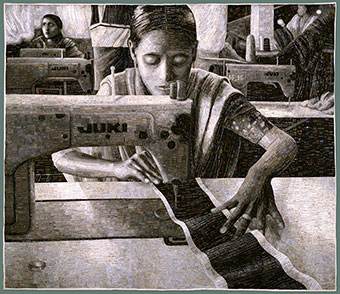
Portrait of a Textile Worker: by Teresa Agnew
Cavanaugh quotes an advertisement in a textile journal paid for by the U.S. Agency for InternationalDevelopment, which states, “Rosa Martinez produces apparel for US markets on her sewing machine in El Salvador. You can hire her for 33 cents an hour.”
At its core, free market capitalism is a system based on a supposed unbridled freedom for persons to enter into non-coerced arrangements which will mutually benefit each partner. So a major apparel company (i.e., the Gap or Old Navy) might contract with Rosa for her services (or contract with hundreds or thousands of Rosas, gathered into factories), and Rosa likewise agrees to work for said amount. Her pay won’t be nearly adequate for a secure life but it’s better than starving to death. Though as Cavanaugh points out, some of them actually work themselves to death. In any case, Rosa freely enters into the arrangement. Right? Or does she?
Cavanaugh suggests we need to re-think our notion of freedom and that we need to do that theologically. He offers St. Augustine as a guide. For Augustine, freedom should not be defined negatively (simply as the absence of any coercion or constraint). Human beings are always constrained or impelled by something–we are always driven by something not entirely under our ‘control.’ So freedom needs to be understood, instead, in light of the goal, or the telos–that toward which we are compelled or that by which we are impelled. When an alcoholic freely chooses to drink, is the choice really free? When Rosie freely chooses to work for less than a living-wage, is that a free choice?
Is Rosie free? At one level, she seems to be. She offers her services for a contracted amount. She willingly enters into the arrangement. But not so fast, Cavanaugh says. This view of freedom “pretends to be blind to the real disparity of power at work here while simultaneously stripping away the ability to judge an exchange on the basis of anything but sheer power, since any telos, or common standard of good has been eliminated from view” (24).
When we think about economic arrangements, and the best way to organize those relationships, we should not only ask whether there is a absence of direct coercion, but whether the arrangement reflects and aims toward a higher goal: the human flourishing of all parties involved in the ‘agreement’; put another way, the “common good.”
It’s important to note that Cavanaugh is not critical of free market capitalism as such. He’s simply saying that we need to think harder about what is actually taking place within the system. How is it working itself out “on the ground”? What do we mean by “freedom”? Who is really free–and for whom is “freedom” a false, empty construct or simply an abstract idea that has no purchasing power (so to speak) in real life?
Is Rosie Martinez really free (in the Augustinian, positive, sense of freedom)? If she isn’t, should we continue to buy clothes–or coffee, or computers, or whatever, made by the Rosies of the world, if our consumerism simply perpetuates a system that is not nearly as free as we thought it was? If we don’t continue to consume, will Rosie have no work (and no paycheck, and no food) at all?
Free market capitalism, for better or worse, isn’t going away. And frankly, it’s hard for many of us to imagine a better overall economic system. But are you and I free to reject, protest, or at the very least acknowledge its unfree instantiations–and to support those who are pushing for a little more justice within the system?
Previous Post

November 14, 2012
Petraeus, David Petraeus
Next Post
November 15, 2012 Sexism at Christian Colleges (and Seminaries)
Browse Our Archives
Select a Category Alex Blondeau Authors Daniel Harrell Daniel Siedell Dawn Duncan Harrell Kyle Roberts Uncategorized Wyndy Corbin
Select a Month November 2014 October 2014 September 2014 August 2014 July 2014 June 2014 May 2014 April 2014 March 2014 February 2014 January 2014 December 2013 November 2013 October 2013 September 2013 August 2013 July 2013 June 2013 May 2013 April 2013 March 2013 February 2013 January 2013 December 2012 November 2012 October 2012 September 2012 August 2012 July 2012 June 2012 May 2012
TAKE THE
Religious Wisdom Quiz
In Hebrews, Abel's blood spoke, but what does Jesus' blood speak?
Select your answer to see how you score.
Words of warning Words of judgment The same message as Abel's A better word than the blood of Abel
Related posts from Cultivare

Young Evangelicals and the "Nones": Jumping Ship


Calling For Public Theology (A Brief Convocation Address)

Don't Ask How to Grow Your Church
TRENDING AT PATHEOS Evangelical

The REST of Your Life: A Creative Wrestles...
This week I had a conversation with a good friend from church....

How the author of the world's best hymn...
I've been working with John Newton for a while now. This makes...

Long before this Lectio Divina, Psalm 130 - the song - started...

What About the Trees? Another Living Parable
After I finished writing the last article about falling leaves as a...

Why Classical Education Is a Conversation, Not a...
Come and Read: Joy in Classical Education When I was a little...

Cornell University has received a great deal of negative publicity and intense...
view all Evangelical blogs
Ad-Free & Subscriber Log-In Subscription Support
- About Us
- 2026 Calendar
- Videos
- Podcasts
- Library of World Religions
- Faith In Media Tracker
- Advertise With Us
- Write for Us
- Privacy Policy
- Terms of Service
- Do Not Sell My Data
- Contact Us
- Radiant Digital
- Manage Newsletter Subscriptions
- Unsubscribe From Notifications
- Sitemap
Copyright 2008-2026, Patheos. All rights reserved.
Subscription Support Ad-Free & Subscriber Log-In
Follow Patheos