
BuddhistCatholicContemplativeEvangelicalGeneral ChristianHinduJewishLatter-day SaintMuslimNew VisionsProgressive Christian
Beliefs
- Buddhist
- Catholic
- Contemplative
- Evangelical
- General Christian
- Hindu
- Jewish
- Latter-day Saint
- More Voices
- Muslim
- New Visions
- Pagan
- Progressive Christian
Topics
- Religion News
- Food and Religion
- Sports and Religion
- Religious Art
- Religious Music and Entertainment
- Religious Events
- History and Religion
- Style and Religion
- Politics and Religion
- Women in Religion
- Recreation Outdoors and Religion
- Business Finance and Religion
- Careers Workplace and Religion
- Education and Religion
- Family Parenting and Religion
- Health Fitness and Religion
- Home and Religion
- Relationships and Religion
- Technology and Religion
- Travel and Religion
Columnists
- Buddhist Columnists
- Business Finance and Religion Columnists
- Careers Workplace and Religion Columnists
- Catholic Columnists
- Contemplative Columnists
- Education and Religion Columnists
- Evangelists Columnists
- Family Parenting and Religion Columnists
- General Christian Columnists
- Health Fitness and Religion Columnists
- Hindu Columnists
- History and Religion Columnists
- Home and Religion Columnists
- Jewish Columnists
- More Voices Columnists
- Latter Day Columnists
- Muslim Columnists
- New Visions Columnists
- Nonreligious Columnists
- Pagan Columnists
- Politics and Religion Columnists
- Progressive Columnists
- Recreation Outdoors and Religion Columnists
- Relationships and Religion Columnists
- Religion News Columnists
- Religious Art Columnists
- Religious Events Columnists
- Religious Music and Entertainment Columnists
- Sports and Religion Columnists
- Style and Religion Columnists
- Technology and Religion Columnists
- Travel and Religion Columnists
- Women in Religion Columnists
Resource Library
- 2026 Calendar
- Library of World Religions
- The 100 Most Holy Places on Earth
- Patheos Answers
- Podcasts
- Videos
- Faith Leaders Database
- Anglican Episcopalian
- Bahai
- Baptist
- Buddhism
- Christianity
- Confucianism
- Eastern Orthodoxy
- Hinduism
- Holiness and Pentecostal
- ISKCON
- Islam
- Judaism
- Lutheran
- Methodist
- The Church of Jesus Christ of Latter-day Saints
- New Age
- Paganism
- Presbytarian and Reformed
- Protestantism
- Religion Behind the Scenes
- Roman Catholic
- Scientology
- Shia Islam
- Sikhism
- Sufism
- Sunni Islam
- Taoism
- Zen
- See all religions
Research Tools
 Ad-Free & Subscriber Log-In Subscription Support
Ad-Free & Subscriber Log-In Subscription Support
Follow Patheos 

- Trending:
- Forgiveness
- |
- Marriage
- |
- Consciousness
- |
- Death Penalty
- |
- Election
- |
- Halloween
 Cultivare
- Home
- Evangelical
- Robert Hughes, Jackson Pollock, and Me
Robert Hughes, Jackson Pollock, and Me
Last updated on: August 11, 2012 at 7:18 am by Daniel A. Siedell
Robert Hughes, Jackson Pollock, and Me 2012-08-11T07:18:55-04:00 Daniel A. Siedell
Patheos Explore the world's faith through different perspectives on religion and spirituality! Patheos has the views of the prevalent religions and spiritualities of the world.
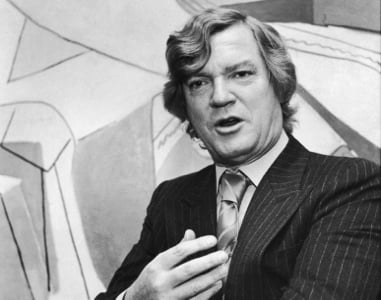
The art critic has an impossible but necessary task. I was reminded of this earlier this week after learning of the death of Robert Hughes, one of the most successful critics of our generation. The art critic’s task is impossible because he or she must use one medium of expression (words) to communicate the significance of another medium of expression (paint). Moreover, a painting by its very nature fights against words, defies words, undermines the capacity of words to make sense of it.
Yet the art critic’s task is necessary. It is necessary because a painting is more complex than we assume. Every day we are bombarded with images that are produced to catch our distracted attention for only the briefest of moments. But because a painting, which, unlike a poem or a piece of music, makes itself present to us all at once, we want to treat it like all the other images we see around us on television, internet, and on billboards. But the art critic exists to remind us that a painting, like a poem and a piece of music, unfolds over time, that it cannot be treated like other imagery; that it demands our full intellectual and imaginative effort. A painting is much, much more than what hits our retina. And so the art critic’s necessary task is to make us stop in front of it, to look more closely, think and imagine more actively. The art critic’s responsibility is to remind us that painting operates in a world in which the slightest visual distinction carries monumental importance. The impossibility of this task is the tension of the critic’s use of words to create space that allows a painting to breathe without words. The critic’s words are disposable, like Wittgenstein’s ladder. They are useful only as means to get us to a place where words are not necessary.
But this is an impossible task. And so the art critic is in constant jeopardy of overstepping his or her bounds, using words to limit rather than expand the work of art’s expressive scope, reducing it to a visual illustration of some theory or idea; or drowning the work in discourse. The Abstract Expressionist painter Willem de Kooning once said that a critic came by his studio for two minutes and then wrote a review that took him all day to read.
And so most art critics refuse to acknowledge the impossibility and necessity of their task. Robert Hughes, however, was one of those rare critics who understood exactly what was at stake. Although I had read his work, it wasn’t until I saw him in action that I truly began to appreciate his vision.
I was standing outside the Museum of Modern Art in New York in 1998 with about three other people the day before a monumental Jackson Pollock exhibition was to open. A colleague at Christies had given me access to a private VIP walkthrough of the exhibition with about half a dozen other people. As I was waiting for the guards to open the door, Robert Hughes, with a copy of The New York Times tucked under his arm and a cup of coffee in the other stopped at the front door as well. He was meeting someone. And that someone was Salman Rushdie, whose public presence at that time was extremely rare, since he had been the subject of a fatwa by the Ayatollah Khomeini in the late 80s for his controversial novel, Satanic Verses.
I followed them throughout the exhibition as Hughes talked to Rushdie about Pollock’s background, his influences, and how he understood the role of painting. As he walked the curious writer through his artistic development, he answered Rushdie’s often puzzled questions along the way, I realized that this tour is the essence of Hughes’s art criticism and the goal of all art criticism. He takes the reader on a tour, a tour of the artist’s work, but also a tour of his thinking about the work. We read Hughes or any other art critic, not only to gain an understanding of art, but to gain an understanding of the critic, what he or she is thinking about, engaging or struggling with. Hughes had been wrestling with Pollock’s paintings for decades and he was allowing Rushdie into that relationship, giving him a sense of that pressure, that tension, and experience, allowing Pollock’s work to get Rushdie in a choke hold, and then showing how him how to respond in order to transform a fight into a graceful dance.
As they shook hands and parted ways, I realized that Hughes had converted Rushdie. He had transformed confusion into understanding. He had shown Rushdie the grace of Pollock’s elegant paintings hewn from his tragic and painful life.

Next Post

August 14, 2012 The Artist, the Work of Art, and the Freedom of the Unfree Will
Browse Our Archives
Select a Category Alex Blondeau Authors Daniel Harrell Daniel Siedell Dawn Duncan Harrell Kyle Roberts Uncategorized Wyndy Corbin
Select a Month November 2014 October 2014 September 2014 August 2014 July 2014 June 2014 May 2014 April 2014 March 2014 February 2014 January 2014 December 2013 November 2013 October 2013 September 2013 August 2013 July 2013 June 2013 May 2013 April 2013 March 2013 February 2013 January 2013 December 2012 November 2012 October 2012 September 2012 August 2012 July 2012 June 2012 May 2012
TAKE THE
Religious Wisdom Quiz
How many books are in the Bible (Protestant version)?
Select your answer to see how you score.
66 40 73 12
Related posts from Cultivare


Young Evangelicals and the "Nones": Jumping Ship


Calling For Public Theology (A Brief Convocation Address)
TRENDING AT PATHEOS Evangelical

The REST of Your Life: A Creative Wrestles...
This week I had a conversation with a good friend from church....

How the author of the world's best hymn...
I've been working with John Newton for a while now. This makes...

Long before this Lectio Divina, Psalm 130 - the song - started...

What About the Trees? Another Living Parable
After I finished writing the last article about falling leaves as a...

Why Classical Education Is a Conversation, Not a...
Come and Read: Joy in Classical Education When I was a little...

Cornell University has received a great deal of negative publicity and intense...
view all Evangelical blogs
Ad-Free & Subscriber Log-In Subscription Support
- About Us
- 2026 Calendar
- Videos
- Podcasts
- Library of World Religions
- Faith In Media Tracker
- Advertise With Us
- Write for Us
- Privacy Policy
- Terms of Service
- Do Not Sell My Data
- Contact Us
- Radiant Digital
- Manage Newsletter Subscriptions
- Unsubscribe From Notifications
- Sitemap
Copyright 2008-2026, Patheos. All rights reserved.
Subscription Support Ad-Free & Subscriber Log-In
Follow Patheos