
BuddhistCatholicContemplativeEvangelicalGeneral ChristianHinduJewishLatter-day SaintMuslimNew VisionsProgressive Christian
Beliefs
- Buddhist
- Catholic
- Contemplative
- Evangelical
- General Christian
- Hindu
- Jewish
- Latter-day Saint
- More Voices
- Muslim
- New Visions
- Pagan
- Progressive Christian
Topics
- Religion News
- Food and Religion
- Sports and Religion
- Religious Art
- Religious Music and Entertainment
- Religious Events
- History and Religion
- Style and Religion
- Politics and Religion
- Women in Religion
- Recreation Outdoors and Religion
- Business Finance and Religion
- Careers Workplace and Religion
- Education and Religion
- Family Parenting and Religion
- Health Fitness and Religion
- Home and Religion
- Relationships and Religion
- Technology and Religion
- Travel and Religion
Columnists
- Buddhist Columnists
- Business Finance and Religion Columnists
- Careers Workplace and Religion Columnists
- Catholic Columnists
- Contemplative Columnists
- Education and Religion Columnists
- Evangelists Columnists
- Family Parenting and Religion Columnists
- General Christian Columnists
- Health Fitness and Religion Columnists
- Hindu Columnists
- History and Religion Columnists
- Home and Religion Columnists
- Jewish Columnists
- More Voices Columnists
- Latter Day Columnists
- Muslim Columnists
- New Visions Columnists
- Nonreligious Columnists
- Pagan Columnists
- Politics and Religion Columnists
- Progressive Columnists
- Recreation Outdoors and Religion Columnists
- Relationships and Religion Columnists
- Religion News Columnists
- Religious Art Columnists
- Religious Events Columnists
- Religious Music and Entertainment Columnists
- Sports and Religion Columnists
- Style and Religion Columnists
- Technology and Religion Columnists
- Travel and Religion Columnists
- Women in Religion Columnists
Resource Library
- 2026 Calendar
- Library of World Religions
- The 100 Most Holy Places on Earth
- Patheos Answers
- Podcasts
- Videos
- Faith Leaders Database
- Anglican Episcopalian
- Bahai
- Baptist
- Buddhism
- Christianity
- Confucianism
- Eastern Orthodoxy
- Hinduism
- Holiness and Pentecostal
- ISKCON
- Islam
- Judaism
- Lutheran
- Methodist
- The Church of Jesus Christ of Latter-day Saints
- New Age
- Paganism
- Presbytarian and Reformed
- Protestantism
- Religion Behind the Scenes
- Roman Catholic
- Scientology
- Shia Islam
- Sikhism
- Sufism
- Sunni Islam
- Taoism
- Zen
- See all religions
Research Tools
 Ad-Free & Subscriber Log-In Subscription Support
Ad-Free & Subscriber Log-In Subscription Support
Follow Patheos 

- Trending:
- Forgiveness
- |
- Marriage
- |
- Consciousness
- |
- Death Penalty
- |
- Election
- |
- Halloween
 Cultivare
- Home
- Evangelical
- The Red Herring of Public Decency
The Red Herring of Public Decency
Last updated on: July 18, 2012 at 6:35 pm by Daniel A. Siedell
The Red Herring of Public Decency 2012-07-18T18:35:14-04:00 Daniel A. Siedell
Patheos Explore the world's faith through different perspectives on religion and spirituality! Patheos has the views of the prevalent religions and spiritualities of the world.
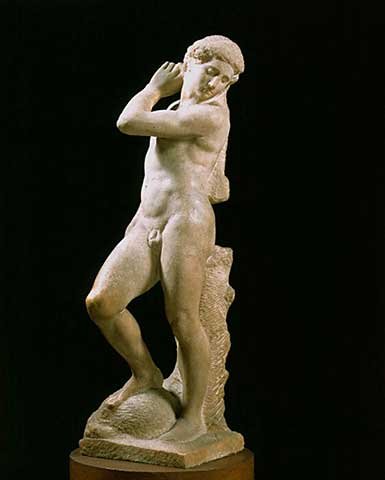
The Chinese government’s “pixelation” of Michelangelo’s marble sculpture, David-Apollo in a television story previewing an exhibition of western art at the National Museum in Tiananmen Square, Beijing, raises the question again of art, nudity, and public decency. Rather than make the sculpture safe for public viewing, did pixelating the work create an indecent or pornographic situation? Should a work of art be subjected to standards of public decency when it was not intended to be viewed, read, or otherwise experienced by the public as defined by television viewers. Perhaps this nervous over-reaction is to be expected by the Chinese government, a government that imprisoned its most famous living artist, Ai Weiwei for nearly three months last year.
But when Lifeway caves to pressure from a pastor in Florida and stops selling copies of the movie, The Blind Side because it includes a few four-letter words, such patronizing over-protection that perceives artistic threats to social cohesion around every corner is not limited to Communist regimes. These examples are not about censorship and the reduction of artistic freedom–neither Michelangelo’s work nor The Blind Side will be adversely effected in the least–in fact, they’ll benefit. Moreover, the whining from artists and arts professionals about censorship and creative freedom is also irrelevant and ineffective because it is usually seasoned with an adolescent view of authority and a megalomaniac obsession with any threat to autonomy.
There are bigger problems than penises and four-letter words.
Art and other forms of creative expression and story-telling are at their best when they are allowed to do what they are intended to do: confront us, work on us, have their imaginative way with us, taking possession of our inner chambers to show us a world beyond our control, expanding and deepening our sense of the human. When we encounter great works of art, when we read great novels, and even when we watch pretty good Hollywood movies, we are not interpreting them, they are interpreting us. They enfold us into their expressive worlds. And that changes us. But this is not our natural inclination, we resist change, we resist expansion, and crave the narrow but stable confines of what is familiar. And so art and our human desire to control often do battle. (In fact, the work of art can and does fight against its creator as well, who is often desperate to control its meaning and significance against “misinterpretations.”)
To look at Michelangelo’s sculptures, the multiple versions of David that he produced throughout his career, is to enter into the world of Michelangelo’s concerns: the ephemerality of beauty, the transitoriness of youth, the search for freedom and quest for eternal life, and the struggle with faith in Christ, all experienced through the expressive palette of David, one of the most richly human characters portrayed in the Bible. To reduce this journey to penises is to use “public decency” as an excuse to destroy the capacity of art to speak to us. To reduce David-Apollo to a penis that must be covered or left uncovered is to transform a work of art that works on us to something that exists for us to engineer, tinker with, and adjust, all of which shields us from being in that most despised of human postures: receptivity and passivity. Focus on the penis or the four-letter word and we can change the topic of conversation.
Justification is much more than a “doctrinal proposition” that we as evangelicals embrace and debate. It is, as Lutheran theologian Oswald Bayer has argued, the ontological structure of reality. Martin Luther even argued that the definition of the human being is summed up by St. Paul in Romans: the human being is “justified by faith.” A primary consequence of our fallenness, however, is our refusal to be justified by faith in Christ, a refusal to accept, to receive God’s righteousness passively through Christ. We want to justify ourselves, we do not want to receive, we want to do, shape, tinker. Like Christ’s disciples, we ask, “What must we be doing to be doing the works of God?” And we, like them, fight against Christ’s response, “believe in the one He has sent” (John 6: 29).
The preoccupation with penises, four-letter words, and other violations of “public decency” are merely manifestations of the human refusal to shut up and allow a painting, a poem, a marble sculpture, or even a pretty good Hollywood movie to work on us, showing us something about our humanity that ultimately points to and is fulfilled in Christ. Pascal once said that all of humanity’s problems are due to the fact we cannot sit still in a room alone. Not only can we not sit still with art, we also cannot sit still with the Bible. The way we as Christians approach art is usually how we approach the Word of God. Instead of allowing it to shape us, allowing the Great Tradition of interpreting the Scriptures to guide our experience of them, to allow the stories, parables, poems, and St. Paul’s logic to unfold for us, we turn the Bible into proof texts, a repository of sounds bytes and rules for our own personal self-justification and recognition agendas. The pastor in Florida who is so deeply offended by some words in The Blind Side that he created a public controversy, has already tipped his hand about how he reads the Bible and the respect he has for it. He’s lost the forest for the trees, he’s obsessed by particular details without concern for the larger patterns of God’s two words: law and gospel or the narrative themes of creation, fall, redemption, and consummation. It is merely a passive instrument that he uses, not the living and active Word of God that molds, shapes, confronts him.
This is not an easy cultural situation as evangelicals to navigate. On one hand, our cultural moment is licentious to the core, crude, and shockingly inhumane. On the other, it is excruciatingly puritanical, prudish, and repressed. And just as inhumane. The licentious and the prudish seem to be two sides of the same ontological coin, a piece of transactional currency in the economy of self-justification.
What is the responsibility of a Christian witness in this profoundly bipolar culture? What does this responsibility look like on the ground, in particular situations of cultural participation?
And what is the role of art?
Previous Post

July 12, 2012
Dictionary of Christian Spirituality
Next Post

July 17, 2012 A Buffalo '66 Theology of Culture
Browse Our Archives
Select a Category Alex Blondeau Authors Daniel Harrell Daniel Siedell Dawn Duncan Harrell Kyle Roberts Uncategorized Wyndy Corbin
Select a Month November 2014 October 2014 September 2014 August 2014 July 2014 June 2014 May 2014 April 2014 March 2014 February 2014 January 2014 December 2013 November 2013 October 2013 September 2013 August 2013 July 2013 June 2013 May 2013 April 2013 March 2013 February 2013 January 2013 December 2012 November 2012 October 2012 September 2012 August 2012 July 2012 June 2012 May 2012
TAKE THE
Religious Wisdom Quiz
Seek the Lord, all you humble of the land. Seek righteousness, seek what else?
Select your answer to see how you score.
Humility Justice Peace Mercy
Related posts from Cultivare



TRENDING AT PATHEOS Evangelical

The REST of Your Life: A Creative Wrestles...
This week I had a conversation with a good friend from church....

How the author of the world's best hymn...
I've been working with John Newton for a while now. This makes...

Long before this Lectio Divina, Psalm 130 - the song - started...

What About the Trees? Another Living Parable
After I finished writing the last article about falling leaves as a...

Why Classical Education Is a Conversation, Not a...
Come and Read: Joy in Classical Education When I was a little...

Cornell University has received a great deal of negative publicity and intense...
view all Evangelical blogs
Ad-Free & Subscriber Log-In Subscription Support
- About Us
- 2026 Calendar
- Videos
- Podcasts
- Library of World Religions
- Faith In Media Tracker
- Advertise With Us
- Write for Us
- Privacy Policy
- Terms of Service
- Do Not Sell My Data
- Contact Us
- Radiant Digital
- Manage Newsletter Subscriptions
- Unsubscribe From Notifications
- Sitemap
Copyright 2008-2026, Patheos. All rights reserved.
Subscription Support Ad-Free & Subscriber Log-In
Follow Patheos